


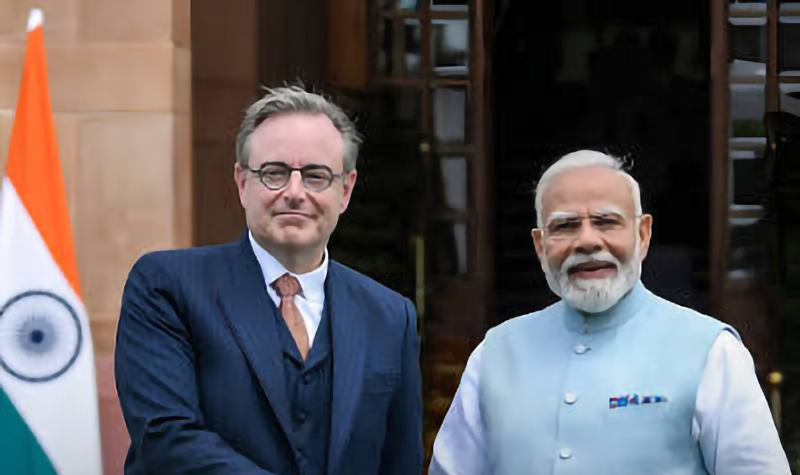







Belgian Prime Minister Bart De Wever’s visit to India brought Europe’s reckoning with Chinese industrial overcapacity, below-cost exports and economic dependency into sharp focus. His acknowledgement of Indian foresight gave the visit a significance extending beyond bilateral diplomacy. For New Delhi, the opportunity lies in converting that recognition into trusted technology, industrial capability and shared prosperity. Historical memory, commercial networks and strategic coordination provide the foundations of a partnership whose direction remains anchored in India’s strategic autonomy.
Europe Listens, India Engages
China’s industrial overcapacity, below-cost exports and cultivation of economic dependencies stood at the centre of Belgian Prime Minister Bart De Wever’s warning before Indian industry in New Delhi in early September 2026. His diagnosis placed responsibility squarely on economic practices that had weakened European producers and turned concentrated supply chains into instruments of leverage. “For Europe, these past years have been a rude awakening,”he declared. He named the country only as a neighbour every listener would recognise, and the references to overcapacity, dependency and India’s neighbour left the target of his criticism in no doubt. He spoke as a leader confessing a miscalculation, and the confession belonged to a continent rather than to a single man.
De Wever’s acknowledgement of Indian foresight gave the warning its larger strategic significance. “Your Prime Minister warned Europe about this a long time ago,” he told the audience, “but he was ignored. We are listening now.” The admission recognised India as a source of strategic judgement whose understanding could inform Europe’s response, and his accompanying declaration, “India is No. 1 on our list,” translated that recognition into an invitation for deeper engagement. For decades Europe had instructed the developing world in the disciplines of open markets, arriving with prescriptions and departing with lectures. Here a European head of government reversed the flow of counsel and placed India in the seat of the analyst who had read the situation correctly.
The warning about China mattered less than the identity of the analyst now credited with it. Europe was doing more than diversifying away from a supplier grown too powerful. It was crediting New Delhi with a strategic reading it had spent years setting aside, and that acknowledgement rearranged the terms on which the two sides would meet.
For India, the significance of this moment lies in the opportunity to turn strategic foresight into enduring national capability. Belgium’s search for reliable partners creates space for industrial investment, technological collaboration and diversified supply chains. New Delhi brings its own ambitions to that engagement: stronger domestic manufacturing, wider access to advanced technology, greater opportunities for its skilled workforce and partnerships that expand its freedom of action. European reassessment and Indian aspiration converge exactly where cooperation delivers tangible gains for both.
China’s economic practices supply the context for Belgium’s strategic reassessment, and India’s priorities shape the partnership’s direction, a distinction that carries real analytical weight. De Wever’s remarks articulate Belgium’s concerns about industrial overcapacity and economic dependency in his own voice. The India–Belgium Joint Statement sets out the commitments both governments share, keeping to neutral language and leaving China unnamed. India approaches this convergence through strategic autonomy, pursuing cooperation that strengthens domestic capability, diversifies economic relationships and advances its developmental interests, and engaging Beijing on its own terms through calibrated dialogue and sovereign judgement. The opportunity lies in translating Belgium’s reassessment into a programme of mutually beneficial industrial renewal.
The visit gave this strategic discussion a human expression rooted in shared remembrance. De Wever had commissioned a replica of India Gate crafted entirely from Belgian chocolate, its surface carrying an inscription honouring the Indian soldiers who fell in Flanders during the First World War. The sculpture broke apart during its journey to Delhi. “Chocolate is excellent for diplomacy, but not excellent for diplomatic travel, we noticed,” he told the press conference, promising with characteristic humour that a second replica would make the journey intact. The choice of monument repaid attention, because India Gate is itself a memorial to the Indian dead of the Great War. A war memorial cast in chocolate, honouring men who died on Belgian soil, offered by a Belgian premier to an Indian one, then shattered in transit and pledged again: the object carried the entire relationship in miniature, including its fragility and the stubbornness with which both sides insist on mending it.
What broke and was promised again is the truer emblem of this partnership than any signed communiqué. Durable relations between states are the ones whose partners keep choosing to carry the gift across a second time, mending in the repair what the journey damaged.
From Flanders Fields to Diplomatic Trust
The chocolate carried a real history, and that history explains why the gesture worked. More than nine thousand Indian soldiers died in Flanders during the First World War, sent across oceans to hold a line in a European quarrel far from their own. The Menin Gate at Ypres bears the names of those among them who rest without a marked grave, and every evening since 1928, through all but the years of German occupation, the town has sounded the Last Post beneath that arch. The endurance of the ritual is the point. A century after the guns fell silent, a small Belgian city still stops each day to remember men who came from villages in Punjab and the United Provinces, and that persistence has turned a wartime debt into a permanent structure of regard. Prime Minister Modi grasped the moral logic of it when he remarked, on an earlier visit to the Western Front, that to die for oneself is one thing and to die for another is something higher. The Indian dead of Flanders died for another, and Belgium holds the obligation in living memory still.
Memory of this kind does diplomatic work precisely because it renews rather than depletes with use. Belgium and India replenish it deliberately, through the partnership between the Flanders Fields Museum at Ypres and the Centre for Armed Forces Historical Research in New Delhi, and through occasions that carry it into public view. The royal visit of King Philippe and Queen Mathilde in November 2017 marked seventy years of diplomatic ties and set the Flanders sacrifice at the centre of the ceremony. De Wever’s broken monument descends directly from that practice. It says the fallen still count, and a relationship that honours its dead together earns a trust beyond the reach of ordinary negotiation. The past here works as living capital rather than as a museum piece.
Trust of that provenance shaped the diplomacy that followed independence. Belgium was among the first states of Western Europe to recognise a free India, opening its mission in Delhi in 1947, and India established itself in Brussels the following year. Honesty requires acknowledging that the road since has not run perfectly straight, and the acknowledgement strengthens rather than weakens the account. When the Congo crisis broke in the early 1960s, India and Belgium stood on different ground, India committing troops to a United Nations force premised on decolonisation while Belgium managed the bitter unwinding of its own colonial presence. A relationship that could absorb so fundamental a disagreement about the meaning of self-determination, and emerge decades later in dense convergence, reveals something about how states actually learn to read one another. They do it slowly, through repeated contact, revising the meanings they assign to a partner until an old adversary on a point of principle becomes a trusted collaborator on a hundred points of practice. Belgium and India performed exactly that revision.
Beneath the diplomacy ran an older and more intimate current of exchange. The diamond corridor binding Antwerp to Surat and Mumbai built one of the most enduring human networks in the whole of Europe’s relationship with India, and the Gujarati merchant families who anchor Antwerp’s trade remain its living proof. Indian workshops came to cut and polish a commanding share of the world’s stones, and the confidence accumulated across generations of that commerce gave the political relationship a warmth that lives beyond anything treaties alone can generate. De Wever knows this world at first hand, having governed Antwerp for years, and observers trace his instinctive ease with India to that mayoral apprenticeship among its traders. The Jain temple that rises in Antwerp, the bust of Tagore at Leuven, the long scientific partnership in astronomy that joins Belgian and Indian observatories: each thread thickens a fabric of familiarity that gives the strategic relationship its human ballast, so that when the two governments speak of partnership they are describing something their peoples have already been practising for a very long time.
The recent past shows this inheritance quickening into intent. Modi came to Brussels in March 2016 in the raw aftermath of the terror attacks that struck the city, and shared grief hardened into a shared instinct on terrorism. The 2017 royal visit renewed the historical bond. Princess Astrid led a substantial economic mission to India in early 2025, hundreds of firms strong, rehearsing an ambition the prime ministerial visit would then formalise. The inaugural India–Belgium Strategic Dialogue in July 2026, between External Affairs Minister Jaishankar and his Belgian counterpart, built the scaffolding a strategic relationship requires. De Wever’s arrival that September, the first by a Belgian prime minister in some two decades, gathered these scattered strands into a single design and gave them direction. The visit named what the relationship had quietly become, giving public form to a bond long in the making.
The Declaration: Trade, Technology and Talent
The Joint Statement arranges the partnership under a triad that the Ministry of External Affairs calls the three Ts, for Trade, Technology and Talent, and the framing rewards a closer look than a slogan usually deserves. Its virtue is that it treats the relationship as a circulation rather than a list. Trade supplies the scale on which everything else depends, technology supplies the capability that raises trade above mere exchange, and talent supplies the human channel that keeps both alive after the officials have gone home. Read as a standard against which performance can later be measured, the Declaration becomes an instrument of accountability rather than a bouquet of intentions, and that is the more demanding and more honest way to read it.
The commercial ambition is exact and deliberately paced. Bilateral trade of roughly thirteen billion United States dollars in 2025 to 2026 is to double within five years, a target the two governments set with enough precision to be held to it. Belgian direct investment in India, near 4.2 billion dollars since 2000, flows through somewhere between 175 and 235 firms already established on Indian ground, and an Investment Fast-Track Mechanism now exists to hurry the next wave through. The India–Belgium Business Forum will convene on a regular calendar rather than by occasion, which converts enthusiasm into routine, the least glamorous and most reliable form of commitment. De Wever reduced the whole logic to a question. “Who else can cooperate with us on the basis of trust?” In a season of tariffs imposed on a whim and lifted on another, he was arguing that reliability itself has become the scarce commodity, and that India holds an unusual quantity of it. He wanted, he said, to lift the relationship to another level, economic, political and strategic at once.
The technological content of the Declaration reaches into the industries that will decide the next decade, and its choices are pointed rather than random. Engagement on semiconductors runs through imec, the Belgian research institute whose command of advanced chip development stands with the best anywhere, and the pairing of Indian scale with Belgian frontier capability is the kind of match that industrial policy dreams of and rarely arranges. Cooperation on refining and recycling critical minerals answers a vulnerability the democratic world has only lately admitted to itself. Renewable energy returns across green hydrogen, offshore wind and storage. A memorandum joining the Central Bureau of Investigation to the Belgian Federal Police extends the partnership into organised crime and cybercrime, and both governments underlined their solidarity on terrorism after the Pahalgam attack of April 2025. Belgium restated its support for a permanent Indian seat on a reformed Security Council, and both committed to carrying the India–European Union trade agreement to implementation alongside instruments on investment protection and geographical indications. A Letter of Intent on defence and a cluster of industry accords completed a document whose organising purpose is coordination that can be counted.
Talent closes the triad and deserves the fuller treatment a later section gives it, because it is the pillar most easily reduced to a courtesy and most consequential when taken seriously. The movement of students, researchers and skilled professionals is what turns a signed page into a living relationship, and it is what allows a partnership to renew itself through people rather than depending forever on the governments that began it. The three Ts, held together, describe an arrangement built to compound, each element lending strength to the others across time.
Political Economy Beyond Diamonds
The diamond keeps its symbolic power, and the Antwerp corridor to Surat and Mumbai remains a genuine feat of commercial civilisation, yet the strategic labour of 2026 is diversification and both governments say so without embarrassment. The relationship is migrating from a single-commodity inheritance toward an economy of many strengths, in which chemicals, pharmaceuticals, semiconductors, defence, ports and clean energy each carry real weight. The stone becomes the emblem of what the partnership was. The breadth of the new agenda measures what it is becoming, and the distance between the two is the distance the relationship has travelled in a generation.
The logic underneath is complementarity, and it is structural rather than sentimental. India brings manufacturing scale, a young and enormous talent base, a stack of digital public infrastructure that leads the developing world, and a consumer market of continental depth. Belgium brings precision engineering, chemicals, pharmaceuticals, high-value manufacturing, deep technology and clean energy, alongside a logistical capacity that far outstrips its size. The Antwerp-Bruges port complex ranks among Europe’s great maritime gateways, and Belgian dredging and port engineering answer India’s blue-economy ambitions almost item for item. Belgium’s deeper advantage lies in a rare double identity that it holds with singular cleanness. As the seat of the European institutions, Brussels is a gateway to the rule-making heart of the continent. As the home of Antwerp-Bruges, it is a gateway to European markets and supply chains. A country can be an argument as well as a place, and Belgium’s argument is that it opens two doors at once.
The India–European Union trade agreement concluded in New Delhi on 27 January 2026, after nearly two decades of negotiation, supplies the rule-structure inside which this complementarity now operates, and it changes the character of every transaction that follows. An agreement lowers barriers and opens markets, but its more important effect is to make the future legible, and long-horizon investment lives or dies on legibility. Belgium has cast itself as an early implementer and a natural conduit for the agreement’s benefits, and De Wever offered to host its signature in Belgium in December 2026, a move that would set his capital at the ceremonial centre of the new India–Europe economy. Two instruments will decide how much of the promise becomes real. An investment protection agreement would give capital on both sides the legal certainty that turns intention into commitment, and an agreement on geographical indications would guard the distinctive goods, Indian and European alike, whose value is cultural before it is commercial.
One feature of the new structure demands balance, and India brings balance to it rather than grievance. The European Union’s carbon border mechanism, which prices the carbon carried in imported goods, poses a genuine question to an economy still industrialising as it decarbonises. India’s answer has been consistent and constructive: development and climate action belong together, and a fair transition asks the early industrialisers to shoulder their proper share while giving those who industrialise later the room and the means to grow clean. The productive response lies in cooperation on standards, in technology that lowers the carbon intensity of Indian production, and in a shared recognition that green and resilient supply chains serve both partners. Approached this way, a carbon standard becomes an invitation to upgrade industry together rather than a wall raised against trade, and Belgium, with its clean-technology depth, is well placed to help India answer the invitation on favourable terms.
India’s digital public infrastructure adds a complementarity that Europe values more each year. The Unified Payments Interface, the real-time system through which a substantial share of Indian retail payments now moves, sits atop a broader architecture of identity, payments and data empowerment that has extended formal economic life to hundreds of millions. Its lesson is that scale and public purpose advance together, and Europe, weighing its own questions of digital sovereignty, has every reason to study it closely. Cooperation on fintech, on secure data ecosystems and on a human-centric approach to artificial intelligence lets both sides pursue a digital economy anchored to dignity and the public good rather than to extraction. Technology cooperation, understood in these terms, becomes a platform for inclusive development, and it gives the partnership a forward tilt that carries it well beyond its diamond past.
Defence, Maritime Security and Trusted Technology
Nowhere is the transformation plainer than in defence. What was once a scatter of private sales in optics and components has become a commitment between governments, carried by a Letter of Intent and a memorandum joining the defence-industry associations of the two states. Roughly ten industry agreements were settled around the leaders’ talks, reaching into the joint production of rockets, ammunition, tank systems, drones and mine-countermeasure vessels. Modi called defence and security a “key pillar” of the relationship, and the texture of the agreements earns the phrase.
The detail is where the meaning lives, because the detail shows the partnership fitting India’s own design rather than a supplier’s convenience. Belgian strength in rockets and precision ammunition, in tank turrets and sighting systems, in drones and in mine-countermeasure technology at sea, maps onto exactly the mid-tier capabilities India means to build at home. Co-production and co-development in these niches feed the Make in India programme directly, transferring capability and rooting it in Indian soil instead of shipping finished platforms from abroad. This is what a trusted technology partnership means in practice. India takes advanced capability from a partner whose reliability a century of dealing has already tested, and it takes it in a form that enlarges Indian sovereignty rather than mortgaging it. Trust of this grade accrues slowly, over generations, and its presence in the defence relationship is itself a dividend paid by the long history the earlier sections traced.
The logic runs out to the sea lanes on which both trading nations depend. The planned call of the Belgian frigate Leopold I at an Indian port in November 2026 gives naval diplomacy a concrete form and signals a common stake in secure sea lanes, resilient ports and a stable maritime commons. Reciprocal defence attachés, a Belgian officer already in Delhi and an Indian officer bound for Brussels, institutionalise the daily contact through which strategic confidence quietly accrues. Counter-terrorism, cybercrime and cyber resilience round out the security agenda, and the solidarity both governments voiced after Pahalgam gives it a moral floor beneath the practical work. Two democracies convert goodwill into dependable coordination through exactly this kind of sustained, unglamorous institutional dialogue, and the maritime and cyber domains offer the clearest ground on which the conversion will be tested in the years to come.
The Green Strategic Partnership
Climate and ecological security hold their own place in the 2026 agenda, treated as strategic terrain rather than a box to be ticked. The renewed renewable-energy memorandum runs across green hydrogen, offshore wind and storage, tied directly to India’s industrial plans, and the Kakinada green ammonia project stands as its flagship, named by Modi among the tangible fruits of the visit. Green hydrogen and green ammonia open a road into the heavy industries that ordinary electrification struggles to reach, and here the two economies hold complementary pieces, India its scale and its sun, Belgium its engineering depth and its port-based hydrogen logistics. The pairing is not rhetorical. It is the sort of match that turns a climate aspiration into an industrial project.
Critical minerals and rare earths give the green agenda its geoeconomic edge and tie it back to the diagnosis with which the visit opened. Cooperation on refining, recycling and the circular economy confronts a concentration of supply that the democratic world has only lately resolved to address. The answer lies in trusted partnership, diversified sourcing, and the patient recovery of value from waste through recycling, an approach that shares the burden across many hands rather than resting it on any single economy. Building resilient supply chains for the inputs of the energy transition is where climate policy and industrial strategy fuse, and India and Belgium have chosen to work that seam together. Green cooperation, on this understanding, becomes a strategic partnership that binds energy security, industrial policy, climate resilience and equitable development into one design, letting each reinforce the others.
The balance India insists upon holds development and decarbonisation in a single frame. India pursues its clean-energy ambitions while meeting the needs of a still-rising population, and it maintains, with justice, that climate fairness and an equitable transition belong at the centre of any settlement worth the name. Belgium’s industrial and technological contribution supports an Indian path of ecological modernisation that couples energy security to employment, innovation and sustainable growth. A green partnership built on these terms creates industries as it lowers emissions, and it demonstrates in practice that ecological responsibility and economic ambition rise together rather than at each other’s cost.
Talent and the Human Foundations of Partnership
The third T is the one most often mistaken for a pleasantry, and the mistake is costly, because talent is the medium through which every agreement either lives or quietly expires. Student mobility carries the partnership into the next generation, as young Indians study in Belgian universities and laboratories and return with networks and knowledge that outlast any accord an official can sign. Research collaboration across the sciences, from astronomy to materials and the life sciences, joins laboratories on two continents and multiplies the intellectual capital available to both. The long-running astronomy partnership gives that collaboration a permanence beyond any individual friendship, converting personal bonds into institutions that survive the people who made them.
Skilled professionals move both ways and stitch the two economies together at the level of ordinary work, Indian engineers and technologists strengthening Belgian firms while Belgian expertise flows into Indian industry and infrastructure. Innovation and entrepreneurship flourish wherever talent circulates without friction, and the technology communities of the two countries find each other more readily every year. Above all, the diaspora and the merchant families, the Gujarati households that have held the Antwerp diamond trade for generations most of all, supply a reservoir of cultural familiarity that lowers the cost of every dealing and raises the trust behind every contract. Familiarity of this kind is a strategic asset in its own right, because partners who genuinely understand one another act together with a confidence that grows in the living and outruns anything a treaty can legislate. People-to-people relations are what finally turn commitments between states into a partnership that renews itself, one that each generation inherits and enlarges.
Europe’s Recalibration and India’s Strategic Autonomy
De Wever’s Delhi remarks carry the settled position of a government, and read against his wider record they reveal how far Europe’s recalibration has already gone. In his letter to the President of the European Commission earlier in 2026 he described a European economy nearing a point of no return before unfair commercial practice, and he has spoken elsewhere of overcapacity, subsidised competition, forced technology transfer and the conversion of economic dependence into political leverage. His Delhi speech distilled that argument and married it to an unusually generous acknowledgement of Indian foresight. He was careful, too, to separate durable distortion from mere turbulence, distinguishing the structural problem from the theatre of “arbitrary” tariffs imposed on a Monday and revoked by the weekend. The deeper danger, he insisted, lies in engineered dependency, not in ordinary competition, and that distinction is the intellectual core of Europe’s awakening.
India receives this recalibration on terms that are entirely its own, and the terms are the whole substance of the matter. Belgium and Europe now court India as a valued and trusted economic, technological and strategic partner, and India’s own long practice in managing asymmetry inclines it toward diversified supply chains and resilient industrial cooperation. India welcomes all of it while keeping its posture fully intact. It maintains an independent policy toward China, Europe, the United States, Russia and the Global South, weighing each relationship on Indian interest and calibrating each on its own merits. The same autonomy that lets India say yes to Belgian defence technology and European market access keeps its channels to every major capital open. Multi-alignment names this deliberate posture, a considered engagement in many directions at once, and the Belgian partnership fits it with uncommon exactness, offering a convergence of interests that leaves India’s freedom of action whole.
Three registers hold this moment in their proper places. Belgium voices its own assessment of dependency and distortion through its Prime Minister’s speeches. The Joint Statement records the common business of two governments in language that leaves China unnamed. India reads both through a sovereign autonomy that welcomes reliability, capability and market access while reserving its own judgement on every major power. Keeping these three apart is the analytical achievement of the visit, and it is the discipline on which India’s foreign policy now rests.
Conclusion
The meaning of the De Wever visit reaches well past the ledger of what Belgium and India agreed. It shows a European state approaching India as an equal and, in one telling moment, as a teacher, letting counsel and capability run in both directions rather than the one direction to which the old order had accustomed everyone. For the relationship between India and Europe, that reversal is the news. A continent that spent decades prescribing to the developing world has begun to consult it, and it has begun with the country that read the age most clearly. What passed in a Delhi conference hall was a small correction to a very old asymmetry, and small corrections of that kind, repeated, are how international orders actually change.
The wider lesson is that a multipolar world can be built by cooperation rather than collision. States of unequal size and unlike history can find durable common ground in shared interest and mutual respect, and India and Belgium have shown how. For the Global South the demonstration matters more still, because it proves that a once-colonised nation can now set the terms of its partnerships with the advanced economies of Europe, exercising a normative agency that a plural order permits and increasingly rewards. India entered this relationship as a power whose foresight Europe had come to respect, taking its place at the table by right rather than by favour, and it dealt from that respect throughout.
A single sequence carries the whole story and explains why it holds. Memory becomes trust, as the Indian dead of Flanders and the long commerce of Antwerp and Gujarat lay a floor of familiarity beneath the politics. Trust becomes coordination, as strategic dialogues, joint commissions, business forums and exchanged attachés turn goodwill into settled routine. Coordination becomes capability, as defence co-production, semiconductor engagement, green-hydrogen projects and mineral recycling raise real capacity on Indian and Belgian ground. Capability becomes shared prosperity and strategic resilience, as two economies grow together and thicken the diversified supply chains on which a stable globalisation depends. Each stage makes the next possible, and the sequence as a whole is the practical shape of a twenty-first-century partnership that means to last.
The horizon is co-creation, and the word is chosen against mere transaction with intent. India and Belgium can create value chains together across two continents, develop together the clean technologies that will decarbonise heavy industry, produce together the defence capabilities that secure them both, and coordinate the maritime and cyber resilience their shared prosperity requires. They can shape together a human-centric governance of artificial intelligence, advance together the cause of climate justice, and strengthen together the multilateral institutions a plural world needs. Every one of these belongs to the two of them jointly, achievable through partnership alone, and each points toward a future larger than the sum of the two histories that produced it.
A chocolate India Gate broke on the way to Delhi, and the man who sent it promised at once to send another, whole. The image lasts because it tells the truth about this partnership, which lives in the will to carry the gift across a second time, to repair what the road damages, and to keep the memory of a shared sacrifice at the centre of a living relationship. From Flanders to Fast-Track, India and Belgium show that the most durable partnerships grow where memory inspires trust, trust enables capability, and capability serves a purpose wider than either partner’s gain. Their task now is to turn convergence into a working architecture of innovation, resilience, ecological responsibility and human connection. In that work India engages Europe with confidence, Belgium engages India with a renewed strategic imagination, and both help compose a world order more plural, more balanced and more capable of cooperation than the one they inherited.
Views: 747

Dr. Maheep
Dr. Maheep is Director, Indian Perspective on Global Affairs (IPGA), and a leading analyst of India’s foreign policy and South Asian geopolitics. He earned his PhD in Arab and Islamic Studies. With more than a decade of teaching and research experience in International Relations and Global Politics, he contributes regularly on issues shaping national and global affairs.


