


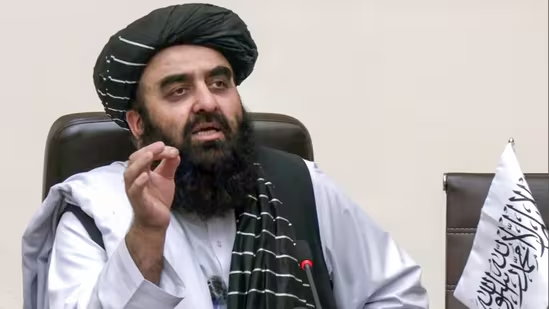







NEW DELHI: When Afghanistan’s Foreign Minister Amir Khan Muttaqi arrived in New Delhi on October 9, 2025, it was more than a ceremonial visit — it marked the first high-level engagement between the Taliban-led Islamic Emirate and India since 2021. For both countries, it was a cautious yet decisive moment of re-engagement, signalling that dialogue, not distance, will define the next phase of their relationship. On October 10, Muttaqi held wide-ranging talks with External Affairs Minister, Dr. S. Jaishankar at Hyderabad House, followed by expected security discussions with National Security Adviser Ajit Doval. The outcome — reflected in the official India–Afghanistan Joint Statement (MEA, October 10, 2025) — was striking: India announced it would upgrade its technical mission in Kabul to a full-fledged embassy, both sides reaffirmed counter-terrorism cooperation, and development and trade were placed at the centre of a revived partnership. The visit symbolised an ice-break in India–Afghanistan relations — a move from estrangement to constructive engagement, balancing India’s principled realism with Afghanistan’s search for regional legitimacy.
Rebuilding a Legacy of Development and Trust
India’s role in Afghanistan has never been transactional, it is civilisational and developmental. Over the last two decades, New Delhi has invested over US $3 billion across more than 500 projects — from the Afghan Parliament building and the Salma (India–Afghanistan Friendship) Dam to schools, roads, and hospitals. These initiatives became the moral bedrock of India’s goodwill in Afghan society. The Joint Statement reaffirmed India’s intent to resume halted development projects, enhance humanitarian assistance, and expand education and health initiatives. Muttaqi himself acknowledged India’s enduring contribution, stating that Afghanistan looks at India “as a close friend in rebuilding our nation.” Notably, following his Delhi meetings, Muttaqi planned visits to Deoband and the Taj Mahal on October 11–12, an act of cultural diplomacy underscoring Afghanistan’s civilisational affinity with India — a bridge built on shared heritage and spiritual scholarship.
Security, Sovereignty, and Strategic Assurance
Security formed the cornerstone of this revived dialogue. The Joint Statement reaffirmed that “the territory of Afghanistan shall not be used against any other country” and emphasised cooperation against terrorism, narcotics, and organised crime. Muttaqi reiterated in his press conference that “Afghan soil will not be used against others,” a phrase widely interpreted as reassurance to India. He also condemned Pakistan’s recent airstrikes on Afghan border provinces, calling them a “big mistake” — a statement made on Indian soil that resonated across the region. These developments underline a strategic convergence: India seeks assurances for its security and projects, while the Taliban seeks legitimacy through credible regional partnerships. Yet both sides are aware that trust cannot be declared — it must be verified and institutionalised through sustained liaison mechanisms, intelligence sharing, and cooperative monitoring.
Pakistan’s Faltering Leverage and the Refugee Catastrophe
Muttaqi’s Delhi visit took place against a backdrop of deepening hostility between Kabul and Islamabad. Pakistan’s cross-border air raids and its mass expulsion of over one million Afghan refugees have pushed bilateral relations to the brink of rupture. In Delhi, Muttaqi’s forthright condemnation of Pakistan’s “interference and coercive behaviour” signalled a decisive rhetorical break from its long-standing tutelage — a relationship historically marked by manipulation and asymmetry.
What Pakistan has executed under the pretext of internal security is not a policy — it is a humanitarian outrage. The forcible eviction of destitute Afghan families, many of whom were born on Pakistani soil and have known no other home, constitutes an unconscionable act of state cruelty and a flagrant violation of international refugee law. By uprooting more than a million people without due process, Islamabad has effectively authored a crime against humanity, one that has shocked global conscience and eroded its residual moral legitimacy.
India’s response has stood in stark ethical contrast. Through UN agencies and civil-society partners, New Delhi extended food, medical aid, and temporary shelter to displaced Afghans, reaffirming its enduring role as a compassionate and stabilising neighbour. This ethical stance, grounded in humanitarian responsibility rather than political calculation, has carved for India a renewed diplomatic space to play a constructive regional role — one that combines moral conviction with pragmatic foresight.
Pakistan’s coercive and inhuman policy has not only alienated Afghans but also diminished its strategic leverage, isolating Islamabad both diplomatically and morally. The image of the Taliban’s Foreign Minister asserting Afghan sovereignty from Indian soil was not merely symbolic, but epochal — a geostrategic inversion of decades of Pakistan’s dominance, and a vivid reminder that moral legitimacy now resides unmistakably with New Delhi.
Economics of Interdependence: Trade, Minerals, and Connectivity
Beneath the political theatre lies a robust economic calculus. Bilateral trade between India and Afghanistan surpassed US $1 billion in FY 2024–25, driven by agricultural exports and air cargo routes that bypass Pakistan. Muttaqi invited Indian investment in Afghanistan’s vast mineral reserves, estimated at US $3 trillion, including lithium, copper, and rare earths vital for clean-energy technologies. India’s developmental model — anchored in transparency and capacity-building — offers Kabul a framework for responsible resource utilisation. Connectivity through Iran’s Chabahar Port and the International North–South Transport Corridor remains central to both nations’ strategic agenda, granting landlocked Afghanistan access to global markets and giving India an overland route to Central Asia. These economic linkages reinforce a broader strategic vision: transforming Afghanistan from a corridor of conflict into a corridor of commerce.
Cultural Diplomacy and the Road to Emancipation
Muttaqi’s planned stop at Darul Uloom Deoband, the seminary historically influential in Afghanistan’s religious discourse, carries profound symbolic meaning. It demonstrates a quest for intellectual reconciliation — a gesture suggesting that Afghanistan’s Islamic ethos and India’s plural civilisational ethos need not exist in opposition.
In parallel, India continues to prioritise educational diplomacy: expanded scholarships under the ICCR scheme, e-learning through e-Vidya Bharati, and vocational training for Afghan youth. Women’s education, although constrained within Afghanistan, remains a field where India’s experience and silent mentorship can promote gradual empowerment through capacity and exposure. By blending culture with compassion, India’s outreach transcends policy; it becomes pedagogical diplomacy — educating for stability.
The Global Chessboard: Competing Motives, Singular Vision
Afghanistan remains a strategic crossroads and a contested chessboard for global powers. China eyes its vast mineral reserves to fuel its industrial resurgence, Russia seeks renewed influence through the Moscow Format, while the United States continues to pursue sanction-driven containment strategies that serve its own geopolitical calculus. The pattern of power politics resurfaced dramatically in September 2025, when U.S. President Donald Trump proposed to regain control of the Bagram Air Base under the pretext of counter-terrorism. The move was met with immediate and unified opposition from India, Russia, and China, who condemned it as an attempt to reimpose “foreign occupation by any pretext.” Kabul’s outright rejection of the proposal underscored both Afghanistan’s assertive sovereignty and the region’s collective fatigue with external militarisation masquerading as security cooperation.
In this turbulent geopolitical arena, India stands distinct. Guided by strategic autonomy and civilisational diplomacy, New Delhi engages the Taliban without endorsing its ideology, fosters peace without external alignment, and places the Afghan people — not great-power theatrics — at the centre of its policy. India’s approach is constructive rather than coercive, collaborative rather than colonial. By combining developmental pragmatism with diplomatic dignity, India offers Afghanistan not mere assistance, but agency — the chance to rebuild sovereignty through partnership, not patronage. This singular vision situates India as the moral and strategic counterpoint to the exploitative ambitions of external powers, reaffirming its credibility not only in Kabul but across the Global South.
Conclusion: The Horizon Widens
Amir Khan Muttaqi’s visit did not resolve every divergence, yet it succeeded in redrawing the map of possibility. It transformed a silent standoff into a structured conversation — one that reintroduces Afghanistan into the regional fold and reaffirms India’s role as a constructive anchor of stability.
For Afghanistan, it was an assertion of sovereignty and a plea for partnership, not patronage. For India, it was a reaffirmation that engagement rooted in development and dignity yields more durable outcomes than isolation or intrusion. The path ahead will demand patience, verification, and constant dialogue, but the direction is unmistakable: the reawakening of a relationship defined not by dependency, but by mutual purpose.
In the heart of Asia — where empires once contended and ideologies collided — India and Afghanistan now stand on the threshold of a more inclusive narrative: one of reconstruction, reconciliation, and shared renewal. If sustained with wisdom and empathy, this horizon of possibility may yet evolve into the architecture of enduring peace and partnership for the region.
Views: 152

Dr. Maheep
Dr. Maheep is Director, Indian Perspective on Global Affairs (IPGA), and a leading analyst of India’s foreign policy and South Asian geopolitics. He earned his PhD in Arab and Islamic Studies. With more than a decade of teaching and research experience in International Relations and Global Politics, he contributes regularly on issues shaping national and global affairs.


