


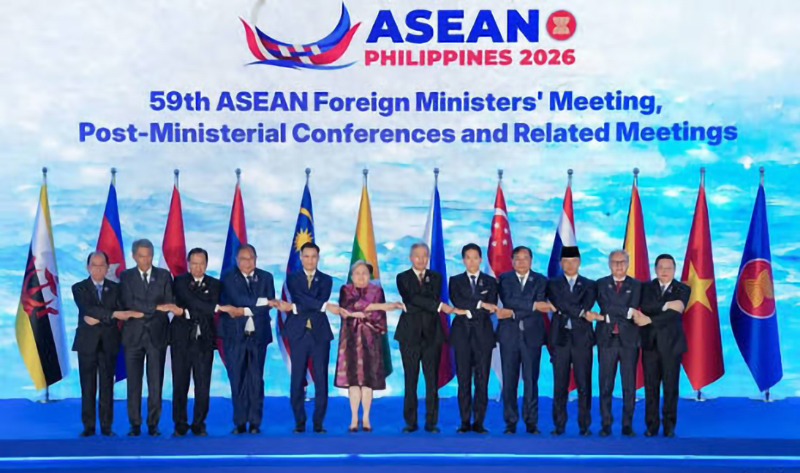







The Geography of Trust and the Manila Foreign Ministers’ Meeting of 2026
Geography brings states together; trust determines the order they are capable of creating. Few regions illustrate this proposition more vividly than the Indo-Pacific, where ancient maritime routes have re-emerged as the principal arteries of 21st century commerce, connectivity, and strategic competition. Across the Bay of Bengal, the Andaman Sea, and the wider maritime expanse of Southeast Asia, India and the Association of Southeast Asian Nations (ASEAN) are connected not merely by geographical proximity but by two millennia of commercial exchange, civilisational interaction, and an increasingly shared commitment to an open, inclusive, and rules-based regional order. The Manila Foreign Ministers’ Meetings of July 2026 were therefore more than a sequence of diplomatic engagements; they became a revealing lens through which to understand the evolving architecture of Indo-Pacific governance and India’s expanding regional role.
External Affairs Minister Dr S. Jaishankar travelled to Manila on 22–23 July 2026 to participate in an intensive series of ASEAN-led ministerial engagements—the ASEAN–India Post-Ministerial Conference, the East Asia Summit Foreign Ministers’ Meeting, and the ASEAN Regional Forum—while also joining the Quad Foreign Ministers’ Meeting alongside Australia, Japan, and the United States. Hosted by the Philippines under the theme “Navigating Our Future, Together,”these meetings acquired particular significance because 2026 had been jointly designated as the ASEAN–India Year of Maritime Cooperation, with India participating as ASEAN’s Comprehensive Strategic Partner. Manila became the point at which multiple strands of contemporary Asian statecraft—maritime security, resilient supply chains, digital transformation, emerging technologies, connectivity, and strategic autonomy—converged within a single institutional setting.
Yet the true significance of Manila lies not in the communiqués it produced but in what they reveal about the changing logic of regional order in the Indo-Pacific. Dr S. Jaishankar’s emphasis on energy, food, and health security, resilient supply chains, de-risking and diversification, and the observance of international law reflected a broader transformation in Indian foreign policy—one that increasingly understands regional stability as emerging from trusted partnerships, institutional cooperation, and shared norms rather than from power alone. The resulting agenda—spanning trade, investment, digital public infrastructure, artificial intelligence, green transition, physical connectivity, and resilient supply chains—demonstrates that twenty-first-century diplomacy increasingly concerns the governance of development as much as the management of security.
This article therefore approaches the Manila meetings not as an exercise in diplomatic reportage but as an opportunity for theoretical interpretation. Its central question is analytical rather than descriptive: What does India’s conduct at Manila reveal about the strategic evolution of the ASEAN–India partnership, and what does that evolution disclose about the emerging architecture of Indo-Pacific order? The article advances an original conceptual contribution—the convergence–implementation paradox—to explain the defining characteristic of contemporary ASEAN–India relations. While strategic, normative, and rhetorical convergence has deepened steadily through the elevation of the relationship to a Comprehensive Strategic Partnership, the growing alignment between the ASEAN Outlook on the Indo-Pacific and India’s Indo-Pacific Oceans Initiative, and a shared commitment to ASEAN Centrality and a rules-based maritime order, the institutional translation of that convergence into binding, measurable, and economically transformative outcomes has progressed far more slowly, most visibly in the prolonged review of the ASEAN–India Trade in Goods Agreement. Understanding why convergence has outpaced implementation—and how that gap may be bridged—constitutes the central intellectual objective of this study. Interpreting this paradox principally through a Constructivist framework, while drawing complementary insights from Strategic Autonomy, Complex Interdependence, Neoclassical Realism, Regional Security Complex Theory, and Hedging, the article argues that, viewed through this theoretical lens, Manila emerges not merely as a diplomatic milestone but as a pivotal moment in the strategic maturation of the ASEAN–India partnership and, more broadly, in the evolving architecture of Indo-Pacific order.
From Bangkok 1967 to the Indo-Pacific Century
The Association of Southeast Asian Nations (ASEAN) emerged in Bangkok in August 1967 from a pragmatic impulse, as five states sought a framework through which to manage mutual suspicions, dampen the risk of intramural conflict, and insulate a fragile region from Cold War currents. The founders built the Association on the operating philosophy later called the ASEAN Way, a method grounded in consensus, quiet consultation, non-interference, and an incrementalism that privileged relationships over binding legalism. This approach reflected the sovereignty sensitivities of newly independent states and the practical wisdom that trust accumulates slowly, and although it attracted criticism for its deliberate pace, it delivered the region’s foundational achievement, which was the transformation of Southeast Asia from a theatre of confrontation into a zone of managed cooperation. Successive enlargements expanded the membership from five to ten, with Timor-Leste advancing through its accession pathway, while institutional consolidation proceeded through the 1976 Treaty of Amity and Cooperation, the 2007 ASEAN Charter, and the 2015 establishment of the ASEAN Community across its political-security, economic, and socio-cultural pillars.
The most consequential conceptual innovation was ASEAN Centrality, the principle that the Association occupies the driving seat of the region’s multilateral architecture. Centrality expressed an insight of enduring value: a group of middle and smaller powers could preserve its autonomy amid great-power competition by making itself the indispensable convenor of regional dialogue. Through the ASEAN Regional Forum, the East Asia Summit, and the ASEAN Defence Ministers’ Meeting Plus, the Association positioned itself as the neutral ground upon which larger powers would meet, allowing it to shape the terms of engagement in its own neighbourhood and to resist absorption into any single power’s sphere. The ASEAN Outlook on the Indo-Pacific, adopted in 2019, marked the decisive adaptation to the new geopolitical vocabulary, framing the Indo-Pacific as a space of dialogue and cooperation rather than containment and emphasising inclusivity, the primacy of ASEAN-led mechanisms, and a development-oriented agenda. This act of normative reformulation illustrates why ASEAN endures despite intensifying rivalry, because it offers regional states and partners such as India an inclusive alternative to bloc politics, a forum in which sovereignty is respected and the smaller state retains agency.
India’s own engagement evolved along a trajectory that mirrored ASEAN’s ascent, and its interpretation reveals the sources of Indian foreign policy. The Look East Policy, launched in 1992 amid the economic reform era, reoriented Indian diplomacy toward the dynamic economies of the east and succeeded in reconnecting India to a region from which decades of continental preoccupation had estranged it, proceeding through a widening sequence of institutional relationships from sectoral dialogue partner in 1992 to full dialogue partner, member of the ASEAN Regional Forum, and summit-level partner. The transformation into the Act East Policy in 2014 signalled a qualitative shift rather than a change of nomenclature, placing strategic investment alongside economic engagement, extending the horizon from Southeast Asia to the wider Indo-Pacific, and infusing the relationship with a security and connectivity content the earlier policy had lacked. The elevation to a Comprehensive Strategic Partnership in 2022, on the thirtieth anniversary of dialogue relations, confirmed that India now regarded ASEAN as an indispensable pillar of its Indo-Pacific vision. This evolution cannot be explained by material factors alone, because the economic complementarities that motivated the original policy persisted throughout; the transformation reflected a change in India’s self-understanding, a growing conception of itself as a shaper of regional order and a provider of public goods, an evolution of identity prior to and constitutive of the redefinition of interest that exemplifies the Constructivist proposition at the centre of this analysis.
The endurance of ASEAN amid great-power competition constitutes a puzzle whose resolution lies in the distinctive function the Association performs. ASEAN endures because it supplies a public good that the region and its partners genuinely value, a neutral and inclusive platform upon which cooperation can proceed without the imposition of exclusive alignment, and in a region marked by competing visions of order this convening authority acquires heightened rather than diminished value. India’s investment in ASEAN Centrality reflects a clear-eyed appreciation of this function, because a cohesive and central ASEAN preserves the multipolar regional balance that Indian statecraft consistently favours, resists the consolidation of any single power’s dominance, and sustains the inclusive institutional order within which India’s own influence can grow. This alignment between India’s interest in a multipolar Indo-Pacific and ASEAN’s interest in preserving its centrality supplies the deep structural foundation of the partnership, and it explains why India consistently affirms ASEAN Centrality even when it possesses the capability to construct alternative architectures.
Institutional Architecture and India’s Place within It
ASEAN’s influence flows through a layered architecture whose mechanisms perform distinct yet complementary functions, and the Manila meetings activated three of them in rapid succession. The ASEAN Regional Forum, which India joined in 1996, remains the premier venue for security dialogue across the widest membership, and India has used it to advocate confidence-building, preventive diplomacy, and cooperative approaches to non-traditional security. The East Asia Summit, inaugurated in 2005 with India as a founding member, occupies a more strategic tier as a leaders-led forum, and India’s founding membership placed New Delhi inside the region’s premier strategic forum well before the Indo-Pacific concept crystallised. The ASEAN Defence Ministers’ Meeting Plus, launched in 2010, provides the platform for practical defence cooperation through expert working groups on maritime security, counterterrorism, humanitarian assistance and disaster relief, peacekeeping, and cyber security, converting declared intent into the routine practice of joint exercises and shared standards, precisely the institutional socialisation that a Constructivist reading identifies as constitutive of durable partnership.
The economic architecture presents a more complex picture. The ASEAN Economic Community advances integration toward a single market, while the Regional Comprehensive Economic Partnership, signed in 2020, created the world’s largest free trade bloc by aggregate output. India participated in the RCEP negotiations across nearly a decade and elected in 2019 to remain outside, a decision grounded in concerns about the trade deficit with China, the vulnerability of domestic manufacturing and agriculture, and the adequacy of safeguards, and representing a deliberate exercise of strategic autonomy that prioritised the protection of domestic interests and policy space. The bilateral and regional trade architecture rests instead on the ASEAN–India Trade in Goods Agreement, signed in 2009 and operational from 2010, and the ASEAN–India Trade in Services Agreement of 2014, instruments that created one of the world’s largest free trade areas by population and opened Indian markets to a multi-country bloc for the first time since the 1991 liberalisation.
Beyond these headline forums, a broad suite of functional mechanisms gives the partnership its developmental substance. Connectivity initiatives, including the India–Myanmar–Thailand Trilateral Highway and the Kaladan Multi-Modal Transit Transport Project, seek to weave physical linkages between India’s northeast and mainland Southeast Asia, though their progress has been conditioned by the instability in Myanmar. Digital cooperation has emerged as a domain of natural convergence, because India’s experience with digital public infrastructure, encompassing biometric identity, real-time payments, and open networks, offers a template that many ASEAN states find attractive as an alternative to proprietary foreign systems. Disaster management cooperation reflects shared exposure to natural hazards across the Bay of Bengal, and emerging technology governance, spanning artificial intelligence, semiconductors, cyber security, and supply-chain resilience, constitutes the newest and most promising frontier. The agenda Dr Jaishankar articulated at Manila, with its explicit inclusion of technology, digital connectivity, and green transition, signals that the partnership increasingly locates its future in these functional domains, where alignment is strong and the sovereignty sensitivities that complicate trade negotiations weigh less heavily.
A rigorous appraisal requires movement beyond the enumeration of agreements toward the evaluation of their implementation, and the record reveals a discernible pattern that the convergence–implementation paradox predicts. The elevation to a Comprehensive Strategic Partnership in November 2022 stood at the apex of an architecture of joint statements and five-year plans of action that identified maritime cooperation, connectivity, digital transformation, and people-to-people ties as priorities. Commitments in the functional and cooperative domains, including maritime exercises, disaster relief coordination, scholarships, and digital cooperation, have advanced with relative success, because they align interests without requiring the concession of sovereignty or the reallocation of market access, and the ASEAN–India Fund, the Science and Technology Fund, and the Green Fund have channelled Indian financing into concrete regional projects. Commitments in trade liberalisation and physical connectivity have advanced more slowly, not through a deficit of political commitment, which remains strong, but through the interaction of domestic economic sensitivities, financing constraints, and the exogenous shock of instability in Myanmar, through which the flagship connectivity projects must pass. Recognising this distinction is essential, because it directs the reform effort toward the strengthening of implementation capacity and the diversification of routes rather than toward the renewal of political will, which is already abundant.
The human and cultural foundations give the partnership its distinctive depth and stabilise it through periods of negotiation friction. The Indian diaspora across Southeast Asia constitutes a living bridge that carries commerce, culture, and goodwill across the Bay of Bengal; educational exchange cultivates the human capital upon which durable cooperation depends; and cultural diplomacy, expressed through the shared heritage of Buddhism, the Ramayana traditions of Southeast Asia, and the maritime networks of the historical Indian Ocean, activates the civilisational register that renders the partnership meaningful beyond the calculus of interest. These foundations supply the relational capital that exemplifies the Constructivist proposition that shared identity constitutes the bedrock upon which cooperation is built.
Maritime Fulcrum and the Year of Maritime Cooperation
The designation of 2026 as the ASEAN–India Year of Maritime Cooperation elevated the maritime domain to the organising theme of the partnership. Dr Jaishankar’s observation that shared dependence on maritime trade makes observance of international law vital captured the essential logic of the maritime fulcrum, because the Indo-Pacific functions as a single interconnected maritime system in which the security of sea lanes underwrites the prosperity of every littoral state. India’s maritime vision and ASEAN’s maritime priorities converge on a common commitment to freedom of navigation, the peaceful settlement of disputes, and a rules-based order anchored in the United Nations Convention on the Law of the Sea. This engagement rests on a coherent doctrinal foundation. The vision of Security and Growth for All in the Region, articulated in 2015, framed India’s approach to the Indian Ocean around security and inclusive development, positioning India as a net provider of security, while the Indo-Pacific Oceans Initiative, launched in 2019, extended this vision eastward around seven pillars encompassing maritime security, maritime ecology and resources, capacity building, disaster risk reduction, science and technology, and trade connectivity. The alignment between this Initiative and the ASEAN Outlook on the Indo-Pacific is substantive rather than rhetorical, and India has consistently invited ASEAN states to lead pillars of the Oceans Initiative, an invitation that operationalises ASEAN Centrality within an Indian-originated framework.
The practical texture of maritime cooperation spans maritime domain awareness through expanding information-sharing and coastal surveillance, naval diplomacy through port calls, coordinated patrols, and multilateral exercises, and the cooperative public goods of anti-piracy operations, search and rescue, and humanitarian assistance and disaster relief that demonstrate the tangible value of partnership. The blue economy agenda, encompassing sustainable fisheries, ocean resource governance, and protection of the marine environment, connects security to development in a manner that resonates with ASEAN’s developmental priorities. The broader framework within which India operates extends through the Indian Ocean Rim Association, the Bay of Bengal Initiative for Multi-Sectoral Technical and Economic Cooperation, and the India–Middle East–Europe Economic Corridor, each complementing the eastward reach of the Act East Policy, while the Quad contributes a further layer through its maritime domain awareness partnership. India’s challenge, and its opportunity, lies in weaving these overlapping frameworks into a coherent posture that reinforces ASEAN Centrality rather than competing with it, and the 2026 Year of Maritime Cooperation provides the occasion to demonstrate that India’s multiple maritime initiatives converge upon a single inclusive vision in which ASEAN retains its convening authority.
Economic Engagement: Achievement, Asymmetry, and Reform
The economic dimension reveals both the scale of achievement and the sharpness of the convergence–implementation paradox. Bilateral trade reached approximately 128 billion United States dollars in 2025–26, a figure that testifies to two decades of deepening engagement and to the complementarities between the Indian and Southeast Asian economies. The balance, however, has moved decisively in ASEAN’s favour: India’s trade deficit widened to more than 50 billion dollars in 2025, a striking increase from little more than 5 billion dollars in 2009, the year before the goods agreement entered into force. Analysis of the trade data reveals a further complication, because a significant share of imports entering India under preferential tariffs may originate outside the region, exploiting rules of origin to route third-country goods through ASEAN members, a phenomenon of trade deflection that erodes the benefits for Indian producers and has become a central motivation for the ongoing review.
The review of the ASEAN–India Trade in Goods Agreement supplies the clearest illustration of the paradox. India requested the review in 2019 after imports surged and the balance tilted, and the thirteenth meeting of the joint committee convened in New Delhi in July 2026, with sub-committees on customs procedures and trade facilitation, national treatment and market access, and rules of origin working toward time-bound deliverables. The review missed its initial deadline of December 2025 and continued through 2026, a pace that stands in instructive contrast to the ASEAN–China Free Trade Area, which advanced to its third upgraded iteration in October 2025 with expanded commitments across supply chains, the green economy, and the digital economy. The comparison yields a lesson not in the assignment of fault but in the identification of the institutional dynamism that sustained economic diplomacy demands, namely the continuous upgrading of an agreement, the co-conditioning of goods liberalisation on services and investment access, and the incorporation of new-generation chapters. India’s recently concluded free trade agreement with the European Union, negotiated on the principle of comprehensive balance across twenty-three chapters, demonstrates that Indian economic diplomacy possesses precisely this capacity when it chooses to deploy it. The application of that lesson to the ASEAN relationship, through an ambitious and time-bound modernisation that tightens rules of origin, expands market access for Indian services and pharmaceuticals, and incorporates chapters on digital trade, investment protection, geographical indications, and sustainability, would transform the economic relationship from a source of asymmetry into a pillar of mutual resilience.
The wider economic agenda acquires its forward momentum from sectoral frontiers where complementarities are strongest. Pharmaceutical and healthcare cooperation meets a genuine regional need with India’s capacity as a producer of affordable medicines; financial technology and the interoperability of real-time payment systems promise to lower the cost of remittances and deepen financial inclusion; semiconductors and critical minerals offer the opportunity to construct resilient and diversified networks that reduce concentration risk; and renewable energy and green hydrogen connect the climate ambitions of both partners to the imperatives of energy security, with the International Solar Alliance offering a platform to scale this cooperation. Agricultural innovation and food security complete the agenda, addressing a domain Dr Jaishankar explicitly identified as one that can no longer be taken for granted. Each frontier rests upon a genuine complementarity, aligns with ASEAN’s developmental priorities, and advances through cooperation on capacity and infrastructure rather than through the contested negotiation of market access. Investment flows reinforce this picture, with Singapore among the principal sources of foreign direct investment into India and Indian enterprises expanding across the region, weaving a web of corporate interest that complements trade and generates constituencies with a durable stake in the partnership. The framing of de-risking and diversification encompasses this investment dimension, because the construction of resilient supply chains requires the coordinated development of manufacturing capacity, logistics, and regulatory compatibility across partner economies seeking to position themselves as trusted and complementary nodes rather than as competitors.
Manila in the Contemporary Geopolitical Environment
The Manila meeting unfolded within a strategic environment marked by intensifying competition, disrupted supply chains, and contested maritime spaces, and India’s approach offers the states of Southeast Asia a valued alternative, because New Delhi advances cooperation without demanding alignment and promotes balance without insisting on exclusion. The South China Sea remains the most consequential arena of maritime contention, and India’s position has been consistent and principled: New Delhi supports the peaceful resolution of disputes in accordance with the United Nations Convention on the Law of the Sea, upholds freedom of navigation and overflight, and endorses the pursuit of an effective and substantive code of conduct that accords with international law. India advances this position through the language of principle rather than confrontation, which enhances its credibility as a partner that respects ASEAN’s own preference for managing tensions through dialogue.
A balanced appraisal requires an evidence-based assessment of China’s expanding influence. China has become the dominant trading partner of most ASEAN states, has extended substantial infrastructure financing through the Belt and Road Initiative, and has upgraded its free trade area with ASEAN to a third iteration, developments that confer genuine economic weight. They also generate documented concerns within the region regarding debt sustainability, the transparency of financing, and the exercise of maritime pressure through grey-zone tactics and maritime militia activity in contested waters. India’s value to ASEAN in this context lies in the provision of alternatives rather than in opposition, because by offering connectivity, digital infrastructure, capacity building, and trade on terms that respect sovereignty, India strengthens the ability of ASEAN states to preserve their autonomy and to diversify their partnerships. This role as a provider of strategic choice constitutes India’s distinctive contribution to regional balance. The situation in Myanmar presents a persistent challenge that affects India directly, because Myanmar constitutes the land bridge through which its flagship connectivity projects must pass, and India approaches it through principled pragmatism, supporting ASEAN’s Five-Point Consensus while maintaining the engagement necessary to protect its security and connectivity interests along a shared border. The wider environment includes instability across maritime chokepoints from the Strait of Malacca to the approaches of the Red Sea and the Strait of Hormuz, disruptions that reinforce the logic of de-risking and diversification, because resilience in the face of chokepoint vulnerability requires diversified routes, suppliers, and partnerships.
The Quad Foreign Ministers’ Meeting held on the margins added a further dimension, and its focus on maritime security, resilient supply chains, and critical and emerging technologies complements the ASEAN-centred agenda. India has consistently framed its Quad participation as compatible with, and supportive of, ASEAN Centrality, participating as an expression of convergent interest among like-minded partners while declining to characterise the grouping as an alliance directed against any state. The simultaneous participation in ASEAN-led forums and in the Quad, within a single visit, demonstrates the multi-alignment that defines contemporary Indian statecraft, in which India cultivates multiple overlapping partnerships without subordinating its autonomy to any of them.
Interpreting India’s Engagement: Theory and Original Contributions
The conduct of India at Manila becomes fully intelligible through theoretical interpretation, and Constructivism carries the principal analytical weight because the distinctive features of India’s engagement correspond closely to the causal factors it identifies. Constructivism holds that the interests of states are shaped by identities, norms, and shared understandings rather than fixed by material structure alone. India frames its engagement with Southeast Asia through a civilisational register that emphasises millennia of maritime, religious, and cultural exchange, and this narrative performs real analytical work by constituting a shared identity that renders cooperation natural and legitimate rather than merely instrumental. The principle of ASEAN Centrality itself operates as a norm that India has internalised and now reproduces through practice, because India could on a purely material calculus seek to build alternative architectures that bypass ASEAN, yet it chooses instead to work through and strengthen ASEAN-led mechanisms, a choice reflecting the internalisation of a regional norm and the recognition that legitimacy in Southeast Asia flows through respect for the Association’s convening role. India further acts as a norm entrepreneur, promoting sovereign equality, inclusive regionalism, and a development-oriented order, with the concept of Vasudhaiva Kutumbakam supplying the vocabulary through which it presents regional engagement as an expression of civilisational values. Institutional socialisation completes the account, because decades of participation in ASEAN-led forums have accumulated shared practices and a common diplomatic grammar that stabilise the partnership, and the dense sequence of meetings at Manila exemplifies the routinised interaction through which shared understandings are continuously reaffirmed.
The complementary frameworks illuminate facets that Constructivism alone leaves partially in shadow. Strategic autonomy explains India’s consistent preference for independent decision-making and the avoidance of alliance entanglement, evident in the decision to remain outside the Regional Comprehensive Economic Partnership and in the simultaneous participation in ASEAN forums and the Quad without characterising either as an exclusive commitment, a multi-alignment that resonates strongly with ASEAN states pursuing their own variants of hedging. Complex interdependence illuminates the multiple channels through which India and ASEAN interact and explains why the relationship exhibits resilience even when specific negotiations stall, because the density of connections across trade, investment, diaspora, and education creates a web of mutual interest that sustains the partnership through friction. Neoclassical realism explains how India’s external conduct reflects both the structural pressures of a competitive Indo-Pacific and the domestic factors, including the imperative to protect manufacturing and agriculture, that shape the translation of systemic pressure into policy, rendering the cautious pace of trade liberalisation intelligible as the product of this interaction. Regional security complex theory clarifies the spatial logic of India’s eastward reach as the extension of its security horizon to encompass an integrated Indo-Pacific complex, while hedging theory explains the behaviour of the ASEAN states, which cultivate India as one element of a diversified portfolio designed to preserve their autonomy, an appeal that rests precisely on India’s respect for ASEAN Centrality and its refusal to demand exclusive alignment.
This analysis advances several original conceptual contributions that together offer a fresh interpretation of the relationship. The first and most central is the convergence–implementation paradox, which names the defining tension: strategic, normative, and rhetorical convergence has deepened continuously while the institutional translation of that convergence into binding economic architecture has lagged. Naming this paradox permits a precise diagnosis, because the partnership does not suffer from a deficit of goodwill or strategic alignment, which are abundant, but from a deficit in the machinery that converts alignment into measurable and enforceable outcomes, a diagnosis that reorients the reform agenda toward the strengthening of implementation capacity rather than the generation of further declarations. The second contribution characterises India’s regional role as that of a normative balancer and capacity partner rather than a competing pole, because India balances the regional order not by assembling a countervailing bloc but by providing ASEAN states with strategic alternatives that expand their room for autonomous manoeuvre, a form of balancing that operates through the enhancement of others’ agency rather than the accumulation of countervailing power and that explains why India’s presence is welcomed rather than resisted. The third contribution identifies the functional-domain migration of the partnership, because as the traditional trade agenda encounters the friction of sovereignty sensitivities and structural asymmetry, the centre of gravity migrates toward digital public infrastructure, maritime cooperation, emerging technology, green transition, and supply-chain resilience, where alignment is strong and binding legal commitment weighs less heavily. Recognising this pattern allows policymakers to concentrate the partnership’s energies where the prospects for rapid and mutually beneficial progress are greatest, while pursuing the more difficult economic reforms on a parallel and patient track.
A Blueprint for Consolidation and the Meaning of Manila
The resolution of the convergence–implementation paradox requires a deliberate agenda that converts abundant political goodwill into ratified, monitored, and measurable outcomes, and five interlocking elements address the implementation deficit while preserving strategic autonomy and respect for ASEAN Centrality. India and ASEAN should complete the modernised trade agreement with commensurate ambition to the upgrades ASEAN has concluded with other partners, negotiating on the principle that the parties agree on nothing until they agree on everything so as to secure a balanced package across goods, services, digital trade, and investment. The momentum of the 2026 Year of Maritime Cooperation should crystallise into a standing maritime cooperation framework encompassing regularised information-sharing, structured capacity building, and a sustained programme of joint exercises and blue economy collaboration, ensuring that the achievements of the commemorative year endure as permanent architecture. Digital and technology cooperation should accelerate as the flagship of the partnership’s functional migration, through interoperable payment systems, cooperation on artificial intelligence governance, collaboration on semiconductors and critical minerals, and joint work on cyber security. Robust implementation and monitoring mechanisms should inject accountability into the partnership, through a joint review mechanism reporting at the ministerial level and equipped with clear metrics and time-bound deliverables that emulate the model of the trade review sub-committees. Connectivity should be strengthened through the completion of flagship physical projects and the development of maritime and digital corridors that reduce dependence on any single overland route through regions of instability. Together these elements convert strategic convergence into an architecture capable of delivering measurable outcomes while respecting the consensual method that defines ASEAN.
The central question concerned the meaning of India’s participation in the Manila Foreign Ministers’ Meeting, and the analysis supports a clear interpretation. Manila represents a phase of strategic consolidation that carries within it the potential for genuine transformation. The consolidation is evident in the density of India’s institutional embedding, the maturity of its maritime doctrine, the breadth of the shared agenda, and the depth of the normative convergence between New Delhi and Southeast Asia, while the potential for transformation depends upon the resolution of the convergence–implementation paradox, which requires the partnership to convert its goodwill into ratified, monitored, and measurable commitments. The meeting therefore marks neither mere tactical diplomacy nor a completed transformation, but a consequential moment of consolidation poised at the threshold of a more ambitious future. The deeper significance extends beyond the bilateral relationship to the character of the regional order itself, because India’s engagement advances a distinctive vision of the Indo-Pacific grounded in inclusivity, sovereignty, development partnership, and a multipolar balance in which no single power predominates, a vision that offers the states of Southeast Asia a valued alternative to bloc politics and expands their capacity for autonomous manoeuvre. India’s role as a normative balancer and capacity partner, providing strategic choice rather than demanding alignment, constitutes a genuine contribution to the stability and pluralism of the regional order, and the civilisational register through which India frames this engagement lends it a legitimacy that pure interest calculation could not supply. The strategic convergence is secure, the normative alignment is deep, and the functional agenda is rich with opportunity; the task ahead is the construction of the architecture through which convergence becomes concrete achievement. The partnership that navigates its shared future together, with patience, ambition, and mutual respect, will help to shape an Indo-Pacific order that is open, stable, and genuinely inclusive.
Views: 386

Dr. Maheep
Dr. Maheep is Director, Indian Perspective on Global Affairs (IPGA), and a leading analyst of India’s foreign policy and South Asian geopolitics. He earned his PhD in Arab and Islamic Studies. With more than a decade of teaching and research experience in International Relations and Global Politics, he contributes regularly on issues shaping national and global affairs.


