







State Visit Of The President Of India To Angola And Botswana: A New Chapter In Global South Cooperation
In an international environment marked by climate urgency, strategic re-alignments, and the ascendancy of Global South voices, the state visit of the President of India, Droupadi Murmu, to Angola and Botswana (8–13 November 2025) signifies a turning point in India’s evolving strategic outreach across the Global South. It is more than a ceremonial engagement; it embodies a strategic and multilayered mission that connects energy security with green transition, trade with technology, and culture with strategic convergence. The visit reflects India’s conscious endeavour to establish itself as the leader and strategic fulcrum of the Global South—a bridge linking continents, ideas, and shared futures.
By interlinking Luanda and Gaborone through shared aspirations of sustainable growth, technological partnership, and equitable development, the visit reinforces India’s vision of global cooperation rooted in mutual respect and cultural solidarity. It also aligns with India’s leadership role ahead of COP 30, where New Delhi champions a balanced transition harmonising climate responsibility with developmental justice.
President Murmu’s engagements in Africa thus carry both substantive resonance and strategic weight, affirming India’s evolving role as the moral and pragmatic leader of the Global South. In a world reconfiguring its political and economic hierarchies, this visit underscores that the essence of 21st-century statecraft lies in partnership, not patronage; in dialogue, not dominance.
Angola: From Energy Security to Sustainable Cooperation
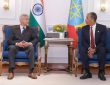
President Murmu’s visit to Angola marks a milestone, the first by an Indian Head of State. In Luanda, she held extensive discussions with President João Manuel Gonçalves Lourenço, focusing on energy cooperation, infrastructure, agriculture, health, defence, technology, and trade. Two Memoranda of Understanding were signed, one on fisheries, aquaculture, and marine resources, and another on consular cooperation voth of which institutionalise collaboration and strengthen administrative connectivity.
Energy remains central to the India-Angola relationship. Angola, one of India’s principal crude-oil suppliers, is now engaging with India to diversify towards renewables and green energy systems. The dialogue covered bio-fuels, waste-to-energy, and sustainable infrastructure, marking a decisive shift from conventional hydrocarbons to clean-energy diplomacy. India’s technological capacity, particularly in renewable-grid integration and smart-energy management complements Angola’s resource endowments, demonstrating a fine example of geoeconomic complementarity.
Infrastructure and connectivity also featured prominently. India has extended technical cooperation for railway modernisation, including possible deployment of Vande Bharat-class trains, and the finalisation of an Air Services Agreement to facilitate enhanced mobility. Together, these initiatives consolidate India’s role in Africa’s infrastructural transformation, combining engineering skill with developmental foresight.
Angola’s decision to join the International Big Cat Alliance and the Global Biofuels Alliance, both Indian-led frameworks, further strengthens engagement in environmental diplomacy and sustainability governance. In her address to the National Assembly of Angola, President Murmu evoked shared anti-colonial struggles and democratic commitments, describing the partnership as “an architecture of trust, technology, and transformation.” Her dialogue with the Indian diaspora in Luanda reiterated India’s belief in people-driven diplomacy, where communities act as living conduits of cooperation.
Botswana: Critical Minerals, Strategic Geography, and Ecological Diplomacy
The Botswana leg extends India’s outreach into Southern Africa, adding both geostrategic relevance and economic depth. Botswana’s wealth in lithium, uranium, and diamonds aligns with India’s quest for critical minerals vital to energy transition, semiconductor production, and defence manufacturing. The consultations are expected to deepen collaboration in critical-mineral partnerships, defence exchanges, and digital innovation, all contributing to supply-chain resilience in an era of global disruptions.
The two nations are also engaging in ecological cooperation, with wildlife conservation emerging as a key pillar. Initiatives such as the cheetah translocation project symbolise a wider philosophy of eco-strategic diplomacy, one that integrates biodiversity, development, and diplomacy into a holistic vision of sustainability.
Botswana’s political stability and regional positioning render it a strategic anchor for India’s interaction with the African Continental Free Trade Area (AfCFTA). Enhanced connectivity across rail, air, and digital domains will enable India to expand its economic and cultural presence throughout Southern Africa, linking the continent more deeply with India’s Indo-Pacific and Western Indian Ocean strategies.
Education, Health, and Cultural Cooperation
President Murmu’s conversations in both Luanda and Gaborone highlighted human-centric development as the foundation of enduring partnerships. Both countries have sought expansion of the Indian Technical and Economic Cooperation (ITEC) programme, digital education, tele-medicine, and vocational training. India’s successful initiatives such as e-Vidya Bharati and e-Arogya Bharati enable virtual classrooms and remote healthcare and demonstrate how digital diplomacy can deliver inclusive transformation across Africa.
In the cultural realm, the President’s tribute to Angola’s national hero António Agostinho Neto represented a moment of deep civilisational empathy. Such gestures embody the civilisational undertone of India’s foreign policy which includes diplomacy anchored in shared memories, moral affinities, and the pursuit of mutual respect. This cultural bridge, when combined with economic and technological collaboration, yields what scholars of strategic studies describe as comprehensive partnership diplomacy; the fusion of heritage and modernity in international engagement.
Green Energy Transition and COP 30
A recurring theme throughout the visit is the advancement of green-energy cooperation. As the global community prepares for COP 30, India’s engagement with Africa acquires additional relevance. President Murmu’s discussions highlighted that no sustainable development model can thrive without fair access to climate finance, technology transfer, and capacity-building. The very issues that lie at the heart of Africa’s developmental discourse.
India’s partnership model offers a pragmatic alternative: co-creation of renewable R&D centres, joint skill development for green employment, and low-cost technology exchange. The underlying philosophy is energy justice—ensuring that developing nations evolve from being recipients of technology to co-producers of innovation. This articulation reflects India’s growing prominence as a climate-responsible power—one that harmonises environmental stewardship with growth imperatives.
India’s Leadership and the Ethics of South–South Cooperation
The visit epitomises the strategic re-orientation of India’s Africa policy from transactional exchanges to multidimensional institutional cooperation. It blends hard power (energy, infrastructure), soft power (education, health, culture), and normative power (values, democracy, sustainability). This integrated approach resonates with India’s civilisational vision of Vasudhaiva Kutumbakam—“the world is one family.”
India’s leadership of the Global South rests not on dominance but on dialogue, reflecting a broader ethos of ethical statecraft. It echoes Johan Galtung’s idea of positive peace, advocating structural reform, social inclusion, and conflict resolution through cooperation. President Murmu’s engagements across Africa embody this principle; of pursuing progress through partnership, prosperity through participation, and stability through shared understanding.
Conclusion
President Droupadi Murmu’s visit to Angola and Botswana transcends the boundaries of bilateralism; it is a vision statement of a secure, sustainable, and human-centred world order. By linking energy with ecology, trade with trust, and culture with compassion, India is redefining diplomacy as a continuum of cooperation. The signed MoUs, sectoral frameworks, and educational and cultural engagements together construct a partnership of mutual empowerment anchored in shared destiny.
As the Global South finds its collective voice amid the shifting geometry of power, India’s engagement with Africa stands as an inspiring model. It is anchored in peace, prosperity, and planetary balance. Guided by the timeless ideal of Vasudhaiva Kutumbakam, India’s partnership with Africa embodies the hope of a safe, secure, and harmonious future for humanity, where the nations of the Global South rise together, stronger, wiser, and united in purpose.
Views: 662

Dr. Maheep
Dr. Maheep is Director, Indian Perspective on Global Affairs (IPGA), and a leading analyst of India’s foreign policy and South Asian geopolitics. He earned his PhD in Arab and Islamic Studies. With more than a decade of teaching and research experience in International Relations and Global Politics, he contributes regularly on issues shaping national and global affairs.


