






MUSCAT: Each year, the monsoon winds traverse the Arabian Sea with a reliability that predates modern cartography, carrying not only rain but memory. Long before passports, treaties, or strategic doctrines, these winds connected the Malabar Coast of India with the ports of Oman, weaving a maritime world defined by commerce, coexistence, and cultural familiarity. In the contemporary international system—fractured by geopolitical rivalry yet hungry for stable partnerships—this oceanic inheritance has re-emerged as a strategic asset.
Indian Prime Minister Narendra Modi’s visit to Oman on 17–18 December 2025, marking seventy years of formal diplomatic relations, should be understood through a longue durée historical perspective. The visit consolidated economic, maritime, and people-centric cooperation; more importantly, it reaffirmed a mode of engagement grounded in civilisational continuity, maritime connectivity, and strategic trust. In doing so, it situated India–Oman relations at the centre of India’s evolving engagement with West Asia and the Arab Gulf, and within the broader recalibration of the Indian Ocean order.
This contemporary moment acquires deeper meaning when viewed against India’s growing inclination toward civilisational statecraft—an approach that draws upon historical depth, cultural continuity, and normative self-confidence to shape foreign policy. In the India–Oman context, this framework is neither rhetorical nor abstract. It is anchored in centuries of interaction across the Indian Ocean, where exchange preceded empire and familiarity preceded formal politics.
Oman’s maritime civilisation developed in constant dialogue with the western coast of India. Trade in spices, textiles, dates, horses, and precious metals fostered durable social ties, while shared ethical codes of commerce produced trust across communities and generations. This legacy distinguishes India–Oman relations from partnerships shaped primarily by colonial mediation or post-war realignment.
As this author has argued elsewhere, India and Oman are bound by a “five-thousand-year tapestry of friendship and trust, sustained by vibrant people-to-people contact and strategic moderation” (Maheep, Sultan Haitham’s Historic Visit: Fortifying India–Oman Ties, The Singapore Post, 14 December 2023). This civilisational continuity explains the resilience, predictability, and strategic ease that have characterised bilateral engagement across leadership transitions and regional turbulence.
Against this backdrop, references during Prime Minister Modi’s visit to ancient maritime links functioned as strategic recall—a deliberate invocation of shared memory to legitimise contemporary cooperation. Such civilisational referencing does not displace institutional diplomacy; rather, it reinforces it by providing emotional ballast and normative grounding in an era of accelerated geopolitical transition.
From a strategic perspective, this historical inheritance intersects with a more contemporary analytical lens—maritime constructivism—which views oceans not as inert geography but as socially produced strategic spaces shaped by norms, practices, and shared expectations. The Arabian Sea exemplifies this logic. Historically, it has served as a corridor of connectivity, enabling movement, exchange, and coexistence rather than confrontation.
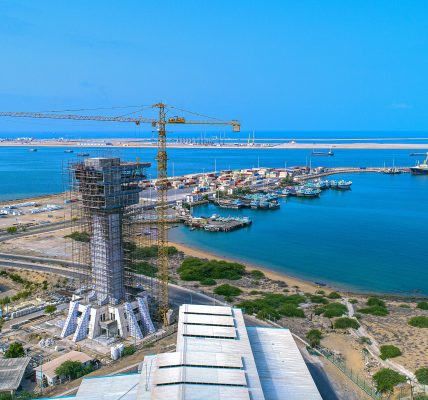
Oman’s geographic position—bridging the Arabian Sea, the Gulf of Oman, and the approaches to the Strait of Hormuz, one of the world’s most consequential energy chokepoints—confers structural strategic significance. Yet Muscat’s foreign policy tradition has consistently emphasised restraint, mediation, and openness, aligning closely with India’s preference for stability, inclusivity, and rule-based maritime order.
The reaffirmation of the India–Oman Joint Maritime Vision during the 2025 visit reflects this shared orientation. By prioritising maritime domain awareness, port connectivity, naval exchanges, and capacity-building across the Indian Ocean Region, both states have advanced a cooperative approach that strengthens resilience while preserving the ocean as a space of economic circulation and collective security.
This maritime logic also informs India’s wider engagement with West Asia and the Arab Gulf, which has evolved from energy dependence into a multidimensional framework encompassing trade, investment, technology, security cooperation, and diaspora welfare. Within this continuum, Oman occupies a distinctive position.
Unlike more conspicuous regional actors, Oman contributes to regional stability through quiet diplomacy, institutional continuity, and strategic moderation. For India, this makes Oman a natural partner in sustaining equilibrium across a region vital to global energy flows, maritime commerce, and the livelihoods of millions of Indian nationals. Oman’s role as a connector state—linking the Gulf with the Indian Ocean and East Africa—has been further underscored within the broader arc of India’s recent West Asia engagements, extending from Jordan to the Horn of Africa, where economic connectivity and supply-chain resilience form a coherent strategic thread.
It is within this stabilising framework that the Comprehensive Economic Partnership Agreement (CEPA) assumes particular significance. Signed during the visit, CEPA represents a decisive step in translating historical familiarity into institutionalised economic partnership. It moves bilateral engagement beyond hydrocarbons toward a diversified economic architecture encompassing pharmaceuticals, information technology, food security, logistics, manufacturing, and green energy, complemented by targeted MoUs on agriculture, education, and maritime heritage.
The Joint Statement accompanying CEPA lends measurable substance to this shift. The agreement provides zero-duty access for 99 percent of Indian exports, including textiles, pharmaceuticals, and engineering goods, and sets an explicit trajectory to double bilateral trade to USD 20 billion by 2030. In this sense, CEPA embeds economic confidence through rules, predictability, and long-term orientation rather than transactional opportunism.
Economic and strategic cooperation, however, rests upon a deeper human foundation. India’s large and well-integrated community in Oman constitutes one of the most enduring pillars of bilateral relations. Indian professionals, workers, and entrepreneurs contribute across healthcare, education, engineering, logistics, and services, earning sustained social respect and institutional confidence.
Within the framework of soft-power realism, this diaspora functions as a strategic asset. Cultural familiarity, linguistic ease, and professional reliability amplify India’s material capabilities by reducing transaction costs and deepening trust. Prime Minister Modi’s engagement with the Indian community in Muscat reinforced a diplomacy rooted in dignity and belonging, strengthening people-to-people bonds while signalling India’s long-term commitment to its overseas citizens.
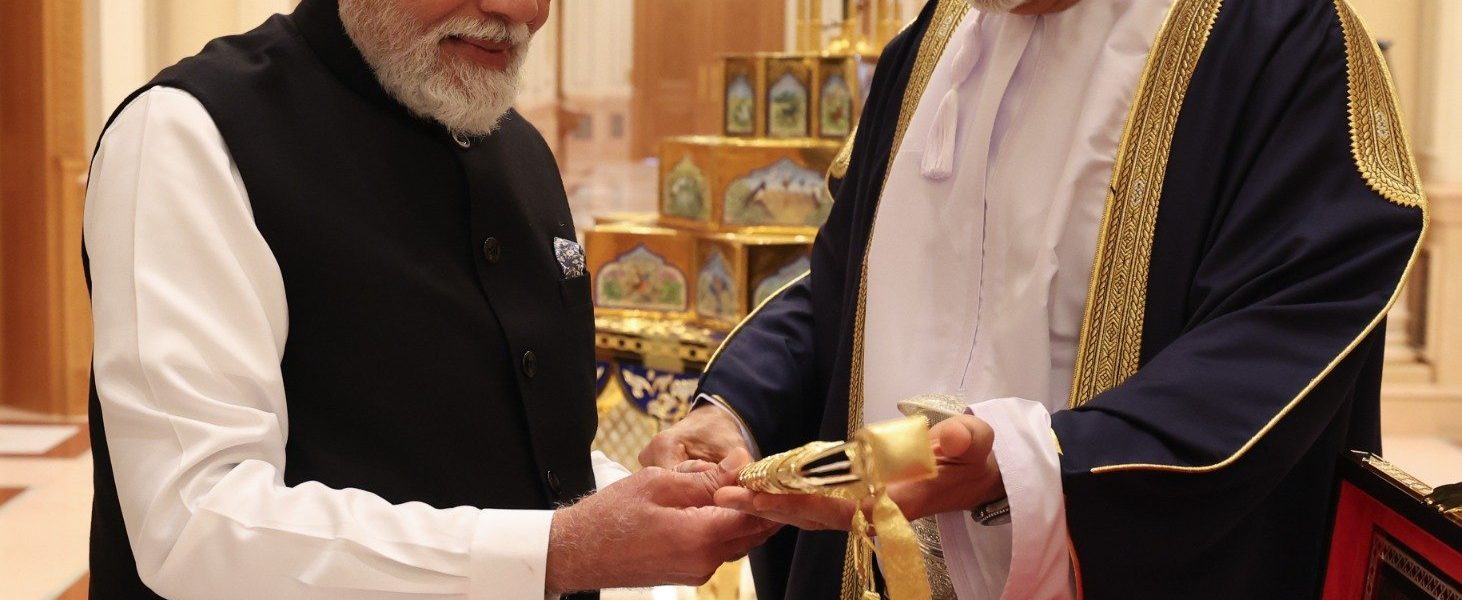
Diplomatic meaning, however, is conveyed not only through policies and populations but also through symbolism and recognition. Diplomatic practice operates through affect as much as through agreements. The warmth of Prime Minister Modi’s reception, the exchange of culturally resonant gifts, and the conferral of honours reflected a relationship characterised by mutual esteem and strategic comfort. The award of the First Class of the Order of Oman, the Sultanate’s highest civilian honour, underscored both the depth of regard and the maturity of the partnership.
Such gestures acquire analytical significance in a system where recognition often signals hierarchy or alignment. In the India–Oman context, they conveyed partnership without asymmetry and respect without expectation—an equilibrium well suited to a multipolar international order in which legitimacy increasingly derives from trust, continuity, and shared agency.
Taken together, these strands illuminate a model of international engagement grounded in continuity, moderation, and maritime connectivity. India–Oman relations demonstrate how civilisational memory can inform modern diplomacy, how oceans can unite rather than divide, and how economic and human ties can reinforce strategic stability.
Prime Minister Modi’s 2025 visit consolidated this model through institutional innovation—CEPA, expanded sectoral cooperation, maritime coordination, and diaspora engagement—while reaffirming a shared commitment to a stable and open Indian Ocean and a balanced West Asia. In an era of global transition, the India–Oman partnership stands as an example of quiet strength: diplomacy anchored in history, executed through institutions, and sustained by people—moving, like the monsoon, with steadiness, predictability, and enduring force.
Views: 1144

Dr. Maheep
Dr. Maheep is Director, Indian Perspective on Global Affairs (IPGA), and a leading analyst of India’s foreign policy and South Asian geopolitics. He earned his PhD in Arab and Islamic Studies. With more than a decade of teaching and research experience in International Relations and Global Politics, he contributes regularly on issues shaping national and global affairs.