


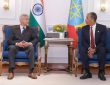



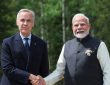

The leaders of the world’s richest democracies gathered from 15 to 17 June 2026 at the G7 Summit in Évian-les-Bains, on the French shores of Lake Geneva, to demonstrate that they still governed the world. Instead, they revealed that they no longer could. Behind the fortified perimeter at Évian, amid the choreographed unanimity of the family photograph, sat an order rehearsing the gestures of authority it had ceased to possess. A war in Europe ground on, sustained by an American patron whose leadership had publicly questioned the costs and durability of that commitment. A war in West Asia had only just been suspended by a memorandum whose ink was scarcely dry. The contest over artificial intelligence, critical minerals, and the future architecture of global trade animated every session, and behind each of these anxieties stood the same uninvited power, deliberated in its absence, shaping the agenda it declined to attend. Évian was not a summit. It was a séance, the industrial democracies communing with the spirit of a primacy that had already departed.
To read the gathering as merely another annual ritual of the Group of Seven is to miss its significance entirely. Évian marked an inflection in the long transformation of global governance, the moment at which the management of the international system passed, quietly and without acknowledgement, from the gift of the West to the cooperation of those it once presumed to instruct. And no presence illuminated that passage more sharply than the one seated among the invited rather than the enthroned. India arrived at Évian neither as supplicant nor as member, but as the indispensable guest whose absence would have emptied the proceedings of their claim to speak for the world. The question that should occupy us is not whether India belongs to the G7 or to its rivals. It is how India, belonging fully to neither, has come to reshape them both.
Why Évian Mattered
What distinguished this summit from its predecessors was the visibility of the contradiction it could no longer conceal. On Ukraine the leaders affirmed unwavering support in language of maximal resolve, while the keystone of that resolve, the United States, reserved the right to withdraw it at the convenience of a single man’s disposition. The alliance held in prose and frayed in conviction, and every state present understood that a coalition is only as durable as the commitment of its indispensable member. On West Asia the assembled democracies welcomed an American understanding with Iran as though a memorandum were a settlement, applauding the appearance of peace while its substance remained undefined and its guarantor disinclined to bind himself. They affirmed the freedom of the Strait of Hormuz days after an American strike had killed Indian seafarers in those very waters, and the gap between the abstraction of maritime security and the corpses of Global South sailors framed, with brutal economy, the moral arithmetic of the order on display.
The economic file disclosed the deepest fracture. France had organised its presidency around the correction of global imbalances, a diagnosis that named China’s overproduction, America’s overconsumption, and Europe’s underinvestment as the disorders of the age. Yet the remedy it sought, a common front on critical minerals to escape Beijing’s command of the supply chain, exposed the absence of the very unity it proclaimed. Washington pressed a pricing mechanism its allies received with scepticism; Japan, France, and Canada explored alternatives to an American-led minerals bloc; and the statement France extracted announced a direction without the substance of a strategy. Here was the condition of the contemporary West in miniature: lucid about its dependence, incapable of its remedy, fluent in the language of resilience and barren of the means to construct it. The recognition of vulnerability had outrun the capacity for collective action, and economic security had become an aspiration more readily declared than built.
India as the Pivot of a Multipolar Age
India came to Évian for the thirteenth time, its prime minister attending his seventh consecutive summit, and the easy interpretation cast this as the courtship of a rising power eager for admission to the high table. The interpretation inverts the truth. The industrial democracies did not summon India to confer a favour; they summoned it because their agenda, on supply chains, on development, on the diversification of energy and minerals away from a single supplier, could not advance without the markets, the manpower, and above all the legitimacy that India alone among the invited could supply. The West needs India more than India needs the West, and the asymmetry, once unspeakable, has become the organising fact of the relationship.
India’s conduct at the summit demonstrated a diplomatic grammar that the Western vocabulary struggles to name. When the Indian prime minister rose to insist that the sea lanes remain safe and the seafarer protected, he transmuted a national grievance, the killing of Indian sailors, into a universal principle that no leader present could disown, raising it to the face of the responsible power without either swallowing it in deference or brandishing it in confrontation. When he displaced the language of development assistance with that of solidarity among equals, he subverted the donor-recipient hierarchy the G7’s own declarations preserved beneath their reformed vocabulary. And when he asked of growth the question the summit dared not, growth for whom, and in what direction, he turned the metric around which the entire gathering was organised into an indictment of the distribution it concealed. India’s initiatives, the solar alliance, the coalition for disaster-resilient infrastructure, the biofuel partnership, the lifestyle-for-environment movement, were offered not as the petitions of a developing state but as the contributions of a power that generates frameworks rather than receiving them. This was the assertion, within the chambers of the West, that the Global South possesses goods to give and not merely needs to be met.
The intellectual foundation of this conduct lies not in the seminar rooms of the West but in a tradition of statecraft older than the Westphalian order by two millennia. The circle of states that Kautilya mapped in the Arthashastra, in which alignment follows from position rather than sentiment and a sovereign secures his interests by the precision of his placement amid rival powers, anticipates by twenty-three centuries the conduct that contemporary analysts, reaching for an imported lexicon, are obliged to call multi-alignment. India’s refusal to choose is not the absence of principle. It is the presence of a sophisticated one, the recognition that autonomy is purchased through the multiplication of relationships rather than their surrender to a single patron.
The Hollowing of Western Authority
The industrial democracies arrived at Évian as the custodians of an order whose legitimacy they have spent two decades squandering, and a clear-eyed accounting of that squander is owed. The grouping speaks for under a tenth of humanity and a declining share of world production, yet presides over an institutional architecture, the Security Council, the weighted ballots of the Bretton Woods bodies, that codifies the distribution of power as it stood in 1945 and has refused, through every decade since, to reflect the world as it has become. This is not oversight. It is the deliberate preservation of privilege by those who designed the rules to favour themselves and have declined every invitation to amend them.
The charge that wounds most is hypocrisy, and it must be stated without euphemism because the West has earned it. The same powers that invoke sovereignty and territorial integrity in Ukraine have violated both wherever their interests commanded, from Iraq to Libya, and have extended to the dead of the Global South a fraction of the solicitude they reserve for their own. The same governments that denounce the weaponisation of trade by their rivals have made coercion an instrument of routine statecraft, wielding the dollar’s dominion as a weapon, compelling third states to honour embargoes they never endorsed on pain of exclusion from the financial system, and dressing economic warfare in the vocabulary of rules. The same democracies that proclaim a rules-based order apply its rules by the identity of the actor rather than the nature of the act, so that the permissible and the criminal are distinguished not by what is done but by who does it. The climate finance promised across a succession of summits remains substantially undelivered, the burden of a crisis the West created shifted onto those who did least to cause it. The architecture of artificial-intelligence governance is arranged so that the rules of the most consequential technology of the age will be written where it is built, in a handful of Western jurisdictions, for the world to receive. This is not the leadership of a society of states. It is the management of a hierarchy by its beneficiaries, and the world beyond the West has ceased to mistake the one for the other.
Fairness requires the rejoinder, for the alternative architectures on offer, ordered by powers indifferent to even the pretence of restraint, would serve the weak no better and quite possibly worse. The West remains a principal source of development finance, of humanitarian relief, of the public goods on which the international system still depends, and its very willingness to consult India and the others evidences an adaptive capacity its harshest critics underrate. But the rejoinder does not absolve the indictment. It merely establishes that the contest is not between virtue and vice but between competing hierarchies, and that the task before the rising powers is not to replace one domination with another but to compel the construction of an order in which domination is harder to exercise at all.
India Between the Clubs
Here lies the intellectual centre of the matter, for India has resolved the dilemma that paralyses lesser powers by refusing its terms. It does not choose between the G7 and the groupings conceived to counterbalance it. It shapes them simultaneously, and the simultaneity is not expedience but doctrine. India holds the presidency of BRICS, the forum through which the Global South presses its grievances against Western financial dominance, while accepting the outreach of the G7 that BRICS was built to balance. It anchors the Quad’s management of the Indo-Pacific alongside the United States and Japan, while sustaining through the Shanghai grouping its channels to Russia and to Central Asia that the West would prefer it abandon. It demonstrated in its 2023 stewardship of the G20 a capacity for global leadership that neither bloc could claim, presiding over the most genuinely representative forum the system affords.
The genius of this architecture is that no single membership constrains the others, and the sum confers a freedom of manoeuvre available to almost no other state. India is the swing power of the emerging order, courted by the West as insurance against a multipolarity it cannot prevent, valued within BRICS as a moderating counterweight to Chinese ambition, indispensable to the G20 as the bridge between the worlds. Its connectivity statecraft, expressed in the corridor it conceived to bind the Indian Ocean to the Mediterranean as an alternative to China’s organisation of Eurasian infrastructure, advances India’s centrality even as the project stalls upon the very frictions that shadow the wider order. This is not the incoherence that an anxious diplomacy would experience as it scattered its commitments. It is the considered practice of a power that has understood, earlier and more deeply than most, that a world of multiplying institutions rewards the state that belongs to many and is captive to none.
The Political Economy of the New Disorder
Beneath the geopolitics, Évian was a summit about political economy, and the vocabulary of that economy has migrated wholesale from the language of efficiency to the language of security. Where an earlier age spoke of comparative advantage and the gains from openness, the present speaks of friend-shoring and de-risking, of supply-chain resilience and economic coercion, of export controls and the denial of critical technologies, of industrial policy pursued as an instrument of statecraft. The discussion at Évian of escaping dependence on a dominant supplier of minerals, of diversifying energy away from a vulnerable strait, of rebalancing trade against what the French presidency termed predatory competition, belonged entirely to this securitised idiom. Geoeconomics has displaced liberal economics as the organising logic of the industrial democracies, and the displacement is the confession that the premise on which their order was built, the separation of commerce from strategy, has collapsed.
The American turn has sharpened every fracture. Tariffs imposed upon allies and partners alike, a minerals strategy that divides the Western camp it was meant to unify, a posture that subordinates the collective order to the national interest narrowly construed, have left the hegemon that built the open system hedging its own creation, and its partners quietly diversifying against the patron they can no longer assume. For India this disarray is opportunity. A West that competes within itself for the markets and supply chains of the emerging world must bid for India’s cooperation rather than command it, and the growing convergence of Indian and Western interests in reducing dependence on China coexists with India’s determination to set the terms of its own participation, a determination enforceable precisely because the participation is required. The resentment of secondary sanctions and the aspiration toward de-dollarisation, which BRICS deliberates and the depth of American capital markets defers, position India to press for reform of a coercive financial order while declining the maximalist projects that would merely substitute Chinese leadership for Western. The autonomy cuts both ways, against Western coercion and intra-BRICS subordination alike.
The Meaning of Modi’s Bilateral Diplomacy
The bilateral encounters at Évian acquired their meaning from the strain that framed them, and none more than the meeting with the American president, the first in some sixteen months between leaders whose states have spent two decades describing themselves as natural partners. The estrangement had concrete causes, punitive tariffs, the president’s claims regarding the de-escalation of India’s clash with Pakistan, the killing of Indian sailors days before, and the encounter neither erased the friction nor surrendered to it. India entered holding the BRICS gavel, sustaining its Russian energy purchases against Western preference, cultivating its partnerships across Europe and the Gulf, and from that multiplicity of options it could register grievance, advance its trade interests, and decline alignment where alignment did not serve it. A power locked into dependence upon Washington would have entered with its grievances muted; India entered with leverage, and the difference is the whole substance of strategic autonomy.
The European engagements displayed the constructive face of the same doctrine. India’s meetings with Berlin, with London, and with the Commission advanced a relationship whose logic has become complementary to India’s design, a West that does not pass through Washington, a hedge against the volatility of the American connection, a demonstration that India’s partnerships with the industrial democracies are plural and therefore proof against any single ultimatum. The long-negotiated trade agreement with the European Union, the cooperation in clean energy, the deepening of defence-industrial collaboration, each furnished the diversification that autonomy requires. The triangulation of Britain, Germany, and Brussels against the friction with Washington was not opportunism but architecture, the cultivation of options that ensures no partner commands India by the threat of its own withdrawal.
India’s Vision, and Its Limits
Against the contradictions of the existing order India advances an alternative conception, and integrity requires that it be assessed without the romance that Indian self-description invites. The vision is reformist rather than revolutionary: the enlargement of the Security Council and the recalibration of the Bretton Woods bodies to reflect the present rather than 1945; the recasting of development from transaction into solidarity; the measurement of growth by its human dividend rather than its aggregate magnitude; equity in the great transitions of climate, of technology, of the digital economy; and, beneath these, the civilisational claim of the world as one family that India offers as an alternative grammar of order grounded in kinship rather than fear.
Yet the vision exceeds, for now, the means to realise it, and the candour that distinguishes analysis from advocacy demands the acknowledgement. India’s maritime doctrine, expansive in its ambition to make India the indispensable security provider of a vast oceanic expanse, remains deliberately nebulous, light on specific commitment, its very vagueness a strategic asset that preserves optionality at the price of substance. India’s capacity lags its articulated purpose; it trades in the currencies of legitimacy and position while it accumulates the harder currencies of capability. Its claim to speak for the Global South coexists with its pursuit of a national interest that will not always align with the South’s, and its advocacy of reformed multilateralism coexists with its participation in the privileges of the order it would reform. India is not the disinterested tribune of the developing world. It is a great power in the making, advancing its own ascent in the idiom of universal good, and the idiom is the more persuasive for being, in significant measure, sincere. The contradiction is not a flaw to be concealed but the ordinary condition of a rising power, and India bears it more gracefully than most.
The View Beyond Évian
What, then, did Évian reveal of the order to come? It revealed an institution that retains the forms of consensus while losing their substance, a directorate that can still draft declarations but can no longer write the rules alone. The Group of Seven may yet endure, but only by completing the transformation it has reluctantly begun, from a club that confers privilege into a forum that brokers cooperation, from the consultation of the periphery into the enfranchisement of new centres of power. It consults India while declining to enfranchise it, borrows the legitimacy of the Global South while withholding its authority, and whether it completes the transformation or clings to the privilege will determine whether it survives as a steward of the order or dwindles into a museum of the order that was.
Whether the rising powers can reshape the institutions of the system remains the open question of the age, and the honest answer is that they have so far proved more capable of contesting the old architecture than of constructing a new one. BRICS can articulate grievance more readily than it can build alternatives; the aspiration to de-dollarise outpaces the instruments to achieve it; the Global South’s solidarity fractures along the seams of its members’ divergent interests. The order is more easily unsettled than replaced, and the interval between the two is the dangerous and protracted present in which we are condemned to live.
And so the decisive role falls to the powers that can move between the worlds without belonging wholly to any, and India has theorised that role furthest and practises it most consistently. It will not be the architect of the coming order, for no single state will be. It will be its indispensable broker, the bridge across which a fragmenting system negotiates the terms of its own succession, courted by all because captive to none. The West convened at Évian to prove that it still governed the world and demonstrated instead that it must now persuade it. The future will belong neither to the clubs of the past nor to the blocs assembled against them, but to the states supple enough to engage them all at once, and patient enough to wait while the old order learns, by the slow tuition of its own decline, that the world it once commanded has resolved at last to govern itself. India sat at Évian among the invited rather than the enthroned, and it understood, as the enthroned did not, that the throne had already become the lesser seat.g/
Views: 1206

Dr. Maheep
Dr. Maheep is Director, Indian Perspective on Global Affairs (IPGA), and a leading analyst of India’s foreign policy and South Asian geopolitics. He earned his PhD in Arab and Islamic Studies. With more than a decade of teaching and research experience in International Relations and Global Politics, he contributes regularly on issues shaping national and global affairs.