


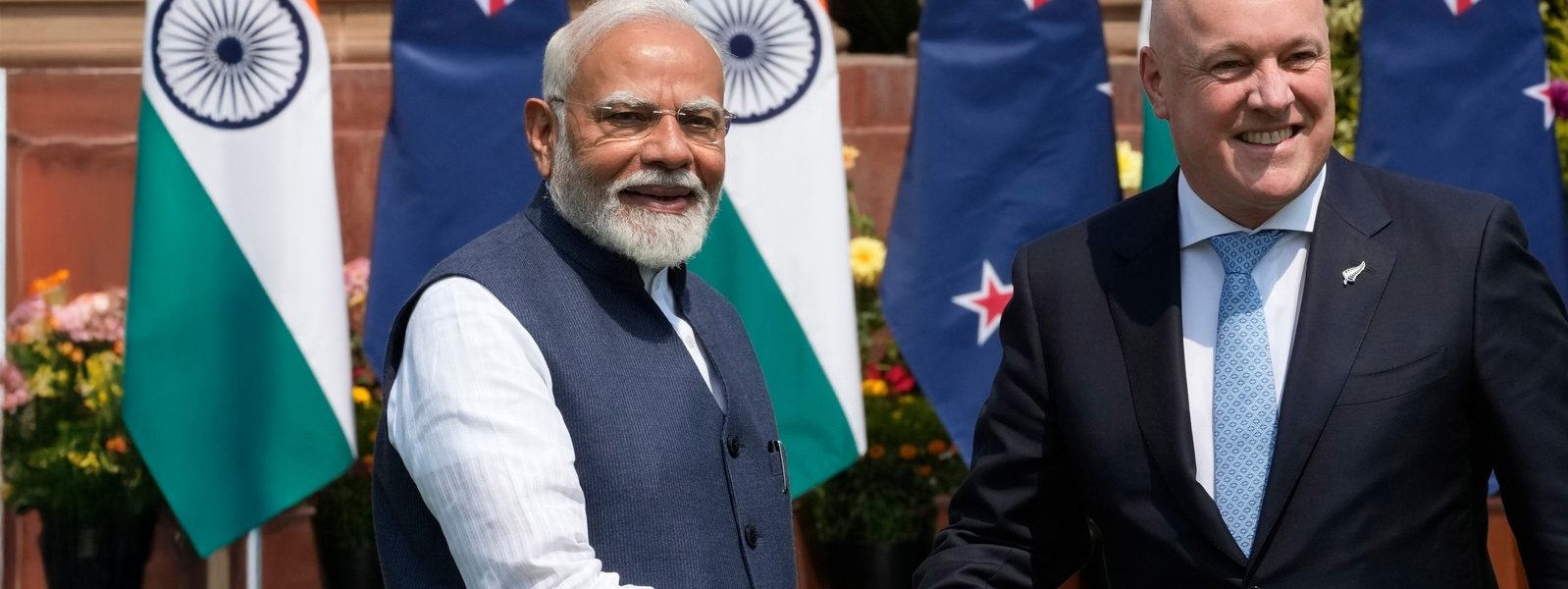







In the contemporary international system, defined by tariff weaponisation, supply-chain securitisation, and the steady erosion of multilateral trade consensus, the India-New Zealand Free Trade Agreement (FTA) concluded on 22 December 2025 must be read as an exercise in strategic political economy, not commercial arithmetic. The agreement emerged amid intensifying geoeconomic competition: prospective tariff escalation by advanced economies, sharpening Sino-Pacific assertiveness, and a broader drift toward selective, interest-driven alignments. Against this backdrop, New Delhi’s compact with Wellington represents a deliberate recalibration of India’s foreign economic policy, one that privileges resilient interdependence over exposure, and minilateral trust over multilateral illusion. For India, the FTA is neither opportunistic nor episodic. It reflects a doctrinal maturation in which trade policy has become a core instrument of foreign policy, national security, and strategic autonomy. For New Zealand, the agreement offers parallel gains: diversification away from excessive market concentration, secure access to a 1.4-billion-consumer Indian market, and deeper anchoring within an Indo-Pacific order no longer centred on a single pole. The convergence is therefore structural, not transactional.
India’s trade diplomacy today reflects hard-won lessons. The post-RCEP turn away from mega-regionals did not signal retreat from globalization but a re-engineering of engagement on terms compatible with domestic political economy and external strategy. The India-New Zealand FTA exemplifies this recalibration. It revives a relationship long characterised by political goodwill but modest economic depth, transforming it into a high-trust bilateral corridor suited to an age of fragmented globalization. Historically, India–New Zealand trade hovered below USD 1 billion for much of the early 2010s. Bilateral trade stood at USD 855 million in 2015, crossed USD 1.3 billion by 2020, and reached approximately USD 2.4 billion (goods and services) by 2024. The 2009 Joint Study Group had projected potential trade expansion of USD 4–5 billion, but progress stalled amid disagreements over agriculture, dairy safeguards, intellectual property, and services mobility. What changed by 2025 was not merely political will, but context: India’s enhanced bargaining capacity, New Zealand’s strategic imperative to reduce overdependence on a narrow set of export markets, and a shared interest in insulating economic relations from great-power turbulence. The unusually rapid nine-month negotiation cycle reflects this alignment of incentives.
The agreement sits at the intersection of complex interdependence and realist hedging. Economic ties are treated as stabilising forces that raise the costs of disruption, yet they are deliberately structured to avoid asymmetric dependence. This logic mirrors India’s broader strategic posture in the Indo-Pacific: balancing without bandwagoning, integrating without aligning. For India, diversification toward Oceania mitigates exposure to unilateral tariff action elsewhere and strengthens its bargaining position in future negotiations. For New Zealand, deeper integration with India provides strategic ballast against over-concentration in any single market and embeds Wellington more securely within a plural Indo-Pacific economic architecture. Relative gains are thus mutually reinforcing: India secures scale and resilience; New Zealand secures growth, predictability, and strategic relevance.
The FTA’s design reflects India’s evolved negotiating doctrine. New Zealand’s commitment to zero-duty access for 100 per cent of Indian tariff lines delivers immediate gains for labour-intensive and MSME-driven sectors—textiles, garments, leather, engineering goods, pharmaceuticals, chemicals, and processed foods. In 2024 alone, Indian exports to New Zealand in pharmaceuticals (approximately USD 300 million) and textiles and apparel (around USD 100 million) faced tariffs of up to 10 per cent; their elimination is projected to generate a 15–20 per cent export expansion over the medium term. India’s own market opening covers around 70 per cent of tariff lines, accounting for nearly 95 per cent of trade value, with phased liberalisation over three to ten years for sensitive categories such as wines, machinery, and select agri-products. Critical sectors, most notably dairy, are protected through tariff-rate quotas and safeguard mechanisms, preserving domestic cooperatives while permitting limited, non-disruptive access. For New Zealand, even calibrated access matters: India is already among the world’s largest food markets, and niche exports viz. horticulture, wool, forestry products, and value-added agri-foods stand to benefit from predictable entry and scale effects. The relative gain for Wellington lies not merely in volumes but in durable market embeddedness.
The agreement’s strategic depth lies in services and mobility. India has secured commitments across over 115 services sub-sectors, including IT, professional services, education, telecom, logistics, and financial services, with most-favoured-nation clauses that automatically extend future liberalisation. Services trade, currently estimated at USD 700–800 million, is projected to cross USD 1.5 billion by 2030. Mobility provisions institutionalise circular human-capital flows, including 5,000 temporary employment entry visas annually for Indian professionals in IT, healthcare, AYUSH, and allied services; expanded post-study work pathways of up to three to four years for STEM graduates; and working-holiday arrangements. For New Zealand, these provisions address persistent skill shortages and bolster productivity; for India, they convert outward mobility into a strategic asset rather than a zero-sum loss. The 250,000-strong Indian diaspora in New Zealand, remitting nearly USD 1 billion annually, thus becomes a durable strategic constituency embedded in the bilateral relationship.
The FTA’s investment chapter anchors the relationship in long-term commitment. New Zealand has signalled USD 20 billion in cumulative investment over fifteen years, targeting manufacturing, agritech, food processing, infrastructure, renewables, and services. A dedicated India-New Zealand investment facilitation mechanism, along with review and consultation clauses, is designed to ensure transparency and delivery. For India, these inflows support value-chain upgrading and supply-chain diversification at a time when nearly 30 per cent of certain electronics and intermediate imports remain concentrated in a single geography. For New Zealand investors, India offers scale, demographic momentum, and policy predictability. Economic resilience, in this framework, becomes a shared security good rather than a unilateral hedge.
The FTA adopts a TRIPS-consistent but non-TRIPS-plus intellectual property framework. It avoids extended patent terms, data exclusivity, and pharmaceutical evergreening, safeguarding India’s USD 50-billion generics industry, while enhancing enforcement cooperation and transparency. A side letter commits New Zealand to amend domestic laws within eighteen months of entry into force to register Indian geographical indications beyond wines and spirits. This potentially enhances value capture for Indian exports worth approximately USD 500 million annually, spanning rice, tea, spices, and handicrafts, while providing regulatory clarity and certainty to New Zealand stakeholders.
Geopolitically, the FTA reinforces India’s Indo-Pacific vision, open, multipolar, and economically integrated rather than bloc-bound. While New Zealand is not a member of the Quadrilateral Security Dialogue (QUAD), the agreement complements the QUAD’s economic and normative agenda by strengthening supply-chain resilience, advancing clean-energy cooperation, and deepening human-capital connectivity, pillars echoed in the QUAD’s Supply Chain Resilience Initiative and Critical and Emerging Technologies Working Group. For India, the bilateral compact extends QUAD-adjacent norms into Oceania without formal alignment. For New Zealand, it offers proximity to QUAD-linked economic ecosystems while preserving strategic autonomy. The result is a convergent synergy in which economic integration reinforces regional stability without alliance rigidity.
The agreement also integrates trade with sustainability and energy security. Cooperation in renewables, green hydrogen, sustainable agriculture, and climate-aligned standards aligns with India’s target of 500 gigawatts of non-fossil capacity by 2030. An estimated USD 2 billion of the announced investment pipeline is earmarked for clean-energy and climate-smart projects, reinforcing energy diversification while supporting Paris-aligned commitments and enhancing long-term resilience for both economies.
Viewed from New Delhi, the India-New Zealand Free Trade Agreement is thus less about tariff schedules than about strategic positioning in a fractured order. It advances India’s core objectives: diversification without dependency, openness without vulnerability, and integration without subordination. For New Zealand, it secures durable access to a rising economic pole, underwrites export growth projected to reach USD 5 billion in bilateral trade by 2030, and embeds Wellington more firmly within Indo-Pacific economic architectures. In an era when trade has become an extension of power politics, the agreement exemplifies a distinctively Indian mode of economic statecraft, measured, selective, and strategically coherent, while delivering tangible relative gains for its partner. More broadly, it signals how India intends to navigate global fragmentation: not by retreating from globalization, but by reshaping it through resilient partnerships that stabilise interdependence and reinforce multipolar equilibrium.
Views: 1136

Dr. Maheep
Dr. Maheep is Director, Indian Perspective on Global Affairs (IPGA), and a leading analyst of India’s foreign policy and South Asian geopolitics. He earned his PhD in Arab and Islamic Studies. With more than a decade of teaching and research experience in International Relations and Global Politics, he contributes regularly on issues shaping national and global affairs.


