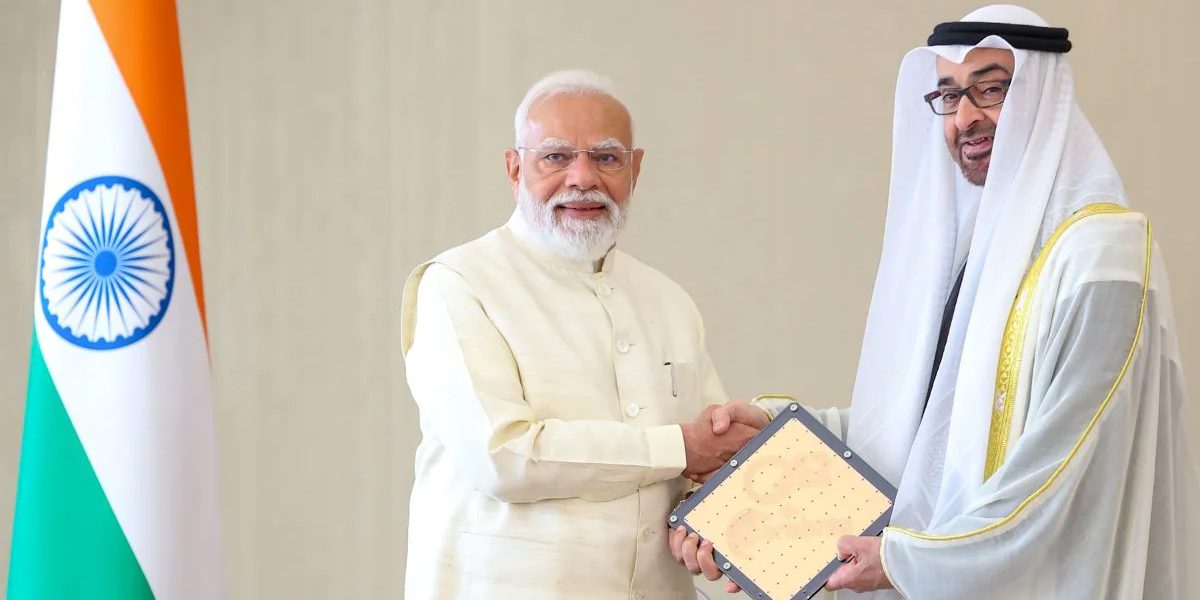







UAE Air Force fighters rose to receive Prime Minister Narendra Modi’s aircraft before it crossed into Emirati airspace on 15 May 2026, providing the kind of aerial escort that sovereign protocol reserves for leaders whose visits carry the full gravitational weight of strategic consequence. President Sheikh Mohamed bin Zayed Al Nahyan awaited him at the threshold of a summit that both capitals understood as a defining moment in the evolution of one of the most consequential bilateral partnerships in the emerging multipolar order. That Abu Dhabi stood as the inaugural destination of Modi’s five-nation diplomatic tour, encompassing the Netherlands, Sweden, Norway, and Italy, was itself a statement of strategic precedence, encoding New Delhi’s recognition that its most indispensable relationships now lie along the arc from the Indian Ocean to the Gulf.
The visit assumed singular significance as Modi’s first overseas engagement following the 2026 Gulf conflict, a regional conflagration whose aftermath continues to restructure the security architecture of West Asia. Its timing was purposeful; its outcomes, substantial. The agreements reached, spanning strategic defence, energy security, artificial intelligence, financial architecture, maritime industry, and digital connectivity, collectively reveal a partnership that has transcended the transactional logic of oil dependency and labour migration to become a genuinely multidimensional strategic ecosystem. This article analyses that transformation through a neoclassical realist framework, selectively enriched by constructivist insights where normative dimensions of the relationship demand interpretation beyond the calculus of material interest alone.
The central argument advanced here is that the India-UAE Comprehensive Strategic Partnership represents one of the most instructive examples of adaptive strategic convergence in the contemporary multipolar order, driven by techno-geoeconomic interdependence, calibrated hedging, maritime security imperatives, post-hydrocarbon energy transition, and the deepening reordering of West Asian geopolitics. It is a partnership that illuminates, with particular clarity, how leading powers of the Global South are constructing new forms of strategic architecture adequate to an era in which rigid alliance structures have yielded to flexible, issue-based coalitions and geoeconomic instruments increasingly determine the balance of influence.
Multipolarity, Strategic Autonomy, and the Logic of Flexible Alignment
The structural context animating the May 2026 summit is the accelerating transition from post-Cold War unipolarity toward a multipolar distribution of power in which no single state commands the combination of capabilities and political will sufficient to impose systemic governance. Both India and the UAE have responded to this transition with strategic intelligence: neither through subordination to any single pole, nor through reactive counter-alignment, but through the disciplined cultivation of multi-vector partnerships that preserve and expand their strategic autonomy.
India’s hedging posture is among the most architecturally sophisticated in contemporary international relations. New Delhi participates in BRICS, whose expanded membership now includes the UAE itself, signalling commitment to multipolar financial governance; simultaneously deepens its Quad engagement with Washington, Tokyo, and Canberra; maintains substantive defence cooperation with Moscow; and now accelerates its partnership with Abu Dhabi, which itself sustains robust economic ties with Beijing through Belt and Road infrastructure while hosting American military installations and enlarging its security cooperation with the United States. The UAE’s own multi-vector diplomacy is structurally analogous, as both states extract maximum leverage from multipolarity by positioning themselves as indispensable interlocutors across rival configurations rather than as clients of any singular patron.
Neoclassical realism, as developed by Gideon Rose and Steven Lobell, illuminates this behaviour with precision. Systemic pressures, including shifting power distributions, Gulf regional insecurity, China’s expanding connectivity footprint, and America’s recalibrated regional engagement, create powerful incentives for leading and middle powers to diversify their strategic relationships. Leadership perceptions mediate how those incentives translate into policy: the Modi-MBZ axis has demonstrated the capacity to convert structural opportunity into durable institutional architecture with a consistency that underscores the centrality of political agency within systemic constraint. The 2026 Gulf conflict, marked particularly by Iran’s coercive strikes on UAE territory, sharpened these calculations decisively, accelerating Abu Dhabi’s interest in supplementing its security relationships and positioning India, with its growing defence capabilities and civilisational familiarity, as an attractive partner whose engagements carry neither the political conditionality of Western alignments nor the dependency risks of Chinese infrastructure investment.
India’s approach to West Asia reflects the SAGAR vision, Security and Growth for All in the Region, first articulated by Modi in 2015 and progressively operationalised through sustained diplomatic investment. SAGAR frames India not as a net consumer of regional security but as a contributor to its architecture: a leading power whose interests in Gulf stability derive from structural economic interdependence and whose capabilities are increasingly adequate to sustaining a genuine stabilising role. The May 2026 summit gave concrete institutional form to this ambition.
The Gulf after Conflict: Regional Reordering and India’s Strategic Opportunity
The 2026 Gulf conflict constitutes a structural inflection point in West Asian geopolitics whose full implications will unfold across years rather than months. Its immediate consequences, comprising the disruption of maritime security frameworks, the repricing of regional risk by international capital, and the acceleration of Emirati interest in diversified security partnerships, have created a strategic environment in which India’s distinctive positioning carries particular value. New Delhi condemned the attacks on UAE territory with unambiguous clarity during the May summit; Modi’s explicit emphasis on the imperative of safe navigation through the Strait of Hormuz, through which approximately one-fifth of global oil trade transits, communicated a substantive Indian interest in Gulf maritime governance that transcends diplomatic convention.
Barry Buzan’s regional security complex framework offers a productive supplementary lens here. The security environments of South Asia and the Gulf have become sufficiently entangled, through energy flows, diaspora networks, maritime connectivity, and shared threat perceptions regarding non-state violence, to constitute a contiguous Indo-Gulf security complex in which instabilities in one subregion generate direct security consequences in the other. India’s investment in Gulf stability is accordingly not charitable multilateralism but rational strategic calculation: the security of energy supply routes, the welfare of 3.5 million Indian nationals residing in the UAE, and the integrity of financial remittance flows all create material stakes in Emirati resilience that make India’s stabilising engagement a function of enlightened self-interest.
India’s Operation Sindoor in 2025 and the subsequent conflict dynamics in the subcontinent, converging with Iran’s coercive adventurism in the Gulf, produced a parallel threat environment in which both states experienced the operational consequences of non-state violence and state-sponsored coercion simultaneously. This convergence of lived security experience, rather than merely rhetorical threat identification, generated a qualitative deepening of the partnership whose sincerity and durability cannot be reduced to performative diplomacy.
Energy Architecture, OPEC Recalibration, and the New Petroleum Compact
Few developments in the pre-summit period carry greater long-term significance than the UAE’s effective recalibration away from OPEC’s production governance framework. As Dr Maheep observed in European Times of 30 April 2026, this shift opens transformative new horizons for India-UAE energy synergy: it signals not disengagement from hydrocarbon markets but a transition toward autonomous energy statecraft liberated from cartel constraints, with consequences for global energy pricing that benefit consuming economies such as India considerably.
The energy security agreements signed during the May 2026 summit translate this realignment into concrete bilateral architecture. The Strategic Collaboration Agreement between ISPRL and ADNOC provides for Emirati crude storage in Indian strategic petroleum reserve facilities at Mangalore, Visakhapatnam, and Chandikhol, with combined capacity reaching up to 30 million barrels, alongside exploration of Indian strategic reserve storage at Fujairah. This constitutes a landmark arrangement of mutual advantage: India acquires emergency access to stored crude without bearing storage costs, while ADNOC secures market-access assurances in the world’s third-largest energy-consuming economy. Dr Sultan Al Jaber’s characterisation of India’s growth trajectory as one of the defining energy markets of the coming decades reflects a commercial judgement whose strategic implications, particularly the embedding of Emirati sovereign capital in Indian strategic infrastructure, are equally profound.
The Long-Term LPG Supply Agreement between IOCL and ADNOC addresses a dimension of Indian energy security whose domestic political sensitivity is acute, namely reliable cooking fuel supply for approximately 340 million households. Long-term supply assurance from a trusted Emirati partner reduces India’s vulnerability to spot market volatility and geopolitical disruption in alternative supply chains in ways whose socioeconomic value is difficult to overstate. The UAE’s parallel diversification into artificial intelligence, green hydrogen, logistics capitalism, and advanced manufacturing simultaneously creates entirely new arenas of techno-economic complementarity that reframe the partnership as a post-hydrocarbon strategic ecosystem rather than a simple oil-and-gas arrangement.
IMEC, Maritime Industry, and the Geopolitics of Connectivity
The India-Middle East-Europe Economic Corridor represents the most ambitious connectivity architecture to emerge from the Indo-Gulf relationship, and the UAE’s centrality within it is structural rather than incidental. Abu Dhabi and Dubai together constitute one of the world’s most sophisticated logistics, finance, and digital connectivity hubs: DP World’s global port network, Jebel Ali’s free zone ecosystem, and the UAE’s rapidly developing digital trade infrastructure position the Emirates as the indispensable pivot through which Indian goods, capital, and data flow toward European markets. The operationalisation of the Virtual Trade Corridor through the MAITRI platform, announced at the May 2026 summit, provides the digital architecture for customs interoperability and supply-chain transparency that transforms rhetorical connectivity into operational commercial reality.
IMEC is appropriately understood, within a geoeconomic frame, as a soft-balancing instrument against Chinese connectivity dominance through the Belt and Road Initiative. It constructs an alternative architecture that reduces the structural leverage Beijing derives from infrastructure investment, without seeking the economic costs of confrontation. For India, supply-chain resilience, that is the capacity to maintain access to critical goods, energy, and technology under conditions of geopolitical stress, constitutes a foundational strategic objective whose pursuit through corridor diplomacy reflects sophisticated adaptation to the demands of economic securitisation in the multipolar era.
The MoU on a Ship Repair Cluster at Vadinar in Gujarat adds a defence-industrial dimension to the maritime relationship whose significance extends beyond immediate commercial value. It positions India as a maritime industrial partner for Emirati naval and commercial fleets under the Make in India initiative, leveraging India’s engineering talent and coastal infrastructure to compete in a market whose strategic and commercial importance the 2026 conflict has significantly amplified. The Vadinar facility encodes India’s ambition to serve as a net maritime security provider across the Indian Ocean region: a leading power whose SAGAR vision finds concrete industrial expression in Gulf partnership.
Technological Frontier: AI Diplomacy and Digital Sovereignty
The 8 Exaflop Super Compute Cluster term sheet between CDAC and G-42, Abu Dhabi’s leading artificial intelligence conglomerate, stands as perhaps the most forward-looking agreement produced by the May 2026 summit. Its significance lies not merely in its computational scale but in what it represents: the deliberate deployment of AI cooperation as an instrument of strategic relationship-building, a phenomenon that may be characterised as AI diplomacy and one of the defining features of geoeconomic competition in the emerging multipolar era. G-42 brings sovereign capital and sophisticated AI infrastructure capacity; CDAC brings India’s engineering talent and access to the diverse data environments that AI training at scale demands. The combination generates a complementary architecture whose strategic value exceeds any transactional assessment.
India’s digital public infrastructure, encompassing Aadhaar, the Unified Payments Interface, and DigiLocker, constitutes a portfolio of proven large-scale technology systems that offer transferable governance models for UAE digital ambitions, while Emirati sovereign wealth capital provides the financial infrastructure to scale Indian technological capacity in ways that more restrictive partnerships might not readily permit. The rupee-dirham settlement mechanism, progressively institutionalised through bilateral financial arrangements, embodies both states’ shared interest in financial multipolarity: the capacity to conduct bilateral trade without mandatory intermediation through dollar-denominated systems constitutes a hedge against the financial statecraft that dollar payment infrastructure can facilitate under adversarial conditions. Keohane and Nye’s complex interdependence framework illuminates the networked dimension of this architecture, as mutual dependencies across financial, technological, and commercial systems raise the costs of adversarial behaviour for both parties by embedding their prosperity in shared infrastructure whose disruption imposes symmetrical losses.
The USD 5 billion UAE investment commitment, comprising USD 3 billion by Emirates NBD into RBL Bank, USD 1 billion by ADIA through the National Infrastructure and Investment Fund, and USD 1 billion by IHC into Sammaan Capital, reflects sophisticated long-term positioning in India’s financial services, infrastructure, and housing markets. Building upon cumulative UAE FDI flows approximating USD 25.3 billion as of early 2026, these investments align Emirati sovereign capital with the sectors generating the most sustained returns as India realises its demographic dividend through the 2030s. CEPA’s progressive liberalisation architecture, and the bilateral trade elevation it has sustained with the UAE consolidating its position as India’s third-largest trading partner, provides the institutional scaffolding upon which this investment architecture rests.
Indo-Abrahamic Strategic Framework
The Framework Agreement on Strategic Defence Partnership, signed between the defence ministries of both nations, exchanged by Lieutenant General Ibrahim Nasser Al Alawi and Foreign Secretary Vikram Misri, and witnessed by both leaders, formalises a security relationship whose depth has been forged through years of shared threat experience and sustained institutional investment. Its provisions encompass defence industrial collaboration, joint innovation, maritime security, cyber defence, counter-terrorism architecture, and intelligence sharing within a single coherent institutional framework that gives the partnership operational substance alongside its diplomatic architecture.
India’s Akash surface-to-air missile system, BrahMos supersonic cruise missiles, and the Light Combat Aircraft Tejas collectively represent a defence industrial portfolio whose competitive pricing and freedom from political conditionality make Indian platforms increasingly attractive to Gulf procurement authorities. This is a development whose regional signalling value for India’s Make in India initiative extends well beyond the bilateral dimension. Joint exercises, Desert Eagle in the air domain and Gulf Star in the naval domain, continue building the interoperability that translates institutional frameworks into genuine operational capability.
The broader Indo-Abrahamic strategic architecture, encompassing India, the UAE, Saudi Arabia, Israel, and the I2U2 minilateral framework, represents a genuinely significant structural development in West Asian geopolitics. I2U2 provides embryonic institutional infrastructure for issue-specific cooperation in food security, clean energy, and technology that may, under favourable political conditions, evolve into a more consequential minilateral architecture linking Indian technological capacity, Emirati financial capital, Israeli innovation, and American strategic assurance. India’s positioning within this framework, as a civilisational actor perceived as a non-hegemonic development partner capable of maintaining equilibrium across rival geopolitical configurations, constitutes a structural advantage that no other aspirant to regional influence currently replicates.
The constructivist dimension of the partnership warrants analytical acknowledgement. The 3.5 million-strong Indian diaspora in the UAE constitutes a form of soft power and societal connectivity whose importance for bilateral resilience exceeds its remittance flows considerably. The UAE’s tolerance framework, institutionalised through the Abrahamic Family House and the broader moderation architecture that Abu Dhabi promotes as an alternative to Islamist extremism, resonates with Indian political preferences in ways that generate genuine normative convergence. The inauguration of the BAPS Hindu temple in Abu Dhabi in February 2024 symbolised a relationship in which both states have invested political capital in demonstrating that civilisational diversity and strategic partnership are mutually reinforcing rather than mutually exclusive; a proposition whose normative significance sustains domestic support for the relationship in both societies and expands the political feasibility space within which leaders can deepen their engagement.
Conclusion
The May 2026 summit between Narendra Modi and Sheikh Mohamed bin Zayed Al Nahyan will be assessed by historians of international relations as a landmark in the progressive construction of a strategic partnership commensurate with the demands of the multipolar era. Its outcomes, spanning energy security, defence cooperation, artificial intelligence, financial architecture, maritime industry, and digital connectivity, constitute a portfolio of agreements whose strategic coherence is more consequential than any individual item, embodying the maturation of a relationship that has traversed, within a single decade, the distance from transactional bilateralism to multidimensional strategic architecture.
The India-UAE partnership illuminates, with unusual clarity, the distinctive form that strategic convergence takes in a world where rigid alliances have yielded to flexible multi-vector diplomacy and techno-geoeconomic instruments increasingly determine the balance of influence. Both states have leveraged multipolarity rather than been victimised by it, transforming the pressures of great-power competition, Gulf regional insecurity, and post-hydrocarbon transition into opportunities for deepened mutual partnership. India emerges from the 2026 Gulf conflict not diminished but enlarged in its strategic utility to a region whose stability is directly consequential for Indian economic welfare and geopolitical ambition alike.
The broader implications of this convergence extend across every dimension of the emerging international order. For Gulf security governance, India’s deepening engagement introduces a welcome pluralism into an architecture historically dependent on American assurance alone, providing the region with a development partner whose economic scale, technological sophistication, and civilisational familiarity generate a distinctive and durable form of strategic value. For Eurasian connectivity, IMEC’s progressive institutionalisation offers an alternative geoeconomic architecture whose success reduces overdependence on any single power’s infrastructure investment. For the Indo-Pacific, the India-UAE axis serves as a western anchor for a broader strategic framework linking South Asia, the Gulf, and the Indian Ocean into a coherent regional order capable of managing great-power competition without catastrophic bifurcation.
Measured against the ambition of its design, the sophistication of its economic architecture, the depth of strategic trust its leaders have cultivated, and its contribution to the stabilisation of a region whose volatility carries global consequences, the India-UAE Comprehensive Strategic Partnership stands as one of the most consequential bilateral relationships of the emerging multipolar order. The aerial escort of 15 May 2026 remains its most eloquent symbol: two sovereign states, bound by calculation and conviction alike, rising together toward an uncertain horizon with the confidence of partners who have earned, through years of patient statecraft, the right to shape it.
Views: 1243

Dr. Maheep
Dr. Maheep is Director, Indian Perspective on Global Affairs (IPGA), and a leading analyst of India’s foreign policy and South Asian geopolitics. He earned his PhD in Arab and Islamic Studies. With more than a decade of teaching and research experience in International Relations and Global Politics, he contributes regularly on issues shaping national and global affairs.