






An Indian strategic reading of the Saudi Arabia–Pakistan–Türkiye Joint Defence Agreement
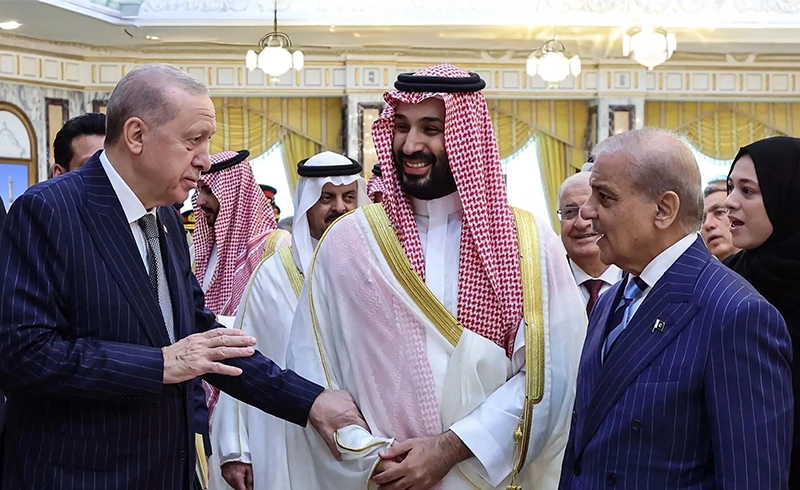
On 7 August 2026, in the sacred precinct of Makkah, Saudi Crown Prince and Prime Minister Mohammed bin Salman, Türkiye’s President Recep Tayyip Erdoğan and Pakistan’s Prime Minister Shehbaz Sharif affixed their signatures to the Makkah Joint Defence Agreement. The operative clause reads with deliberate gravity: an armed attack against any one of the three shall be regarded as an attack against them all. The staging was calculated to the last detail, the holy city summoned as backdrop, the Friday congregation enlisted as witness, the vocabulary of faith draped over an instrument of hard strategic bargaining. Commentators reached at once for the grandest available label and called it an emerging “Arab NATO,” a Sunni collective-defence architecture born to fill the vacuum left by a receding American guarantor.
The label flatters the arrangement and obscures its substance. Read from New Delhi, through the disciplined lens of strategic studies rather than the fog of headline diplomacy, the Makkah compact reveals something altogether more sobering for Islamabad. It marks Pakistan’s completed descent from autonomous security actor to militarised security subcontractor, a state whose only remaining export at scale is the organised coercive labour of its own citizens. This analysis builds upon a settled argument advanced across earlier essays in these pages: “The Pakistan-Saudi defence pact does not threaten India” of 28 September 2025, “Saudi Arabia-Pakistan security pact, an illusive mirage?” of 17 October 2025, “Rented Security, Revealed Fragility: The Arab Gulf States’ Strategic Reckoning” of 8 April 2026, and “Kuwait – Pakistan Defence Pact: A Question of Credibility” of 3 August 2026, together with the companion assessment “Strategic Patience, Quiet Power — India’s Enduring Gulf Equation.” The trilateral expansion of August 2026 confirms every proposition those pieces advanced. It deepens the asymmetry, magnifies Pakistan’s blunder, and exposes the strategic myopia of a praetorian establishment that has mistaken a mortgage for a monument.
The pact is a rental agreement, not an alliance
The foundational error in the alarmist reading is categorical. It treats a security-for-finance transaction as though it were a covenant among equals. Strip away the theology of the venue and a plain commercial truth remains: a state hollowed out by debt, fiscal haemorrhage and chronic developmental deficit has hung a price tag on its own army. Islamabad contributes manpower, combat experience and residual strategic capability. Riyadh contributes capital and patronage. The vocabulary of Islamic solidarity conceals a hierarchy of buyer and seller.
This is the logic of rentier militarism, and it is not new. As the October 2025 analysis established, Saudi Arabia has for decades practised a rentier-security doctrine, delegating hard-power functions to external actors while its own society remains insulated from the costs of combat. The Kingdom’s strategic comfort rests in outsourcing; Pakistan’s fragile treasury and its search for Gulf patronage drive it toward a subservience dressed as partnership. The outcome is profoundly one-sided. Pakistan commits blood; Saudi Arabia commits capital. The Makkah agreement does not transform this bargain. It codifies it, expands it to a third signatory, and gilds it with the symbolism of the holy city.
The theoretical vocabulary here matters, because precision defeats sentiment. What the three states have constructed is an architecture of asymmetric interdependence, a discursive scaffolding of dependency that legitimises subordination under the guise of faith. Saudi Arabia seeks maximum deterrence with minimum entanglement. Pakistan seeks maximum external rent and a borrowed relevance it can no longer generate from its own resources. The preferences are structurally divergent, and divergent preferences do not produce durable alliances. They produce contracts, and contracts lapse when the paying party finds a cheaper supplier or a better instrument.
Pakistan sells its young as cannon fodder
The gravest indictment is domestic, and it exposes the moral bankruptcy of the Pakistani state itself. A praetorian establishment that styles itself the guardian of national sovereignty now auctions that sovereignty by the battalion, treating its own citizens as inventory to be shipped abroad. Pakistan’s soldiers become the disposable collateral of a security architecture designed in other capitals to serve other interests. Young men will garrison Gulf installations and patrol foreign skies, conscripted into conflicts remote from their own borders, marched into other people’s wars to defend other people’s oil, reduced to cannon fodder for a paymaster who will mourn none of them.
This is the clearest confession of an anti-people state. A regime that starves its schools and hospitals while renting out its sons, that has no bread for its citizens yet finds soldiers to spare for hire, has inverted the first duty of any government. The military monetises national defence as export capital and prices the lives of the poor as the currency of the deal.
This is not conjecture. Earlier in 2026, under the bilateral Strategic Mutual Defence Agreement signed in Riyadh on 17 September 2025, Islamabad deployed roughly 8,000 troops, a squadron of some sixteen JF-17 fighters, two squadrons of drones and a Chinese-built HQ-9 air-defence system to the Kingdom. The equipment is operated by Pakistani personnel and financed by Saudi Arabia. Reports place the eventual ceiling far higher, with some assessments suggesting an expansion toward tens of thousands. The squadron arrived in early April 2026, at the height of the regional conflict, positioning Pakistani aircrew and air defences around Saudi Arabia’s Eastern Province oil infrastructure. The pattern is set and the trajectory points only one way: the garrison expands, the dependency deepens, and the young Pakistani becomes the Gulf’s rented rifleman.
Here lies the blunder in its full magnitude, a strategic self-mutilation dressed as diplomacy. A nation with the vision to invest in its people would have built factories, classrooms and hospitals. Pakistan’s generals, gripped by a myopia that mistakes mercenary contracts for grand strategy, have chosen instead to export the very generation that could have rebuilt the country. The opportunity cost is generational. Every rupee of strategic rent extracted from Riyadh substitutes for the economic reform Pakistan refuses to undertake, and every soldier stationed abroad is a citizen withdrawn from the productive rebuilding of a broken economy. Military diplomacy has become a substitute for statecraft. The citizen remains the ultimate financier and the ultimate casualty of a bargain he was never asked to ratify.
The treaty that failed its own test
The most damning evidence against the Makkah architecture comes from the mutual-defence clause tested against events. A treaty is measured by what it guarantees when its members face fire, and by that measure the Saudi–Pakistan understanding has already failed spectacularly.
Consider the Durand Line. Since early 2026, Pakistan and Afghanistan have plunged into what Islamabad’s own Defence Minister called “open war,” with Pakistani airstrikes on Kabul and Kandahar, Taliban claims of dozens of Pakistani soldiers killed in retaliatory operations, and a succession of Qatar- and Türkiye-mediated ceasefires in Doha and Istanbul that collapsed across three rounds. Pakistani soldiers have died in significant numbers along the 2,600-kilometre frontier. Throughout this sustained border warfare, Riyadh has remained conspicuously passive. No condemnation, no diplomatic intervention beyond a routine phone call, no logistical or intelligence assistance of consequence.
The lesson writes itself. If an act of aggression against Pakistan genuinely activated Saudi solidarity, Islamabad’s combat along the Durand Line should have summoned the Kingdom’s support. Instead, the Kingdom’s silence confirmed the truth established in the October 2025 analysis: Pakistan’s defence of Saudi Arabia is unilateral, while Saudi Arabia’s defence of Pakistan remains purely rhetorical. Mutual defence exists in the letter, not in the spirit, and certainly not in the strategy.
The 2026 regional war offered a mirror-image test, and the treaty failed that one too. When conflict engulfed the region, Pakistan supplied a defensive garrison to protect Saudi oil installations but stopped short of entering hostilities on any front that carried genuine risk to itself. The United States, for its part, discovered the limits of its own regional partnerships during the same conflict. A mutual-defence agreement guarantees very little when its members hold different threat perceptions and different thresholds of willingness to bear military cost. What Makkah produces is the appearance of collective deterrence without the substance of collective commitment, precisely the illusion the earlier essays diagnosed.
The ledger of a serial backstabber
Pakistan’s entire Gulf security posture is a decades-long exercise in calculated self-interest dressed as fraternity. Since the 1980s it has cultivated a role as the peninsula’s reservoir of trained military manpower, supplying soldiers, trainers, advisers and mine-clearance engineers across the Gulf, and it did so primarily to extract money, jobs and institutional leverage for the Pakistani army. Gulf capitals were encouraged to regard Islamabad as a dependable, affordable and deniable source of security assistance. That carefully constructed image has always been closer to propaganda than to record, because the historical ledger tells a story of commitments deferred and allies abandoned the moment they ceased to be convenient. Pakistan’s signature secures the announcement rather than the outcome.
The defining proof is Yemen. In April 2015, Saudi Arabia, Pakistan’s most generous long-term benefactor and the provider of repeated deposits, deferred oil payments and political cover, formally requested troops, ships and aircraft for the coalition against the Houthis. Pakistan’s parliament debated the request for five days and then voted to remain neutral, urging mediation instead of participation. Riyadh had underwritten Islamabad financially for decades, and when it asked for military weight at a moment of high regional stakes, Islamabad declined. This was the central request of Pakistan’s foremost Gulf patron, refused at the decisive moment, and it exposed the capability–commitment gap that widens the instant Pakistan’s own regional calculus, above all its long and delicate border with Iran, points the other way.
The same pattern reappeared during the 2026 regional war and the sustained bombardment of Saudi Arabia and other Gulf states. Despite the Strategic Mutual Defence Agreement and the earlier bilateral deals, Pakistan’s response remained calibrated, delayed and self-serving, offering a defensive garrison for oil installations while stopping short of the commitment the treaty language implied. Meaningful engagement arrived only where it was cost-free or profitable.
This mercenary logic underwrote quieter forms of engineering as well. In Bahrain, the monarchy recruited former Pakistani soldiers into its National Guard and riot police, and human-rights organisations have documented such recruitment as part of a broader policy of political naturalisation intended to alter the kingdom’s sectarian balance, with credible estimates placing Pakistani nationals in Bahrain’s security forces in the range of ten thousand amid far larger contested cumulative figures. Pakistan supplied the manpower that a Sunni monarchy used to police a Shia majority, a commercial and strategic transaction rather than an act of brotherhood. The purpose was never regional solidarity. It was the creation of a dependent Sunni security class that served regime survival and Pakistani institutional interest at once.
Against this record of serial non-performance, the smarter Gulf actors have simply refused to buy the myth. Kuwait is the instructive case. On 26 July 2026 it ratified its Defence Cooperation Agreement with Pakistan, three years after signature, through an instrument that contains no mutual-defence clause, commits neither party to troop deployment, and creates no automatic guarantee. Kuwait chose cooperation without covenant, a committee rather than a commitment, an insurance policy rather than an alliance. It emerges as a rational hedger within an interdependent Gulf security complex, diversifying its options across Washington, Riyadh and Tehran while preserving its autonomy and declining to mistake a Pakistani framework for a security guarantee. The contrast with Islamabad’s grander claims is the contrast between prudence and pretension.
The wider lesson, drawn out at length in “Rented Security, Revealed Fragility,” is that the Gulf’s underlying vulnerability lies in a security that has been rented rather than built. External rents allowed the monarchies to sidestep the harder task of constructing durable indigenous defence cultures, and the 2026 war stripped the illusion bare. Security cannot be subcontracted. The Makkah pact, by deepening reliance on a supplier whose ledger records more promises deferred than delivered, entrenches the very fragility the war exposed.
Saudi Arabia will never turn anti-India
Riyadh’s own conduct dismantles the alarmist reading with a completeness that requires no exaggeration. National Security Adviser Ajit Doval visited Riyadh on 21 July 2026, his third trip to the Kingdom that year following visits in February and April, holding talks with the Saudi Energy Minister, Foreign Minister and National Security Adviser on energy security, the protection of maritime corridors and the regional situation. No Pakistani interlocutor commands equivalent sustained access, and none ever will. The cumulative institutionalisation of India–Saudi strategic communication, senior visit upon senior visit across a single year, is evidence of settled strategic confidence rather than tactical symbolism.
The structural foundations run deeper still. Saudi Arabia is consistently among India’s top crude suppliers, bilateral trade exceeds forty billion dollars annually, and nearly 2.7 million Indian migrants power the Kingdom’s hospitals, infrastructure, logistics and modernisation while sustaining vital remittance flows. India is a partner of choice in Vision 2030, engaged across NEOM, green hydrogen, the digital economy and the India–Middle East–Europe Economic Corridor. The India–Saudi Strategic Partnership Council, co-chaired at the highest level, stands as an institutional contrast to Pakistan’s largely defence-centred and transactional relationship with Riyadh. One relationship is multidimensional interdependence; the other is a manpower contract.
Saudi Arabia’s overriding priorities are regime security, energy stability and economic diversification, and each of those binds it tighter to India, not to Pakistan’s revisionism. Riyadh will not incinerate a mature, future-oriented partnership to service Islamabad’s obsessions with the subcontinent. The Kingdom purchased additional deterrence against Iran and the Houthis; it did not purchase Pakistan’s India policy, and it never intended to. The deeper reading inverts the alarmist one entirely: Riyadh acquires Pakistani manpower precisely so that its own strategic autonomy, including its widening embrace of Delhi, remains undisturbed. Pakistan is hired help in the Saudi calculus, and hired help does not dictate the master’s friendships.
Türkiye’s Frankenstein bargain with the wrong neighbour
Ankara enters the pact from a position of weakness, and its participation carries risks that Türkiye itself has not fully reckoned with. President Erdoğan governs amid currency instability, domestic political rivalry and the accumulated strain of over-extension across Syria, Iraq, Libya, the Caucasus and the eastern Mediterranean. A partner absorbed by internal fragility and external overreach adds symbolism to the compact and little dependable weight. Türkiye covets the prestige of pan-Islamic leadership while lacking the fiscal and strategic ballast to underwrite it.
The graver danger for Ankara is strategic, and it concerns Iran. Türkiye and Iran maintain a complex but functional relationship built on substantial energy trade, deep commercial interdependence, managed competition across Syria and the South Caucasus, and a shared border that neither can afford to militarise. This is the delicate equilibrium of two neighbouring powers that compete without rupturing. By binding itself into a visibly Sunni military architecture alongside Saudi Arabia and Pakistan, Türkiye risks a Frankenstein problem of strategic alignment, whereby a state joins a compact for limited defence-industrial and diplomatic gains, only to find that the institutional momentum of that alignment generates threat perceptions and commitments it never intended and cannot control.
Tehran will not read the Makkah pact as an abstraction. It will read it as the crystallisation of a hostile Sunni bloc on its periphery, and it will recalibrate accordingly. For a country that shares a long and sensitive border with Iran, that outcome is acutely detrimental. Türkiye’s over-identification with Pakistan, a state widely regarded across capitals as a serial exporter of instability, threatens to convert Ankara from a balancing actor with cultivated autonomy into a participant in precisely the regional polarisation it has spent years trying to avoid. The same alignment jeopardises Türkiye’s ability to cultivate a constructive, economically productive relationship with India, a far larger and more consequential long-term partner than Pakistan can ever be. Ankara stands to trade durable strategic value for hollow symbolic capital. In the long run this is a substantial deficit, and a self-inflicted one.
The financing question and the limits of a rented deterrent
Saudi Arabia is no naïve actor, and it would be an analytical error to portray it as one. Riyadh is a sophisticated hedger acquiring an additional instrument of deterrence within a diversified security portfolio. Yet every instrument carries a price, and the strategic return must be measured against the alternatives. This is where the concept of security opportunity cost becomes decisive. The capital Riyadh channels into financing foreign military manpower could instead build indigenous capability across air and missile defence, cyber, autonomous systems, maritime surveillance and critical-infrastructure protection, capabilities that appreciate as sovereign assets rather than perpetuating dependency on a foreign supplier.
Financing external military capacity risks purchasing dependency in place of security. It introduces command-and-control vulnerabilities, political entanglement, and the moral hazard of a provider whose strategic objectives, escalation thresholds and exit calculations are set in another capital. The lesson drawn by Gulf analysts from the 2026 war was blunt and correct: security cannot be subcontracted. The Kingdom’s most rational path runs toward indigenous capability and partnership pluralism, and its deepening engagement with India sits comfortably within that logic.
The nuclear dimension demands particular analytical care, and no small measure of caution against Pakistani pretension. Pakistan’s arsenal, estimated at roughly three hundred warheads, is embedded within the India–Pakistan strategic dyad. It was built for deterrence against India and, in its doctrinal architecture, tethered to a posture Pakistan has interwoven with its long record of sponsoring cross-border militancy as an instrument of state policy. Nuclear deterrence is not a commodity that can be rented, outsourced or operationally transferred through a defence agreement. There is no mechanism by which Islamabad’s warheads become a credible Saudi or Arab umbrella, because extended deterrence requires the guarantor to risk its own existence for the client, a commitment no rational Pakistani establishment would ever honour against a nuclear-armed adversary. Riyadh should understand the distinction between purchasing conventional protection and acquiring an independent strategic deterrent. The sooner that distinction is understood, the better, for a deterrent that cannot be commanded is a deterrent that does not exist.
Why the “Arab NATO” label collapses
The comparison to NATO does not survive scrutiny, and it is worth stating why with precision, because the label does real rhetorical work for the pact’s promoters. An alliance is not a treaty clause. NATO’s Article 5 rests upon seventy years of integrated command, interoperable forces, standardised procurement, shared intelligence, joint planning, a common strategic culture and credible, rehearsed escalation mechanisms. The Makkah arrangement possesses none of these. It offers a sentence of mutual obligation, unsupported by the institutional depth that alone converts words into deterrence.
Treaty language alone does not create an alliance architecture. It creates an aspiration. And an aspiration bound together by a financial transaction and a shared vocabulary of faith, spanning three states with divergent threats, divergent adversaries and divergent priorities, is an aspiration with a short horizon.
India’s calculus: quiet power and strategic patience
India requires no alarmism, because India’s Gulf position rests on structural interdependence rather than episodic military symbolism. This is the essence of the quiet power thesis. Indian statecraft has moved progressively from rhetorical positioning to the patient accumulation of strategic capital, economic, technological, diplomatic and human. India does not compete with Pakistan for Gulf attention, because India’s relevance to the Gulf is increasingly structural and Pakistan’s is merely instrumental.
The contrast is the analytical heart of the matter. Pakistan offers manpower because it has nothing else to offer. India offers a vast market, technological depth, a demographic engine, an expanding defence-industrial base, energy partnership, infrastructure, investment corridors and the I2U2 framework that already binds India, Israel, the UAE and the United States into a functioning economic-security lattice. Delhi’s modernising military, its indigenous production and its growing force-projection capabilities rest on its own foundations, not on borrowed strength. The Gulf’s own future runs through Delhi, through its refineries and remittance corridors and technology markets, and the shrewdest capitals in the region already know it.
India’s response should remain what it has always been under this doctrine: quiet, institutional, economic, technological and long-term. Deepen the partnerships with Saudi Arabia, the UAE, Oman, Qatar, Bahrain and Kuwait. Strengthen maritime security, energy security, counter-terrorism cooperation, defence-technology collaboration and the protection of the diaspora. Consolidate rather than agitate. The Ministry of External Affairs tracks this architecture at close quarters, and the Ministry of Home Affairs observes the security dimension with equal attention. India’s advantage is that it need not raise its voice to be heard in the Gulf.
The architecture will collapse under its own weight
The Makkah compact carries the seeds of its own unravelling. Its members hold divergent threats, divergent adversaries and divergent priorities, bound only by a financial transaction and a shared invocation of faith. Saudi Arabia will not fight India’s enemies. Türkiye cannot sustain the commitment without wrecking its equilibrium with Iran. Pakistan will discover, as it has discovered with every patron before, that rented deterrence answers to the landlord and not the tenant.
The fault lines are already visible, and the first serious contingency will expose them, as the Durand Line and the 2026 war have exposed them in advance. When one signatory’s war is not another’s, the mutual-defence clause will reveal itself as a slogan rather than a strategy, and each partner will consult its own interest before its treaty obligation. Just as Washington once used and discarded Islamabad across the Cold War and the War on Terror, Riyadh now practises a subtler version of the same logic, strategic outsourcing beneath the banner of fraternity.
The Makkah pact monetises Pakistan’s decline and mistakes it for ascent. It confuses a mortgage for a monument. Structures built on that inversion do not endure. This one will fall under its own weight, and the rubble will bury the illusion that a nation can rent out its army and keep its sovereignty. In the politics of patronage, as these pages observed a year ago, the hired sword always bleeds alone.
Views: 1304

Dr. Maheep
Dr. Maheep is Director, Indian Perspective on Global Affairs (IPGA), and a leading analyst of India’s foreign policy and South Asian geopolitics. He earned his PhD in Arab and Islamic Studies. With more than a decade of teaching and research experience in International Relations and Global Politics, he contributes regularly on issues shaping national and global affairs.