









India, Kuwait and the Making of Indo-Gulf Strategic Arc in an Era of Geopolitical Transition
A Minister in a Burning Gulf
The Gulf entered the summer of 2026 as the epicentre of global anxiety. Iranian missiles had struck American installations across the region in answer to United States strikes on Iran’s nuclear facilities; Bahrain had absorbed drone and missile fire before a fragile ceasefire took hold; tankers were still burning near the Strait of Hormuz even as indirect negotiations resumed in Doha following the death of Ayatollah Ali Khamenei. Every trajectory across those waters carried a price in oil, in inflation, in the sea lanes of world commerce and in the security of the nine million Indians who make the Gulf their home. Into this landscape, on 7 July, flew India’s External Affairs Minister, Dr. S. Jaishankar, beginning the longest stop of a four-nation Gulf tour: three full days in Kuwait, against a single day each in Qatar, Bahrain and Oman.
The arithmetic of that itinerary is this essay’s point of departure, and its puzzle. Kuwait has long been the quietest corner of India’s Gulf diplomacy, overshadowed in commentary by Saudi scale, Emirati dynamism and Qatari gas. Yet New Delhi chose to spend the largest share of its ministerial attention, at the most dangerous regional moment in a generation, in Kuwait City. The choice was deliberate. It reflected a judgement, matured across a decade of Indian statecraft, that Kuwait is a keystone in an emerging geostrategic structure this essay calls the Indo-Gulf Strategic Arc, and that keystones are tended precisely when the structure trembles.
The argument, stated plainly, runs as follows. Jaishankar’s visit marked the operational consolidation of the Strategic Partnership that Prime Minister Narendra Modi and the Amir of Kuwait proclaimed in December 2024, and with it India’s definitive passage from a transactional Gulf policy built on hydrocarbons and remittances to a multidimensional compact spanning geoeconomics, maritime security, connectivity, technology, defence, food security, climate cooperation and the politics of a multipolar order. Summits proclaim; ministers deliver. July 2026 was the delivery, executed under fire, and its success tells us something important about the kind of Gulf power India has become in an era of geopolitical transition.
The Underestimated Partner
History explains why Kuwait rewards India’s attention, and the explanation begins with a currency. The Indian rupee circulated as legal tender in Kuwait until 1961. That single monetary fact condenses an entire pre-modern political economy: Kuwaiti dhows carrying dates, pearls and Arabian horses to the ports of western India and returning with timber, textiles, spices and rice; Indian merchants, credit networks and legal practice forming, as the historian James Onley has demonstrated in his account of the Arabian frontier of the British Raj, the connective tissue of the entire Gulf littoral. Kuwait marked in 2025 roughly two hundred and fifty years of organised trading voyages to India with an exhibition pointedly titled Rihla-e-Dosti, the Journey of Friendship, mounted jointly with the Indian Embassy. Civilisational memory of this order is a strategic asset that neither Beijing nor Washington can mint. Trust, in international politics as in banking, compounds.
Modern diplomacy drew steadily upon that account. India stood among the first states to recognise Kuwait’s independence in 1961, established full relations in 1962, and anchored the partnership in a lattice of instruments: the Trade Agreement of 1974, the Economic, Commercial and Technical Cooperation Agreement of 1992, the Investment Protection Agreement of 2001, the Double Taxation Avoidance Agreement of 2006 and the Labour Memorandum of 2007, some thirty agreements across six decades, according to the Indian Embassy’s own reckoning. Prime Minister Indira Gandhi’s visit of 1981 crowned the early period. The severest test arrived in 1990, when Iraq’s invasion turned Kuwait’s agony into India’s logistical epic: the evacuation of roughly 170,000 Indian nationals from the occupied emirate, among the largest civilian airlifts in history. The crisis taught New Delhi a lesson it absorbed slowly and applied fully only in the Modi era: that India’s Gulf exposure, human and economic, demanded institutional depth to match. Each episode in this chronology deepened the same commodity. The rupee ceased to circulate in 1961; the trust it denominated never did.
Contemporary fundamentals give that inheritance present-day weight. Kuwait hosts an Indian community of approximately one million, the largest expatriate group in the country and the densest Indian human presence in the northern Gulf, whose remittances sustain households across India and whose labour sustains Kuwait’s hospitals, construction sites, trading houses and technology firms. Kuwait ranks as India’s sixth-largest supplier of crude oil, meeting roughly three per cent of Indian energy demand, and stands among its foremost sources of liquefied petroleum gas, a fuel of direct welfare significance to hundreds of millions of Indian households. Bilateral trade runs to approximately ten and a half billion dollars, and the Kuwait Investment Authority, among the oldest and largest sovereign wealth funds on earth, maintains substantial portfolio holdings in the Indian economy. A partner with those attributes, commanding the head of the Gulf between Iraq, Iran and Saudi Arabia, deserves a scholarship it has rarely received. Radhika Lakshminarayanan’s study of small-state strategy in India-Kuwait relations stands nearly alone in the peer-reviewed literature, and the persistent underpricing of Kuwait in analyses of India’s Gulf policy says more about the sociology of commentary than about the strategic map.
From Barrels to Statecraft
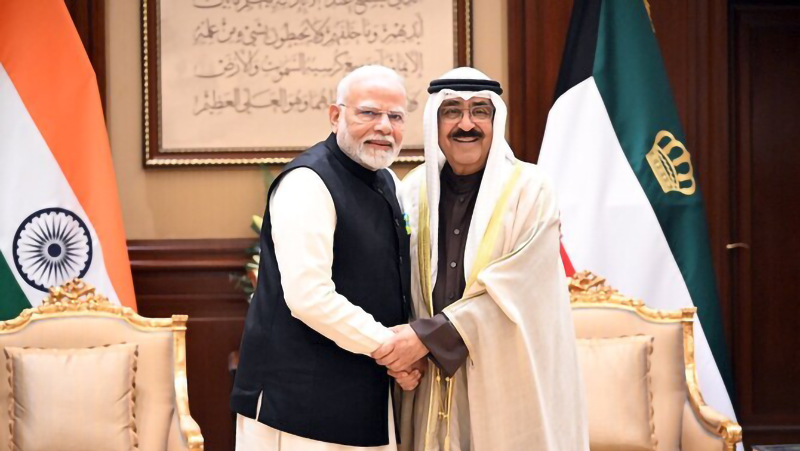
Prime Minister Modi’s visit to Kuwait on 21 and 22 December 2024, the first by an Indian premier in forty-three years, converted inheritance into architecture. The Amir conferred upon Modi the Order of Mubarak Al Kabeer, Kuwait’s highest honour; the two governments proclaimed a Strategic Partnership; and the Joint Statement of 22 December supplied its blueprint. A memorandum on defence cooperation created an institutional framework for training, joint exercises, exchanges of personnel and experts, defence-industry collaboration, supply of equipment, research and development, and coastal and maritime security. A framework agreement brought Kuwait into the International Solar Alliance, carrying the relationship into solar power, green hydrogen and the technologies of decarbonisation. A Cultural Exchange Programme for 2025 to 2029 and an Executive Programme on Sports Cooperation for 2025 to 2028 ran the people-to-people track through the decade. Weeks earlier, the visit of Kuwait’s then Foreign Minister, Abdullah Ali Al-Yahya, to New Delhi had set the keystone of the whole edifice: a Joint Commission for Cooperation at foreign-minister level, beneath which new working groups on trade, investment, education, technology, agriculture, security and culture joined the existing machinery on hydrocarbons, health and consular affairs.
The design deserves more attention than diplomatic architecture usually receives. Institutionalisation of this density converts episodic goodwill into routinised delivery; it creates bureaucratic constituencies on both sides with careers invested in continuous performance; and it insulates cooperation against leadership change and regional shock. The forward agenda in the Joint Statement reads as the deliberate charter of a multidimensional compact: completion of a modernised Bilateral Investment Treaty, expanded civil aviation capacity, Kuwaiti capital in Indian food parks, pharmaceutical manufacturing in Kuwait, harmonised drug regulation, cooperation in semiconductors, artificial intelligence and e-governance, and the reconstruction of the energy relationship from a buyer-seller exchange into a full-spectrum partnership spanning upstream exploration, refining, petrochemicals and renewables, including prospective Kuwaiti participation in India’s Strategic Petroleum Reserve. Analysts writing in The Diplomat, among them Elizabeth Roche and Alvite Ningthoujam, rightly judged that the visit closed the last crucial gap in India’s Gulf outreach and placed the relationship on a qualitatively new trajectory.
Energy remains the gravitational core of the relationship, yet its character is changing in ways that measure the larger transition. Reliability is the currency of this trade: through the price shocks of the pandemic, the Ukraine war and now a Gulf conflict, Kuwaiti barrels have reached Indian refineries with contractual steadiness, a fact of considerable value to an economy that imports over eighty-five per cent of its oil. The Strategic Partnership deliberately rebuilds this exchange as ballast rather than cargo. Kuwaiti participation in India’s Strategic Petroleum Reserve, under active discussion since the Joint Statement, would give the emirate an equity stake in Indian energy resilience and give India assured stocks against exactly the class of disruption the 2026 war threatened; Kuwaiti crude stored on Indian soil would be, in the strictest sense, mutual insurance. Kuwait’s accession to the International Solar Alliance carries the compact across the transition horizon, into solar deployment, green hydrogen and carbon-reduction technologies, and aligns the hydrocarbon partnership of the present with the decarbonised interdependence of the future. Energy statecraft of this kind converts a commodity relationship into a strategic one, and the conversion is the whole point.
The substance of the compact is elegantly reciprocal, and reciprocity is its strength. Kuwait’s Vision 2035 seeks diversification away from oil dependence; India offers scale, technology partnerships and one of the world’s largest clean-energy markets. India seeks decarbonisation without energy poverty; Kuwait offers patient capital and hydrocarbons for the transition decades. India feeds Kuwait, with cereals leading its export basket and the planned food-park investments poised to formalise India’s role as guaranteed breadbasket for a state that imports nearly everything it eats; Kuwait funds India, through sovereign wealth today and treaty-protected direct investment tomorrow. Each side thus holds a stake in the other’s most existential supply chain, an interdependence, in the sense Robert Keohane and Joseph Nye gave the term, that raises the cost of estrangement more surely than any communiqué. Softer instruments complete the weave: a Hindi Chair at the Gulf University of Science and Technology from 2025, India Corners in Kuwaiti universities, and the visible service of tens of thousands of Indian doctors and nurses within the Kuwaiti health system. Statecraft of this kind treats every domain, from wheat to hydrogen to language, as a strand of the same cable.
Beneath every strand of the cable moves the human bridge, and it deserves treatment as strategy rather than sentiment. Modi’s description of the million-strong Indian community as a living bridge is analytically exact: the diaspora converts an inter-state relationship into an inter-societal one, thickening interdependence, multiplying the constituencies invested in stability, and raising the cost of estrangement for both capitals. Its remittances are counted in the hundreds of millions of dollars; its conduct across generations has earned a reservoir of goodwill on which formal diplomacy continually draws; and its safety in wartime became, during the 2026 conflict, an immediate test of Kuwaiti stewardship that the emirate passed. Jaishankar’s public thanks to Kuwait’s Foreign Minister for ensuring the well-being of the Indian community carried, in this relationship, a resonance few others could match, because Kuwait remembers 1990, when its catastrophe became India’s airlift and India’s citizens became Kuwait’s guests in adversity. Human security, in this partnership, is grand strategy conducted one family at a time.
The Indo-Gulf Strategic Arc
Grand strategy begins with geography read correctly, and the geography demands a new concept. Between the western coast of India and the eastern Mediterranean now stretches a single, increasingly integrated continuum: the Arabian Gulf littoral and the Strait of Hormuz, the sea lanes of the western Indian Ocean, the India-Middle East-Europe Economic Corridor announced at the New Delhi G20, the International North-South Transport Corridor, and the newer arteries of the energy transition, digital trade and food security. Scholars of regional security, following Barry Buzan and Ole Wæver, have long observed that the Gulf and the subcontinent form interlocking security complexes, bound together by energy flows, diaspora populations, maritime chokepoints and transnational threats. The Indo-Gulf Strategic Arc gives that insight an operational form. It treats the space between Mumbai and the Mediterranean as one theatre; it understands individual bilateral relationships as load-bearing nodes; and it holds that the resilience of each node conditions the stability of the whole.
The framework does real analytical work, in three ways. It explains resource allocation: three ministerial days in Kuwait City during a regional war cease to look anomalous once Kuwait is recognised as the Arc’s northernmost load-bearing node, commanding the approaches to Hormuz-bound commerce, adjacent to Iraq and Iran, and financially formidable through its sovereign wealth. It explains sequencing: Jaishankar travelled onwards from the Gulf to New York, launching India’s campaign for a United Nations Security Council seat in 2028-29, and thence to Brussels for the third India-European Union Trade and Technology Council, because in the logic of the Arc, Gulf partnerships, multilateral candidacies and Euro-Atlantic technology diplomacy constitute a single policy rather than three. It explains institutional form: an Arc maintained through joint commissions, working groups, treaties and corridors is an Arc that survives the weather, and the India-Gulf Cooperation Council free trade negotiations launched with the signing of Terms of Reference in February 2026 will bind the whole structure into a preferential economic space stretching from Indian ports to European markets, with Kuwait’s harbours at the head of the Gulf serving as natural gateways for corridor traffic bound for Iraq and the Levant.
The Arc also clarifies what distinguishes India’s Gulf proposition from the alternatives on offer. China builds infrastructure and buys hydrocarbons at a scale India cannot match, yet arrives with the gravitational pull of a superpower whose embrace small states instinctively hedge against. The United States provides the security umbrella beneath which Kuwait shelters, yet its attention is episodic and its wars have twice arrived uninvited on Kuwaiti soil. Japan and the European powers bring capital and technology without strategic weight in the region’s hard-security domain. India offers a fourth proposition: a continental-scale market and a first-rank navy, joined to a doctrine of strategic autonomy that seeks partners rather than clients. Jaishankar’s own writing in The India Way describes a statecraft of engaging multiple power centres simultaneously while preserving decisional independence. Kuwait, a small state running its own sophisticated hedge among Washington, Beijing, Riyadh and Tehran, and practising, alone among the smaller monarchies, a studied moderation towards both Iran and Iraq, recognises in that doctrine a mirror of its instincts. F. Gregory Gause’s work on Gulf international relations and Vali Nasr’s account of the region’s contested geopolitics both underline the premium small Gulf states place on diversified great-power ties as insurance against abandonment and entrapment alike. India is valuable to Kuwait precisely because Indian power arrives without hegemonic ambition; strategic autonomy, the axiom of Indian statecraft, is simultaneously the quality that makes India the safest partner for a hedging state.
The Inflection Point of July 2026
Inflection points have run-ups, and this one was carefully prepared. Jaishankar visited Kuwait in June 2021, marking sixty years of diplomatic relations and carrying a letter from Modi to the Amir; he returned in August 2024 for a day of consultations with the Crown Prince, the Prime Minister and the Foreign Minister that laid the ground for the summit season to follow; the Kuwaiti Foreign Minister’s December 2024 journey to New Delhi then created the Joint Commission weeks before Modi’s own arrival. The July 2026 visit thus completed a five-year cadence of reciprocal ministerial diplomacy, and cadence is itself a strategic signal. Great powers are judged in the Gulf less by the size of their promises than by the regularity of their presence, and India’s presence in Kuwait has become metronomic.
Diplomacy conducted amid conflict reveals the true depth of a partnership, which is why the timing of Jaishankar’s visit matters as much as its content. He landed in Kuwait City days after the ceasefire had paused direct hostilities between Washington and Tehran, while tankers were still under attack near Hormuz and negotiators shuttled through Doha. Kuwait lies closer to Iranian territory than any Gulf capital save Doha, hosts significant American forces and feeds itself through sea lanes the war had imperilled. India routes the majority of its crude through the same strait and counts its Gulf diaspora, its remittance flows and its westward corridors among its most exposed strategic assets. The crisis was, in effect, a joint stress test of the Arc. The decision to proceed with an extended visit, rather than a truncated or virtual engagement, told Kuwait and the wider region that India regards itself as a resident stakeholder in Gulf stability rather than a fair-weather customer of its oil.
The choreography confirmed the message at every level. Received on arrival by Deputy Foreign Minister Hamad Suleiman Mashaan Al-Mashaan, Jaishankar called the next morning on Crown Prince Sheikh Sabah Al-Khaled Al-Sabah, conveying Modi’s greetings and recording publicly his appreciation of the Crown Prince’s commitment to the relationship and his sharing of perspectives on developments in the Gulf: the language of genuine strategic consultation, conducted at the apex of Kuwaiti decision-making, in the middle of a regional war. His talks with Foreign Minister Sheikh Jarrah Jaber Al-Ahmad Al-Sabah then performed the systematic review the Joint Commission architecture prescribes; the minister discussed, in his own words, the impact of the Gulf conflict on the region and beyond, thanked Kuwait for ensuring the well-being of the Indian community, and jointly assessed cooperation across energy, trade, investments, defence, technology, food security and health.
That final enumeration is the single most telling detail of the visit, and it repays a moment’s scrutiny. The agenda Jaishankar recited maps with striking fidelity onto the working-group structure created in December 2024: hydrocarbons, trade, investment, security, technology, agriculture and health, each proclaimed on paper eighteen months earlier, each reviewed in person under wartime conditions. Diplomacy rarely offers such clean evidence of institutional machinery functioning exactly as designed, under precisely the conditions it was designed for. The defence memorandum’s maritime clauses were vindicated by the tanker attacks within eighteen months of signature; the food-security track acquired new urgency as the war menaced Kuwait’s seaborne imports; the energy dialogue proceeded even as the strait that carries the oil came under fire. An inflection point in strategy is the moment a posture stops being declaratory and starts being operational. For India’s Gulf policy, that moment has a date and a place: Kuwait City, July 2026.
Kuwait, India and the Multipolar Order
The bilateral story opens onto a larger structural transformation. The Gulf of 2026 is a region in transition between orders: American primacy endures in basing agreements and carrier groups, yet the war with Iran has advertised its costs; Chinese economic weight grows annually, yet Beijing’s security offer remains untested; the Gulf states themselves, flush with sovereign wealth and national visions, have graduated from arena to actors. In such a landscape, middle powers and small states discover one another. India’s courtship of Kuwait, and Kuwait’s reciprocation, exemplify a pattern that scholars of multipolarity should expect to generalise: states that prize autonomy contracting with states that respect it, building institutions dense enough to survive great-power turbulence, and converting interdependence in food, energy, finance and people into a form of mutual insurance. The partnership’s shared commitments to reformed multilateralism, and Kuwait’s sympathy for India’s Security Council candidature, extend the same logic to the global level: both states seek an international order with more seats at the table and fewer vetoes above it.
Maritime geopolitics gives the argument its hardest edge. The tanker attacks of 2026 vindicated, within eighteen months of its signature, the decision to embed coastal and maritime security in the December 2024 defence memorandum, and they clarified the division of labour that makes India attractive as a security partner. India’s navy, its maritime domain awareness architecture in the western Indian Ocean and its record as the region’s first responder complement, rather than duplicate, Kuwait’s American alliance; New Delhi offers presence without bases, capability without command, reassurance without entanglement. Counter-terrorism, cyber security, intelligence sharing and the disruption of transnational finance, all codified in the Joint Statement and carried forward through the security working group, extend the same complementarity ashore. Buzan and Wæver taught that security complexes are defined by their patterns of amity and enmity; India and Kuwait have constructed a durable pattern of amity inside a regional complex otherwise structured by rivalry, and the wartime consultations of July 2026 demonstrated that the amity now extends to candid dialogue on the region’s most dangerous fault line.
Candour nonetheless requires an accounting of risk, and four constraints deserve sober attention. The first is the region itself: the ceasefire is young, the Doha talks are indirect, and renewed hostilities would imperil Hormuz transit, Kuwaiti infrastructure and the Indian community in the same hour. The second is velocity: Gulf diplomacy is littered with memoranda that outran delivery, and the investment treaty, the food parks and the petroleum-reserve discussions all still await conversion from negotiation to signature; the July visit’s systematic review is the right discipline, and the discipline must be sustained. The third lies in Kuwait’s domestic labour politics, where demographic rebalancing under Vision 2035 will require management sensitive both to the interests of Indian workers and to Kuwaiti sovereignty over its labour composition. The fourth is competition: China’s Gulf presence deepens year on year, and India’s privileged position rests on a diplomatic tempo, of which the 2026 visit is the exemplary instance, that must be maintained rather than assumed. Each risk is real. Each is precisely the kind of risk that dense institutions exist to manage, which is why the architecture of 2024, more than any single agreement, remains the relationship’s best insurance.
The Return of the Rupee
Jaishankar’s three days in Kuwait City will generate no anniversary. They yielded no proclamation, no decoration, no signature ceremony. Their significance is of a rarer kind: proof that a partnership proclaimed in fair weather works in foul; that the machinery built in December 2024 turns under load; and that India’s Gulf policy has acquired the quality that distinguishes mature powers, the habit of showing up when it is hardest to do so. Within the Indo-Gulf Strategic Arc, Kuwait has revealed itself as a keystone: geographically pivotal at the head of the Gulf, financially formidable through its sovereign wealth, demographically bound to India by a million-strong living bridge, and temperamentally congenial through a shared instinct for moderation, mediation and multipolarity.
The tasks ahead are legible: conclude the Bilateral Investment Treaty, land the India-GCC trade agreement, operationalise defence and maritime cooperation, and deliver the food-security, health and technology partnerships now moving through the working groups. Their completion would position India and Kuwait as pivotal partners in the multipolar order taking shape from the Hormuz roadstead to the corridors of Brussels, and would confirm the Arc as a durable feature of Asian grand strategy in an age of transition rather than a season’s metaphor. The deeper achievement is already visible, and it is best expressed in the image with which the relationship began. The rupee that once passed from hand to hand in Kuwait’s souks has returned in a new denomination: a strategic currency of trust, accumulated over two and a half centuries of commerce, crisis and rescue, and now redeemable across every domain of twenty-first-century statecraft.
Views: 560

Dr. Maheep
Dr. Maheep is Director, Indian Perspective on Global Affairs (IPGA), and a leading analyst of India’s foreign policy and South Asian geopolitics. He earned his PhD in Arab and Islamic Studies. With more than a decade of teaching and research experience in International Relations and Global Politics, he contributes regularly on issues shaping national and global affairs.


