


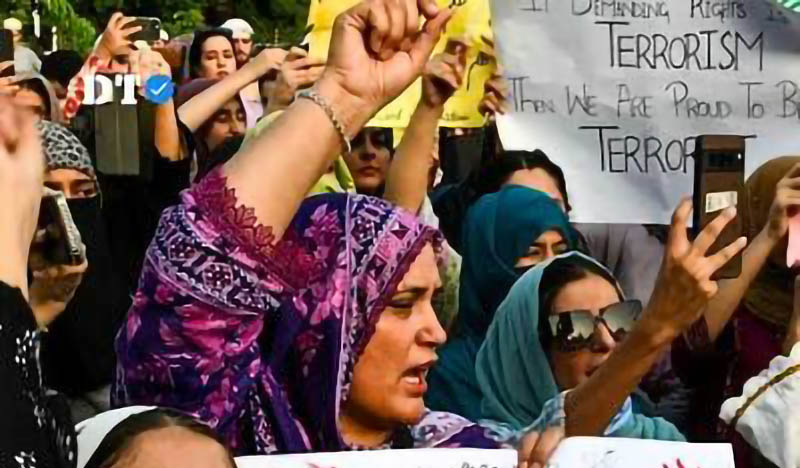







In August 2026 an election in Muzaffarabad measured not the will of a people but the distance between a state and its subjects. Pakistan staged a legislative poll across the territory it administers as “Azad Jammu and Kashmir,” and the territory answered with shuttered bazaars, blockaded roads, a communications blackout, and the funerals of protesters felled by its own security forces. The Indian Ministry of External Affairs named the exercise a complete farce, observing that the true event in the region was the pattern of public protest and the killing of civilians rather than the ritual of voting. That judgement, dismissed in some quarters as the predictable rhetoric of a rival, in fact identified the precise theoretical stakes of the crisis. An election is an instrument for manufacturing consent, and consent is the one commodity that seven decades of occupation had failed to produce. The events of the summer exposed a legitimacy deficit that no procedural performance could conceal, and they did so in the voices of the very population whose contentment the occupying power had long claimed to embody.
The significance of this moment reaches beyond the immediate tally of casualties, contested though those figures remain, with Indian official statements placing civilian deaths since June at approximately ninety and Pakistani authorities disputing responsibility. The deeper importance lies in what the crisis reveals about the architecture of the dispute itself. Sovereignty, legitimacy and territorial identity are not natural facts inscribed upon the land. They are social constructions, sustained by shared belief and vulnerable to its withdrawal. For over seventy years Pakistan maintained a construction of remarkable durability, in which the portion of the former princely state under its control figured as “free” Kashmir, the authentic expression of Kashmiri aspiration, set against a supposedly oppressed Indian-administered remainder. The uprising of 2026 did not merely embarrass this narrative. It falsified it at the source, because the people the narrative claimed to speak for rose to denounce the state that spoke in their name. This essay reads that collapse through the lens of Constructivist International Relations, and it argues that the crisis has furnished India’s long-standing legal and political position with an evidentiary force it never previously commanded.
To grasp why requires attention first to the present, and only then to the history that produced it. The movement at the centre of the unrest, the Jammu Kashmir Joint Awami Action Committee, began in 2023 not as an insurgency but as a coalition of shopkeepers, transporters, lawyers and clerics protesting the price of flour and the cost of electricity. The paradox of the territory gave those grievances their combustible force. PoJK sits atop the reservoirs and turbines that illuminate Pakistan’s cities, yet the households above the dams endure punishing tariffs and prolonged darkness. A land that exports power cannot keep its own lights lit. From this elementary injustice the movement ascended, through a thirty-eight-point charter of demands unveiled in 2025, from the economics of the household to the architecture of power. It came to contest the reserved seats through which Islamabad shapes the territory’s government, the extraction of resources without return, the privileges of an administrative elite, and the absence of genuine local autonomy. The trajectory from the price of bread to the question of who rules, and by what right, is the essential narrative of the crisis, and it is a trajectory that no quantity of subsidised wheat could arrest.
The reserved seats deserve particular scrutiny, for they concentrate the logic of the occupation in a single institution. Twelve seats in the legislative assembly stand allocated not to the residents of the territory but to Kashmiri refugees who migrated to Pakistan after 1947 and now live beyond its bounds. In practice these seats deliver a bloc controlled by Pakistan-based parties, permitting Islamabad to determine the complexion of a government its subjects do not freely elect. The arrangement dresses external control in the garments of internal representation. When the movement demanded the abolition of these seats, it struck at the mechanism by which the fiction of autonomy is sustained, and when the territory’s Supreme Court ruled in June 2026 that the seats were constitutionally protected and could be removed only by an amendment the expired assembly could no longer pass, the legal order revealed its true design. The one demand the population most fervently pressed was the one demand the system had been engineered to refuse. A negotiated settlement reached in October 2025 had promised redress and then dissolved in non-implementation, teaching the territory that the state’s word carried no weight, and inviting it to seek through resistance what negotiation could not secure.
The state’s response converted grievance into rupture. In June 2026 the authorities proscribed the committee under anti-terrorism legislation, suspended internet and mobile services across the region, sealed the movement’s offices, and arrested its leaders on charges of sedition, with detentions mounting into the hundreds. Live fire met the crowds. A defence minister branded the protesters enemies indistinguishable from India, fusing internal dissent with external threat in a reflex that betrayed the security establishment’s inability to conceive of legitimate domestic opposition. When the state restricted international broadcasters reporting the boycott, it confirmed that the contest had become a contest over narrative, and that Pakistan believed itself to be losing it. A polity confident in its legitimacy does not fear a camera or a ballot freely cast. The instinct to censor and to shoot was the instinct of a construction coming apart, and the world was permitted to watch it fracture in real time.
The Making of the Frontier
The frontier now in revolt was fashioned in the autumn of 1947, and its fashioning followed rules that illuminate the present. The Indian Independence Act dissolved British paramountcy and left the rulers of the princely states to accede to India or to Pakistan through a standard legal instrument whose validity turned upon the sovereign will of the ruler. Jammu and Kashmir, the largest of these states and the most fatefully placed, was ruled by Maharaja Hari Singh, who hesitated. Pakistan resolved his hesitation by force. On 22 October 1947 tribal lashkars, armed and directed from Pakistani territory, crossed into the state, advanced through Muzaffarabad and reached Baramulla on the road to Srinagar. This invasion was the founding act of the occupation. It established by conquest a presence that no legal instrument had authorised, and it created the material fact upon which Pakistani control has rested ever since. The self-styled provisional government of “Azad” Kashmir, proclaimed on 24 October while the state remained lawfully the Maharaja’s, was born upon the back of that raid. Its birth marked the origin of a narrative rather than the birth of a free state, and the distinction has governed the dispute for eight decades.
The accession answered the invasion in law. On 26 October 1947 the Maharaja executed the Instrument of Accession, ceding defence, external affairs and communications to the Dominion of India, and the Governor-General accepted it the following day. From that moment the entire territory of the princely state, its whole extent and not some fraction, became in law a constituent part of the Indian Union. Indian forces airlifted to Srinagar did so as the troops of the sovereign now lawfully responsible for the state’s defence. The legal position India has maintained ever since crystallised in this sequence, and its documentary clarity is not easily dissolved. The lawful ruler acceded through a valid instrument identical in form to those executed by scores of other states; the accession was accepted; the territory became Indian; and the areas Pakistan holds, it holds in defiance of that act. Pakistan’s counter-arguments, that a prior standstill agreement bound the Maharaja or that the accession was conditional upon a plebiscite never held, dissolve upon inspection, for a standstill agreement governs administrative continuity and confers no sovereignty, and the plebiscite was contingent upon a condition Pakistan itself never fulfilled.
That condition is the pivot of the international dimension, and it is persistently misremembered. India carried the dispute to the United Nations in January 1948, and the Security Council’s Resolution 47 envisaged a plebiscite framed by the United Nations Commission for India and Pakistan. The Commission’s resolution of 13 August 1948 established the sequence by which such a plebiscite might occur, and its first substantive step required Pakistan to withdraw its tribesmen and nationals from the state. Only after that withdrawal, and the demilitarisation that would follow, could a plebiscite be organised. Pakistan withdrew nothing. The condition precedent failed, and with it the entire edifice that a plebiscite would have crowned. India’s position rests upon this uncontested chronology. The obligation to vacate fell first upon Pakistan; Pakistan never discharged it; and no subsequent stage of the process ever became due. To invoke the unfulfilled plebiscite while ignoring the unfulfilled withdrawal that was its precondition is to read the record backwards, and the reading collapses the moment the sequence is restored to its proper order.
The ceasefire of 1 January 1949 and the Karachi Agreement that followed froze a line that has hardened, through the Simla Agreement of 1972 and the brief renewal of the Lahore Declaration of 1999, into the Line of Control. That line converted the wages of the 1947 invasion into a durable partition of the state, and the frontier that burned in 2026 is precisely the frontier the invasion drew. On the Indian side, the constitutional orders of August 2019 read down Article 370 and reorganised the Indian-administered territory, a measure the Supreme Court of India upheld in December 2023. Whatever assessment one makes of those steps, they concern the territory India administers and leave untouched the legal status of the areas under Pakistani occupation. Above the entire edifice stands the resolution unanimously adopted by both Houses of the Indian Parliament on 22 February 1994, which affirmed that the whole of Jammu and Kashmir is an integral part of India and demanded that Pakistan vacate the territories it holds. The legal chain is therefore continuous and coherent, running from the accession of 1947, through the Pakistani withdrawal the United Nations required and never received, to the parliamentary affirmation of 1994, and restated in every subsequent statement of Indian policy, including those of the present crisis.
Sovereignty as a Social Fact
Constructivist theory supplies the instrument adequate to these events. Its central insight holds that the structures of international life are constituted by shared ideas rather than by material forces alone, that anarchy, as the discipline’s most influential formulation has it, is what states make of it. Sovereignty is the exemplary case. It presents itself as a natural attribute of states, yet it exists only because states recognise one another as sovereign and act upon that recognition. Sovereignty is a social fact, real and consequential precisely because it is collectively believed, in the manner of money or marriage or any institution whose existence depends upon continued human assent. The corollary bears directly upon the occupied territory. A regime that holds ground by force while its subjects withhold recognition possesses control without legitimacy, and control without legitimacy is a standing invitation to the crisis that eventually arrives. The theory further teaches that state identities and interests are themselves socially produced, that norms are established and overturned by entrepreneurs who advance rival standards of legitimate conduct, and that nations are imagined communities sustained by narrative, memory and ritual rather than given by nature.
These propositions transform the reading of the “Azad” narrative. The name itself is a claim, a category of practice projected outward to persuade international audiences and to discipline domestic ones. Its power never resided in the facts upon the ground, which told a different story of extraction and control. Its power resided in the belief it commanded abroad and demanded at home. Constructions of this kind carry a concealed vulnerability, for they depend upon the acquiescence of the very people they describe, and that acquiescence may be withdrawn. When the residents of a territory named “free” took to the streets to denounce their administration, they did not merely protest a tariff. They falsified a claim about their own identity and consent, and they did so in the one voice the narrative could not answer, their own. The irony was total and legible to the world. In a place whose name proclaims freedom, elections proceeded under curfew, a grassroots movement was branded terrorist, communications were severed, and the state answered its citizens with bullets. The gap between the name and the reality became the entire story, and that gap is exactly what a Constructivist analysis is equipped to perceive.
The mutual constitution of the crisis unfolds across interlocking registers. History shaped the identity of the territory, the memory of 1947 and of the exodus it produced. That identity shaped the competing claims to sovereignty, each state grounding its title in a rival account of the founding. Sovereignty in turn shaped the constitutional forms through which each administered its portion, the reserved seats and executive orders on one side, the accession and its constitutional integration on the other. Those constitutional forms shaped the diplomacy each conducted before the world, the internationalisation of the grievance and the assertion of legal title. And diplomacy shaped the international legitimacy each could claim. At every link in this chain, ideas performed the work that material power alone could not accomplish. Pakistan held the ground through the entire sequence, yet it never secured the belief that would have rendered the holding legitimate. The reserved seats, the blackouts and the proscriptions were successive attempts to sustain by coercion a meaning that consent had ceased to supply. Coercion may hold territory. It cannot manufacture legitimacy, because legitimacy resides in the minds of the governed, and the governed had spoken.
The Territory Held in Suspension
Gilgit-Baltistan occupies a category of its own and exposes the contradiction at the heart of Pakistan’s position with singular clarity. The region acceded to India as an integral part of the princely state in 1947, passed under Pakistani control thereafter, and has since been governed as neither a province of Pakistan nor a genuinely autonomous entity, but as a territory suspended between the two. It is administered through executive orders rather than constitutional amendment, a device that confers the appearance of self-government while withholding its substance. The reason for this suspension is not administrative oversight but deliberate calculation, and Pakistan has articulated it with disarming candour. Islamabad declines to integrate the region as a full province precisely because doing so would concede that the territory is not disputed, which would in turn undermine its own posture on the wider Kashmir question. The people of the region are thereby held hostage to a diplomatic stratagem. Their disenfranchisement is a policy rather than an accident, sustained because their full incorporation would prove legally inconvenient. Pakistan cannot grant them the rights of citizens without conceding that it holds their land, and it cannot concede that it holds their land without abandoning the fiction that the land’s status remains open. The population pays the price of the contradiction in the coin of its rights, and even the courts of Pakistan have registered the anomaly while declining to resolve it.
The political economy of the occupation supplies the material substrate of the legitimacy crisis and reveals its logic in the plainest terms. The occupied territories hold a substantial share of the water and hydropower upon which Pakistan’s economy depends. Great dams within the territory supply power and irrigation to the Pakistani heartland while the communities their reservoirs displaced continue to contest their compensation across the decades. The electricity generated in the mountains flows to the national grid, and the territory that produces it pays retail tariffs for the privilege. This is extraction in its textbook form, the periphery generating wealth that the metropole consumes, and the demand for resource royalties that animates the charter of grievances is at bottom the ordinary claim of any community that a share of the wealth drawn from its land should return to fund its schools, its hospitals and its roads. That so modest a claim should have driven a population into open confrontation testifies to the completeness with which the arrangement had failed it. The contrast across the Line of Control sharpens the grievance, for the residents of the occupied territory can now observe, in the Indian-administered remainder, a land that shares their history receiving the investment their own administration withholds. The developmental gap has become a legitimacy gap, and it feeds the very unrest the extraction produced.
The Chinese dimension transforms the dispute from a bilateral quarrel into a triangular strategic problem, and it does so through territory whose legal ownership India asserts. The China-Pakistan Economic Corridor, the flagship of Beijing’s connectivity statecraft in South Asia, runs from Xinjiang through Gilgit-Baltistan to the Arabian Sea, and India has objected to it from inception on the ground that its northern reaches traverse territory under illegal occupation. The corridor embeds a Chinese strategic and economic interest in the perpetuation of an occupation India rejects. The cession of the Shaksgam Valley crystallises the legal grievance, for under the boundary agreement of 1963 Pakistan purported to transfer some five thousand square kilometres of that territory to China, and India rejects the transfer as void on the elementary ground that Pakistan held no sovereign title and could convey none. The agreement betrays its own defect, providing that the boundary is provisional and must be renegotiated once the Kashmir dispute is settled, an implicit admission that the party ceding the land did not own it. A cession that anticipates its own renegotiation concedes the frailty of the title behind it, and the instability now shadowing the corridor demonstrates that the population through whose land it runs has not consented to the arrangement. Geoeconomic statecraft cannot manufacture the legitimacy that consent alone confers.
Occupation, Recognition and the Comparative Lens
The vocabulary of international law sharpens the judgement that the political analysis reaches. The United Nations Charter forbids the acquisition of territory by force, and the tribal invasion of 1947 was an acquisition by force that no lawful instrument authorised. Against the settled title conferred by the accession, Pakistan’s presence bears the classic marks of belligerent occupation, control exercised over territory to which the controlling power holds no sovereign right. The principle of self-determination, which Pakistan invokes, cuts against it once the sequence is restored, for the United Nations conditioned any expression of the popular will upon a Pakistani withdrawal that never occurred, and no party may claim the benefit of a process whose precondition it refused to satisfy. Comparison disciplines this judgement, provided its limits are stated with care. Northern Cyprus demonstrates that effective administration may persist for decades without acquiring the legitimacy that recognition confers, and the parallel sharpens the Indian point, for Pakistan claims for the occupied territory a freedom it does not grant even in form. The international response to the annexation of Crimea illustrates the principle that territory seized by force cannot be legitimated by the control that follows, a principle that applies directly to a territory whose origin lies in invasion. Each analogy has its limits, and the occupied territory differs from all of them in the documentary strength of the displaced sovereign’s original title, yet the comparative survey yields a single robust conclusion. Sovereignty is a matter of recognised right rather than of effective control, and the international order, however unevenly, withholds its recognition from title acquired and held by force.
Symbolic politics completes the analysis and returns it to its beginning. Cartography is among the foremost instruments through which states constitute territory, for a map is not a neutral record of the world but an assertion about it, a claim to sovereignty rendered in ink and projected as fact. India has consistently depicted the entire former princely state, including the areas under Pakistani and Chinese control, as its own territory, and this cartographic constancy is itself an act of sovereignty maintained across eight decades, performed daily in classrooms and offices until it becomes second nature to the national imagination. Collective memory operates alongside cartography, fixing in the institutional conscience of the state the conviction that the territory’s incompleteness is a wound sustained by invasion. The reserved seats bring the argument full circle, for they are themselves a symbol, ostensibly commemorating the displacement of 1947 by reserving representation for its refugees, yet functioning in practice as instruments of external control. The movement’s demand to abolish them was a demand to reclaim the meaning of representation from the apparatus that had captured it, and the court’s refusal defended the symbol against the population it was said to honour. In the occupied territory, symbolic politics is the politics of occupation conducted by other means, and the struggle over the seats was a struggle over meaning itself.
The Frontier and Its Future
The summer of 2026 will be remembered as the season the story broke. A territory named for freedom voted under curfew, a movement of shopkeepers and lawyers was declared a terrorist enterprise, and a state that claimed to speak for Kashmir fired upon Kashmiris in the streets of its own capital. India named these facts plainly, held to the legal title it has asserted since 1947, and invited the world to see through the veneer, and the events furnished the witnesses that seven decades of argument had lacked, because the people of the occupied territory testified, in their own voices and at grave cost, to the character of the rule imposed upon them. The distinctive feature of the present moment is precisely this convergence, in which the legal record, the strategic analysis and the testimony of the population speak at last with one voice. Indian institutions have long maintained that developments on the ground contradict Islamabad’s claims of autonomy and representation, and international commentary now independently observes that the “Azad” narrative has been shattered by the conduct of the state that authored it. For the first time in the long history of the dispute, argument and evidence run together.
The forward view identifies enduring structural trends rather than particular predictions. The legitimacy crisis in the occupied territories is structural rather than episodic, rooted in an arrangement of reserved seats, extracted resources, constitutional suspension and centralised control that no single concession will resolve, and it will therefore recur until the arrangement itself is transformed. The Chinese stake in Gilgit-Baltistan and the Shaksgam Valley raises the cost of instability for a great power now bound to the corridor, internationalising a crisis that Islamabad long sought to contain as a domestic matter and drawing an external actor into a dispute whose legal foundations it silently corroborates even as it contests them. And the Indian claim, long treated abroad as a bilateral talking point, has acquired an evidentiary weight it did not previously possess, precisely because the residents of the territory have become witnesses to its truth. These are not the transient features of a single summer but the deep structure of a dispute entering a new phase, in which the gap between coercive control and genuine consent has become impossible to conceal.
Constructivism teaches that the settlements of world politics endure only so long as the meanings that sustain them are believed. The meaning called “Azad Kashmir” was fashioned in 1947 upon the back of an invasion and maintained for three generations by projection and coercion. In 2026 the people within the construction withdrew their belief, and a construction abandoned by those it purports to describe cannot be rebuilt by the state that built it. India’s position holds that the whole of Jammu and Kashmir is Indian by law, that Pakistan occupies part of it by force, and that the people of that part are struggling, suffering and being fired upon for asking to be heard. The record of the year sustains each clause of that position. The frontier drawn by the invasion still holds upon the map, immovable and heavily garrisoned. The story once told to justify it no longer holds in the minds of those who live behind it, and it is from that fracture, between the line on the ground and the belief that has deserted it, that the future of the region will be written.
Views: 331

Dr. Maheep
Dr. Maheep is Director, Indian Perspective on Global Affairs (IPGA), and a leading analyst of India’s foreign policy and South Asian geopolitics. He earned his PhD in Arab and Islamic Studies. With more than a decade of teaching and research experience in International Relations and Global Politics, he contributes regularly on issues shaping national and global affairs.


