






New Delhi’s Quiet Inflection: BRICS, Non-Traditional Security, and a Multipolar Security Architecture
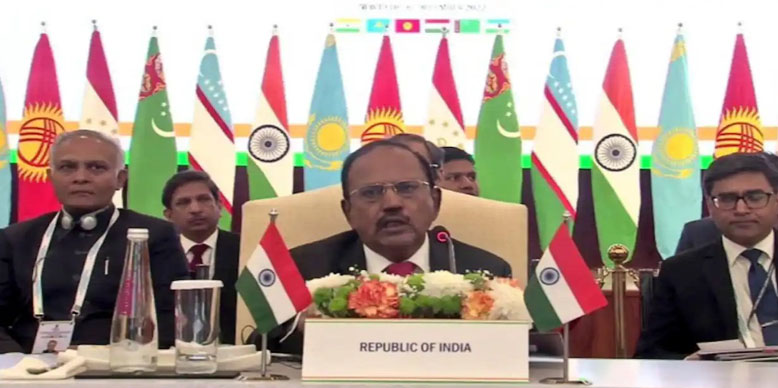
On the morning of 23 June 2026, in a New Delhi rendered torpid by the pre-monsoon heat, India’s National Security Adviser, Ajit Doval, opened the Sixteenth BRICS National Security Advisers’ Meeting with a statement that was less a diplomatic courtesy than a diagnosis of the international condition. The world, he observed, was confronting a profound convergence of military conflict, geopolitical uncertainty, economic volatility, and disruptive technologies.
The gravest challenge, however, was not simply the proliferation of threats, but the growing incapacity of the institutions and mechanisms long entrusted with preserving international order to respond to them. Multilateralism itself, he suggested, was under visible strain. Behind the familiar tableau of the opening photograph, in which the security chiefs of eleven states assembled beneath the BRICS banner, lay a proposition of considerable analytical significance.
The architecture of global governance has become progressively less capable of managing the insecurities that increasingly define international politics, while the institutions once expected to arbitrate conflict have themselves become arenas of geopolitical contestation.
This research article argues that the New Delhi meeting marks an important inflection in the evolution of BRICS, from an economic coalition into an increasingly consequential platform for non-traditional security governance. It takes Doval’s proposition as its analytical point of departure. If the institutions fashioned in the aftermath of the Second World War are increasingly unable to furnish collective security, what forms of cooperation are emerging in their place?
More precisely, what does the meeting reveal about the architecture of security governance in an international system that is at once more multipolar, more fragmented and more technologically complex than at any moment since the Cold War? These are no longer peripheral questions. They lie at the centre of the contemporary debate over global order. Convened under India’s fourth BRICS Chairship, and guided by the overarching theme “Building for Resilience, Innovation, Cooperation and Sustainability,” the gathering was organised around the deceptively modest rubric of “Non-Traditional Security Challenges Confronting the World Today.”
It brought together the security leadership of an enlarged BRICS that now encompasses close to half of humanity, around two-fifths of global output and roughly a quarter of world trade. Rather than read the meeting as a sequence of speeches, readouts and bilateral encounters, this article interprets it as a political text, one that discloses how emerging powers are redefining the very meaning of security in the twenty-first century.
At the heart of the meeting lies a broader transformation in the meaning of security itself. BRICS increasingly treats cyber governance, terrorism, technological disruption, supply-chain resilience and human welfare not as discrete policy domains but as interconnected dimensions of a single security architecture. The wager that animates this article rests on one distinction. For most of the twentieth century the discipline conceived security as a property of states, threatened by the organised violence of other states and secured by military power. Against that inheritance stands the broadened, deepened and resolutely transnational conception, gathered under the heading of non-traditional security, that has since displaced it at the analytical frontier. The New Delhi meeting matters precisely because it institutionalises the latter within a forum the West has long been inclined to dismiss as an economic talking shop.
Three propositions order the argument that follows. The first holds that BRICS security cooperation is best understood not as the embryonic formation of a military alliance but as a sovereigntist appropriation of the vocabulary of non-traditional security, one that embraces its substantive concerns while rejecting its interventionist implications. The second holds that India’s 2026 Chairship constituted a deliberate exercise in strategic re-coding, repositioning BRICS as a Global South platform on which New Delhi’s priorities, cross-border terrorism, terror financing, cyber governance and supply-chain resilience, occupied a prominence equal to the macroeconomic concerns of Beijing and Moscow. The third holds that the absence of a joint communiqué should not be read as institutional failure. It reveals, rather, a forum sufficiently mature to sustain meaningful cooperation despite persistent divergences among its members on the major geopolitical questions of the day.
How Security Was Redefined: From the Charter to the Algorithm
The conception of security that animated the meeting did not spring fully formed from the anxieties of 2026; it is the sediment of an intellectual evolution whose strata remain legible in the very vocabulary the BRICS principals employed. For most of the twentieth century the realist canon held security to be a property of states, secured by the accumulation of military power, though Arnold Wolfers had warned as early as 1952 that national security functioned as an ambiguous symbol. The frame cracked in the 1980s, when scholars such as Richard Ullman argued that a security confined to military threats was not merely incomplete but dangerous; and Barry Buzan’s People, States and Fear performed the decisive widening, distributing security across five sectors, military, political, economic, societal and environmental, while the Copenhagen School he founded with Ole Wæver added the constructivist refinement of securitisation, the discursive act by which an issue is rendered an existential threat warranting extraordinary measures.
The concept alerts us to the politics of naming: when BRICS designates terrorism, cyber insecurity and supply-chain fragility as security threats, it does not merely describe the world but constitutes a field of legitimate collective action. Parallel to this widening ran a deepening, a migration of the referent object from the state to the human being, whose watershed was the United Nations Development Programme’s Human Development Report of 1994, reconceiving security around the individual beneath the twin banners of freedom from fear and freedom from want.
Its lineage reaches back through Mahbub ul Haq’s architecture of human development and Amartya Sen’s capability approach, which redefined development as the expansion of substantive freedoms rather than the accumulation of income, supplying the philosophical bridge between security and development that the BRICS rhetoric of resilience perpetually invokes; while beneath the broadened agenda lies Johan Galtung’s structural violence, the avoidable harm inflicted by the unequal distribution of power embedded in social structures, which warrants the treatment of poverty, hunger and the digital divide as security concerns and resonates with the Global South’s insistence that the architecture of the international order is itself a source of insecurity for its peoples.
The critical and Welsh schools, in Ken Booth’s rendering of security as emancipation, pressed in the opposite direction, toward the freeing of individuals from the structural constraints that prevent them from acting as they would freely choose; and it is precisely the distance between Booth’s emancipatory horizon and the sovereigntist instincts of BRICS that constitutes one of the most illuminating fault lines in the analysis that follows.
It was the dissolution of bipolarity that opened the conceptual space within which non-traditional security could flourish, releasing into view the threats the Cold War had obscured: environmental degradations that respected no border, pandemics that travelled the arteries of globalisation, financial contagions, and transnational networks that exploited the very openness on which the liberal order prided itself. The Commission on Human Security gave the paradigm its mature statement in 2003, and the World Summit of 2005 incorporated, in circumscribed form, the responsibility to protect.
It is at this threshold that the BRICS conception parts company with the liberal mainstream, for the doctrine of conditional sovereignty, however hedged, is anathema to states that have experienced intervention as a euphemism for the violation of their independence. Herein lies the central paradox the essay seeks to illuminate: BRICS embraces the substance of non-traditional security, the concern for the welfare and resilience of populations, while emphatically repudiating the political theology of intervention that, in Western practice, came to accompany it.
The 2030 Agenda consolidated the security-development nexus, and the literature on global public goods explained why a stable climate, an open cyberspace and resilient supply chains can be furnished by no single state. The most recent stratum is technological: Mary Kaldor’s new wars anticipated the hybrid and grey-zone conflicts that now preoccupy planners, while the extension of securitisation into the digital domain illuminated a cyber security whose referent object is at once the network, the state and the individual.
When Doval spoke of disruptive technologies and camouflaged variants of terrorism, and the delegations dwelt on the misuse of artificial intelligence by terrorist networks, they were registering the latest addition to a genealogy that runs, without rupture, from the Charter to the algorithm, an inheritance that for India carries a particular charge, since New Delhi has long argued that the security of the Global South cannot be disentangled from its development, a conviction to which Sen’s capability approach lends a depth the rhetoric of people-centric security only partly conveys.
How BRICS Built Its Security Architecture
BRICS was not conceived as a security organisation. Its origins lie in an acronym minted to denote the large emerging markets whose growth would reshape the global economy, and its early summits were absorbed in the reform of the international financial architecture and the aspiration to a more representative global governance. The transformation of this economic caucus into a vehicle for security cooperation has been gradual, cumulative and, until recently, largely unremarked, and the New Delhi meeting both consummates and reveals it. The scaffolding was erected in two phases.
The first, in the digital domain, began in 2013, when the National Security Advisers established a Working Group on Security in the Use of Information and Communication Technologies, a body the Ufa Declaration of 2015 formalised and charged with the sharing of best practice, coordination against cybercrime, collaboration among national incident-response teams, capacity-building and the development of norms for responsible state behaviour in cyberspace.
The second, in counter-terrorism, gathered momentum from 2016, when the Counter-Terrorism Working Group first convened under India’s earlier Chairship, and matured through a Counter-Terrorism Strategy in 2020 and an Action Plan in 2021, the latter establishing thematic sub-groups on terror financing, the misuse of the internet, foreign terrorist fighters, radicalisation and capacity-building, with the Roadmap for Practical Cooperation supplying the operational spine of the cyber track.
The architecture that emerged is at once more substantial and more circumscribed than its critics allow. More substantial, because the working groups have moved beyond declaratory diplomacy to the construction of operational mechanisms, directories of points of contact, protocols of exchange, the rudiments of a network linking national computer-emergency-response teams, and a calendar of capacity-building tailored to the uneven capacities of the membership.
More circumscribed, because the entire edifice rests on a foundation of consensus, sovereignty and non-interference that precludes the binding obligations, the pooled authority and the intrusive verification of more demanding institutions; in the idiom of institutionalist theory, it is a low-sovereignty-cost arrangement, maximising the autonomy of its members at the price of the depth of its commitments. Its enlargement has sharpened the dilemma.
The accession in 2024 of Egypt, Ethiopia, Iran, Saudi Arabia and the United Arab Emirates, followed by Indonesia in 2025, transformed a coalition of five into a grouping of eleven, vastly augmenting its demographic and economic mass while multiplying the divergences of threat perception, strategic alignment and political system that any common agenda must accommodate, a heterogeneity in which the very meaning of terrorism, sovereignty and security is contested.
It is against this backdrop that the dual-track structure of the meeting must be read, for the security principals convened to review the outcomes of the two working groups that had met in the preceding weeks and to furnish them with high-level political guidance. That the meeting braided counter-terrorism, cyber insecurity, the weaponisation of emerging technology and the resilience of energy, food and supply chains into a single field of vulnerability is the closest the institution has yet come to a comprehensive security doctrine.
Why the Missing Communiqué Matters
The substantive core of the meeting was the review of the two working groups. On counter-terrorism, the National Security Advisers reaffirmed their commitment to combating terrorism in all its forms and manifestations, a formula whose significance lies less in novelty than in its insistence on the indivisibility of the threat, and extended it explicitly to the misuse of new technologies by terrorist networks. On the digital track they endorsed enhanced capacity-building, the sharing of information and intelligence, and coordination among law-enforcement agencies, registering the growing entanglement of cyber risk with the wider agenda.
The official readout recorded that the participants had discussed energy security, food security, supply-chain resilience, cyber security and climate-induced instability, a litany that maps with precision onto the non-traditional security agenda. Yet the most instructive feature of the meeting was what it declined to produce: no joint statement was issued at its conclusion, an omission the more attentive observers correctly read as a barometer of divergence on the great macro-security questions of the moment.
The temptation is to construe this absence as failure, a demonstration of incapacity to forge a common position. The argument here is the contrary. The absent communique is the meeting’s most eloquent datum, for it discloses a forum matured to the point of being able to function, to review its working groups, advance its practical cooperation and conduct its bilateral diplomacy, without requiring the fiction of unanimity on questions where unanimity does not exist.
A grouping that could meet only when it agreed would be brittle; a grouping that can deliberate and cooperate while openly disagreeing is resilient. This is the paradox of consensus rightly understood: that the discipline of the achievable, and the willingness to fall silent where convergence fails, is the very condition of the grouping’s durability, a species of institutional maturity that the consensus-bound forums of an earlier era, with their laboriously negotiated lowest-common-denominator declarations, conspicuously lacked.
The substance of the disagreement is itself revealing. Iran’s deputy secretary of the Supreme National Security Council, Ghadir Nezamipour, used the counter-terrorism agenda to press a contention of genuine theoretical interest, that terrorism could no longer be understood solely as the work of non-state actors, and that when violent acts are perpetrated with the active sponsorship and direction of sovereign governments they constitute what he termed state terrorism, a category he linked directly to the recent military campaign waged against his country, which he characterised as an unambiguous manifestation of it.
That the official Indian readout pointedly declined to acknowledge the intervention exposed the conceptual fault line running through the entire enterprise, the unresolved question of whether terrorism is defined by the identity of its perpetrators or the character of its acts, and whether the conduct of states may fall within its compass. The Russian contribution moved toward the construction of material resilience against coercion. Sergei Shoigu delivered a pointed critique of the established multilateral institutions, the United Nations, the World Health Organization and the World Trade Organization, which he argued had been politicised to the point of irrelevance, and called upon BRICS to lead their reform; more concretely, he proposed the creation of a BRICS emergency reserve, a mechanism for the stockpiling of medicines, food, energy, fertilisers, rare-earth metals and other vital goods against crisis, so that no member might be economically coerced through sanction or tariff.
The proposal translates the abstract aspiration to strategic autonomy into a tangible architecture of resource security, situating the supply-chain and critical-minerals anxieties of the moment within a framework of collective self-insurance; that the most ambitious institutional proposal of the meeting concerned not military cooperation but the resilience of supply chains is itself a confirmation that BRICS security has migrated decisively into the non-traditional domain. The meeting culminated, as protocol required, in a collective call upon the Prime Minister, who underscored the grouping’s rising role in a period of rapid global change, reiterating the chairmanship’s commitment to a people-centric agenda and to the priorities of the Global South.
Terrorism and Cyberspace: Two Frontiers of Cooperation
If there is a single domain in which the BRICS security agenda has acquired operational substance it is counter-terrorism, and if there is a single member for whom that domain carries an existential charge it is India, for whom the campaign against terrorism is not an abstraction but a generational ordeal. The conceptual centrepiece of New Delhi’s diplomacy is the Comprehensive Convention on International Terrorism, a draft instrument India first placed before the General Assembly in 1996 and which has languished ever since in the limbo of definitional disagreement, its purpose to supply what the patchwork of sectoral treaties conspicuously lacks, a single, universal and binding definition that would foreclose the evasions through which states have sheltered the perpetrators of violence they find congenial.
That it remains unadopted after three decades is among the more telling indictments of the existing order, and it lends the BRICS counter-terrorism agenda a particular resonance for a state that sees in the grouping a forum where its long-frustrated advocacy might gain traction among partners less invested in the definitional ambiguities that have served Western strategic convenience.
The adversary confronted at New Delhi is, however, no longer the terrorism of the 1990s. It has mutated, and the insistence on the misuse of emerging technologies registered the mutation. The contemporary terrorist operates across a digital terrain that multiplies its reach while diminishing its visibility: it radicalises through the algorithmic amplification of grievance, recruits through encrypted channels impervious to interception, finances itself through the pseudonymous rails of cryptocurrency and the opaque markets of the dark web, and has begun to harness artificial intelligence for the generation of synthetic content and the automation of radicalisation.
The drone, once the instrument of states, has been democratised into a weapon of non-state actors, and the boundary between terrorism and hybrid warfare has grown perilously indistinct. Against this the grouping deploys its thematic sub-groups, aligning its efforts on financing with the standards of the Financial Action Task Force even as virtual assets outpace the regulatory architecture, while its normative output, the insistence on zero tolerance, on the rejection of double standards, and on the impermissibility of safe haven, aligns closely with India’s priorities and furnishes New Delhi with a multilateral echo for positions the Western forums have been reluctant to amplify.
Yet the consensus-bound character of the grouping imposes a ceiling: the same principle that enables eleven heterogeneous states to cooperate precludes the naming of specific perpetrators, confines outcomes to principle and capacity-building rather than binding operational action, and renders the grouping more robust on the exchange of information than on the conduct of joint operations. The Iranian intervention throws this limitation into the sharpest relief, for the grouping’s reticence on the question of state terrorism is not evasion but prudence, a recognition that the cohesion of the agenda depends upon a studied silence regarding its most divisive conceptual frontier.
The digital domain occupies a place at once the most promising and the most fraught of the grouping’s non-traditional frontiers. Most promising, because its members share a common grievance against an internet whose governance has been dominated by the West and whose vulnerabilities were laid bare by the revelations of mass surveillance that catalysed the working group’s establishment in 2013; most fraught, because the very concept of cyber security fractures along the lines that divide the membership, between those who prize the openness of the network and those who prize its control.
The Roadmap for Practical Cooperation organises the effort around the exchange of policy, a network linking incident-response teams through directories of points of contact, cooperation against cybercrime, joint research in secure technologies, and academic exchange; and the meeting endorsed its continued implementation, with the same operational triad of capacity-building, intelligence-sharing and law-enforcement coordination that structured the counter-terrorism track.
The normative dimension is inseparable from the wider contest over digital governance at the United Nations, where the adoption in late 2024 of a Convention against Cybercrime marked a contested milestone, the BRICS members positioning themselves as advocates of a multilateral, state-led approach counterposed to the multistakeholder model favoured by the West. It is the irruption of artificial intelligence that lends the agenda its contemporary urgency, a dual-use technology at once the most promising instrument of development and the most destabilising of threats, whose governance poses in its acutest form the central dilemma of non-traditional security: how to harness the developmental promise of a technology while containing its destructive potential, through cooperation among states whose interests, capacities and values diverge.
Here the grouping has articulated the interconnection of cyber risk with terrorism, supply chains and critical infrastructure, but cannot readily progress to the binding norms so volatile a domain would require, for the pace of the underlying technology, encompassing the looming disruptions of quantum computing, perpetually outstrips the deliberative rhythms of a consensus-bound forum. Its achievement lies not in a finished architecture but in the patient accumulation of connective tissue, the points of contact, the response-team linkages, the habits of exchange, upon which the preconditions of trust, and one day more demanding cooperation, might be built.
India in the Chair: Re-Coding the Coalition
To chair BRICS in 2026 was, for India, an exercise in strategic subtlety of a high order. The grouping whose gavel it inherited is one in which the gravitational pull of China is unmistakable, and in which Western anxiety has fastened upon the prospect of a China-centred bloc arrayed against the established order. India’s task was to demonstrate that BRICS is not China-plus, that it can serve as a platform for the priorities of the Global South rather than the ambitions of a single power, and that New Delhi can preside over it without choosing between Washington and Beijing.
The evidence suggests it discharged the task with skill, in a deliberate exercise of re-coding whose instruments were two. The first was the framing of the agenda: by elevating cross-border terrorism, terror financing and cyber norms to equal billing with the macro-economic preoccupations of the larger members, India ensured that its own concerns received a multilateral hearing and that the grouping’s security identity bore the imprint of its priorities.
The second was the choreography of bilateral diplomacy, in which Doval, on the sidelines, deliberately diversified the grouping’s internal geometry, meeting his Brazilian, Ethiopian and South African counterparts to deepen ties across Latin America and Africa and engaging the Iranian deputy secretary on West Asia, the subtext unmistakable: BRICS is, for India, a forum in which to cultivate the Global South across three continents without being seen as anti-Western.
The most closely watched of the bilaterals was the encounter between Doval and the Chinese Foreign Minister Wang Yi, the two Special Representatives on the boundary question that has poisoned the relationship between Asia’s giants. The talks, described as constructive and forward-looking, noted progress toward the gradual normalisation of a relationship strained by confrontation on the Himalayan frontier, and exemplified what may be the most distinctive feature of India’s contemporary statecraft, the willingness to engage rivals multilaterally without conceding to them bilaterally, to manage a festering antagonism within a shared institution while holding firm on the substantive points of difference.
That India can sit with China in a security forum, advance common positions on terrorism and cyber governance, and simultaneously contest the boundary and the wider balance of power in Asia, is a testament to a dexterity that the older categories of alliance and enmity struggle to capture. This is non-alignment reinterpreted for a multipolar age: the abiding aspiration to strategic autonomy, the refusal to subordinate the country’s freedom of action to any external power or bloc, married to a developmental conception of security, articulated in the people-centric and humanity-first vocabulary advanced at the Rio Summit of 2025, which insists that the security of nations cannot be disentangled from the welfare of their peoples.
This developmental vision, with its roots in the Indian intellectual tradition and its debt to the capability approach, is India’s distinctive contribution to the BRICS security agenda, and it lends the grouping’s rhetoric of resilience a substance it might otherwise lack.
The meeting convened against a backdrop of extraordinary turbulence that no abstract agenda could have conferred. The war between Russia and Ukraine, grinding into its fifth year, continued to corrode the foundations of European security and to bind Moscow ever more tightly to its non-Western partners; the conflagration in West Asia, and the military campaign against Iran whose reverberations dominated the corridors, supplied the occasion for Tehran’s intervention; the insecurity of the maritime commons, the threat to navigation through the Strait of Hormuz and the Red Sea, lent the discussions of energy and supply-chain resilience the logic of weaponised interdependence, in which the chokepoints of the world economy become instruments of coercion, and the supply chains that bind the global division of labour reveal themselves as vulnerabilities to be exploited.
It is against this condition of generalised insecurity that Shoigu’s proposed reserve must be read, as an attempt to insulate the membership from the coercive leverage that the fracturing of the order has placed in the hands of the powerful, a burden that falls heaviest upon the developing world, where the disruption of supply chains inflates the price of food and medicine in the markets least able to absorb it, and the technological rivalry of the great powers threatens to entrench the digital dependence of the many upon the few. India’s articulation of these grievances, and its insistence that the security of the Global South be placed at the centre of the agenda, lends the grouping a representative legitimacy that distinguishes it from a mere concert of revisionist powers.
What New Delhi Tells Us about the Coming Order
A scholarly assessment must resist both the triumphalism of the grouping’s advocates and the dismissiveness of its detractors. The achievements are real: over a decade and more BRICS has built an institutional architecture of working groups, strategies and roadmaps that carries it beyond declaratory diplomacy toward the accumulation of practical cooperation; it has placed upon a common agenda the full spectrum of non-traditional challenges and begun to articulate their interconnection; it has furnished the Global South with a platform on which to assert its priorities and resist the selective narratives of the established powers; and it has shown a capacity to function despite the divergence of its members.
The constraints are equally real, and largely structural. The consensus-bound character of the grouping imposes a ceiling on the depth of its commitments; the heterogeneity of the enlarged membership renders consensus on the great geopolitical questions increasingly elusive; the gap between rhetoric and implementation leaves cooperation hostage to national capacities and political will; and the pace of technological change outstrips the deliberative rhythms of the forum. There is, too, the constraint of resources and the absence of the open support of the affluent West, for BRICS aspires to construct an alternative architecture of resilience, the emergency reserve, the independent financial platforms, the indigenous technological capacities, without the institutional depth the established powers command and in the face of their evident unease.
Yet to dwell exclusively upon these constraints is to misconstrue the achievement. BRICS is not, and does not aspire to be, a military alliance or a supranational authority; it is a forum for consultation among sovereign states that prize their autonomy. Judged by the standard of an alliance, it is bound to disappoint; judged by the standard of what it is, a platform for the construction of habits of cooperation among the emerging powers of the Global South, it has accomplished a great deal, and its value lies not in the binding commitments it has failed to extract but in the connective tissue it has assembled.
From this several recommendations follow: the gradual operationalisation of information-sharing protocols, beginning where convergence is greatest and sovereignty least imperilled; a deliberate investment in the capacity-building of newer members, lest heterogeneity degenerate into a hierarchy of the capable and the dependent; a dedicated mechanism for the governance of emerging technologies; and a sustained engagement with the United Nations processes, so that the grouping’s efforts complement rather than duplicate the wider multilateral architecture.
The sixteenth National Security Advisers’ Meeting will not be remembered for the grandeur of its deliverables, for it produced no treaty, no alliance and not even a joint communique. It will be remembered, if the argument here is sound, for the consolidation of a distinctive model of security governance, sovereigntist in form yet developmental in content, consensual in method, and for the demonstration that the emerging powers of the Global South can cooperate on the challenges of the age without the disciplines of alliance or the fictions of unanimity. The three propositions are vindicated by the evidence.
The grouping embraced the substance of the broadened agenda while subordinating it to sovereignty and non-interference, declining the interventionist corollaries of the human-security tradition. India’s Chairship re-coded the forum as a Global South platform through the framing of the agenda, the choreography of the bilaterals, and the insistence upon the priorities of the developing world. And the absent communique disclosed a forum mature enough to function despite, rather than because of, the convergence of its members’ interests.
The proposals advanced at New Delhi will be tested at the Leaders’ Summit of September 2026, where the principals’ preparatory work will either be elevated into the commitments of heads of state or quietly deferred, and the measure of the meeting’s significance will be the extent to which its frameworks transition from concept to operational reality.
For the student of international relations, the deeper significance of the meeting lies in what it reveals about the emerging international order, one best understood not as settled bipolarity or fleeting unipolarity, but as a polycentric and multiplex arrangement of multiple actors, layered authority, and no single civilisational centre. Within this evolving landscape, the institutions of the post-war settlement coexist uneasily with the alternative architectures that emerging powers are patiently constructing. Security has migrated decisively into the non-traditional domain of transnational, technological, developmental, and ecological challenges, demanding forms of cooperation that the Westphalian grid was never designed to provide. Yet the anarchical society of states, bound by common rules even in the absence of common government, retains its enduring explanatory power.
Within this fluid landscape, India has positioned itself, by virtue of its demographic weight, developmental vision, and diplomatic dexterity, to play a role out of all proportion to the modesty of its material capabilities: as a bridge between the Global South and the established powers, an advocate of security that is simultaneously people-centric and sovereignty-conscious, and a steward of a multipolarity that seeks to be inclusive rather than confrontational.
The world that gathered in New Delhi in June 2026 was, in the words of India’s National Security Adviser, Ajit Doval, a beleaguered one, its conflicts multiplying, its uncertainties deepening, and its institutions increasingly found wanting. The response of the eleven BRICS members was neither the construction of a counter-alliance nor resignation to geopolitical fragmentation. It was the patient assembly of an alternative security architecture founded upon sovereignty, animated by development, strengthened through resilience, and advanced by consensus. Whether this architecture will prove equal to the challenges it confronts, only the coming years can determine. Yet the New Delhi meeting demonstrated that the emerging powers of the Global South possess both the political will and the institutional imagination to attempt such an undertaking, and that India, in the chair, possesses the diplomatic capacity to convene, reconcile, and lead them.
In an age defined by strategic fracture and institutional uncertainty, that is no small accomplishment. Durable international orders are rarely fashioned through dramatic proclamations or theatrical confrontations. More often, they emerge through quiet institutional inflections that gradually reshape expectations, norms, and practices. The Sixteenth BRICS National Security Advisers’ Meeting in New Delhi was one such inflection. Its lasting significance lies not merely in the declarations it produced, but in the alternative vision of non-traditional security governance and multipolar cooperation that it began to consolidate. If the twenty-first century is indeed to be characterised by a more plural, resilient, and inclusive international order, historians may well regard New Delhi in June 2026 as one of the moments when that architecture quietly began to take institutional form.
Views: 643

Dr. Maheep
Dr. Maheep is Director, Indian Perspective on Global Affairs (IPGA), and a leading analyst of India’s foreign policy and South Asian geopolitics. He earned his PhD in Arab and Islamic Studies. With more than a decade of teaching and research experience in International Relations and Global Politics, he contributes regularly on issues shaping national and global affairs.