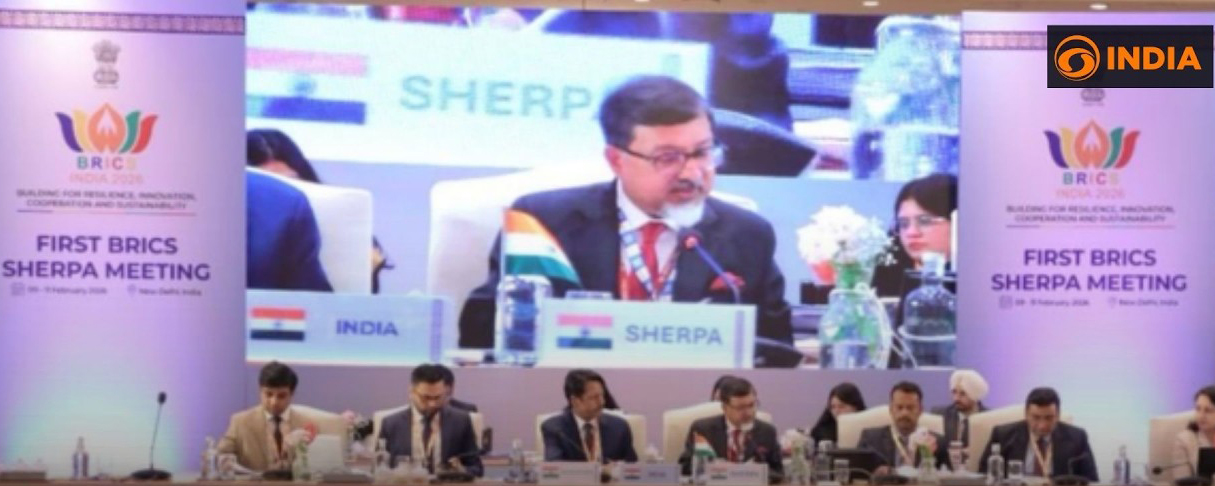







NEW DELHI: The First Meeting of BRICS Sherpas and Sous-Sherpas under India’s 2026 Chairship, held in New Delhi from 9–11 February 2026, marked a significant stage in the institutional consolidation of the expanded grouping amid a rapidly transforming global order. With ten full members now accounting for over 45 per cent of the world’s population and close to one-third of global GDP in purchasing-power-parity terms, BRICS has entered a phase where demographic and economic weight increasingly demands commensurate governance capacity. Anchored in India’s thematic framework of resilience, innovation, cooperation and sustainability, the Sherpa deliberations advanced procedural coherence, strengthened coordination around development finance through the New Development Bank, and reaffirmed a collective commitment to reforming multilateral institutions in favour of greater Global South representation. This article argues that the New Delhi meeting represents a gradual yet consequential institutionalisation of multipolarity, moving BRICS from symbolic assertion towards structured, development-centred governance reform.
Multipolarity in Structural Transition
The international system is experiencing a phase of structural transition characterised by shifting economic centres, technological transformation, and expanding political agency across the Global South. As emerging economies assume greater roles in global production, trade and innovation, pressures for more equitable representation within international institutions have intensified. Within this evolving landscape, BRICS has emerged as one of the most consequential platforms articulating reform-oriented multipolarity.
From its origins as a coordination forum among five major emerging economies, BRICS has expanded into a ten-member grouping encompassing Brazil, Russia, India, China, South Africa, Egypt, Ethiopia, Iran, Saudi Arabia and the United Arab Emirates. This expansion has significantly broadened the grouping’s geographic and political reach, bringing together economies that collectively command substantial shares of global energy production, manufacturing capacity and population. At the same time, enlargement has increased institutional complexity, making coherence and procedural discipline central to BRICS’ future relevance.
India’s assumption of the 2026 Chairship occurred precisely at this juncture. The inaugural Sherpa and Sous-Sherpa Meeting in New Delhi therefore functioned as more than a routine preparatory exercise; it became an early test of whether BRICS’ expanded representational breadth could be translated into functional institutional coherence. In his analysis of India’s BRICS leadership published in European Times on 14 January 2025, Dr Maheep described India’s chairship as an attempt to align global power rebalancing with institutional responsibility, emphasising reform, inclusivity and developmental pragmatism. The Delhi meeting provided the first procedural foundation for this approach.
India’s Reformist Multilateral Strategy
India framed its 2026 Chairship around the theme “Building for Resilience, Innovation, Cooperation and Sustainability”, a formulation that embeds normative ambition within institutional design. Prime Minister Narendra Modi’s articulation of people-centric and humanity-first multilateralism shaped the tone of the Sherpa deliberations, placing development equity and systemic stability at the heart of BRICS’ agenda.
Resilience was interpreted primarily in economic and institutional terms, encompassing debt sustainability, supply-chain security and financial shock absorption for developing economies navigating an increasingly volatile global environment. Innovation centred on digital public infrastructure, artificial-intelligence governance and technology cooperation, with a shared understanding that digital asymmetries risk reproducing older patterns of dependency if left unaddressed. Cooperation focused on strengthening intra-BRICS economic coordination while maintaining constructive engagement with existing multilateral institutions. Sustainability integrated climate finance, green energy transitions and adaptive development strategies into BRICS’ operational priorities.
The Sherpa Meeting endorsed the rationalisation of thematic tracks and the streamlining of working groups, aligning more than a hundred planned engagements in 2026 with time-bound, outcome-oriented processes. This emphasis on procedural discipline signalled a shift from expansive declaratory politics towards institutional consolidation, reinforcing BRICS’ credibility as a governance platform rather than a purely political coalition.
Institutional Maturation Amid Expansion
The most consequential challenge confronting BRICS at the Delhi meeting was ensuring that rapid expansion translated into enhanced effectiveness rather than institutional dilution. India’s chairship responded with measured procedural discipline, prioritising transparency, inclusivity and outcome orientation as guiding principles of institutional reform.
The launch of the BRICS 2026 portal, brics2026.in, symbolised this commitment to accessibility and procedural clarity, providing a centralised platform for documents, events and priorities. Within the Sherpa discussions, member-state contributions reflected both diversity and convergence. Russia emphasised continuity in political and economic coordination through the interventions of Deputy Foreign Minister Sergey Ryabkov, who underscored continuity in political-security cooperation, linking India’s priorities to the trajectory established under Brazil’s 2025 chairship. China, represented by Executive Vice Foreign Minister Ma Zhaoxu, reaffirmed its emphasis on “high-quality development”, consistent with President Xi Jinping’s broader focus on innovation-driven growth and infrastructure leadership. Brazil highlighted trade facilitation and macroeconomic coordination, while South Africa foregrounded reform of global financial governance and debt sustainability.
Newer members added further dimensions to the dialogue. Egypt stressed equitable representation within multilateral institutions, Ethiopia underscored Africa’s infrastructure and development financing needs, Iran raised concerns related to financial resilience, Saudi Arabia emphasised sustainable energy transitions, and the UAE focused on innovation ecosystems and investment connectivity. India’s diplomatic craftsmanship lay in integrating these perspectives into a shared developmental narrative without suppressing legitimate divergences.
As Dr Maheep argued in his The Print analysis of the 2023 BRICS Summit, the grouping’s long-term relevance depends on “transforming numerical weight into normative influence” (August 2023). The Delhi Sherpa Meeting vividly illustrated this transition, demonstrating how procedural refinement and shared developmental priorities can convert diversity into institutional momentum.
The New Development Bank and the Architecture of Financial Resilience
Economic coordination constituted the substantive core of the Sherpa deliberations. Discussions covered trade facilitation, digital public infrastructure cooperation, supply-chain resilience and emerging governance challenges associated with artificial intelligence. Within this broader agenda, the New Development Bank emerged as the central institutional anchor of BRICS’ development-centred governance.
Established with an authorised capital of US$100 billion, the NDB has approved financing for infrastructure, renewable energy and sustainable urban development across member states. The Sherpas discussed strengthening the Bank’s lending capacity — building on its US$100 billion authorised capital and expanding portfolio of sustainable infrastructure projects across member states — while enhancing project transparency and aligning its portfolio more closely with climate resilience and sustainable development objectives. This focus reflects a shared recognition that institutional authority in global governance is derived from delivery and credibility rather than rhetoric alone.
Currency-related discussions reflected a calibrated and pragmatic orientation. Rather than advocating abrupt systemic realignment, the Sherpa Meeting endorsed incremental diversification through local-currency settlements, cross-border payment coordination and risk-mitigation mechanisms. These measures were framed as tools for enhancing resilience and policy autonomy, complementing rather than displacing existing global financial arrangements. Dr Maheep characterised this approach as emblematic of BRICS’ “institutional pragmatism grounded in development deliver.” The Delhi deliberations confirmed this orientation, reinforcing BRICS’ positioning as a reformist, stability-enhancing actor within the global financial architecture.
The Global South as Normative Horizon
The Global South emerged as the most resonant normative frame of the New Delhi meeting, yet the Sherpas’ discussions moved beyond symbolism toward substantive policy coordination. Deliberations converged around reform of international financial institutions, debt sustainability mechanisms and equitable representation in global governance forums, including the United Nations and climate-finance bodies.
India’s language throughout the meeting remained reformist and inclusive, reinforcing legitimacy while advancing substantive demands. This posture aligns with New Delhi’s broader diplomatic strategy of pursuing institutional recalibration rather than systemic rupture. The emphasis on development finance, climate resilience and digital inclusion reflects shared vulnerabilities across BRICS members, particularly in the context of capital volatility and technological asymmetries.
At the same time, the Global South narrative encompassed internal diversity. Infrastructure priorities in Ethiopia and Egypt, regional dynamics involving Iran and Saudi Arabia, and China’s technological leadership ambitions required careful balancing. India’s understated diplomacy, evident in the cooperative tone of the Sherpa discussions, navigated these dynamics by anchoring consensus around sustainability and inclusivity rather than ideological alignment.
Geopolitical Balancing and Strategic Moderation
The Delhi meeting unfolded against a backdrop of intensifying global rivalry, yet BRICS deliberately maintained a development-centred focus. The Sherpa forum functioned as a space of disciplined dialogue among states with varying strategic orientations, demonstrating the grouping’s capacity for procedural cooperation amid diversity.
India’s orchestration reflected strategic moderation. By prioritising institutional reform and development cooperation, the chairship reinforced cohesion and avoided ideological polarisation. From a structural perspective, BRICS represents an emerging pole in a transitioning international order, yet its internal asymmetries necessitate consensus-driven governance. The Delhi meeting underscored a shared understanding that institutional maturity, rather than geopolitical assertion, remains central to BRICS’ long-term influence.
India’s Strategic Window
India’s 2026 Chairship represents a convergence of diplomatic credibility, developmental experience and institutional leadership. The Sherpa Meeting served as an institutional rehearsal for the leaders’ summit later in the year, embedding procedural coherence, calendarisation and inter-ministerial coordination across BRICS processes.
India’s approach reflects leadership through facilitation rather than domination, advancing multipolarity as pluralism rather than confrontation. By anchoring BRICS in pragmatic governance outcomes, New Delhi has positioned the grouping as a stabilising pillar within an evolving multipolar order.
Conclusion
The First BRICS Sherpa and Sous-Sherpa Meeting held in New Delhi in February 2026 marked a consequential stage in the institutionalisation of multipolarity. Through procedural consolidation, development-finance coordination and reform-oriented consensus, BRICS advanced from symbolic assertion towards operational governance capacity.
India’s stewardship aligned demographic weight with institutional discipline, reinforcing the grouping’s ability to shape inclusive global governance. As Dr Maheep observed in his assessment of India’s BRICS leadership (European Times, January 2026), BRICS is increasingly positioned as an instrument of balanced global power reconfiguration rooted in development pragmatism. The Delhi meeting stands as a defining milestone in this evolution, demonstrating that multipolarity acquires durability through institutions carefully designed, negotiated and sustained. India can elevate the grouping’s global stature while advancing its own vision of equitable, inclusive multipolarity. Should internal asymmetries remain unaddressed, however, the grouping risks remaining aspirational rather than operational — a challenge India’s chairship is uniquely positioned to navigate.
Views: 1306

Dr. Maheep
Dr. Maheep is Director, Indian Perspective on Global Affairs (IPGA), and a leading analyst of India’s foreign policy and South Asian geopolitics. He earned his PhD in Arab and Islamic Studies. With more than a decade of teaching and research experience in International Relations and Global Politics, he contributes regularly on issues shaping national and global affairs.