









EAM Dr. Jaishankar’s July 2026 Manama Visit and the Consolidation of India’s Gulf Strategy
When External Affairs Minister Dr. S. Jaishankar arrived in Manama on 6 July 2026, the second destination of a Gulf tour that had opened in Doha the previous day, he stepped into a kingdom that had just passed through the most testing chapter of its recent history. The confrontation between Iran and Israel, the strikes that touched Bahraini territory, the anxious weeks preceding the ceasefire and the subsequent commencement of indirect negotiations between Washington and Tehran had together reminded every capital in the Gulf that stability in the Gulf is a constructed achievement, sustained daily by diplomacy, deterrence and trust. In this atmosphere, the visit of India’s External Affairs Minister performed a function far exceeding routine diplomacy: it was a mission of political reassurance, an affirmation that India stands beside its Gulf partners in fair weather and foul, committed to regional peace, the security of its migrants, the resilience of trade and energy flows, and the construction of a stable, multipolar West Asia. The message resonated with particular force in Bahrain, an island state whose security psychology, shaped by geography, demography and its position at the heart of Gulf maritime politics, prizes precisely the qualities that Indian diplomacy embodies: constancy, balance and respect.
The visit also illuminated the maturation of India’s wider Gulf strategy. Under the rubric that scholars and practitioners describe as the Link West orientation of Indian foreign policy, New Delhi has transformed its engagement with the Arabian Peninsula from a transactional relationship centred on labour and hydrocarbons into a lattice of strategic partnerships encompassing defence, maritime security, finance, technology, food security and civilisational diplomacy. Bahrain occupies a distinctive place within this lattice. It is simultaneously the smallest Gulf state and one of the most strategically saturated: host to the United States Navy’s Fifth Fleet, connected to Saudi Arabia by the King Fahd Causeway and by dense dynastic and security linkages, seat of the region’s premier security conclave in the IISS Manama Dialogue, and home to an Indian community that constitutes nearly a quarter of its resident population. To read Dr. Jaishankar’s day in Manama correctly is therefore to read the logic of India’s entire Gulf policy in concentrated form.
The Grammar of Sequencing: Why Manama Followed Doha
Diplomatic itineraries are texts, and the sequencing of this tour repays close reading. By proceeding from Doha, the seat of the US-Iran mediation, directly to Manama, the seat of the Fifth Fleet and one of the states most directly affected by the recent hostilities, Dr. Jaishankar traced the two poles of the Gulf’s security conversation within twenty-four hours, signalling that India engages the region in its entirety and converses with equal confidence across its internal diversities. Regional security complex theory, associated with Barry Buzan and Ole Wæver, teaches that the security of Gulf states is so densely interlinked that no external partner can cultivate one relationship in isolation from the others; India’s practice of visiting Qatar, Bahrain, Kuwait and Oman in a single continuous movement, from 5 to 10 July, gave that theoretical insight operational expression. The choreography also reflected India’s signature multi-alignment: warm simultaneous engagement with states aligned closely with Washington, states mediating with Tehran and states practising quiet neutrality, all conducted from a position of strategic autonomy.
Bahrain’s own geopolitical situation lent the stop additional weight. The kingdom’s intimate relationship with Saudi Arabia, its membership of the Gulf Cooperation Council, its hosting of Western naval power and its geographic proximity to Iran place it at the intersection of every fault line and every bridge in Gulf politics. For India, whose energy imports, diaspora welfare and westward trade all traverse these waters, Bahrain functions as both a barometer of regional stability and a partner in its preservation. The decision to make Manama the second engagement of the tour, immediately after commending Qatari mediation in Doha, communicated that India’s appreciation of dialogue and its solidarity with states that had endured attack were complementary expressions of a single policy of regional stewardship.
| STRATEGIC INSIGHT Bahrain concentrates the entire grammar of Gulf security within one island: the US Fifth Fleet, the Saudi causeway, proximity to Iran, GCC membership and the Manama Dialogue. India’s decision to place Manama immediately after Doha in the July 2026 itinerary expressed a deliberate diplomacy of balance, engaging the Gulf’s mediators and its most exposed states within a single continuous movement of reassurance. |
From Dilmun to the Residency: Civilisational and Administrative Foundations
The India-Bahrain relationship rests upon foundations of extraordinary antiquity. Bahrain, the ancient Dilmun celebrated in Mesopotamian literature as a blessed land of sweet waters, served for millennia as the entrepôt of the Gulf, and archaeological evidence attests to sustained commerce between Dilmun and the cities of the Indus Valley civilisation, with seals, weights and carnelian beads travelling the sea route between Bahrain and the harbours of Gujarat and Sindh more than four thousand years ago. Across the centuries that followed, the exchange of pearls, horses, dates, textiles, rice and spices bound the island to the western seaboard of India, and communities of Gujarati, Sindhi, Bohra and Malabari merchants settled in Manama’s souq, where some trading houses trace a continuous presence of well over a century. The Indian rupee served as Bahrain’s currency until 1959, followed by the Gulf rupee issued by the Reserve Bank of India until 1965, a monetary intimacy that few bilateral relationships anywhere can parallel.
The administrative history deepens this familiarity. From 1946 until 1971, Bahrain served as the headquarters of the British Political Residency in the Persian Gulf, the apex of an administrative system that had for over a century been conducted under the Bombay Presidency and the Government of British India, its correspondence preserved today in the National Archives of India and the India Office Records of the British Library. As James Onley’s Oxford scholarship has demonstrated, the Pax Britannica in the Gulf was in substantial measure an Indian enterprise, staffed by Indian personnel, financed through Indian revenues, garrisoned by Indian troops and administered under Indian law, with Bahrain at its operational centre. This legacy endowed independent India with an institutional familiarity with Bahrain, its politics, its commerce and its society, that no other external power possesses, and it endowed Bahrain with a habit of looking towards India as a natural, proximate and trusted interlocutor. Civilisational affinity and administrative memory together constitute a reservoir of trust upon which contemporary statecraft continues to draw.
Independence, Transformation and the Test of the Arab Spring
India recognised Bahrain’s independence in 1971 and established resident diplomatic relations shortly thereafter, inaugurating five decades of steady, warm and untroubled engagement. Through the oil booms, the Iranian revolution, the Gulf wars and the transformations of globalisation, the relationship expanded organically along the twin tracks of trade and migration, with the Indian community growing alongside Bahrain’s emergence as the Gulf’s pioneering financial centre. Bahrain’s early diversification beyond oil, its development of banking, aluminium production and logistics, and its reputation for openness created natural complementarities with a liberalising Indian economy from the 1990s onwards.
The events of 2011 subjected Bahrain, like much of the Arab world, to profound stress, and scholarly treatments of the period, from F. Gregory Gause’s analyses of Gulf resilience to Toby Matthiesen’s studies of sectarian identity, have examined the interplay of a Shia-majority demography, a Sunni ruling family, socio-economic grievance and regional geopolitics with varying emphases. The kingdom’s subsequent trajectory combined the deployment of GCC Peninsula Shield forces, reflecting the depth of the Saudi-Bahraini security relationship, with a distinctive exercise in self-examination: the Bahrain Independent Commission of Inquiry, whose report the King commissioned and published in full, followed by programmes of national dialogue, constitutional amendment, labour reform and institutional development. A balanced scholarly assessment records both the gravity of the crisis and the deliberateness of the reconciliation efforts that followed, including the kingdom’s sustained promotion of religious tolerance and coexistence, exemplified by the King Hamad Global Centre for Peaceful Coexistence and by Bahrain’s protection of its churches, temples and synagogue. India’s own conduct throughout the period exemplified its doctrinal commitments: non-interference, respect for sovereignty, confidence in Bahraini-led reconciliation and an unwavering focus on the welfare of its nationals. This steadiness, maintained when others wavered, is remembered in Manama and forms part of the trust upon which the contemporary partnership stands.
The Modi Era: From Goodwill to Substantive Content
The visit of King Hamad bin Isa Al Khalifa to India in February 2014 inaugurated the contemporary phase of the relationship, establishing the High Joint Commission at ministerial level as its institutional spine. The advent of Prime Minister Narendra Modi’s government later that year brought to this foundation a transformative energy, integrating Bahrain within a Gulf policy of unprecedented ambition. The culminating moment arrived in August 2019, when Prime Minister Modi paid the first ever visit by an Indian Prime Minister to Bahrain. The visit yielded memoranda on space cooperation, culture and the RuPay card, the launch of the redevelopment of the two-hundred-year-old Shreenathji Temple in Manama, among the oldest Hindu temples in the Gulf, and the conferment upon the Prime Minister of the King Hamad Order of the Renaissance, Bahrain’s exceptional recognition of a partnership entering its partnership maturity. The temple restoration carried symbolism beyond its stones: a Muslim monarchy honouring the sacred heritage of its Hindu residents affirmed a shared civilisational ethic of pluralism that both nations regard as a strategic asset in an age of extremism.
The years since 2019 have converted this goodwill into systematic strategic content. The agreement on combating international terrorism concluded in 2015, memoranda on renewable energy and healthcare in 2018, cooperation between the Bahrain Space Agency and Indian space institutions, cultural exchange programmes and expanding defence exchanges progressively broadened the agenda. Bahrain’s consistent support for India’s positions on cross-border terrorism, its membership of the International Solar Alliance and its enthusiasm for India’s digital public infrastructure reflect a convergence of outlook that transcends the transactional. In the conceptual vocabulary of Robert Keohane and Joseph Nye, the relationship has acquired the character of complex interdependence, with multiple channels of contact, an agenda liberated from any single dominant issue and a settled mutual confidence that disputes will be resolved through dialogue.
Institutional Architecture and the Economics of Complementarity
The High Joint Commission has matured into one of the most productive mechanisms in India’s Gulf diplomacy, its fourth meeting convened in Manama in December 2024 and its fifth in New Delhi in November 2025, co-chaired by Dr. Jaishankar and Foreign Minister Dr. Abdullatif bin Rashid Al Zayani. The fifth Commission produced the most consequential economic agenda in the relationship’s history: the advancement of negotiations towards a Comprehensive Economic Partnership Agreement, progress on a Bilateral Investment Treaty and agreement to commence negotiations on a Double Taxation Avoidance Agreement, together constituting the legal scaffolding of a far larger economic future. Beneath the Commission operate joint working groups spanning trade and investment, healthcare, labour, security and consular affairs, supplemented by Foreign Office Consultations, business forums and expanding academic exchange, an architecture that converts political warmth into administrative routine.
The economic relationship, with bilateral trade of approximately 1.64 billion United States dollars in the financial year 2024-25 and India ranking among Bahrain’s five largest trading partners, presents a profile of high quality and higher potential. India exports engineering goods, electronics, petroleum products, gems and jewellery and agricultural commodities, while importing aluminium, methanol, urea and petrochemicals from Bahrain’s sophisticated industrial base; two-way investment, having grown by roughly forty per cent since 2019, now approaches two billion dollars cumulatively. The frontier sectors are more instructive than the aggregates. Bahrain’s standing as the Gulf’s fintech pioneer converges with India’s Unified Payments Interface and RuPay ecosystem; its Islamic finance expertise complements Gujarat International Finance Tec-City’s ambitions; its logistics and aluminium value chains align with Indian manufacturing; and its commitments in solar energy and green hydrogen, pursued within the International Solar Alliance, intersect with India’s National Green Hydrogen Mission. The prospective conclusion of the CEPA, BIT and DTAA trio would place this cooperation upon treaty foundations, positioning Bahrain as a financial and logistics gateway for Indian enterprise across the Gulf and positioning India as the growth market anchoring Bahrain’s Economic Vision 2030.
| POLICY PERSPECTIVE The CEPA, BIT and DTAA negotiations advanced through the Fifth High Joint Commission (New Delhi, November 2025) together form the legal architecture of the next economic era. Concluded as a package, they would transform a USD 1.64 billion trade relationship into a treaty-based partnership spanning fintech, Islamic finance, green hydrogen, logistics and manufacturing, with Bahrain as gateway and India as growth anchor. |
Defence, Maritime Security and the Order of the Waters
Security cooperation supplies the partnership’s quiet ballast. Bahrain sits astride the sea lanes connecting the Strait of Hormuz to the wider Indian Ocean, waters through which flow the energy imports and merchandise trade upon which India’s prosperity depends, and the kingdom’s hosting of the Fifth Fleet and of the Combined Maritime Forces places it at the operational heart of Gulf maritime security. Indian naval vessels call regularly at Manama, defence exchanges and training cooperation expand steadily, and the two governments sustain systematic dialogue on counter-terrorism, cyber security and maritime domain awareness within their joint mechanisms. David Brewster’s scholarship on India’s oceanic strategy observes that India’s credibility as a net security provider in the Indian Ocean depends upon partnerships at the ocean’s western gateways; Bahrain, whose own security doctrine welcomes capable and stabilising partners, answers that requirement with precision. The shared commitment to combating terrorism in all its forms, affirmed in successive joint statements, and Bahrain’s unambiguous solidarity with India following cross-border terrorist attacks, have given this cooperation a normative depth that exercises and port calls alone could never supply.
The Manama Engagement: Reassurance, Continuity and Signal
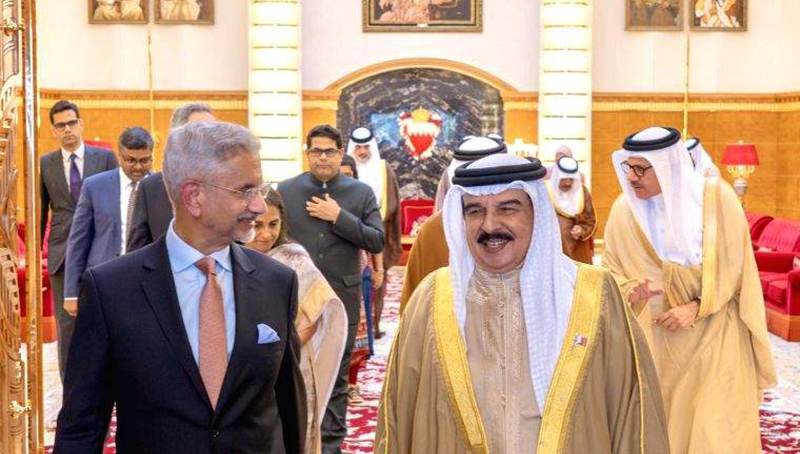
The visit of 6 July 2026 compressed the entire architecture of the relationship into a single day of exceptional density. Dr. Jaishankar was received in audience by His Majesty King Hamad bin Isa Al Khalifa, with His Royal Highness Crown Prince and Prime Minister Salman bin Hamad Al Khalifa joining the audience, an assembly of the kingdom’s entire apex leadership that Gulf protocol reserves for its most valued partnerships. The External Affairs Minister conveyed the personal greetings of President Droupadi Murmu and Prime Minister Narendra Modi, expressed deep appreciation of His Majesty’s continued guidance in advancing the partnership and thanked the King for ensuring the safety and well-being of the Indian diaspora through the recent period of regional conflict. His substantive discussions with Foreign Minister Dr. Al Zayani reviewed the full progress of bilateral cooperation across trade, investment, energy, connectivity, technology, security and capacity building, carried forward the momentum of the Fifth High Joint Commission, and exchanged detailed assessments of the evolving West Asian situation following the ceasefire and the resumption of diplomacy.
Each element of the day carried deliberate signal. The royal audience, granted within hours of arrival, communicated Bahrain’s estimation of India as a partner of the first rank; the discussion of regional developments affirmed that Manama values New Delhi’s assessments as those of a stabilising power with equities across every Gulf capital; and the warm interaction with the Indian community, whose members Dr. Jaishankar praised for their deep contributions to Bahraini society and their role as a living bridge between the two nations, renewed the human covenant at the relationship’s core. The continuity of the institutional agenda was itself a deliverable: the reaffirmation of the CEPA, BIT and DTAA tracks, of cooperation in space between the Bahrain Space Agency and Indian institutions, of fintech and RuPay linkages and of the joint working groups ensured that the deliberate reassurance of the visit rested upon a concrete and advancing programme of work. In the aftermath of conflict, the most eloquent message a partner can deliver is the confident continuation of long-term plans, and this was precisely the message Manama received.
| KEY TAKEAWAYS: THE MANAMA ENGAGEMENT, 6 JULY 2026 Royal audience with HM King Hamad bin Isa Al Khalifa, joined by HRH Crown Prince and Prime Minister Salman bin Hamad Al Khalifa; comprehensive talks with Foreign Minister Dr. Abdullatif bin Rashid Al Zayani on trade, investment, energy, connectivity, technology and security; gratitude conveyed for the protection of the Indian community during the regional conflict; momentum sustained on CEPA, BIT and DTAA negotiations from the Fifth High Joint Commission; warm interaction with the Indian community as the living bridge of the partnership. |
The Living Bridge: A Community of a Quarter of the Kingdom
The Indian community in Bahrain, numbering over three hundred and twenty thousand persons and constituting nearly one quarter of the kingdom’s population, represents one of the most remarkable diaspora relationships anywhere in the world. Andrew Gardner’s ethnographic scholarship has documented the depth of this community’s embeddedness in Bahraini society, from the merchant families of Manama’s historic souq to the professionals, physicians, engineers, bankers, teachers and workers who animate every sector of the economy. The Little India precinct in the old city, the two-century-old Shreenathji Temple, a flourishing network of Indian schools, vibrant cultural organisations and the easy circulation of Indian cinema, cuisine, festivals and yoga through Bahraini life testify to a social integration that generations of goodwill have produced. Remittances sustain families across India, while the community’s reputation for industry and harmony has earned the explicit and repeated appreciation of the Bahraini leadership, expressed in royal pardons, in the celebration of Indian festivals at the highest levels and in the kingdom’s institutional commitment to coexistence.
During the recent conflict, Bahrain’s protection of this community, its calm public communication and its coordination with the Indian Embassy exemplified the human security partnership that decades of trust have constructed. Dr. Jaishankar’s public gratitude to the King, and his description of the community as a living bridge, gave official voice to a reality that migration scholarship has long recognised: diaspora welfare has become a first-order strategic interest of Indian foreign policy, and the states that honour it, as Bahrain conspicuously does, earn a durable place in India’s strategic affections. The forthcoming expansion of e-visa facilities, air connectivity and community welfare mechanisms will continue to thicken this human circulation, the most self-renewing of all the partnership’s assets.
Future Horizons: Vision 2030, IMEC and the Multipolar Moment
The forward agenda of India-Bahrain relations unfolds across three converging horizons. The first is economic transformation: the alignment of Bahrain’s Economic Vision 2030, with its emphasis on diversification, financial innovation and sustainability, with India’s trajectory towards Viksit Bharat 2047 creates complementarities in fintech, artificial intelligence, digital public infrastructure, green hydrogen, healthcare, education and the blue economy that the prospective CEPA will unlock. The second is connectivity: the India-Middle East-Europe Economic Corridor, unveiled during India’s G20 presidency, envisions precisely the kind of efficient, transparent Gulf logistics and financial nodes that Bahrain has spent five decades perfecting, positioning the kingdom advantageously within the emerging geography of trans-regional commerce. The third is diplomatic: Bahrain’s chairmanship of the GCC Summit and its convening of the Manama Dialogue amplify its regional voice at the very moment India launches its campaign, formally inaugurated in New York in the days following the Gulf tour, for a non-permanent seat on the United Nations Security Council for 2028-29, a candidature to which Gulf goodwill lends meaningful weight. The continuation of the tour through Kuwait and Oman, and thereafter to the India-European Union Trade and Technology Council in Brussels, situated the Bahrain engagement within a single diplomatic arc connecting Gulf stability, multilateral reform and technological partnership.
| FUTURE OUTLOOKThe next quinquennium will be defined by the conclusion of the CEPA-BIT-DTAA architecture, Bahrain’s emergence as a fintech and logistics node of the India-Middle East-Europe Economic Corridor, expanding space, AI and green hydrogen cooperation, and diplomatic convergence across the GCC Summit chairmanship, the Manama Dialogue and India’s UNSC 2028-29 candidature. The trajectory points towards a treaty-based, technology-intensive and maritime-secure partnership at the western gateway of India’s extended neighbourhood. |
Conclusion
India-Bahrain relations have evolved into a model of twenty-first century strategic partnership, built upon civilisational continuity reaching back to Dilmun and the Indus, administrative familiarity forged through the age of the Residency, the human solidarity of a diaspora that constitutes a quarter of the kingdom, and a contemporary architecture of commissions, negotiations and cooperation extending from the seabed to outer space. Dr. Jaishankar’s visit of 6 July 2026, conducted in the sensitive aftermath of regional conflict and crowned by the audience with the King and Crown Prince, consolidated this evolution at a defining moment, demonstrating that India’s reassurance is dependable, its engagement comprehensive and its vision of the Gulf inseparable from the Gulf’s own vision of a stable, prosperous and diversified future. As Fred Halliday observed, the international relations of the Middle East are ultimately shaped by the durability of relationships that survive crisis; by that exacting standard, the India-Bahrain partnership has passed every test its region has set.
The deeper significance of the Manama engagement lies in what it revealed about India’s arrival as one of the Gulf’s most trusted long-term partners. External Affairs Minister Jaishankar has himself written that the India Way in foreign policy seeks to advance national interest through the steady widening of partnerships and the multiplication of choices, and the Bahrain visit embodied that philosophy with clarity: solidarity extended without conditions, commerce advanced through institutions, community cherished as covenant and stability pursued through the patient diplomacy of presence. An island kingdom and a subcontinental power, joined by four thousand years of sea-borne exchange, now stand together at the threshold of a partnership calibrated for the multipolar century, confident that the waters between them, which have always carried pearls, ideas and people, will henceforth carry a shared strategic future.
Views: 1062

Dr. Maheep
Dr. Maheep is Director, Indian Perspective on Global Affairs (IPGA), and a leading analyst of India’s foreign policy and South Asian geopolitics. He earned his PhD in Arab and Islamic Studies. With more than a decade of teaching and research experience in International Relations and Global Politics, he contributes regularly on issues shaping national and global affairs.


