


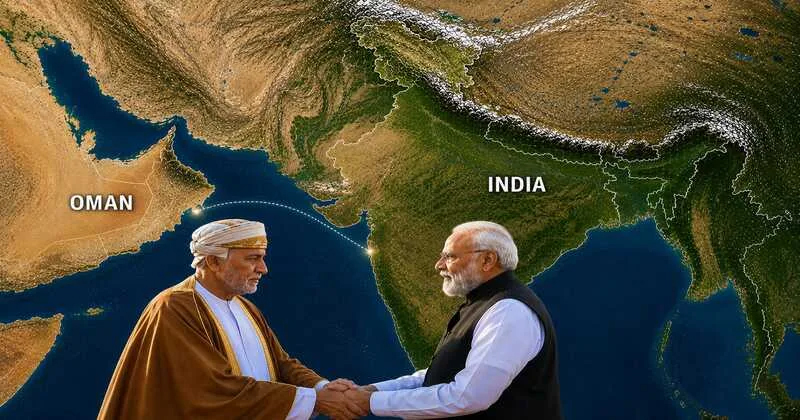







On the first day of June 2026, in a measured but consequential ceremony in New Delhi, the Comprehensive Economic Partnership Agreement between India and the Sultanate of Oman entered into force. The instrument had been signed six months earlier, on 18 December 2025, in Muscat, in the gracious presence of Prime Minister Narendra Modi and His Majesty Sultan Haitham bin Tarik Al Said. Within hours of its operationalisation, consignments of agricultural produce and of gems and jewellery were flagged off from Mumbai, Kolkata, and Chennai under the new preferential regime, small but symbolically potent acts that translated a schedule of tariffs into the lived economy of Indian producers and Omani consumers. To the casual observer it amounted to a customs notification and the familiar choreography of ministerial statements. To one who has spent the better part of three decades observing the slow tides of India–Gulf relations, it represented something far larger: the formal institutionalisation of a relationship that long predates the modern state system, arriving at the precise moment the wider region most needs reassurance.
The timing is not incidental. The Agreement matures into force against a West Asian horizon darkened by recurrent conflict, contested sea lanes, fractured supply chains, and a pervasive anxiety about the reliability of partners. In such an environment, an accord granting near-total duty-free access covering 98.08 percent of Oman’s tariff lines and 99.38 percent of the value of India’s exports, liberalising trade across 127 services sub-sectors, and building durable scaffolding for investment and professional mobility, reads less as a routine commercial transaction than as a deliberate act of construction amid surrounding decay. It is, in the truest sense, a beacon: a demonstration that even in a fragmenting order, states bound by trust and complementary need can choose to deepen rather than retreat.
My central argument is both simple and consequential: the India–Oman CEPA is not merely a trade agreement. Rather, it is the contemporary institutionalisation of a maritime partnership measured in millennia, translating an ancient reservoir of civilisational trust into the formal grammar of twenty-first-century economic statecraft. In this sense, the Agreement represents not the beginning of a new relationship, but the renewal of one of the oldest and most enduring partnerships of the Indian Ocean world. At its deepest level, the CEPA embodies what may be termed Monsoon Diplomacy: the formalisation, in modern legal and commercial architecture, of a centuries-old pattern of seasonal mobility, reciprocal exchange, and civilisational engagement shaped by the rhythms of the Indian Ocean. Viewed through this lens, the Agreement marks the transition of a historically rooted friendship into a future-oriented framework of strategic partnership, economic integration, and shared prosperity. More significantly, it offers the Global South a fascinating model of cooperation founded not on dependency or coercion, but on mutual respect, reciprocity, and convergent developmental aspirations.
Long Memory of the Monsoon: Civilisational Foundations
To understand why this Agreement rests on such solid ground, one must begin not in the negotiating rooms of 2025 but on the deck of a wooden dhow some five thousand years ago, its single sail filled by the seasonal reversal of the monsoon. The maritime intimacy between the Indian subcontinent and the Arabian Peninsula is among the oldest sustained commercial relationships in human history. The cuneiform tablets of Mesopotamia speak of Magan, which scholars of the ancient Near East persuasively identify with present-day Oman, as a source of copper and diorite; and the same trading world drew the artisans and merchants of the Indus Valley, whose great port at Lothal in Gujarat stood as a node in a web of exchange stretching across the Arabian Sea.
The genius of this early commerce lay in the monsoon itself. The mariners of the western Indian Ocean learned, with a sophistication that humbles the modern mind, to read the rhythm of the winds, sailing westward to Arabia on one season’s breath and returning eastward to the Konkan and Malabar coasts on its reversal. Copper, beads, carnelian, and textiles moved in one direction; frankincense, dates, and the prized horses of Arabia moved in the other. The ports of Sohar, Muscat, and Sur became the great clasps binding the two civilisational worlds, and Sohar in particular earned its reputation in medieval Arab geography as a gateway to the lands of Hind, the legendary home port of the Sindbad of folklore.
What is striking, and what gives the present Agreement its unusual depth, is that this exchange was never confined to goods. It carried ideas, aesthetics, and people. Specific mercantile communities gave the relationship its human grain. The Bhatia and Kutchi traders of Gujarat, the Lawatiya community of Muscat whose very name records its subcontinental origins, the Hindu merchant houses that clustered in the old quarter of Matrah, all wove themselves into the commercial life of Oman across generations. By the eighteenth century a Hindu temple stood in the Omani capital, a quiet monument to a coexistence that the modern vocabulary of tolerance struggles to capture. Architectural sensibilities crossed the water, visible in the carved teak doors and balconies shared across Omani and western Indian coastal traditions. Arabic loanwords sedimented into the coastal languages of Gujarat, Kerala, and the Konkan, while culinary practices intermingled until the boundary between them grew pleasantly indistinct. Oman’s own historical reach across the Indian Ocean, from Gwadar to Zanzibar, ran along the same arteries that bound it to India, so that the Sultanate sat at the very crossing-point of the ocean’s commerce.
This is the essential point that scholars of civilisational connectivity, among them Dr. Maheep Singh in his article for European Times on Prime Minister Modi’s visit and India’s projection into the Gulf, have rightly emphasised: the relationship between India and Oman carries no colonial residue, no memory of subjugation, no inheritance of grievance. It is a relationship of equals who met as traders and remained as friends. Where so many contemporary partnerships must first labour to overcome the suspicions bequeathed by history, India and Oman begin from a reservoir of trust that few bilateral relationships on earth can match.
“The monsoon taught both peoples a lesson that diplomacy is only now formalising: that prosperity arrives on winds that blow in both directions.”
From Treaty of Friendship to Strategic Partnership
The modern chapter opens with the Treaty of Friendship, Commerce and Navigation of 1953, concluded even before Oman’s contemporary renaissance and India’s own consolidation as a republic had fully matured. It was a recognition, in the language of the new state system, of a bond the states themselves had not created but inherited. The relationship deepened steadily thereafter, acquiring a defence dimension of genuine substance, including naval cooperation, joint exercises, and access arrangements that lend the partnership real strategic weight in the northwestern Indian Ocean. The elevation to a Strategic Partnership in 2008 gave formal name to a closeness that had long been operational.
Energy has been a steady current within this relationship, with Oman a reliable supplier of crude and a partner in the petrochemical and fertiliser trade on which Indian agriculture quietly depends. Yet to reduce the relationship to hydrocarbons would be to mistake the visible for the vital. The truer foundation is human. Today an Indian community of roughly 680,000 lives and works in Oman, constituting close to a fifth of the Sultanate’s population and forming one of the most respected and deeply integrated expatriate communities anywhere in the Gulf. More than six thousand Indian enterprises operate in the Sultanate, and annual remittances of some two billion dollars trace, in the dry language of balance-of-payments accounting, the warm reality of intertwined livelihoods. They are not a transient labour force alone but a settled presence woven through Omani economic life: in healthcare and education, in construction and finance, in technology and entrepreneurship.
It is worth pausing on a phenomenon I have observed with growing interest over the years: the marked preference among Omanis, and Gulf residents more broadly, for India as a destination for healthcare, higher education, and professional services. India offers medical care of genuine quality, in cardiology, oncology, organ transplantation, and the traditional systems of Ayurveda, at a fraction of the cost of Western alternatives. But cost alone does not explain the pattern. Where a patient from Muscat might once have looked to London, Frankfurt, or Bangkok, the Indian option now combines clinical excellence with three advantages those destinations cannot jointly offer: the proximity of a short hop across the Arabian Sea that the monsoon mariners would have recognised; the cultural intelligibility of familiar food, shared social rhythms, and the absence of alienation; and trust, that intangible inheritance, the quiet confidence of being received not as a stranger but as a guest within a long acquaintance. Indian medical professionals, who constitute a substantial share of Oman’s private healthcare workforce, are themselves the living embodiment of this confidence. For the Omani patient or student, India represents not an alternative to the West but a complement whose quality is matched by cultural familiarity and geographic nearness, a combination no marketing expenditure can replicate. Here, in the realm of human security, is soft power of the most authentic kind.
Oman’s Singular Place in India’s Gulf Policy
Among the six states of the Gulf Cooperation Council, Oman occupies a position in Indian strategic thinking that is genuinely unique, and the distinction is worth drawing precisely. Oman has long practised a foreign policy of studied independence and quiet mediation. While its neighbours have at various moments been drawn into the sharper rivalries of the region, Muscat has cultivated a reputation as the Gulf’s indispensable interlocutor, maintaining functional relations with parties that scarcely speak to one another, including a measured and pragmatic channel to Tehran across the Strait. This temperament, inherited from the long reign of the late Sultan Qaboos and sustained by Sultan Haitham, has made Oman a venue for discreet diplomacy and a stabilising presence rather than a partisan one.
For India, whose own statecraft prizes strategic autonomy and the maintenance of relations across regional divides, this Omani disposition is not merely congenial but precious. A partner that is trusted by all and aligned against none offers New Delhi something rarer than commercial volume: it offers reliability insulated from the region’s factional turbulence. Oman has never asked India to choose sides, and India has never had cause to doubt Oman’s constancy. It is no accident that India’s deepest defence access arrangements in the Gulf are with Muscat, nor that the first comprehensive economic partnership India has concluded with a GCC member beyond the United Arab Emirates should be with Oman. The Agreement rests, in this sense, on a foundation of political trust that is as material to its prospects as any tariff schedule.
The Architecture of a Next-Generation Agreement
To grasp why the CEPA represents a qualitative advance rather than an incremental one, the distinction between a conventional free trade agreement and a comprehensive economic partnership must be drawn with care. A traditional FTA is, at its heart, a tariff instrument: it lowers duties on goods and, having done so, largely exhausts its ambition. A comprehensive economic partnership agreement is a creature of a different order. It treats tariff liberalisation as a foundation rather than an edifice, and builds upon it a structure encompassing trade in services, the protection and facilitation of investment, the mobility of professionals, the harmonisation of standards, the safeguarding of intellectual property, mechanisms for the orderly settlement of disputes, and the deliberate integration of supply chains. Where a conventional agreement would have stopped at the border, the CEPA crosses it.
The headline figures are remarkable in themselves. The opening of 98.08 percent of Oman’s tariff lines, covering 99.38 percent of the value of India’s exports, ranks among the most generous market-access outcomes India has secured anywhere in the Gulf. The immediate practical consequence is the elimination of the baseline five percent duty that had encumbered some 3.6 billion dollars of Indian goods, a change the Global Trade Research Initiative and others have noted will translate directly into competitive advantage. Products from honey and cashews to processed foods, dairy, marine products, and confectionery gained instant duty-free entry, alongside faster marketing authorisation for Indian pharmaceuticals.
Yet the goods chapter, however generous, is only the threshold, and here the distinctive logic of the comprehensive form reveals itself. The liberalisation of 127 services sub-sectors does not merely open markets; it formalises and protects the very channels through which Indian capabilities and Omani developmental needs already intersect, in information technology, healthcare delivery, education, and research. The provisions on professional mobility convert an existing informal flow, the doctors, engineers, accountants, and educators who already form the connective tissue of the relationship, into a predictable and protected channel. A pure tariff agreement cannot do this; it has no language for the human and regulatory architecture on which modern services trade depends. This is the genius of the comprehensive design: it does not invent the relationship, it secures it.
India’s exporters of pharmaceuticals, gems and jewellery, textiles, leather and footwear, engineering goods, and processed agricultural products stand among the principal beneficiaries, and the gains accrue disproportionately to the labour-intensive sectors in which India’s micro, small, and medium enterprises concentrate. Oman secures privileged access to a market of 1.4 billion for its petrochemicals, fertilisers, metals, and energy products. Bilateral trade, which reached 11.18 billion dollars in the 2025–26 financial year, rising from 10.61 billion the year before, now possesses the institutional scaffolding to climb considerably higher. The pre-signing studies of the Research and Information System for Developing Countries, notably the work of Professor S. K. Mohanty and Dr. Pankhuri Gaur, anticipated precisely this potential for trade expansion and investment deepening, and aligned it intelligently with Oman’s developmental blueprint.
Two Models in the Gulf: The Oman and UAE Agreements Compared
The Oman accord is best understood alongside its immediate predecessor, the India–United Arab Emirates CEPA of 2022, not as its rival but as its complement. The UAE agreement was the pathbreaker, and its results have been emphatic. Bilateral trade crossed the hundred-billion-dollar threshold in the 2024–25 financial year and stood above 101 billion in 2025–26, a cumulative expansion of more than a third in roughly four years. The gem and jewellery sector furnished the signature success, Indian exports surging by over sixty percent as the elimination of the prior five percent duty took hold, and non-oil trade expanded so vigorously that the two governments have since set a fresh target of two hundred billion dollars by 2032. The UAE CEPA proved, beyond argument, that a comprehensive agreement could deliver rapid and visible gains when political will and mutual confidence align.
Yet the two agreements answer to different strategic logics, and the contrast illuminates each. The Emirati partnership is commercially the larger, anchored in the role of Dubai and Abu Dhabi as global financial and re-export hubs through which Indian goods reach onward markets; it is a deal of capital, scale, and velocity. The Omani partnership is strategically the deeper. Where the UAE offers a financial entrepot, Oman offers a maritime gateway; where the Emirati model is trade-driven and built upon re-export, the Omani model is connectivity-driven and built upon industrial diversification and logistics. The UAE links India to global capital flows; Oman links India to the geography of the open Arabian Sea and the corridors beyond it. Lower in volume, the Oman Agreement is higher in strategic value, and the two together describe a coherent Gulf architecture rather than a duplicated one.
An Indian Ocean Agreement: Maritime Statecraft and Vision 2040
The deepest significance of the India–Oman CEPA lies in a dimension that conventional trade analysis tends to overlook. This is not merely a bilateral trade accord; it is an Indian Ocean agreement. Its true import lies in its capacity to reconnect the economic geography of the western Indian Ocean, linking Indian manufacturing centres, Omani logistics hubs, East African markets, Gulf energy networks, and emerging transcontinental corridors. In this sense the accord transcends the conventional logic of tariff reduction and assumes the character of maritime statecraft, transforming ancient sea routes into contemporary pathways of prosperity, resilience, and strategic convergence.
Geography makes the argument vivid. Oman occupies the southern shoulder of the Strait of Hormuz, the narrow channel through which much of the world’s seaborne oil must pass and through which it must also remain vulnerable. Crucially, Oman’s principal ports, Sohar, Duqm, and Salalah, lie largely outside the Strait, fronting the open Arabian Sea. In an era when the chokepoint’s security can be neither assumed nor guaranteed, this geography acquires extraordinary value. It offers India, and the wider community of trading nations, a potential corridor to the Gulf and onward to East Africa that does not depend upon transit through the world’s most contested waters. The deep-water port and special economic zone at Duqm, in particular, stands as a natural anchor for Indian commercial and logistical engagement on the Arabian Sea littoral, and the CEPA furnishes the institutional framework within which such engagement can mature.
This maritime reading aligns the Agreement with the broader arc of Indian oceanic strategy, the vision of the Indian Ocean as a region of shared security and growth in which India acts as a net provider of stability and a partner in the prosperity of its neighbours. It situates the accord, too, alongside the emerging transcontinental corridors that increasingly define the region’s economic future, the architecture being assembled to link the Gulf, the subcontinent, and Europe into a continuous artery of trade and energy. Oman’s ports and India’s manufacturing, joined by a comprehensive partnership and pointed toward East Africa and the wider ocean, form a logical and resilient segment of any such design.
The economic complementarity that underwrites all this is codified, on the Omani side, in Vision 2040, the Sultanate’s strategy for an economy diversified beyond oil and anchored in logistics, manufacturing, tourism, and a knowledge-based private sector. The alignment with India’s offering is almost uncannily precise, pillar for pillar. Where Vision 2040 seeks to build logistics and port-led industry, India brings shipping, engineering, and project capability. Where it seeks tourism and a service economy, India brings both visitors and the hospitality and healthcare expertise to serve them. Where it seeks a knowledge economy, India brings information technology, financial technology, and the experience of building digital public infrastructure at civilisational scale, from unified digital payments to identity and data systems whose relevance to Oman’s own digital ambitions is direct. And where Vision 2040 looks toward the energy transition, the convergence may prove most transformative of all: Oman has staked a serious claim to leadership in green hydrogen and green ammonia, and its abundant solar and wind resources, joined to Indian capital, renewable-energy capability, and appetite for clean fuel and carbon-neutral logistics, open a frontier of cooperation that reaches far beyond the hydrocarbons of the past. Analysts at the Middle East Institute in New Delhi, among them Professor Sameena Hameed, have illuminated how Oman’s strategic geography unlocks possibilities neither party could realise alone, while the Centre for Public Policy Research has examined the Agreement’s capacity to reshape the wider architecture of Gulf economic ties.
India’s CEPA Diplomacy and the Path to the Gulf
The Oman accord does not stand alone. It is the latest and in some respects the most refined expression of a broader transformation in Indian economic statecraft, a turn toward the deliberate construction of deep, comprehensive partnerships as instruments of both prosperity and strategic positioning. The agreements with the United Arab Emirates, with Australia, and with the states of the European Free Trade Association extended the pattern across continents. The Oman CEPA, India’s fifth trade pact to be operationalised within five years, confirms that this is no longer experiment but settled strategy.
Read together, these agreements describe a coherent vision. India is constructing, partner by partner, a diversified web of economic relationships designed to reduce its exposure to any single market, any single chokepoint, any single source of supply. In a world where trade has increasingly become an instrument of pressure, this patient diversification is itself a form of security, the commercial equivalent of strategic autonomy. The Oman Agreement carries particular weight because it serves as both an achievement in itself and a stepping stone toward the larger prize: the comprehensive India–Gulf Cooperation Council arrangement, negotiations toward which have gathered momentum. The Gulf bloc accounts for a substantial share of India’s trade and the majority of its energy imports, and a successful Oman partnership offers a proof of concept, a demonstration to Riyadh, Doha, Kuwait, and Manama that comprehensive integration with India yields tangible and balanced rewards. When commentators at Gateway House, drawing on the deep experience of practitioners such as Ambassador Anil Wadhwa, a former Indian envoy to Muscat and a seasoned trade hand, assess the Agreement’s significance, they return repeatedly to this dual character, the deal as both destination and doorway.
A Candid Reckoning: Challenges and the Work Ahead
Intellectual honesty requires that admiration not curdle into uncritical celebration. The CEPA is a framework of possibility, not a guarantee of outcome, and the distance between a signed text and a transformed economy is measured in the unglamorous labour of implementation. Even the conspicuously successful UAE agreement continues, four years on, to demand sustained attention to utilisation rates and non-tariff frictions; the Oman partnership should expect no easier path, and its more modest volumes leave less margin for complacency.
The first challenge concerns non-tariff barriers and regulatory harmonisation. Tariff elimination, however generous on paper, can be quietly undone by divergent standards, opaque licensing, and the friction of incompatible regimes. The rules of origin framework, with its product-specific requirements, regional value content thresholds, and de minimis tolerance, strikes an intelligent balance — rewarding genuine transformation and supply-chain integration while guarding against trade deflection. Yet its administration must be efficient lest it become an obstacle to the very trade it is meant to authenticate.
The second concerns capacity, particularly among the micro and small enterprises the Agreement is meant most to benefit, for preferential access is worthless to a firm that lacks the awareness, the certification, or the logistical reach to use it. The third set of challenges is exogenous: a volatile regional security environment, global economic headwinds, the fragmentation of trade into rival blocs, and intensifying competition from other suppliers in the Omani market. Here, however, the comprehensive form offers its own quiet answer, for the Agreement’s institutional mechanisms, its provisions for dispute settlement and regulatory cooperation, are precisely the instruments through which shocks can be absorbed and frictions resolved without rupture. None of these caveats negates the Agreement’s transformative potential. They simply locate it correctly, as an instrument whose promise will be realised through diligence rather than delivered by signature. The wise course is to treat 1 June 2026 not as a destination but as a starting line.
Conclusion
In an international order increasingly defined by fracture, by the weaponisation of interdependence, by the retreat of nations into suspicion and self-reliance, the India–Oman CEPA offers a quietly radical proposition: that the deepest security lies not in isolation but in the patient cultivation of trusted partnership. The Agreement that entered into force on the first of June is, on its surface, a document of tariff schedules and services annexes. Beneath that surface it is something closer to a covenant, the formal renewal of a relationship that the monsoon winds inaugurated five thousand years before any chancellery existed to record it.
This is the continuum I have sought to trace, the monsoon diplomacy whose latest instrument this Agreement is: from the copper of Magan to the pharmaceuticals of Gujarat, from the dhow to the container vessel berthed at Duqm, from the Hindu temple in eighteenth-century Muscat to the 680,000 Indians who today call Oman a second home. Each era found its own instrument for an unchanging impulse toward exchange, settlement, and mutual flourishing. The CEPA is simply our era’s instrument, more elaborate than its predecessors but animated by the same ancient confidence.
For the Global South, watching from beyond the region, the lesson is instructive, and it is sharpened by contrast. Here are two states of unequal size and dissimilar systems demonstrating that partnership need not mean subordination, that integration can rest on genuine respect and complementarity rather than on extractive asymmetry, and that the oldest bonds, tended with care, can be made to bear the newest fruit, in green hydrogen and digital infrastructure no less than in textiles and spices. If the twenty-first century is to discover a model of cooperation worthy of an interdependent and endangered world, it may well find an early and elegant draft of it in the waters between Muscat and Mumbai, where the winds have always known the way home.
Views: 1696

Dr. Maheep
Dr. Maheep is Director, Indian Perspective on Global Affairs (IPGA), and a leading analyst of India’s foreign policy and South Asian geopolitics. He earned his PhD in Arab and Islamic Studies. With more than a decade of teaching and research experience in International Relations and Global Politics, he contributes regularly on issues shaping national and global affairs.


