



Sheikh Hamad bin Khalifa Al Thani (1952–2026): Architect of Modern Qatar and the Rise of India – Qatar Relations
A shrouded body, a brief prayer at dusk, and a plain grave in the sand north of Doha, Qatar: the Gulf buried one of its greatest builders, on the evening of 12 July 2026, with a plainness that would have suited a fisherman. The mourners at the Imam Muhammad ibn Abd al-Wahhab Mosque understood the eloquence of that austerity. Sheikh Hamad bin Khalifa Al Thani had never required marble, because he had chosen a different material for his monuments. His memorials broadcast in Arabic and English to half the planet; they confer degrees in Doha; they hold equity in the banks, airports and boulevards of Europe; they sit at negotiating tables from Kabul to Gaza; and they ship, every few hours, another cargo of liquefied gas toward the furnaces of Asia. A statesman who builds in institutions can afford to be buried in sand.
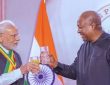
A day later and two thousand miles to the east, the tricolour descended to half-mast across the Republic of India. New Delhi declared a full day of State Mourning for the Father Emir, suspended official entertainment, and despatched a Union Minister to Doha bearing the nation’s condolences, while Prime Minister Narendra Modi mourned a “visionary leader” and a “true friend” he had embraced in Doha in February 2024. India lowers its flag for foreign statesmen perhaps once in a generation. That it did so for the retired ruler of a peninsula smaller than many Indian districts is a fact that demands explanation, and the explanation is the subject of this essay. The mourning measured something real: the distance one man’s judgement had moved his country, and the depth to which that country had been woven into India’s own conception of its western horizon.
This essay reads Sheikh Hamad’s life as a sequence of five great wagers, each placed against the settled wisdom of his time, each redeemed by history, and each instructive for the multipolar age his passing now symbolically opens. He wagered on gas when counsel urged caution; on voice when the region prized silence; on trust when cynicism was the regional currency; on minds when wealth alone would have sufficed for legitimacy; and finally on time itself, walking away from a throne at the height of his powers. India appears in this story twice over, first as the earliest beneficiary of several of these wagers and then as their philosophical kin, for the statecraft Sheikh Hamad practised from the vantage of the very small is recognisably the statecraft India practises from the vantage of the very large. The tribute that follows is therefore analytical before it is elegiac, in the conviction that the most respectful memorial a scholar can offer a strategist is to take his strategy seriously.
The Gamble on Gas
Destiny handed the young Hamad a geological gift and a strategic nightmare in the same decade. The North Field, identified offshore in 1971, held more natural gas than any single reservoir on earth, yet through the 1970s and 1980s it lay essentially fallow, dismissed in Doha as a resource whose development would demand sums no prudent micro-state should hazard. The nightmare arrived in August 1990, when Iraq swallowed Kuwait in a single night and taught every small Gulf ruler the same terrible arithmetic: wealth without weight invites appetite. Hamad, then heir apparent and defence minister, drew from Kuwait’s agony a conclusion that would organise the rest of his life. A small state survives by becoming valuable to the strong, visible to the world and expensive to molest, and the North Field, properly developed, could purchase all three conditions at once.
He assumed power on 27 June 1995, at forty-three, in a bloodless family transition, and he governed from the first morning like a man racing a clock only he could hear. Within eighteen months the first Qatari LNG cargo sailed for Japan. Within a decade Qatar had partnered the international majors on terms that kept sovereignty at home while importing technology at scale, had commissioned the largest liquefaction trains and gas carriers ever built, and had overtaken every rival to become the world’s leading exporter of liquefied natural gas. The choice of LNG over pipelines was itself a geopolitical philosophy compressed into an engineering decision: pipes would have chained Qatar to its neighbourhood, while ships married it to Tokyo, Seoul, London and, fatefully, to India. Then, at the very crest of the boom in 2005, he halted new development of the field for a generation, so that the reservoir could be studied and the patrimony husbanded. Restraint at the moment of triumph is the rarest gesture in the politics of windfalls, and it announced a ruler whose horizon was measured in grandchildren.
The proceeds became instruments. Gas revenue financed a sovereign wealth fund, created in 2005, that within a decade held Harrods and stakes in Heathrow, Volkswagen, Barclays and the skyline of London, so that the prosperity of Qatar became a line item in the balance sheets of the powerful. Revenue built Al Udeid, the airbase that anchored the American security guarantee; it endowed a broadcaster, an education city and a mediation budget; it carried a national airline to every continent and, in December 2010, brought the World Cup to Arab soil for the first time. Economists teach that hydrocarbon windfalls corrode the states that receive them. Sheikh Hamad’s Qatar stands in the textbooks as the great exception, and the exception was authored, deliberately, by a man who treated every exported molecule as a diplomatic messenger.
Al Jazeera: A Nation Finds Its Voice
Opportunity, in 1996, arrived dressed as a failure. The BBC’s Arabic television service collapsed that spring when its Saudi financiers found its independence unbearable, stranding a complete newsroom of Arab journalists trained to the exacting standards of British public broadcasting. Sheikh Hamad hired them almost en bloc, granted them a founding budget and an editorial latitude no Arab government had ever contemplated, and on 1 November 1996 put Al Jazeera on the air from Doha. The Arab information order, until that evening a landscape of protocol bulletins and ministerial handshakes, changed permanently before the first year was out. Debates that had lived only in exile magazines and private majlis conversations now played nightly in tens of millions of living rooms, and a channel from a state of a few hundred thousand citizens set the agenda of a civilisation of hundreds of millions.
Ambassadors were recalled from Doha in protest; bureaux were shuttered from Algiers to Amman; superpowers complained bitterly in wartime. The Emir paid every invoice of displeasure without flinching, because he had calculated the deeper ledger correctly. Al Jazeera made Qatar a name pronounced daily in every chancellery and every kitchen of the Arab world, and a state that everyone is watching is a state that cannot be quietly devoured. Scholars of communication would later coin a term for the phenomenon of a broadcaster bending the behaviour of governments; they might as accurately have named it the Hamad effect. His critics observed, fairly, that the channel’s candour thinned at the water’s edge of Qatari politics, and he never pretended to have founded a charity. He had founded a strategic instrument that also, and genuinely, enlarged the space in which Arabs could argue, and the enlargement outlived every controversy of any given editorial season.
The World’s Meeting Room
The most original of his creations was a national profession. Sheikh Hamad turned Qatar into the world’s meeting room, wagering that a small state which resolves other peoples’ quarrels acquires an insurance no army could provide. The peninsula’s qualifications were assembled as deliberately as an investment portfolio: friendship simultaneously with Washington and Tehran, channels to Israel and to Hamas, a comfortable neutral capital, a treasury able to sweeten any settlement with reconstruction money, and a broadcaster able to summon the world’s attention to any table. Upon these foundations Doha built a record without regional parallel. Lebanese factions stepped back from civil war in the Doha Agreement of 2008; the most comprehensive framework ever achieved for Darfur bears the city’s name; Yemeni, Chadian, Sudanese, Eritrean and Palestinian antagonists all, at various hours, found in Qatar the only room where both sides would sit.
The Afghan file revealed the horizon of the design. In June 2013, in the closing days of his reign, the Emir permitted the Taliban to open a political office in Doha, creating the sole address at which the movement and the West could exchange sentences rather than fire. Through that single door would eventually pass the negotiations of 2020, the desperate airlift of 2021 and the world’s continuing conversation with Kabul. In Gaza, where he travelled in 2012 as the first head of state to breach the blockade in person, he pledged reconstruction on a scale that made Qatar the indispensable intermediary of every subsequent ceasefire. His constitution, remarkably, wrote the peaceful settlement of disputes into the founding purposes of the state itself, converting a diplomatic technique into a national identity. Trust of this kind compounds like capital and evaporates on a single betrayal; across two decades of the most combustible secrets on earth, no confidence placed in Doha was ever sold, and the reputational fortune he banked still pays out to his successors.
Knowledge as Sovereignty
Wealth can rent respect for a season; only knowledge purchases it permanently, and Sheikh Hamad grasped the distinction at the very outset of his reign. The Qatar Foundation, established with Sheikha Moza bint Nasser in 1995, within months of his accession, grew into Education City, a campus on the desert’s edge where Georgetown, Cornell, Carnegie Mellon, North-western, Texas A&M, Virginia Commonwealth and HEC Paris taught side by side, and where young Gulf women came to outnumber men in the lecture halls. Around the universities rose a research fund, a science park, a biomedical centre and the annual global summits on education and health that made Doha a capital of ideas as surely as of gas. The abolition of the Ministry of Information in 1998, the enfranchisement of women in the municipal elections of 1999 and the constitution approved by referendum in 2003 belonged to the same design: a national identity, consciously drafted, in which openness and authenticity were declared compatible and then, institution by institution, proved so.
The present author must here declare an interest, and declares it with pride. My own career in research began inside the world this man built, on a Qatar National Research Fund project led from Education City that trained me to locate, map and digitise the scattered archives of the Gulf across Qatar, India, Britain and Denmark, and to return Gulf history to Gulf and Indian hands in the post-Orientalist spirit of Edward Said. Thousands of scholars across the Global South carry comparable debts. When Qatar National Vision 2030 proclaimed human development the first pillar of the state, the phrase described an experienced reality rather than an aspiration, and it explains why the grief of July 2026 was felt in seminar rooms and archives far beyond the Gulf. The Emir had understood that an educated society is the one form of national greatness that no blockade can embargo and no rival can nationalise.
The Ruler Who Walked Away
The final wager was placed against himself. On 25 June 2013, aged sixty-one, in sound command of his state and his faculties, Sheikh Hamad addressed his people on television and handed the country to his thirty-three-year-old son. Gulf thrones had previously changed hands through death, infirmity or the palace coup; a voluntary abdication in favour of a prepared successor was an innovation as radical, in its own register, as anything he had broadcast or built. He then honoured the harder half of the bargain, withdrawing so completely from governance that the region’s habitual whisper of the ruler behind the curtain found nothing to report. Succession is the moment personalised systems die, and he had spent a decade insuring against it: an heir designated in 2003, schooled at Sandhurst and seasoned through real portfolios, surrounded by institutions engineered to require no founder.
History promptly stress-tested the architecture. The blockade that Qatar’s neighbours imposed in 2017 was designed to break precisely the independence Sheikh Hamad had spent two decades constructing, and instead it demonstrated the load-bearing capacity of everything he had made: the LNG revenues flowed untouched, the sovereign fund cushioned the siege, the airline rerouted, the friendships in Ankara, Tehran, Washington and New Delhi held, and world opinion, cultivated across twenty years of visibility and good offices, sided decisively with the blockaded. The father watched from retirement as the son delivered a World Cup to global acclaim and carried the mediation files through Kabul and Gaza. When death came on 12 July 2026, it found the founder long unnecessary to the foundation, which had been his exact and stated intention. Few statesmen are granted the sight of their work standing complete without them; fewer still have deliberately arranged the view.
India: A Friendship Written in Trust
New Delhi’s flag flew at half-mast for reasons that began with a signature in 1999. In that year, when India had never imported a cargo of liquefied gas, owned no terminal to receive one and attracted polite scepticism in global energy markets, Qatar committed itself to a twenty-five-year supply contract with Petronet LNG, and the Emir travelled to India in person to bless the bargain. The first shipment reached the new jetty at Dahej in January 2004, and from that morning Qatari gas became a load-bearing element of the Indian economy, feeding the fertiliser plants, power stations and city networks through which a fifth of humanity heats, eats and manufactures. The 1999 contract was an act of faith in India’s future undertaken before that future was fashionable, and nations, like individuals, remember who believed in them early.
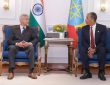
Faith was thereafter renewed at every test. When gas prices collapsed in the following decade and the old contractual terms turned crushing for Indian buyers, Doha renegotiated rather than litigated, repricing supplies and forgiving penalties in an accommodation with few precedents in the unforgiving world of long-term LNG. In February 2024 the foundational contract was extended to 2048 on terms Indian officials described with visible satisfaction, and in the same season the relationship survived its severest trial, when eight Indian naval veterans, condemned to death in Doha in a case that had transfixed Indian opinion, were first spared and then quietly sent home. Their release, achieved through the personal diplomacy of Prime Minister Modi and Amir Tamim without a single public recrimination, revealed the true balance in an account that Sheikh Hamad had opened decades earlier. Days afterwards the Prime Minister called on the Father Emir in Doha, the meeting his condolence message of July 2026 would so pointedly remember.
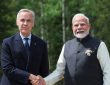
The Emir’s three state visits to India, in 1999, 2005 and 2012, progressively widened a gas relationship into a civilisational one, layering investment frameworks, a landmark defence agreement received during Prime Minister Manmohan Singh’s 2008 journey to Doha, naval exercises in the waters both countries live by, and a human bridge that grew to more than eight hundred thousand Indians, the largest expatriate community in Qatar and among the most cherished. He spoke of that community with an appreciation that never sounded like protocol, and the labour reforms of later years answered, in substantial part, concerns that India had raised as the workers’ homeland. The consummation arrived at Hyderabad House on 18 February 2025, when Amir Tamim and Prime Minister Modi signed the agreement elevating India and Qatar to a formal Strategic Partnership, accompanied by a ten-billion-dollar Qatari investment commitment, a Qatar Investment Authority office for India and a pledge to double a trade already approaching fifteen billion dollars. The son signed the document; the father had spent thirty years writing its preconditions.
The deeper affinity is philosophical, and it explains why Indian strategic thought regards the Hamad experiment with something warmer than professional respect. Qatar under his hand practised multi-alignment before the term existed, holding the American base and the Iranian gas condominium in the same steady grip, belonging to its region while refusing to be owned by it, and treating strategic autonomy as the precondition of deep interdependence rather than its enemy. India recognises the method because India, at continental scale, employs it, and the two states’ shared vocabulary of the Global South, of reformed multilateralism and of the Gulf and the Indian Ocean as one strategic water is a genuine convergence of worldview rather than a communiqué courtesy. Constructivist theory holds that states become what their interactions make them, and three decades of honoured contracts, discreet rescues and reciprocal honour have made India and Qatar, in the fullest sense of the word, friends. The half-mast tricolour was that theory rendered in cloth.
The Lesson for a Multipolar World
Sheikh Hamad’s legacy resolves, in the end, into a single demonstrated proposition: that in the contemporary international system, meaning is power. A state of a few hundred thousand citizens acquired global consequence because one leader understood that identity can be designed, that trust can be banked, that a broadcaster can outrange an air force, that a university is a strategic asset and that the market value of a nation’s word, once established, appreciates forever. The proposition matters far beyond the Gulf. In a multipolar world where no hegemon can impose order and every state must compose its own security from partnerships, reputation and usefulness, the Qatari playbook he authored has become required reading for the middle and rising powers of the Global South, India first among its admirers.
The grave at Lusail is already indistinguishable from the sand around it, which is precisely as its occupant arranged. His true tomb is a skyline of institutions that no longer need him, a partnership across the Arabian Sea that mourned him as family, and a proof, entered permanently into the record of statecraft, that vision honestly executed can make a small nation immense. India lowered its flag for the man; this essay is lowered, in its own fashion, for the idea. May the Father Emir rest in the peace he so often manufactured for others.
Views: 388

Dr. Maheep
Dr. Maheep is Director, Indian Perspective on Global Affairs (IPGA), and a leading analyst of India’s foreign policy and South Asian geopolitics. He earned his PhD in Arab and Islamic Studies. With more than a decade of teaching and research experience in International Relations and Global Politics, he contributes regularly on issues shaping national and global affairs.