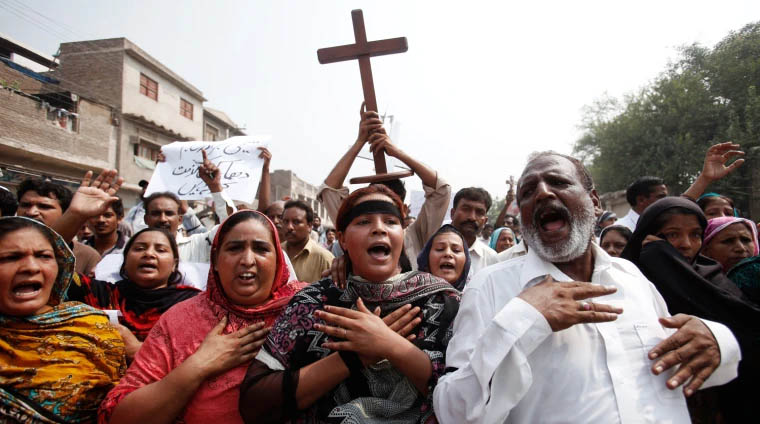







When Pakistan’s Federal Constitutional Court delivered its ruling in Maria Shahbaz on 25 March 2026, it disposed of more than a single habeas petition. It crystallised, with disquieting clarity, the constitutional condition of a community whose vulnerability now operates not at the margin of the law but through its central structures.
A thirteen-year-old Christian girl abducted in Lahore in July 2025; a thirty-eight-year-old Muslim abductor; a seminary-issued conversion certificate produced within days; a nikāhnāma contracted while she remained in his custody; and an apex constitutional court that chose to credit a “maturity certificate” and a coerced in-court statement over the documentary record of her age—her NADRA child registration, baptismal record, and school enrolment papers.
The bench reasoned that, under the operative interpretation of Muslim personal law applicable to a convert, the validity of the marriage turned not on the Punjab Child Marriage Restraint Act or Pakistan’s obligations under the Convention on the Rights of the Child, but on her post-pubertal capacity within Sharia-derived doctrine. The constitutional protections of childhood, the federal and provincial child-marriage statutes, and the international treaty commitments Pakistan has assumed all yielded to a personal-law framework that, at the moment of decision, carried greater force than the constitutional text itself.
| CORE ARGUMENT This condition reflects not episodic injustice but a constitutional configuration in which religious identity is juridically operationalised. Law does not merely fail to protect — it actively mediates differential standing, translating identity into hierarchy through the ordinary functioning of legal doctrines, evidentiary practice, and institutional deference. |
The case is not isolated. Within months of the verdict, Adan Sabir — a nineteen-year-old Christian woman from Faisalabad, abducted at gunpoint in July 2025 after rejecting a marriage proposal — followed the same procedural template: forged nikāhnāma, conversion certificate, an in-court statement at the August magistrate’s hearing in which her silence, attributed by family to credible death threats, was interpreted as consent.
High Court intervention secured her return; what it could not secure was the dismantlement of the machinery of impunity that has continued, through April 2026, to operate against her family in the form of gunshots discharged at the home, cyber-harassment, and the labelling of Adan as “apostate” by hostile clerics. The corrective ruling did not end the persecution. It produced the regime of extra-judicial threat that operates where the law has formally retreated.
The argument advanced here, drawing on more than two decades of fieldwork in Punjab and Sindh and on the documentation of every major Pakistani and international human rights body engaged with the country, is that the everyday insecurity of Pakistan’s Christians is best understood not as the residue of administrative weakness alone but as the cumulative outcome of an evolving legal-institutional configuration in which non-Muslim religious identity has come to function as an axis of differential standing.
The diagnosis is structural rather than deterministic: it does not contend that every Pakistani institution is irredeemable nor that reform is foreclosed, but it does contend that the dominant pattern requires structural rather than merely administrative response. The Centre for Social Justice has documented eighty-three abduction and forced-conversion cases of minority girls in Punjab alone during 2024 — thirty-seven per cent involving Christian girls — and a cumulative figure of four hundred and twenty-one such cases between 2021 and 2024, with one hundred and thirty-seven Christian victims.
The National Commission for Justice and Peace, in its April 2026 Captive Souls report, traces the recurrent procedural arc — abduction, conversion certificate, nikāhnāma, judicial validation — across a five-year case set. United Nations experts, in a joint statement of 22 April 2026, estimated that approximately twenty-five per cent of forced-conversion victims in 2025 were Christian, with eighty per cent of incidents reported from Sindh and victims concentrated in the fourteen-to-eighteen age range. These are not statistical anomalies. They are the visible peaks of a much larger structure.
| STRUCTURAL MECHANISM Legal asymmetries enable judicial deference; judicial deference normalises evidentiary displacement; displacement reproduces the vulnerabilities the system is nominally designed to adjudicate. This is not dysfunction in the conventional sense — it is structured operation, sustained through the quiet normalisation of unequal outcomes. |
To name that condition analytically requires a layered conceptual vocabulary. The human security paradigm of the United Nations Development Programme’s Human Development Report 1994 insisted that security be assessed at the level at which it is lived — the home, the school, the workplace, the courtroom — and by that measure the freedom from fear and from want of Pakistan’s Christians is severely compromised.
Johan Galtung’s structural violence framework identifies how harm can be produced systematically through the operations of laws, institutions, and recognised hierarchies even where no single legislator, judge, or police officer intends harm: violence “built into the structure,” manifesting as unequal life chances. The Copenhagen School’s account of securitisation explains how non-Muslim religious identity has, over four decades, been figured discursively as a potential threat to the Islamic state project. Post-colonial legal critique — of which Abdullahi An-Na’im’s work on Islam and the secular state remains foundational, and which Farahnaz Ispahani has applied to Pakistan with care — illuminates the hybrid orders in which constitutional guarantees of equality coexist uneasily with personal-law regimes operating under fiqḥī presumptions.
Intersectionality clarifies how vulnerability concentrates at the conjunction of religion, gender, age, and caste-coded occupational marginality. Legal consciousness theory, after Ewick and Silbey, identifies how the pattern reproduces itself across generations through the internalised expectations that constrain Christian life-choices long before any specific case arrives in court. These frames do not compete; they integrate.
The historical sedimentation of this pattern is decisive. The Pakistan that Muhammad Ali Jinnah addressed on 11 August 1947 was offered an explicitly pluralist constitutional vision — religion as a matter of personal faith, citizenship as the political bond. That vision encountered its first decisive challenge with the Objectives Resolution of March 1949, which embedded a structural ambiguity at the foundation of the constitutional order between equal citizenship and the privileging of an Islamic state project.
The Bhutto-era Second Amendment of 1974 declared Ahmadis non-Muslim by constitutional fiat — establishing the principle that the state could and would adjudicate religious belonging. The decisive rupture came with General Zia-ul-Haq’s eleven-year regime: the Hudood Ordinances of 1979, the Federal Shariat Court of 1980, the Eighth Amendment of 1985 incorporating the Objectives Resolution as Article 2-A, and the amendments to the blasphemy provisions of the Pakistan Penal Code — Section 295-B (1982) criminalising defilement of the Quran with life imprisonment; Section 295-C (1986) criminalising derogatory remarks about the Prophet Muhammad with mandatory death, and crucially requiring no proof of intent.
The post-Zia period has not undone this configuration; it has elaborated it. The Centre for Social Justice records more than 2,200 formal blasphemy accusations since the 1980s amendments, with Christians grossly over-represented; 344 cases in 2024 alone. The demographic record bears witness: the Christian share of Pakistan’s population, 1.59 per cent in 1998, had declined to 1.27 per cent by 2017 even as the absolute population grew. The machinery does not need to expel; it suffices that it makes life substantively more difficult for Christian families than for Muslim families of comparable socio-economic standing. That, in Galtung’s terms, is structural violence rendered demographic.
The legal-institutional anatomy of this condition deserves precise specification. The Constitution of 1973 contains, in formal text, an array of provisions that would compare favourably with those of any liberal-democratic state — Article 20’s freedom of religion, Article 25’s equality, Article 25-A’s right to education, Article 27’s prohibition of discrimination in public service, Article 36’s affirmative duty to safeguard minority interests. The implementation deficit is, however, severe and patterned.
The blasphemy provisions of Sections 295-B and 295-C contain no intent requirement in operative interpretation; trials are conducted under documented mob pressure; counsel for the accused have, in several cases, been assassinated. The personal-law regime is structurally asymmetric: the recent restructuring of the superior judiciary by the 26th Constitutional Amendment of October 2024 and the 27th of November 2025 — formalising the Federal Constitutional Court as Pakistan’s apex constitutional forum, with executive-influenced appointment of its founding cohort — has further compromised the institutional autonomy on which counter-majoritarian adjudication depends.
The International Commission of Jurists characterised the 27th Amendment, on the day of its passage, as a “flagrant attack on the independence of the judiciary”. The Federal Constitutional Court that decided Maria Shahbaz is a paradigmatic instance of managed constitutionalism — judicial review formalised while adjudicatory autonomy is politically disciplined. Read in this register, the bench did not deviate from its institutional logic. It expressed it.
The condition operates, in causal terms, through a recursive loop: legal asymmetry enables judicial deference; judicial deference normalises evidentiary displacement; evidentiary displacement reproduces the very vulnerabilities the system is nominally tasked with adjudicating. Each turn of the loop deepens the conditions of the next, and it is in this self-reinforcing operation that its durability resides. A possible objection deserves direct engagement: it might be argued that the documented outcomes are best attributed to administrative incapacity, localised judicial failure, or the contingent pressures of particular moments rather than to a coherent structural condition.
Three considerations tell against the objection. The recurrence of the procedural arc across two decades, four provinces, and successive political dispensations indicates a pattern that survives changes in administration and personnel. The doctrinal consistency of the personal-law presumptions deployed by trial benches, magistrates, and now the Federal Constitutional Court indicates a settled interpretive framework rather than idiosyncratic miscalculation.
The institutional reinforcement supplied by the Federal Shariat Court, the Council of Islamic Ideology, and the curricular apparatus indicates a doctrinal infrastructure that does not depend on the failure of any single actor. Administrative incapacity is part of the picture; it is not adequate as the picture.
| GENDERED AND INTERSECTIONAL DIMENSION Vulnerability converges most acutely at the intersection of religious identity, gender, age, and socio-economic marginality. The result is layered dispossession — bodily integrity, personal autonomy, and life chances simultaneously foreclosed. This is gendered structural violence embedded in, and amplified by, institutional practice. |
No dimension of this condition is more acute than the gendered structural violence it produces. The pattern of abduction and forced conversion documented above means that the parents of every adolescent Christian girl in the affected districts engage in routine risk-management practices — restricting travel, withdrawing daughters from school at puberty, marrying them young within the community to pre-empt external abduction — that themselves constitute deprivations of freedoms of movement, education, and personal development.
Open Doors International’s World Watch List 2026 identifies the gendered intersection of religious minority status and forced conversion as a driver of compounded vulnerability that analyses focused on either gender or religion alone cannot adequately capture. The phenomenon must be understood not only as a religious-minority issue but as a form of gendered structural violence in which the affected girls suffer a compounded denial of personhood — the abduction itself, the period of coerced detention, the procedural validation of the union by the courts, the foreclosure of return to family and community, the foreclosure of educational and occupational possibility, and the lifelong stigmatisation that follows even where corrective rulings are eventually obtained.
The Adan Sabir trajectory illustrates the durability of the gendered insecurity even where adjudication corrects: the corrective ruling secured return; what it could not secure was protection from the post-ruling regime of extra-judicial threat that has reshaped the family’s life. The intersectional dimension is integral and inescapable. Reform that addresses only one axis of this vulnerability will leave the others operative.
The reform agenda that emerges from this diagnosis is neither exotic nor externally imposed. It is recoverable from Pakistan’s own constitutional resources, from the documentation of its own civil society, and from the indigenous reform tradition running from Jinnah’s 11 August address through Justice Tassaduq Hussain Jillani’s 2014 Suo Motu judgment on minority rights to the contemporary advocacy of the National Commission for Justice and Peace and the Centre for Social Justice.
In the legal register, the urgent priorities are: the introduction of a statutory intent requirement and false-accusation penalties into Sections 295-B and 295-C; procedural safeguards in blasphemy adjudication; and the enactment of a uniform federal Prohibition of Forced Conversion Act establishing a minimum age of eighteen, a mandatory ninety-day reflection period, mandatory NADRA-based age verification at marriage registration, and gender-protective provisions aligned with Pakistan’s obligations under the Convention on the Rights of the Child and CEDAW.
In the institutional register, the priorities are the Paris Principles–compliant strengthening of the National Commission for Human Rights; the equivalent reform of the National Commission for Minorities Rights, currently constituted with merely advisory authority; and the establishment of dedicated Minority Rights and Forced Conversion benches in each High Court staffed by judges with documented training in human rights law, child protection, and gender-based violence.
In the societal-educational register, the priority is comprehensive curricular reform addressing the textbook content that has positioned non-Muslim citizens as objects of toleration rather than equal participants in the constitutional polity. The pathways are real but narrow. The cost of inaction — measured in minority emigration, demographic contraction, communal trauma, and Pakistan’s eroding international standing — far exceeds the political price of coherent, domestically anchored reform.
| NORMATIVE STAKES What is ultimately at stake extends beyond any single community. When rights are mediated through identity rather than guaranteed by citizenship, equality ceases to be a foundational principle and becomes a conditional entitlement. A constitutional order that permits this drift risks substituting hierarchy for equality — and contingency for justice. |
The Maria Shahbaz verdict need not be remembered as another data point in the sedimentation of structural persecution. It can mark, instead, the inflection at which Pakistan chooses to align constitutional promise with lived reality — restoring Christian and all minority identity from a vector of insecurity to equal standing, and thereby securing the polity’s own pluralist future. Which of these the verdict becomes is now, as it has always been, a question for Pakistan to answer.
A constitutional order that conditions rights on identity does not merely fail its minorities; it redefines citizenship itself as contingent rather than equal — and in so doing places the polity’s own foundational promise in jeopardy. The girl in the Lahore courtroom is a child citizen of Pakistan, entitled to the protection of its laws on the same terms as any other child citizen; the machinery that has rendered her age, her identity, and her non-consent legally invisible is a Pakistani machinery; its dismantlement is a Pakistani task; and its replacement with a constitutional order in which her identity is encountered as an attribute rather than as an axis of differential standing is the unfinished work of a constitutional project that began on 11 August 1947 and has not yet been completed.
The recovery of that promise, on terms that Jinnah would recognise and that Pakistan’s own constitutional resources sustain, remains the work in front of us. A state that conditions rights on identity does not merely fail its citizens; it transforms equality into a contingent privilege.
Views: 1228

Dr. Maheep
Dr. Maheep is Director, Indian Perspective on Global Affairs (IPGA), and a leading analyst of India’s foreign policy and South Asian geopolitics. He earned his PhD in Arab and Islamic Studies. With more than a decade of teaching and research experience in International Relations and Global Politics, he contributes regularly on issues shaping national and global affairs.