









From IBSA to Bharat Niti: India–Brazil and Civilisational Statecraft in the Global South
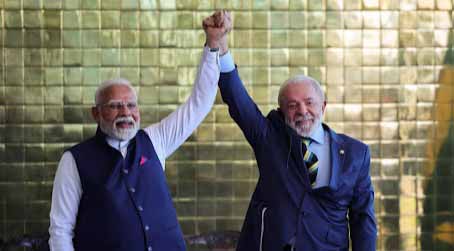
NEW DELHI (India): History has a way of concentrating its deepest meanings into singular moments, and the arrival of Brazilian President Luiz Inácio Lula da Silva in New Delhi on 18 February 2026 was precisely such a moment. Accompanied by eleven cabinet ministers and more than 260 business leaders—the largest commercial delegation Brazil has ever dispatched to any single nation—Lula’s four-day state visit was an act of deliberate world-ordering. Two of the most consequential democracies of the Global South signalled, through coordinated political intent and institutional preparation of remarkable depth, that the transition toward a multipolar international system has moved irrevocably beyond aspiration into structural reality. The visit carried the accumulated weight of two decades of institutional architecture—the IBSA Dialogue Forum, the BRICS framework, successive G20 presidencies—and the deepening conviction of both leaders that the relationship between their two civilisations had for too long been held hostage to its own unrealised potential.
Historical Conjunction and Geopolitical Context
The moment arrived at a precise historical conjunction. India assumed the BRICS Chairship for 2026 under the theme Building for Resilience, Innovation, Cooperation and Sustainability, while Brazil had recently hosted COP30 in Belém in November 2025. Three consecutive G20 presidencies—India in 2023, Brazil in 2024, South Africa in 2025—had produced what Anit Mukherjee of ORF America described as the most coherent diplomatic alignment among the founding IBSA democracies since the Bandung era. The geopolitical environment sharpened its significance considerably: American tariff unilateralism under the second Trump administration imposed fresh coercive pressures on both nations; the Russia–Ukraine conflict continued to fracture energy markets; West Asian instability revealed the structural limitations of a United Nations Security Council still structured around the power configurations of 1945. Against this confluence of pressure and opportunity, the Lula–Modi summit crystallised what this article terms civilisational statecraft—the conscious, institutionally grounded deployment of shared historical consciousness, civilisational ethics, and developmental solidarity as instruments of genuine geopolitical agency.
This article argues that the February 2026 India–Brazil summit marks a decisive inflection in Global South diplomacy, where civilisational ideas, geoeconomic complementarity, and coordinated multilateral leadership converged to accelerate the reordering of multipolar order on Southern terms.
Constructivist Architecture of Bharat Niti
The constructivist architecture of Bharat Niti provides the deeper meaning of the summit. Alexander Wendt, in Social Theory of International Politics (1999), established that international order is constituted not merely by material power but by the intersubjective meanings, shared norms, and collective identities that states construct through interaction. Bharat Niti is precisely such a constructivist act of world-making—a systematic encoding of Vasudhaiva Kutumbakam (the world as one family), Vishwa Maitri (universal friendship), and the ancient aspiration of Vishwa Guru into the operational grammar of twenty-first-century statecraft. Dr. Maheep, writing in European Times on the architecture of India’s emerging strategic partnerships, describes this orientation as a diplomatic philosophy wherein “strategic interdependence replaces isolation, integration supersedes exclusion, and human capital becomes the bridge between continents”—a formulation that reframes power not as domination but as the capacity to build inclusive architectures of cooperation, marking the precise distance between Bharat Niti and both Western liberal hegemony and Chinese state-centric developmentalism.
Prime Minister Modi’s seven-point cooperative vision, articulated at the G20 South Africa Summit and now functioning as the philosophical scaffolding of India’s South–South engagements, gave the February 2026 summit its civilisational coherence and strategic direction. Encompassing Green Development, Digital Transformation, Inclusive Growth, Women-led Development, Health for All, Trade Reform, and Anti-Terrorism, it mapped directly onto the bilateral agreements signed with President Lula—the biofuel and solar partnerships serving Green Development; the UPI–Pix digital cooperation embodying Digital Transformation; the Vaccine Maitri pharmaceutical legacy animating Health for All; and the joint UNSC reform advocacy addressing multilateral integrity. When Modi declared at Hyderabad House that India and Brazil are “countries that engage with all without automatic alignments,” he was making an identity claim as much as a foreign policy statement—announcing a third normative space in the international system, authored by the Global South itself, premised on cooperative sovereignty rather than competitive subordination.
Institutional History of India–Brazil Relations
The institutional history of the India–Brazil relationship begins with the IBSA Dialogue Forum of June 2003, co-founded under the contemporaneous leadership of President Lula and Prime Minister Vajpayee. Oliver Stuenkel characterised IBSA as “the most ambitious attempt by emerging democracies to institutionalise South-South cooperation outside the Cold War framework.” M.A. Vieira’s analysis of the “paradox of regional leadership” illuminated the structural tension both states have long navigated—simultaneously anchoring their respective regions while projecting global identities through multilateral cooperation, a triangulation that neither the G77 nor the NAM had previously institutionalised for major emerging democracies.
The relationship achieved genuine institutional depth through BRICS expansion, IBSAMAR naval exercises, and successive multilateral engagements, yet bilateral trade remained chronically underdeveloped relative to political ambition—approximately $12–13 billion in recent years despite estimates suggesting that expanded trade architecture could raise this figure to $40–50 billion within a decade. The Bolsonaro years of 2019 to 2022 temporarily suspended momentum, but the structural interests that patient diplomacy had built survived intact. Lula’s return in January 2023, coinciding with India’s G20 Presidency, inaugurated the present phase of accelerated convergence. Modi’s state visit to Brasília in July 2025, where he received Brazil’s Grand Collar of the National Order of the Southern Cross, and Lula’s reciprocal visit in February 2026 are the bilateral culmination of this multilateral inheritance. As President Lula told The Hindu before his departure, “As two of the world’s largest democracies and dynamic economies, India and Brazil cannot remain distant,” a statement that functioned simultaneously as diagnosis, commitment, and civilisational claim.
Weaponised Interdependence and Strategic Convergence
Henry Farrell and Abraham Newman demonstrated that asymmetric global economic networks create chokepoints that powerful states can deploy as instruments of political coercion. The second Trump administration’s tariffs—ranging from ten to twenty-five per cent on Brazilian steel and Indian pharmaceuticals, textiles, and technology products—represented precisely such weaponisation: market centrality converted into geopolitical leverage. Both nations responded through deliberate supply-chain diversification, reduction of chokepoint exposure, and the construction of alternative economic architectures distributing strategic dependencies across multiple partners.
Lula’s formulation at Hyderabad House—that countries facing trade coercion “should negotiate collectively rather than individually”—effectively positioned BRICS as a collective bargaining mechanism. Roberto Goulart Menezes observed that Brazil was repositioning its understanding of strategic resources “beyond their commercial dimension, recognising their geopolitical relevance.” India’s Aatmanirbhar Bharat doctrine reflects the same reorientation—developmental sovereignty as a strategic imperative. Both nations’ strategic autonomy on Russia–Ukraine and West Asian crises reinforced this alignment, grounding their diplomacy in the shared conviction that international disputes must ultimately be resolved through dialogue. Their mutual endorsement of permanent membership in the United Nations Security Council further transformed individual aspirations into a coordinated campaign for institutional reform.
Strategic Agreements and Geoeconomic Complementarity
The agreements signed during the February 2026 summit created a multi-domain framework encompassing critical minerals, digital infrastructure, pharmaceuticals, aerospace manufacturing, renewable energy cooperation, and agricultural partnerships. The centrepiece MoU on critical minerals is strategically significant because Brazil’s reserves of niobium, lithium, manganese, and rare earth elements correspond directly with India’s industrial ambitions in electric vehicles, semiconductor production, renewable energy technologies, and defence electronics. By linking Brazilian mineral resources with Indian manufacturing ecosystems, the two countries are constructing resilient supply chains capable of reducing dependency on highly concentrated global processing networks.
The digital partnership represents another transformative dimension. Brazil’s Pix system and India’s Unified Payments Interface together process nearly one billion digital transactions daily. Their potential interoperability would demonstrate that digital public infrastructure can serve as a scalable model for Global South financial integration. President Lula’s suggestion that artificial intelligence be integrated into digital platforms to maximise developmental impact reflects a shared technological philosophy: innovation designed to serve public welfare rather than purely private profit.
Defence cooperation also deepened significantly through aerospace partnerships involving Embraer and Indian industrial partners. These arrangements move beyond procurement into co-production, strengthening indigenous technological capacity. Pharmaceutical collaboration, particularly the Fiocruz–Biocon partnership and the ANVISA–CDSCO regulatory framework, builds upon the legacy of Vaccine Maitri and expands access to affordable medicines across developing regions.
Multilateral Convergence and Global South Agency
India’s BRICS chairmanship in 2026 and Brazil’s hosting of COP30 in Belém in November 2025 together represent a rare convergence of multilateral leadership within the contemporary architecture of Global South diplomacy. Their agendas intersect across climate finance reform, energy transition pathways, and the restructuring of global development finance, creating a coordinated institutional moment through which emerging economies can shape the evolving norms of global governance. BRICS+ today represents roughly 37 percent of global GDP and more than 54 percent of the world’s population, giving the grouping an unprecedented capacity to influence debates on climate finance, development lending, and institutional reform. Dr. Maheep has argued that India’s leadership within BRICS represents “the institutionalisation of multipolarity itself,” reflecting a gradual transformation of international order through institutional participation rather than confrontational revisionism. India and Brazil’s coordinated diplomacy across BRICS and the COP30 climate agenda therefore represents a broader strategic effort to reshape the architecture of global governance toward greater representation, developmental equity, and inclusive multilateralism.
Critical Assessment
Yet despite the summit’s achievements, structural challenges remain. Bilateral trade continues to operate far below its potential—approximately $12–13 billion in recent years, despite estimates suggesting that expanded trade architecture could raise this figure to $40–50 billion within a decade. The critical minerals agreement also remains non-binding and dependent upon sustained institutional follow-through. Effective implementation will require regulatory reform, coordinated industrial policy, and long-term political commitment from both governments. Lula’s environmental policy constraints and India’s administrative complexities may also influence execution timelines and the pace at which agreements translate into material outcomes.
Nevertheless, these constraints do not diminish the summit’s strategic significance. Rather, they illuminate the deeper institutional labour required to convert diplomatic alignment into durable structural power. The India–Brazil partnership thus represents not a completed transformation but the early institutional architecture of a longer process through which emerging powers seek to translate civilisational vision, multilateral coordination, and strategic complementarity into a more representative and resilient international order. In a world increasingly shaped by geoeconomic competition, climate transition pressures, and the fragmentation of traditional multilateral institutions, the coordinated diplomacy of India and Brazil signals the gradual emergence of a more confident and institutionally grounded Global South agency.
Conclusion
The state visit of President Luiz Inácio Lula da Silva to New Delhi from 18 to 22 February 2026 is best understood, in the final analysis, not as a bilateral diplomatic event but as a civilisational act of world-ordering—deliberate, politically willed, and institutionally grounded. From IBSA’s foundational moment in 2003 to the consecutive G20 presidencies of 2023, 2024, and 2025, from the critical minerals pact and AI governance convergence to the shared commitment to UNSC reform and climate justice at COP30, from the electric vehicle supply chain architecture to the pharmaceutical partnership building on Vaccine Maitri’s legacy, from the ISA’s solar diplomacy to the biofuel alliance advancing the Panchamrit commitment—India and Brazil are engaged in what the constructivist tradition would recognise as a fundamental act of international social construction: the deliberate, intersubjective reimagining of what international order can and should mean for the world’s developmental majority.
The rare earth and critical minerals partnership represents a supply chain reordering of global strategic significance. The digital and AI governance convergence represents a normative intervention in the architecture of the twenty-first century’s most consequential technology domain. The biofuel alliance demonstrates that the energy transition is achievable on Southern terms, without waiting for Northern philanthropy or regulatory permission. The UNSC reform advocacy, jointly prosecuted at presidential level by two of the world’s largest democracies, represents the most legitimate demand for institutional justice in the contemporary international system. Taken together, these initiatives constitute civilisational statecraft in its fullest expression—the deployment of shared philosophical traditions, complementary developmental experiences, and mutually reinforcing institutional positions as instruments for the construction of a world order genuinely plural, genuinely just, and genuinely universal in ways that the post-1945 Western order never fully managed to achieve.
As Dr. Maheep notes in The European Times, India’s global engagements reflect “a consistent belief that global challenges require connected societies and cooperative solutions.” That belief—simultaneously philosophical and practical, civilisational and institutional—is precisely what the February 2026 summit embodied. It is the conviction that animates the entire architecture of India–Brazil partnership: that the world’s most urgent problems—climate disruption, technological inequity, democratic deficit in global governance, and the developmental injustice of a fractured multilateral order—cannot be solved by any single power, however dominant, but only through the kind of sustained, principled, and genuinely plural cooperation that the Global South’s two greatest democracies are together learning to produce. Whether this emerging partnership ultimately reshapes global governance will depend on sustained institutional implementation, but its strategic direction is already unmistakable.
The world is not merely watching. It is learning. And the Global South is no longer waiting for permission to write the next chapter of international order. In New Delhi, in February 2026, India and Brazil began writing it together—with the confidence of ancient civilisations, the ambition of the world’s largest democracies, and the moral authority of nations that have earned their place at the table not through the coercion of others but through the patient, principled, and generous development of themselves and of those they call their partners in the great human family that Vasudhaiva Kutumbakam envisions and that Bharat Niti is building, one summit, one agreement, one relationship at a time.
Views: 703

Dr. Maheep
Dr. Maheep is Director, Indian Perspective on Global Affairs (IPGA), and a leading analyst of India’s foreign policy and South Asian geopolitics. He earned his PhD in Arab and Islamic Studies. With more than a decade of teaching and research experience in International Relations and Global Politics, he contributes regularly on issues shaping national and global affairs.


