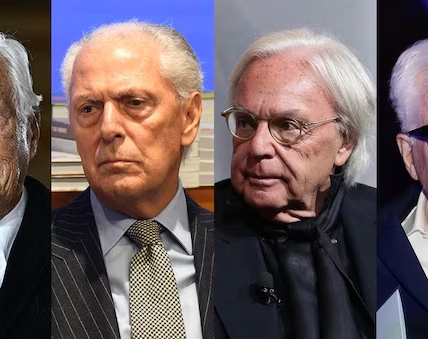






The European Free Trade Association (EFTA) consisting of Switzerland, Iceland, Norway and Liechtenstein signed a Free trade agreement (Trade and Economic Partnership Agreement) with India which formally enters into force on the 1st of October.
When the India–European Free Trade Association (EFTA) Trade and Economic Partnership Agreement (TEPA) formally entered into force on October 1, 2025, it was more than the culmination of sixteen years and twenty-one negotiation rounds. It marked the assertion of a new strategic grammar of India’s economic diplomacy — one that blends state-led development imperatives with global market integration, and does so on terms that respect India’s sovereignty while courting high-value investment and advanced technology.
The European Free Trade Association — comprising Iceland, Liechtenstein, Norway and Switzerland — forms non-EU Europe’s high-income core, with a combined GDP of about USD 1.2 trillion and a population of 14 million. These are advanced, innovation-driven economies with deep capital reserves and regulatory influence disproportionate to their size. By concluding this pact, India has stepped into a rarefied circle of high-standard trade diplomacy that is as much about geopolitical positioning as about commerce.
At its heart, TEPA liberalises goods and services trade, enhances market access and commits the EFTA states to mobilise USD 100 billion in foreign direct investment over fifteen years — tied explicitly to the creation of one million jobs in India’s manufacturing and technology-intensive sectors. The agreement also protects sensitive domestic industries such as dairy and pharmaceuticals, preserves India’s generic medicines ecosystem by avoiding excessive intellectual property obligations, and embeds sustainable development norms, aligning India’s growth with climate goals and innovation-led industrial upgrading.
Its promise, however, is not automatic. TEPA’s success will hinge on regulatory stability, modern infrastructure, competitive manufacturing capacity, and India’s ability to translate investment commitments into productive capacity and employment. It must also navigate a volatile global economy marked by tariff nationalism, resurgent protectionism, and renewed trade frictions — from Trump-era tariff politics to Europe’s own economic headwinds.
The Prosperity Summit held in New Delhi on October 1, 2025, where Commerce and Industry Minister Piyush Goyal hosted senior EFTA leaders, underscored this moment’s significance. The pact’s coming into force is not a ceremonial milestone; it is a structural inflection point that repositions India within the political economy of the Global North and strengthens its claim to be an anchor of supply chain resilience in an age of geopolitical fragmentation and trade turbulence.
Beyond Tariffs: India’s Strategic Tradecraft Comes of Age
The EFTA bloc, though modest in population, wields extraordinary influence in capital, innovation and regulatory rule-making. Switzerland is a global powerhouse in finance, life sciences and precision manufacturing; Norway commands energy and shipping networks; Iceland pioneers renewable technologies; and Liechtenstein contributes high-value industrial components. Engaging these economies signals India’s transition from a market to be accessed into a rule-shaping, negotiation-capable actor.
This moment also comes as the global trading system wobbles. The Trump-era tariff wars — from steel and aluminium to advanced technology — exposed the fragility of unbridled globalisation and accelerated Europe’s search to diversify beyond China. India’s response has not been protectionism but strategic patience and selective openness: opening where it gains technology and investment, protecting where vulnerabilities persist. TEPA is the clearest expression yet of that deliberate, self-assured tradecraft.
TEPA’s Blueprint: Ambition Anchored in Strategy
TEPA is far more than a tariff-cutting arrangement. It is a multi-dimensional, politically astute framework, with fourteen chapters spanning goods, services, investment, intellectual property, sustainable development and dispute resolution — balancing openness with domestic policy space.
EFTA has removed or reduced tariffs on over 92 percent of its lines, granting India near-universal access to affluent European markets in textiles, leather, chemicals, machinery and premium agriculture — including basmati and non-basmati rice, mangoes, grapes, millets and seafood. India reciprocates on 82 percent, but over a phased three-to-ten-year horizon, shielding dairy, coal, pharmaceuticals and processed foods. Gold — over 80 percent of India’s imports from EFTA — remains largely untouched, a choice of macroeconomic prudence aimed at preventing the deficit from widening.
Services liberalisation plays to India’s strengths. New Delhi has opened 105 sub-sectors, while EFTA has gone further — Switzerland 128, Norway 114, Iceland 110, Liechtenstein 107. Mutual recognition of professional qualifications — in architecture, accountancy and nursing — promises smoother mobility for Indian professionals in Europe’s high-skill economies.
The USD 100 billion foreign direct investment commitment is TEPA’s most groundbreaking innovation. For the first time in any Indian trade pact, partners have bound themselves to mobilising long-term productive capital, with USD 50 billion expected in the first decade, aimed at advanced manufacturing, clean technology, health sciences, precision engineering and digital innovation — and directly tied to creating one million jobs and upgrading skills among India’s young workforce.
Intellectual property rules are TRIPS-aligned but development-sensitive: India resisted patent evergreening and excessive data exclusivity, preserving affordable generics while assuring investors of regulatory stability. A sustainability chapter integrates climate goals and inclusive growth into the pact’s economic architecture.
Why This Deal Matters: Power, Capital and Supply Chains
For Indian exporters, TEPA unlocks wealthy, high-demand markets long constrained by tariff and regulatory barriers. Agricultural and processed foods — rice, millets, grapes, cashews and seafood — gain preferential access. Engineering goods, refrigeration units and mobility components find new buyers. Textiles and leather stand to revive under zero-duty regimes. Pharmaceuticals and chemicals expand in affluent, high-regulation markets while retaining India’s cost-efficient innovation edge. Electronics, gems, jewellery and medical technology benefit from both tariff concessions and technology-led FDI.
The USD 100 billion FDI infusion could accelerate India’s shift from low-value assembly to precision manufacturing, clean-tech leadership and digital innovation, generating high-quality jobs and deepening industrial capacity. For EFTA economies, this is a strategic hedge against China-centric supply chains and a foothold in one of the world’s largest and most stable emerging markets.
Geopolitically, TEPA is a signal of India’s strategic autonomy. It shows that New Delhi can negotiate high-standard, sovereignty-conscious agreements with the Global North, strengthening its leverage in the long-pending India–EU Free Trade Agreement and future mega-regional negotiations.
Navigating Tariff Nationalism: India’s Measured Tradecraft
TEPA’s promise, however, will be tested against a world where tariff nationalism is resurging. The persistent trade deficit, fuelled by gold imports, must be narrowed through export diversification and value-chain upgrading. Intellectual property obligations, though balanced, require vigilant oversight to protect India’s pharmaceutical innovation model. Sectors shielded now — notably dairy and processed foods — may face competitive stress later.
Most critically, the USD 100 billion investment pledge is aspirational but not guaranteed. Its realisation depends on India’s ability to ensure regulatory stability, contract enforcement, modern logistics and predictable taxation. External turbulence looms large: a renewed US tariff agenda under Donald Trump, European economic slowdowns or energy shocks could erode investor appetite. TEPA will need institutional resilience and agile policy responses to stay credible in such a contested global economy.
India’s Bid to Redesign Globalisation on Its Own Terms
TEPA reflects a third path for emerging economies — neither the uncritical liberalism of the 1990s nor the defensive protectionism of recent years, but strategic, sovereignty-conscious globalisation. India is opening where it gains, shielding where it must, and embedding domestic industrial policy into global trade rules.
To convert this framework into transformation, India must pair market access with domestic competitiveness. That means clear regulations, swift dispute resolution, modern supply chain infrastructure, and active support for exporters to move up the value chain and meet advanced standards. Innovation ecosystems — research hubs, technology parks, design-led manufacturing — must align with sectors EFTA capital will energise. Done well, TEPA could become an economic inflection point rather than merely a trade deal.
Conclusion: Trade as Statecraft, Integration as Strategy
The India–EFTA TEPA is more than a trade schedule; it is a declaration of India’s maturing economic diplomacy in an age unsettled by tariff nationalism, great-power rivalry and fragile supply chains. By blending openness with prudence, attracting high-value capital while protecting developmental autonomy, and embedding sustainability into trade, New Delhi offers a new template for globalisation — ambitious yet pragmatic, open but not vulnerable.
If India now matches this diplomatic breakthrough with domestic reform, competitive manufacturing upgrades and policy stability, TEPA could define a new Indian economic model — globally integrated yet development-driven, confident yet sovereign. More than a pact with four affluent European states, it may well become a blueprint for how rising powers can shape the next phase of globalisation itself: resilient in the face of protectionist politics, anchored in national strategy, and influential in shaping the rules of tomorrow’s global commerce.
Views: 562

Dr. Maheep
Dr. Maheep is Director, Indian Perspective on Global Affairs (IPGA), and a leading analyst of India’s foreign policy and South Asian geopolitics. He earned his PhD in Arab and Islamic Studies. With more than a decade of teaching and research experience in International Relations and Global Politics, he contributes regularly on issues shaping national and global affairs.