


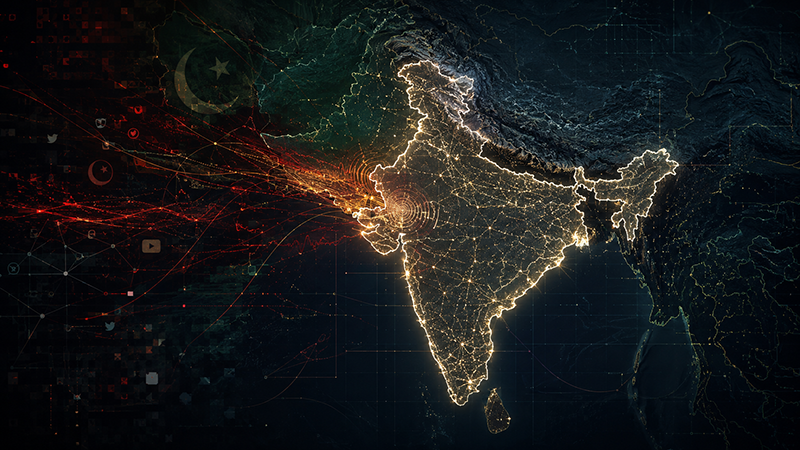







Pakistan’s ISI, Hybrid Warfare, and the Strategic Destabilisation of India
In early May 2026, Delhi Police Special Cell dismantled a meticulously constructed terror module linked to an ISI-directed operative identified as Shahzad Bhatti. Gang Bust Operation 2.0 led to the arrest of nine individuals across the National Capital Region whose intended targets, namely temples, family restaurants, and military cantonments, had been selected not for their military significance but for their potential to inflame communal tensions. The precision of targeting, the exploitation of encrypted social media platforms, and the careful selection of locations calculated to provoke inter-community violence collectively reflected the operational sophistication of an intelligence-directed network rather than an improvised militant cell. As the Observer Research Foundation observed in its post-Operation Sindoor assessment, the operation necessitated a fundamental reconfiguration of India’s security architecture because the threat confronting the country was not episodic but deeply embedded within a broader strategic framework.
This episode was not an anomaly. Rather, it represented the contemporary manifestation of a strategic pattern pursued with remarkable institutional consistency since the Inter-Services Intelligence Directorate evolved into an expansive covert-action apparatus in the decades following Partition. According to cumulative data compiled by the South Asia Terrorism Portal, more than forty thousand fatalities have been associated with ISI-linked militant activity across India and Pakistan-administered territories since the late 1980s. The magnitude of this figure reveals the profound human consequences of a campaign that official Pakistani discourse has frequently portrayed as either non-existent or entirely indigenous in origin. What distinguishes the contemporary phase from its predecessors is the sophistication of the instruments employed, the transnational reach of the networks mobilised, and the seamless integration of physical violence with digital psychological operations. Together, these characteristics constitute the defining signature of twenty-first-century hybrid warfare.
As Julian Richards notes in his comprehensive institutional history of the ISI, the organisation has undergone successive doctrinal transformations that have rendered it simultaneously more deniable in method and more consequential in effect. Its contemporary operational architecture possesses the capacity to generate insecurity across an extensive geographic and social landscape while preserving the appearance of state non-involvement. This article draws upon two complementary theoretical traditions. The first is hybrid warfare theory, which explains the deliberate fusion of conventional, unconventional, informational, cyber, and psychological instruments in pursuit of strategic objectives that remain unattainable through direct military confrontation. The second is the securitisation framework developed by Barry Buzan and Ole Waever, which illuminates the processes through which political, social, and communal vulnerabilities are transformed into existential security threats through deliberate acts of mobilisation and intervention. Together, these perspectives reveal ISI activities not as isolated terrorist incidents but as components of a coherent strategy of sub-conventional coercion embedded within a strategic culture that has consistently privileged asymmetric instruments over direct engagement.
The central argument advanced in this article is that the contemporary challenge posed by the ISI extends far beyond conventional understandings of cross-border terrorism. The organisation has progressively evolved into a multidimensional instrument of hybrid conflict whose operational repertoire encompasses proxy warfare, digital radicalisation, information manipulation, criminal-terror nexuses, psychological operations, and transnational influence networks. These activities are designed not merely to inflict casualties but to erode social cohesion, deepen communal fault lines, undermine institutional confidence, and impose persistent security costs upon the Indian state. Consequently, the significance of ISI operations lies not only in their immediate tactical effects but also in their cumulative contribution to an architecture of deliberate insecurity that seeks to shape the strategic environment through deniable and indirect means.
By examining the historical evolution, organisational architecture, operational methods, regional footprint, and contemporary transformation of the ISI, this article seeks to situate recent developments within a broader framework of strategic analysis. In doing so, it argues that understanding the ISI requires moving beyond episodic accounts of terrorist incidents and toward a more comprehensive appreciation of how intelligence agencies can employ hybrid instruments of coercion to influence regional security dynamics. Such an approach is essential for understanding not only the enduring challenges confronting India but also the wider implications for peace, stability, and security across South Asia.
| ISI’S NEFARIOUS DESIGN: HARVESTING HUMAN VULNERABILITY Across five decades, ISI operatives have systematically trolled the margins of Indian society, scouring madrasa networks, social media platforms, and encrypted messenger groups, hunting for young men whose economic desperation, social isolation, or communal grievance renders them susceptible to weaponisation. The operational methodology is indistinguishable from criminal predation: progressive isolation from moderating influences, construction of an exclusive in-group identity, incremental normalisation of violence, and the manufacture of obligation structures that make exit psychologically impossible. These are not recruits. They are victims, harvested, consumed, and discarded by an intelligence apparatus so habituated to treating human lives as operational material that it has ceased to register the moral enormity of its own conduct. |
Historical Formation: From Coordinator to Covert Action Agency
The Inter-Services Intelligence Directorate was established in 1948 under Brigadier Walter Joseph Cawthorne, an Australian officer, primarily to coordinate intelligence-sharing among Pakistan’s nascent armed services. In its original institutional conception ISI was modest in scope and inward in orientation, functioning as a coordinator rather than an operator. What it became across subsequent decades is a phenomenon of an entirely different order: one of the most consequential intelligence organisations in the post-Cold War world, distinguished less by technical capability than by its sustained willingness to deploy militant non-state actors as instruments of state policy.
The decisive transformation occurred under General Mohammed Zia ul-Haq, who seized power in 1977 and systematically reconfigured the Pakistani state around a militarised Islamist strategic vision. Shuja Nawaz, whose Crossed Swords remains the definitive account of the Pakistan Army’s institutional evolution, documents with precision how Zia weaponised ISI simultaneously to prosecute a proxy war against Soviet forces in Afghanistan, in coordination with the CIA and Saudi intelligence, and to escalate insurgency in Indian-administered Kashmir through militant organisations capable of generating violence at scale while preserving Pakistani deniability. The mujahideen networks constructed during the Afghan jihad constituted what Bruce Riedel of Brookings has described as a strategic investment whose dividends and liabilities would define South Asian security for decades. Owen Sirrs, in his rigorous analysis of ISI’s covert action doctrine, traces the direct institutional continuities between that Afghan infrastructure and the networks subsequently turned against India: the same operational templates, the same handler-militant relationship structures, the same doctrine of plausible deniability.
C. Christine Fair, whose scholarly work on Pakistani strategic culture is among the most rigorous in the field, has demonstrated that this doctrine reflects a deeply embedded institutional conviction: conventional military parity with India is unachievable, and therefore asymmetric instruments, including proxy warfare, nuclear deterrence, and covert destabilisation, constitute the rational strategic alternative. The consequences for India have been profound, sustained, and, as events through 2026 demonstrate, undiminished in contemporary relevance.
Organisational Architecture: The State within a State
ISI’s formal structure, as documented by Hein Kiessling in Faith, Unity, Discipline and by Richards, comprises directorates covering joint intelligence, technical intelligence, counter-intelligence, external intelligence, political intelligence, and what the organisation’s own vocabulary terms ‘special operations’, a bureaucratic euphemism for the coordination of militant networks. The Joint Intelligence North directorate has historically maintained primary operational responsibility for Kashmir-related activities; other divisions manage relationships with militant organisations operating against Indian targets elsewhere and coordinate political influence operations targeting India’s domestic constituencies and diaspora communities.
What renders ISI’s architecture particularly consequential is not its formal structure but the ecosystem of relationships it has cultivated with a diverse constellation of militant organisations, relationships that Ayesha Siddiqa in Military Inc. characterises as involving not merely operational direction but financial sustenance, ideological patronage, and institutional protection. Lashkar-e-Taiba, founded in 1987 with direct ISI support and currently designated a Foreign Terrorist Organisation by the United States government, has maintained a particularly intimate relationship with Pakistani intelligence that survived successive cycles of nominal government prohibition and actual ISI-mediated protection. Jaish-e-Mohammed, established in 2000 by Masood Azhar following his release from Indian custody in exchange for the passengers of a hijacked Indian Airlines aircraft, has demonstrated comparable institutional durability. The FATF grey-listing of Pakistan between 2018 and 2022 created additional institutional incentives to restructure militant financing away from traceable formal channels and toward criminal economies, specifically drug trafficking, hawala networks, extortion, and cryptocurrency flows, whose participants are driven by material incentives rather than ideological commitment.
MJ Roberts, writing in the Joint Force Quarterly, identified the defining paradox with analytical precision: ISI’s formal subordination to civilian and military authority coexists with a demonstrated capacity for autonomous action, producing a state-within-a-state dynamic that systematically constrains any Pakistani civilian government’s ability to deliver on commitments regarding ISI’s activities. This structural immunity from accountability represents, in the analytical vocabulary of securitisation theory, the weaponisation of institutional impunity itself.
Proxy Warfare against India: Doctrine, Operations, and the Mumbai Paradigm
The proposition that ISI deploys militant non-state actors as instruments of strategic coercion against India is not a controversial analytical claim. It is a conclusion supported by an extensive evidentiary record assembled across multiple decades, corroborated by the intelligence agencies of multiple Western governments, documented in United Nations Security Council resolutions, and acknowledged with carefully calibrated ambiguity by senior Pakistani officials in various contexts. What demands analytical precision is not to rehearse this proposition as though it remained contested but to examine the operational mechanisms through which proxy warfare is prosecuted.
The 2008 Mumbai attacks, in which ten Lashkar-e-Taiba operatives coordinated across multiple simultaneous assault locations, killed 166 people including citizens of multiple nationalities, and paralysed one of the world’s major financial centres for three days, represented the most lethal single manifestation of this framework in the twenty-first century. The subsequent investigation by Indian, American, and international authorities established the role of ISI-linked individuals, including the American citizen David Coleman Headley, whose reconnaissance missions were conducted with ISI awareness. The Global Terrorism Index 2026, published by the Institute for Economics and Peace, ranked Pakistan first among nations experiencing the most severe terrorism impact globally, a ranking whose relationship to ISI’s cultivation of militant ecosystems is analytically indissociable.
The Pahalgam attack of April 2025, executed by the ISI-linked Resistance Front and killing twenty-six Hindu pilgrims in the Baisaran Valley before triggering Operation Sindoor, represented the latest strategic provocation in this continuum. The Stimson Center’s forensic analysis documented how its operational characteristics, namely the selection of Hindu pilgrims as targets, timing relative to a scheduled diplomatic initiative, and exploitation of topographic cover, bore the hallmarks of deliberate strategic provocation rather than spontaneous militant action. The urban module paradigm that now dominates ISI’s India operations reflects adaptive institutional learning: small, dispersed, locally recruited cells directed by handlers operating from Pakistani territory, financed through hawala, trained through encrypted channels, directed toward targets selected to maximise both physical harm and communal inflammation, all within deniability architectures that insulate the directing intelligence agency from formal attribution.
| ▲ ISI’S NEFARIOUS DESIGN: MANUFACTURING COMMUNAL APOCALYPSE ISI’s target selection is not random. It is a calculated science of social demolition. Temples, pilgrimage routes, restaurants frequented by mixed communities, military cantonments housing families: each site is chosen to maximise communal outrage, to drive a wedge between Hindu and Muslim communities, and to transform a democratic polity’s greatest strength, its plural and tolerant social fabric, into its most catastrophic vulnerability. Every bomb placed in a place of worship is not merely an act of murder; it is a calculated assault on the civilisational architecture of Indian coexistence. The ISI’s anti-civilisational methodology seeks nothing less than the fracture of the world’s largest democracy from within, an objective whose barbarism is matched only by its strategic cynicism. |
Criminal-Terror Nexus and the Instrumentalisation of Youth
Among the most consequential developments in ISI’s operational evolution has been the deepening integration of its militant infrastructure with transnational criminal networks, a fusion that security analysts at Brookings and the Jamestown Foundation have independently characterised as the defining structural feature of contemporary ISI-sponsored terrorism. This nexus serves multiple simultaneous functions: financing independent of FATF-monitored banking channels; logistical infrastructure through smuggling networks, safe houses, and weapons procurement corridors; layered deniability structures complicating attribution; and embedding of terrorist networks within criminal ecosystems whose participants are driven by material incentives that resist conventional deradicalisation interventions.
Afghanistan’s position as the world’s dominant opium producer, and Pakistan’s role as its primary transit corridor, has created an intersection between the drug economy and the militant economy that ISI has, by multiple credible accounts, facilitated rather than disrupted. The Long War Journal’s documentation of ISI’s S Wing notes its operational coordination with trafficking networks whose revenue streams sustain the militant infrastructure. The United Nations Office on Drugs and Crime has consistently documented the correlation between narcotics trafficking routes through Pakistani-administered territory and militant infiltration corridors into India, a correlation that exceeds the boundaries of coincidence.
The recruitment architecture that sustains ISI’s India operations inflicts its most devastating costs not on the states it targets but on the young human beings it harvests. The profiles of individuals arrested in ISI-linked terror modules across India over the past five years reveal a consistent and morally arresting pattern: young men in their late teens or early twenties, drawn from families of limited economic means, with constrained educational attainment, minimal stable employment, and a recent history of social isolation or personal crisis. These are not individuals driven by sophisticated ideological conviction. They are individuals whose vulnerabilities, economic, social, and psychological, have been systematically identified, exploited, and weaponised by an intelligence apparatus whose willingness to consume young lives as operational material represents a fundamental violation of the humanitarian foundations of modern statehood. Every entrapped young man represents not merely a personal tragedy but an intergenerational wound: families shattered, communities stigmatised, developmental potential permanently foreclosed, and social trust corroded across the broader communities from which they are drawn.
ISI and the Evolution of Digital Hybrid Warfare (2020–2026)
The most consequential transformation in ISI’s operational doctrine over the past half-decade has occurred not in the physical domain of proxy militancy, though that domain remains lethally active, but rather in the digital domain of information warfare, cognitive manipulation, and technologically mediated subversion. This transformation represents, in the analytical vocabulary Frank Hoffman employed in his foundational work on hybrid warfare, the full realisation of the simultaneous, adaptive fusion of conventional weapons, irregular tactics, and psychological operations, now extended into cognitive and informational dimensions that Hoffman’s original formulation could not fully anticipate.
The ORF’s comprehensive analysis of Pakistan’s information warfare operations (October 2025) documented with granular precision the institutional architecture through which ISI and the Inter-Services Public Relations directorate coordinate digital influence operations targeting India’s domestic information environment. This architecture spans coordinated social media accounts designed to amplify communal tensions, fabricated content attributed to Indian government officials, synthetic religious texts engineered to inflame inter-community hostility, and the algorithmic exploitation of platform recommendation systems to ensure destabilising narratives achieve viral amplification. What the ORF analysis identified as distinctive about the 2023–2026 phase was the systematic integration of artificial intelligence tools into what had previously been labour-intensive manual disinformation processes, representing a qualitative leap that enabled the production of synthetic text, fabricated quotations, and manufactured documentary evidence at scales and speeds that overwhelm the manual fact-checking infrastructure of even sophisticated media organisations.
Deepfake technology constitutes an additional dimension of this arsenal whose operational deployment by ISI-linked networks has been documented with increasing frequency since 2023. Audio and video deepfakes have been deployed to fabricate inflammatory statements by Hindu religious leaders, manufacture apparent confessions by Indian security officials, and create synthetic video evidence of alleged atrocities designed to trigger communal violence. The Institute for Strategic Technology at King’s College London identified in its 2025 survey that South Asia had emerged as the second most active region globally for state-sponsored synthetic media operations, with Pakistan-attributed networks accounting for a substantial proportion of India-targeted content. The epistemological damage thereby inflicted, namely the systematic corrosion of citizens’ ability to trust any video or audio evidence and the undermining of the shared factual basis that democratic discourse requires, constitutes a form of cognitive infrastructure warfare whose long-term consequences may exceed the immediate physical damage of conventional terrorist operations.
The social media recruitment architecture through which ISI ensnares vulnerable individuals represents perhaps the most insidious refinement in its contemporary operational doctrine. The methodology documented across multiple arrested module members reveals a sophisticated, multi-stage process of algorithmic targeting and progressive radicalisation. Initial contact occurs through carefully cultivated personas, typically fake profiles presenting as sympathetic religious figures, diaspora professionals, or romantic interests, designed to identify individuals displaying vulnerability indicators predictive of susceptibility: economic frustration, communal grievance, social isolation, or disillusionment with democratic institutions. Once contact is established, the target is progressively introduced to radicalising content, initially framed as legitimate political grievance, subsequently escalated toward religious obligation, and ultimately directed toward violent action, through a process social psychologists recognise as identical to criminal grooming methodology: isolation from moderating social influences, construction of an exclusive in-group identity, and the incremental normalisation of transgressive behaviour. Cyber intrusion activities targeting Indian governmental, financial, and critical infrastructure systems, conducted by APT36 (Transparent Tribe) and related Pakistan-associated threat actor groups, complete the convergence of physical proxy terrorism, digital disinformation, social media recruitment, and cyber penetration into a coherent operational architecture that exploits every available dimension of human and technological vulnerability.
| ISI’S NEFARIOUS DESIGN: DIGITAL PREDATION AND THE GROOMING STATE The ISI’s digital recruitment apparatus is, in its operational architecture, a state-run predation machine. Fake personas scout social media platforms for economically marginalised youth displaying indicators of vulnerability. Encrypted channels then funnel radicalising content in controlled doses, progressing from grievance to ideology, from ideology to obligation, and from obligation to violence, replicating with industrial precision the grooming techniques that criminal courts prosecute as among the most egregious violations of human dignity. The devastating irony is precise: India’s democratic freedoms, specifically the open internet, the free exchange of ideas, and the absence of authoritarian digital censorship, are weaponised by Pakistan’s intelligence directorate against Indian citizens. Every encrypted recruitment channel is a crime against the very human potential it extinguishes. |
Bangladesh Theatre and the Eastern Strategic Flank
The political transformation of Bangladesh following the removal of Prime Minister Sheikh Hasina in August 2024 created strategic circumstances that ISI’s institutional capacity proved well-positioned to exploit. Hasina’s government had maintained robust counter-terrorism cooperation with India, dismantling multiple ISI-linked networks seeking to use Bangladeshi territory as an operational staging ground against India’s north-eastern states. The transition government proved significantly less attentive to these concerns, a transformation that Ashley Tellis of the Carnegie Endowment has characterised as among the most consequential strategic reversals in India’s immediate neighbourhood in the post-Cold War era.
News18’s investigative reporting of December 2025 documented the emergence of what it characterised as an ISI Dhaka Cell, a structured operational presence systematically cultivating relationships with Bangladesh’s military intelligence services, Islamist political organisations, and logistical networks capable of supporting ISI activities against India’s north-eastern states. The Geostrata’s analysis of the Bangladesh-Pakistan strategic reset identified multiple operational mechanisms: deployment of ISI officers under diplomatic cover at Pakistan’s expanded High Commission in Dhaka; cultivation of madrasa networks in Bangladesh’s eastern regions; renewed support for north-eastern separatist movements; and exploitation of Bangladesh-India border porosity to establish infiltration corridors closed during the Hasina years. The Sunday Guardian’s May 2026 reporting on formal ISI-Bangladesh intelligence-sharing agreements suggested that this recalibration had progressed from informal cultivation to institutionalised cooperation. Bangladesh’s geography makes it strategically critical: the Siliguri Corridor, at its narrowest measuring only twenty-two kilometres in width, provides the sole land connection between India’s northeast and the Indian mainland. An ISI operational presence capable of supporting separatist movements or disrupting this corridor represents a textbook application of hybrid warfare’s principle of exploiting peripheral vulnerabilities to achieve disproportionate strategic effects at minimal direct cost.
Strategic Blowback and the Self-Consuming Doctrine
The Taliban’s return to power in Afghanistan in August 2021 was greeted within elements of Pakistan’s military establishment with satisfaction rooted in the conviction that ISI’s decades of strategic investment had produced its intended dividend: a friendly government in Kabul denying India the intelligence and diplomatic presence Pakistan had historically viewed as threatening. Former ISI Director General Faiz Hameed’s appearance in Kabul’s Serena Hotel days after the Taliban’s military victory, communicating Pakistani ownership with more transparency than its strategic doctrine typically permits, was read by Indian analysts as a declaration of strategic triumph. The subsequent evolution of Pakistan-Afghanistan relations has demonstrated with striking rapidity the fundamental limits of proxy investment as a strategic instrument. The Tehrik-i-Taliban Pakistan proved unwilling to subordinate Pakistani security interests to the new Afghan political order. The Council on Foreign Relations’ 2026 analysis documented a deterioration approaching conditions of armed conflict, with TTP cross-border attacks on Pakistani military and civilian targets reaching historically unprecedented levels.
Seth Jones of CSIS has documented how the proliferation of militant organisations with autonomous ideological agendas and independent financing bases has created a landscape in which the original patron-client relationships through which ISI sought to manage proxy networks have become increasingly difficult to sustain. Michael Kugelman of the Wilson Center characterises this as the defining strategic pathology of Pakistan’s security establishment: the cultivation of instruments of others’ insecurity that become, through the inexorable logic of violent political ecosystems, generators of domestic insecurity. The same militant ecosystems constructed to destabilise India have returned to destabilise Pakistan, confirming with devastating empirical clarity the analytical proposition that state-sponsored terrorism is ultimately a self-consuming strategic instrument. The Global Terrorism Index 2026’s ranking of Pakistan as the country experiencing the most severe terrorism impact globally is not a verdict on external hostility toward Pakistan; it is a verdict on the consequences of Pakistan’s own strategic choices, compounded across decades of proxy investment whose domestic returns have been catastrophically negative.
The international costs have been commensurate. Pakistan’s FATF grey-listing between 2018 and 2022 imposed substantial costs on its access to international financial markets, its ability to attract foreign direct investment, and its credibility in multilateral diplomatic forums. Stephen Tankel’s scholarship on the institutionalisation of Pakistani militant networks argues that the military establishment’s persistent resistance to fundamental doctrinal change reflects not rational strategic calculation but institutional path dependence, specifically the accumulated weight of invested interests, established relationships, and cultural assumptions that makes strategic adaptation genuinely difficult even when its necessity is intellectually acknowledged. This is the deepest strategic irony of the ISI’s anti-India doctrine: in pursuing the destabilisation of a neighbouring democracy, Pakistan’s security establishment has systematically destabilised its own state.
| ISI’S NEFARIOUS DESIGN: ANTI-DEMOCRATIC, ANTI-CIVILISATIONAL, ANTI-HUMANITY The ISI’s operational doctrine represents, in its totality, an assault not merely on Indian sovereignty but on the foundational principles of civilised human coexistence. It is anti-democratic: it systematically targets the institutions, processes, and social conditions that make democratic governance possible. It is anti-national: it subverts the citizens of a neighbouring nation-state by harvesting their economic desperation, brainwashing their youth, and converting their vulnerabilities into weapons directed against their own homeland. It is anti-civilisational: its deliberate targeting of temples, pilgrimage sites, and interfaith spaces constitutes warfare against the accumulated moral architecture of millennia of Indian civilisation. And it is anti-human: the deliberate manufacture of radicalised killers from vulnerable young men, using them as disposable instruments and discarding them in prisons, represents the most barbarous violation of human dignity that a state apparatus can perpetrate against the youth of a neighbouring people. |
Implications for India and the Future of Regional Security
India’s security architecture has undergone substantial evolution in response to the sustained challenge of ISI-directed hybrid warfare. The establishment of the National Investigation Agency in 2008, the expansion of the Multi-Agency Centre as the primary hub for intelligence fusion, the progressive modernisation of RAW’s technical collection capabilities, and the enhanced inter-agency coordination protocols developed in the aftermath of the Mumbai attacks all represent institutional responses calibrated through operational experience. Operation Sindoor in May 2025 represented a further significant recalibration: the demonstrated willingness to impose direct kinetic costs on Pakistani infrastructure in response to ISI-backed terrorism departed decisively from the strategic restraint doctrine that had characterised Indian responses across the preceding two decades. The Carnegie Endowment’s February 2026 assessment of a quarter century of nuclear South Asia identified the combination of sub-conventional conflict, escalation risk, and the absence of effective crisis management mechanisms as the most dangerous structural feature of the bilateral relationship, precisely the feature that ISI’s hybrid warfare operations are structurally designed to exploit.
Yet the adaptive capacity of ISI’s operational doctrine, spanning its shift from physical network-based operations to digital-platform recruitment, from direct infiltration to locally-recruited module deployment, and from organisational sponsorship to criminal-economy embedding, imposes continuous demands that no static institutional response can fully satisfy. Rana Banerji’s extensive analysis through India’s Institute for Defence Studies and Analyses argues that the fundamental challenge for Indian counter-intelligence is not the disruption of specific operational modules but the structural disruption of the recruitment and radicalisation ecosystems from which those modules draw their human resources. This demands a multi-dimensional policy response: enhanced digital counter-radicalisation infrastructure, more effective regulation of encrypted platforms exploited by ISI recruiters, deeper intelligence fusion between central and state security services, sustained multilateral pressure through FATF-style mechanisms and targeted sanctions against ISI-linked entities, and the diplomatic isolation of militant organisations maintaining ISI relationships. China’s deepening strategic partnership with Pakistan, manifesting through CPEC, the provision of advanced military equipment, and diplomatic protection in United Nations forums against terrorist designation efforts, creates a structural constraint on the multilateral pressure the international community might otherwise bring to bear, embedding ISI’s operations within a wider competitive dynamic extending to great-power rivalry in the Indo-Pacific.
Above all, India’s long-term resilience to ISI-directed radicalisation requires sustained investment in economic opportunity, educational access, and civic inclusion that renders its most vulnerable youth communities genuinely resistant to the narratives of grievance through which ISI’s recruitment operations function. India’s security against ISI-directed subversion is, in the deepest sense, inseparable from its commitment to the inclusive democratic values that constitute its most fundamental strategic advantage over the security paradigm that ISI represents, and that commitment serves equally as its most powerful repudiation of an intelligence apparatus that has chosen, as its defining institutional purpose, the systematic destruction of human potential in service of strategic malice.
Conclusion
The evidence presented in this article leads to a conclusion whose weight is difficult to avoid. Pakistan’s Inter-Services Intelligence constitutes a profoundly destabilising force in South Asian security, one whose operational activities across seven decades have imposed severe human costs on India’s citizens, undermined India’s sovereign integrity, and perpetuated enduring risks to regional stability in one of the world’s most strategically consequential nuclear environments. These operations cannot be adequately understood as spontaneous expressions of popular discontent or legitimate political grievance. Rather, they represent instruments of state-directed hybrid warfare, conceived, facilitated, resourced, and protected by an intelligence organisation operating with the knowledge, material support, and strategic endorsement of the Pakistani state, which consequently bears responsibility under international law for their effects.
From the systematic exploitation of economically marginalised youth and the weaponisation of religious identity for recruitment, to the deployment of artificial intelligence and deepfake technologies to manipulate perceptions, manufacture communal outrage, and contaminate information ecosystems, these practices challenge the foundational norms upon which contemporary interstate relations are constructed. They stand in direct opposition to a conception of sovereignty rooted in responsibility, restraint, and the protection of human dignity. In this understanding, states derive legitimacy not from their capacity to project instability beyond their borders but from their commitment to the welfare, security, and flourishing of their own citizens while respecting the equivalent rights of neighbouring societies.
As Hein Kiessling observes in his authoritative institutional history, the ISI’s exceptional operational reach and deep embeddedness within Pakistan’s strategic culture render it unusually resistant to meaningful reform through either external pressure or internal accountability mechanisms. This reality does not invite fatalism; it demands strategic clarity. India, the wider region, and the international community confront a structural challenge that is unlikely to dissipate through the natural evolution of regional politics alone. The path toward a more stable South Asia requires more than reactive crisis management. It requires the gradual replacement of strategic paradigms centred upon proxy warfare, deniable coercion, and managed instability with frameworks grounded in accountability, regional cooperation, and mutual security.
The aspiration is neither punitive nor exclusionary. It is the pursuit of a South Asia in which economically vulnerable young people are no longer transformed into instruments of geopolitical competition; in which the shared information environment of the world’s largest democracy is not distorted by synthetic fabrications and coordinated disinformation campaigns; and in which the nuclear capabilities of two ancient civilisational states are not repeatedly subjected to the risks generated by proxy conflict and strategic miscalculation. Such a future depends upon a broader international consensus that state-sponsored terrorism, hybrid subversion, and the instrumentalisation of non-state violence are fundamentally incompatible with the responsibilities of contemporary statehood.
Ultimately, the question raised by the ISI phenomenon extends beyond India and Pakistan. It concerns the role intelligence institutions should play in the twenty-first century international order. Intelligence agencies can serve as instruments of national protection, strategic foresight, and regional stability. Equally, they can become vehicles of destabilisation when insulated from accountability and embedded within doctrines that privilege coercion over cooperation. The future security of South Asia will depend in significant measure on which of these paths prevails. At its deepest level, the challenge is therefore not merely strategic but civilisational: whether intelligence will serve the protection of human life and political order, or remain a mechanism through which insecurity is systematically reproduced across generations.
Views: 3883

Dr. Maheep
Dr. Maheep is Director, Indian Perspective on Global Affairs (IPGA), and a leading analyst of India’s foreign policy and South Asian geopolitics. He earned his PhD in Arab and Islamic Studies. With more than a decade of teaching and research experience in International Relations and Global Politics, he contributes regularly on issues shaping national and global affairs.


