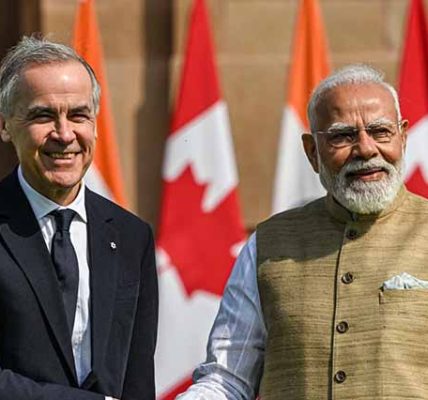






In the opening weeks of 2026, as the international system drifted further into fragmentation, shaped by intensifying geopolitical rivalry, the geoeconomic weaponisation of interdependence, and deepening normative uncertainty-India and Germany chose deliberation over drift. Chancellor Friedrich Merz’s two-day visit to India on 12–13 January 2026 unfolded with measured restraint and strategic intent, reflecting a shared recognition that contemporary diplomacy can no longer be confined to managing relations; it must actively shape strategic outcomes. What emerged from the engagement was not a performance of diplomatic familiarity, but a purposeful alignment between two states navigating a world where autonomy must be constructed, resilience must be institutionalised, and partnerships must generate power without coercion.
At 75: Continuity without Complacency
That alignment draws meaning from the longer arc of seventy-five years of India-Germany diplomatic relations, a relationship whose evolution mirrors the shifting architectures of global order. In the immediate post-independence period, cooperation was grounded in developmental pragmatism: technical assistance, institutional capacity-building, scientific exchange, and vocational training formed the backbone of engagement between a newly sovereign India and a rebuilding Federal Republic of Germany. During the Cold War, the relationship acquired stability without strategic overreach-insulated from ideological confrontation yet shaped by the geometry of bipolarity. German reunification and the end of bloc politics coincided with India’s economic liberalisation, ushering in a phase of deeper commercial integration, expanding research collaboration, and sustained people-to-people ties.
What distinguishes the contemporary phase is not rupture but strategic re-interpretation. As global politics has shifted toward multipolar competition, technological rivalry, and securitised interdependence, India and Germany have recalibrated their engagement from functional cooperation to strategic intent. From an Indian perspective, the imperative is clear: partnerships must expand national capability, mitigate external vulnerability, and widen strategic choice without binding alignment. The January 2026 visit crystallised this logic, marking a transition from endurance to agency, where history becomes a resource for foresight rather than a comfort of continuity.
Defence and Security: Capability as Strategy
The visit’s most consequential turn lay in the elevation of defence and national security to the centre of bilateral engagement. This shift matters because it replaces earlier caution with a logic of capability-building. The emphasis on defence-industrial collaboration, co-development, co-production, and technology partnership signals convergence between India’s pursuit of strategic autonomy and Germany’s reassessment of its global security role in a more contested world.
For India, the value lies not merely in access but in capability formation. Partnerships that embed technology, manufacturing, and skills within domestic ecosystems strengthen autonomy rather than dilute it. For Germany, deeper engagement with India represents a move away from geographically narrow security conceptions toward a distributed posture that recognises the Indo-Pacific as integral to global stability.
Operational cooperation like joint exercises, maritime coordination, and information-sharing in the Indian Ocean reinforces this alignment. Germany’s participation in major Indian-led exercises, alongside the deployment of a Bundeswehr Liaison Officer to India’s Information Fusion Centre-Indian Ocean Region (IFC-IOR), exemplifies minilateralism: flexible, interest-based cooperation that deepens trust while preserving sovereign decision-making. This model sits comfortably within India’s foreign-policy doctrine which is active engagement without entanglement and offers Germany a credible Indo-Pacific presence grounded in practicality rather than posture.
The Indo-Pacific as Shared Strategic Space
The establishment of a bilateral Indo-Pacific consultation mechanism reflects a quiet but consequential reframing of strategic geography. It acknowledges that Europe’s security can no longer be conceptually detached from developments across the Indian Ocean and Asia-Pacific. For India, this reinforces its role as a stabilising maritime actor and agenda-setter; for Germany, it signals acceptance that economic and security interests now extend well beyond Europe’s immediate periphery.
This convergence is notably non-adversarial. Cooperation is articulated around maritime stability, freedom of navigation, and adherence to international law, shared interests rather than shared adversaries. Such restraint enhances credibility and preserves diplomatic flexibility, allowing cooperation to deepen even amid divergences elsewhere.
Technology, Energy, and the Geopolitics of Resilience
Beyond security, the visit revealed acute awareness of how power increasingly operates through technology, supply chains, and standards. Cooperation on semiconductors, critical minerals, digital governance, and advanced manufacturing reflects a shared strategy of de-risking without autarky, diversifying dependencies while preserving openness. For India, such engagement accelerates integration into high-value technological ecosystems; for Germany, it strengthens resilience amid global supply disruptions.
Climate and energy cooperation further illustrates this logic. New green-finance commitments under the Green and Sustainable Development Partnership, targeting renewable energy, green hydrogen, sustainable mobility, and climate-resilient urban infrastructure, reposition climate action within the calculus of national capability. From an Indian perspective, this marks an important transition, from being primarily a site of climate responsibility to becoming a contributor to global energy solutions. It also challenges traditional North–South hierarchies by embedding India within Europe’s long-term energy transition as a partner, not merely a beneficiary.
Trade, Europe, and Strategic Linkage
The implications of Chancellor Merz’s visit extend beyond bilateralism to the wider India–Europe strategic horizon, particularly in trade and economic integration. Expanding trade volumes now exceeding $50 billion annually between India and Germany and accounting for over 25% of India’s total trade with the European Union have elevated economic engagement from technical negotiation to strategic linkage. Trade is no longer merely about market access; it is increasingly about supply-chain diversification, industrial resilience, and the creation of mutual dependencies in high-value sectors that stabilise relations amid geopolitical volatility.
Germany’s role in this process is pivotal. As Europe’s principal economic anchor and India’s largest trading partner within the EU, Berlin possesses the capacity to translate bilateral momentum into continental direction. Cumulative German foreign direct investment in India has reached $15.11 billion (April 2000–March 2025), with inflows of $469 million in FY 2024–25 alone. More than 2,000 German companies operate in India across manufacturing, transport, chemicals, and advanced engineering, while over 215 Indian firms have established operations in Germany underscoring reciprocal capital flows and the emergence of shared innovation ecosystems rather than one-directional dependence.
For India, deeper integration with Europe promises more than incremental trade gains. It offers embeddedness within advanced industrial and regulatory ecosystems, an essential condition for sustaining growth while preserving policy autonomy in an era marked by tariff uncertainties, supply disruptions, and geoeconomic competition. Rising services trade, which increased 12.5% year-on-year to $16.65 billion in FY 2024–25, further reinforces India’s position as a critical partner in Europe’s evolving economic architecture.
It is in this context that the forthcoming presence of senior European Union representatives at India’s Republic Day celebrations acquires strategic significance. Their participation signals a broader political convergence between India and Europe, of which the India-Germany axis is a central driver. Taken together, these dynamics suggest that India-Europe relations are entering a phase of greater coherence and long-term intent, lending momentum to efforts to conclude the EU-India Free Trade Agreement within the current strategic window.
Knowledge, Mobility, and the Long Arc of Influence
Less visible but no less consequential is the emphasis on education, research, and ethical mobility—domains that shape the long arc of influence in global politics by quietly converting human capital into strategic capability. Through a comprehensive Indo-German Roadmap on Higher Education, including German university campuses in India and structured joint and dual-degree programmes, the partnership is building shared intellectual ecosystems rather than episodic exchange. These initiatives extend the logic of the Migration and Mobility Partnership Agreement, in force since 2023, from facilitation to strategic design.
Educational mobility already reflects this momentum. Indian students now form the largest international cohort in German universities, with enrolments having more than doubled since 2020, concentrated largely in engineering, technology, and the sciences. Sustained by Germany’s English-language programmes, accessible public education model, and post-study work pathways, these flows align closely with India’s emphasis on skill formation and global employability.
Mobility is increasingly embedded within Germany’s longer-term talent strategy, including targeted measures for India and the Global Skills Partnership, particularly in healthcare and technical sectors affected by demographic decline. Anticipated workforce shortages have accelerated structured recruitment from India, while India’s growing professional presence in Germany contributes across information technology, engineering, and care services. From an Indian perspective, such circulation complements initiatives such as Skill India by enabling knowledge repatriation, remittance flows, and durable capability enhancement.
Recent facilitation measures, including visa-free airport transit for Indian passport holders, further ease movement and reinforce trust. Analytically, these dynamics foster transnational epistemic communities capable of sustained co-innovation in artificial intelligence, quantum technologies, and sustainable infrastructure. By privileging circular mobility over one-way extraction, the partnership mitigates brain drain while strengthening India’s research ecosystem and Germany’s workforce resilience, creating networks that endure beyond electoral cycles and geopolitical shocks.
Conclusion
Chancellor Merz’s January 2026 visit marked a clear transition from anniversary diplomacy to strategic agency. It demonstrated that India and Germany now engage each other not merely as reliable partners, but as co-shapers of a more plural and resilient international order. The test ahead lies in execution, translating frameworks into capabilities, and dialogue into durable institutions as the next Inter-Governmental Consultations in Germany later in 2026 approach.
From an Indian perspective, the visit’s significance rests in its alignment with a broader foreign-policy objective: expanding strategic space without sacrificing autonomy. In an era defined by flux and contestation, the India-Germany partnership offers a model of measured power, purposeful cooperation, and strategic restraint-a partnership anchored not in alignment, but in shared responsibility for shaping the international order.
Views: 1100

Dr. Maheep
Dr. Maheep is Director, Indian Perspective on Global Affairs (IPGA), and a leading analyst of India’s foreign policy and South Asian geopolitics. He earned his PhD in Arab and Islamic Studies. With more than a decade of teaching and research experience in International Relations and Global Politics, he contributes regularly on issues shaping national and global affairs.