






NEW DELHI: On the morning of 23 June 1914, the Komagata Maru — a Japanese steamship carrying 376 Punjabi Sikh passengers holding British Imperial passports — was refused entry to Vancouver Harbour and ordered back across the Pacific. Engineered through bureaucratic artifice, the Continuous Journey Regulation of 1908 was designed with deliberate cynicism to exclude Indian migrants from a Dominion that proclaimed Imperial fraternity whilst practising racial exclusion. The vessel’s enforced return, ending in the blood of its passengers at Budge Budge, became the founding trauma of the Punjabi-Canadian experience — a parable, quietly persistent across a century, about the distance between Canada’s professed values and its practised ones.
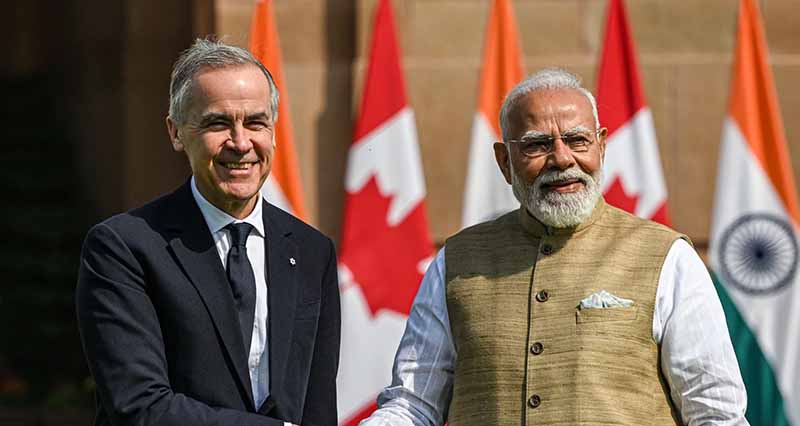
More than a century later, on 27 February 2026, Canadian Prime Minister Mark Carney landed in New Delhi to begin the first bilateral visit by a Canadian premier to India since Justin Trudeau’s ill-starred tour of 2018 — a journey weighted not by racial exclusion but by its inverse pathology: the systematic indulgence of a diaspora extremism that had held two democracies hostage to the grievances of a separatist fringe. That the visit produced seventeen formal agreements, a landmark ten-year uranium supply accord valued at CAD 2.6 billion, and Terms of Reference for a Comprehensive Economic Partnership Agreement targeting bilateral trade of CAD 70 billion by 2030 is, by any measure, a remarkable diplomatic achievement. Yet the reset unfolded at a moment of profound geoeconomic reconfiguration: in an era defined less by territorial conquest than by supply-chain leverage, mineral dependency, technology governance, and tariff coercion, what appeared diplomatically restorative was, in structural terms, an exercise in economic statecraft. To understand why it was neither inevitable nor straightforward requires a reckoning with the structural pathologies that have repeatedly frustrated what ought to be, by all logic of complementarity and shared democratic values, a pre-eminent middle-power partnership.
The symbolism was layered and deliberate. Carney quoted Swami Vivekananda — ‘Arise, awake, and stop not’ — a choice resonating beyond diplomatic courtesy as a tacit acknowledgement of India’s civilisational self-understanding. Modi received him with visible warmth. The joint leaders’ statement, dense with the vocabulary of ‘strategic trust’ and ‘a free, open, inclusive, and rules-based Indo-Pacific order,’ announced that both governments had chosen the future over the recent past. Whether that choice is structurally durable, or another diplomatic interlude before the centrifugal forces of diaspora politics and judicial proceedings reassert their customary gravity, is what scholarship must address.
Archaeology of Grievance: Punjab, Diaspora, and the Weaponisation of Democracy
The liberalisation of Canadian immigration law in 1967 transformed the demographic landscape irrevocably. Punjabi migration surged through the 1970s and accelerated dramatically following the convulsions of 1984: Operation Bluestar’s storming of the Golden Temple at Amritsar, the anti-Sikh pogroms engulfing north India following the assassination of Prime Minister Indira Gandhi, and the generalised insecurity that fractured the Sikh community’s confidence in the Indian state. Canada today hosts approximately 770,000 Sikhs — the largest such community outside India — concentrated in constituencies that have become among the most fiercely contested in Canadian federal politics. Their political ascent is, in its legitimate dimensions, a triumph of Canadian pluralism: Jagmeet Singh led a major federal party; Harjit Sajjan served as Minister of National Defence.
Yet within this accomplished community, a hardened separatist fringe — carrying the ideological DNA of the 1980s Punjab insurgency — never abandoned its aspiration for Khalistan. Proscribed organisations including Babbar Khalsa International and Sikhs for Justice operated within Canadian free-speech protections whilst functioning, by the concurrent assessments of Indian and allied intelligence services, as nodes for radicalisation, terrorist financing, and the glorification of political violence. Their most catastrophic act — the bombing of Air India Flight 182 on 23 June 1985, killing all 329 aboard in the deadliest terrorist attack in Canadian history — cast an unatoned shadow over bilateral relations for four decades. The subsequent Canadian investigation, plagued by intelligence failures and political sensitivities, produced no successful prosecution: a failure that New Delhi never fully forgave.
Multiple intelligence disclosures established sustained operational contact between Pakistan’s Inter-Services Intelligence and Khalistan-aligned diaspora organisations in Canada — providing financing, training, and logistical infrastructure for activities that served Islamabad’s long-standing objective of keeping India diplomatically isolated and internally destabilised. Drug trafficking networks extending from the Punjab into the Canadian diaspora supplied an additional layer of criminal financing and transnational reach.
Canadian politicians, structurally incentivised by minority-government arithmetic to court diaspora constituencies rather than risk their alienation, attended events at which convicted terrorists were venerated and assassinations commemorated. Indian diplomats and Hindu community members faced harassment, temple vandalism, and credible threats to their safety. The relationship was compromised at its structural foundations by a fundamental asymmetry: Canada’s representative system rewarded accommodation of extreme diaspora sentiment, whilst India bore the security consequences. As the East Asia Forum presciently observed, the bilateral relationship was trapped in a ‘doom loop’ — a self-reinforcing cycle of mutual accusation and institutional erosion from which neither government could extract itself without political cost.
The Trudeau Nadir: Institutional Capture and the Architecture of Rupture
The deterioration reached its nadir under Justin Trudeau, whose political survival depended upon NDP confidence anchored in Jagmeet Singh’s Sikh electoral base — a dependency that produced, across eleven years, a systematic distortion of Canadian statecraft toward India. The 2018 state visit, which included in Trudeau’s delegation Jaspal Atwal — convicted of the attempted murder of an Indian cabinet minister in 1986 — exposed either an extraordinary failure of due diligence or an extraordinary indifference to Indian sensitivities. The 2020–21 farmers’ protest movement became a second inflection point, as Khalistan-linked diaspora networks amplified narratives hostile to the Indian government and Trudeau expressed solidarity in terms that New Delhi regarded as unacceptable interference in Indian domestic affairs.
The decisive rupture came in September 2023, when Trudeau rose in the House of Commons to announce that Canadian intelligence held credible evidence linking agents of the Indian government to the murder of Hardeep Singh Nijjar — a Canadian citizen and prominent Khalistan activist designated a terrorist by India — in Surrey, British Columbia. The allegation, without precedent in the history of Canadian foreign policy against a democratic partner, detonated the relationship. India expelled a senior Canadian diplomat; Canada subsequently withdrew forty-one diplomatic staff. Visa services were suspended. Both high commissioners were recalled. The diplomatic infrastructure that had processed applications for approximately 600,000 Indian students in Canadian institutions contracted sharply, producing processing paralysis, permit uncertainties, and enrolment collapses whose financial consequences rippled through universities that had built their revenue models substantially on Indian student fees. The affair acquired a multilateral resonance when Five Eyes disclosures implicated American and Australian agencies in wider allegations of Indian government interference — drawing Australia, as the Lowy Institute noted, inescapably into the crossfire.
The Carney Effect: New Leadership and the Imperative of Diversification
Trudeau’s resignation in January 2025 and the Liberal federal election victory under Mark Carney — a former Governor simultaneously of the Bank of Canada and the Bank of England, a technocrat formed by international financial crisis management rather than identity politics — created the structural precondition for normalisation that India had indicated, candidly, it regarded as essential. The ORF’s January 2025 analysis was unambiguous: ‘For an India–Canada reset, Trudeau really had to go.’ Carney moved decisively to distinguish diaspora political management from the conduct of foreign policy, treating a relationship with the world’s fifth-largest economy and most populous democracy as a matter of strategic national interest rather than an electoral variable.
The structural imperative was sharpened by the second Trump administration’s economic nationalism. Sweeping tariffs on Canadian exports and the extraordinary rhetorical suggestion that Canada might be incorporated as a fifty-first American state confronted Ottawa with a reality no longer manageable through diplomatic patience: the assumption of frictionless American market access — the foundational premise of Canadian economic strategy since 1988 — was no longer safe. India ceased to be merely desirable; it became necessary. For Ottawa, diversification was no longer a rhetorical aspiration but an economic survival strategy — a hedge against systemic vulnerability in an increasingly coercive and fragmented global order. India’s market scale, democratic accountability, resource complementarity, and positioning outside the American economic orbit provided precisely the diversification anchor that a structurally exposed Canadian trade policy urgently required. Carney arrived in New Delhi not as a suitor seeking goodwill but as a strategist pursuing structural realignment.
Converging Visions: The Indo-Pacific and Middle-Power Strategy
The deeper theoretical architecture underpinning the 2026 reset lies in the substantive convergence between Ottawa’s Indo-Pacific Strategy and New Delhi’s own regional doctrine. India’s conception of the Indo-Pacific — articulated through its SAGAR framework (Security and Growth for All in the Region), its insistence on a free, open, inclusive, and rules-based maritime order, and its constitutive commitment to strategic autonomy — rests on sovereign equality, maritime domain awareness, resilient connectivity, and multipolar equilibrium. Unlike alliance-centric architectures, India’s framework privileges inclusive partnerships over bloc-based polarisation and Global South capacity-building over the binary alignments that great-power competition continuously seeks to impose on non-aligned actors. Canada’s Indo-Pacific Strategy intersects with this outlook at precisely the points that matter: rules-based dispute resolution, democratic technology governance, critical mineral supply-chain diversification, and maritime security cooperation.
In constructivist terms, the Carney visit operationalised a shared normative identity in the Indo-Pacific — anchored in pluralism, rule of law, and strategic autonomy — repositioning the bilateral relationship as a stabilising middle-power convergence within an evolving regional balance of power under simultaneous pressure from Chinese revisionism and American unpredictability. The visit should be read not as a tactical rapprochement born of diplomatic convenience but as a structural alignment of Indo-Pacific visions between two federal democracies that have recognised, with some delay, that resilience in a fragmenting order requires calibrated cooperation without the constraints of formal alliance entanglement.
Architecture of Partnership: Substance and Strategic Implications
The uranium supply agreement between Cameco Corporation and India’s Department of Atomic Energy — covering approximately twenty-two million pounds of high-grade ore from 2027 to 2035 at CAD 2.6 billion — is the agreement most laden with strategic significance. It restores a supply relationship severed following India’s 1974 Pokhran test, which Canadian authorities regarded as a diversion of civilian nuclear assistance to military ends — a rupture of fifty-two years. It anchors Canada in India’s clean energy architecture for a generation and supports India’s ambition to expand nuclear baseload capacity as the indispensable complement to intermittent renewables toward its net-zero 2070 commitment. For India’s vast rural and peri-urban population — where reliable electricity transforms health outcomes, female educational attainment, and the burden of domestic labour — nuclear energy expansion is not merely an energy policy decision but a developmental imperative of the first order. That Canada — historically cautious after 1974 — now embeds itself within India’s civilian nuclear expansion also reflects a broader recalibration: recognition that India’s energy transition is integral to global climate stability, and confidence in India as a responsible nuclear stakeholder within a reconfigured international energy architecture.
The CEPA Terms of Reference, targeting conclusion by end-2026 and a doubling of bilateral trade to CAD 70 billion by 2030, represent the most transformative commercial undertaking in the history of the relationship. Canada’s advanced capabilities in aerospace, financial services, agricultural technology, clean energy infrastructure, and extractive industries align structurally with India’s developmental needs. India’s strengths in software services, pharmaceuticals, and processed food create reciprocal market access opportunities of substantial scale. Crucially, provisions on professional credential recognition address the systematic refusal to acknowledge the qualifications of Indian-trained doctors, engineers, and accountants — confining thousands of highly capable professionals to occupations below their competence and depriving Canadian public services of talent they urgently require. Properly understood, CEPA is not merely a trade agreement but an instrument of strategic industrial alignment — embedding Canadian capital and resource inputs within India’s manufacturing expansion whilst integrating Indian services and skilled labour into Canadian growth sectors. In a world defined by friend-shoring, supply-chain securitisation, and industrial policy revival, such integration constitutes deliberate economic statecraft rather than routine liberalisation.
The MoU on Critical Minerals Cooperation addresses the most consequential supply-chain vulnerability in the contemporary global economy. The clean energy transition’s dependence on lithium, cobalt, nickel, and rare earth elements — and China’s dominant position in their processing, made coercive through 2023–24 export controls — has been identified across democratic capitals as an unacceptable strategic exposure. Canada’s geological endowment is extraordinary; India holds approximately six per cent of global rare earth reserves in Andhra Pradesh and Odisha and has been investing in domestic processing capacity as industrial strategy. The bilateral framework creates incentives for joint investment and integrated supply chain development that could reduce both economies’ vulnerability to Chinese coercion whilst generating high-value employment in Indian mining regions historically confined to low-value primary extraction. In the contemporary geoeconomic landscape, control over processing capacity increasingly determines strategic influence: by coordinating upstream extraction with downstream refinement, India and Canada position themselves not merely as raw material suppliers but as co-architects of post-carbon industrial power — a partnership in which strategic autonomy rests as much on mineral governance as on military capability.
The trilateral Australia–Canada–India Technology and Innovation MoU (ACITI) — encompassing artificial intelligence, quantum computing, cybersecurity, and clean technology governance — positions all three democracies as co-architects of technology supply chains resilient to authoritarian-state market distortions, an alignment whose significance extends well beyond its stated sectoral scope. The twenty-four-plus education and talent MoUs, anchored by the AICTE-MITACS arrangement committing to three hundred Indian research internships annually, create institutionalised people-to-people pathways more durable than purely commercial arrangements. For Indian women in particular — gaining access to formalised STEM corridors, professional mobility, and credential portability — these agreements represent a lever of gender-inclusive development whose cumulative effect on female economic agency will be significant. The Strategic Energy Partnership on green hydrogen and carbon capture, the Maritime Security Partnership, the space implementing arrangement, and the Pulse Protein Centre of Excellence renewal collectively constitute an integrated architecture of cooperation — not a catalogue of transactions — whose breadth reflects the genuine complementarity of two economies that have, for too long, underinvested in each other.
Shadows that Linger: the Unresolved Tensions
The reset is real; it would be analytically dishonest to present it as unburdened. The Nijjar investigation remains before the Canadian courts; India continues to deny official involvement; the pressure on Carney to address interference allegations has not evaporated with the change of prime minister. Khalistan-linked organisations retain their presence in Canadian political life, and the structural conditions that enabled a separatist fringe to distort Canadian foreign policy — the concentration of Sikh voters in marginal constituencies, the incentives of minority-government arithmetic, the breadth of Canadian constitutional free-speech protections — are institutional features unchanged by leadership transition. India, reciprocally, must manage the limits of what it can legitimately demand of a constitutional liberal democracy. The expectation that Canadian authorities prosecute political speech falling within Charter protections is one that no liberal democracy can satisfy without compromising the normative foundations that render it a valued partner. Long-term bilateral health requires a shared framework in which security cooperation — on which both governments can and must deliver — is clearly distinguished from the management of legitimate political dissent that Canada’s constitutional order does not permit its executive to suppress at foreign governmental request.
Conclusion
The Komagata Maru was turned away in 1914 by a Canada that had not reckoned with the implications of its own professed values. The Air India bombing of 1985 was inadequately prosecuted by a Canada that had not reckoned with the extremism it harboured. The Trudeau years represented a third failure of reckoning — the capture of foreign policy by diaspora electoral arithmetic that inflicted measurable harm on Indian students, workers, and businesses whilst conferring no discernible security benefit on the Canadian public. Carney’s New Delhi visit, at its most historically resonant, is a belated reckoning with all three: a tacit acknowledgement that a democratic partner of India’s magnitude and trajectory cannot be managed through the optics of vote-bank politics.
The seventeen agreements represent not a destination but a point of structural departure. The CEPA, if concluded as ambitiously as both sides have signalled, will create commercial constituencies for partnership more durable than any diplomatic arrangement. The uranium accord anchors Canada in India’s energy architecture for a generation. The education MoUs will produce, within a decade, a cohort of Indian professionals with deep Canadian institutional experience and Canadian researchers with sophisticated Indian expertise — a human capital foundation for the relationship that no subsequent political perturbation can easily erase. The ACITI trilateral framework embeds the bilateral reset within a broader democratic architecture of technological governance whose strategic significance will grow as the contest over global technology standards intensifies. Taken together, these agreements reflect a conscious decision by two middle powers to insulate their prosperity from great-power volatility by embedding it within diversified networks of trade, technology, and resource interdependence. The thaw is not merely diplomatic — it is infrastructural.In constructivist terms, the visit re-established India and Canada as sharing a sufficiently coherent set of values — democratic governance, rule of law, strategic autonomy, and commitment to a multipolar, rules-based Indo-Pacific order — to sustain the institutionalised trust that cooperation at this scale requires. Two great democracies, separated by the Pacific and bound by history, migration, and the imperatives of a contested global order, have chosen — with more deliberate structural commitment than at any previous moment — to face the future together. After the winter of 2023–25, in a world where democratic partnerships are under pressure from within and without, that is no small achievement
Views: 1609

Dr. Maheep
Dr. Maheep is Director, Indian Perspective on Global Affairs (IPGA), and a leading analyst of India’s foreign policy and South Asian geopolitics. He earned his PhD in Arab and Islamic Studies. With more than a decade of teaching and research experience in International Relations and Global Politics, he contributes regularly on issues shaping national and global affairs.