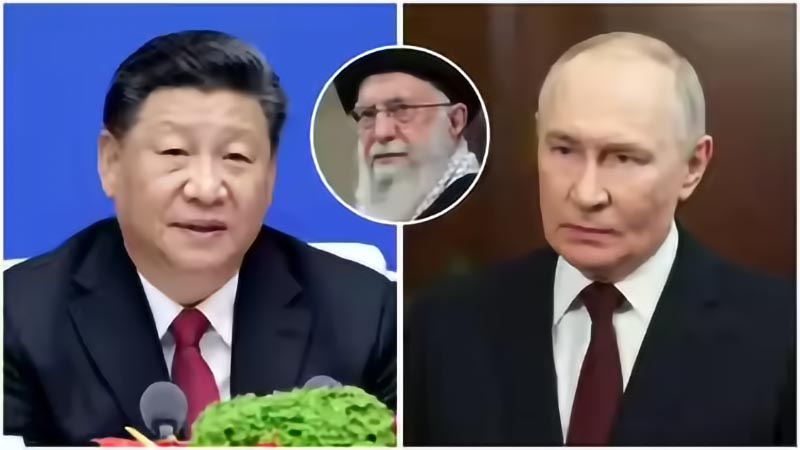







When the United States and Israel launched sweeping military strikes against Iran, killing Supreme Leader Ayatollah Ali Khamenei and promising a massive and ongoing campaign, many wondered whether Iran’s powerful partners – China and Russia – would intervene. The reality is stark. Despite their rhetoric and arms transfers, neither Beijing nor Moscow can meaningfully come to Iran’s aid in the face of direct U.S. military action.
Geography and Logistics
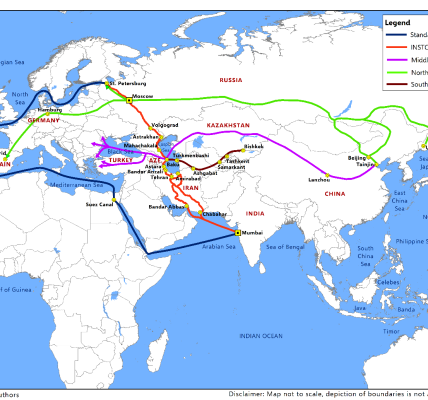
Distance matters. Russia and China are thousands of miles away from Iran. Unlike the U.S., which maintains extensive bases and naval assets across the Middle East, neither Moscow nor Beijing has the logistical infrastructure to project sustained military power into the Persian Gulf. There are no secure corridors. Any attempt to move forces would require crossing contested airspace or waters dominated by U.S. and allied militaries.
Military Posture
China’s support is symbolic, not strategic. Beijing has delivered drones, missile batteries, and even discussed hypersonic systems with Iran. However, these are incremental transfers, not the deployment of Chinese forces. They cannot offset the overwhelming U.S. strike capacity.
Russia is overstretched. With its military bogged down in Ukraine, Russia lacks the bandwidth to open another front against the U.S. Its arms sales to Iran are real, but its ability to intervene directly is nonexistent.
Political Constraints
Both China and Russia seek to avoid direct confrontation. They are careful to avoid military clashes with the U.S. Neither wants escalation that could spiral into global war.
Their support for Iran remains strategically ambiguous. It is calibrated enough to signal defiance of Washington, but not enough to risk catastrophic consequences.
Economic and Diplomatic Realities
China’s global interests depend on stability. Beijing’s economic lifelines run through global trade routes that require steady energy flows and predictable markets. A direct clash with the U.S. in the Gulf would jeopardize its energy imports and its global standing.
Russia is already heavily sanctioned. Moscow cannot afford further isolation. Openly fighting the U.S. in Iran would cement its pariah status.
Iran’s Isolation
Despite receiving weapons and rhetorical backing, Iran stands alone on the battlefield. China and Russia may arm and advise, but they will not bleed for Tehran.
China and Russia’s relationship with Iran is transactional, not sacrificial. They will sell weapons, issue condemnations, and exploit the crisis to needle Washington. But when U.S. missiles rain down, Iran cannot expect rescue. Geography, military overstretch, political caution, and economic self interest ensure that Beijing and Moscow will remain spectators – loud ones, perhaps, but ultimately unwilling to risk war with the United States.
Views: 1657

Khedroob Thondup
Khedroob Thondup is the son of Gyalo Thondup, elder brother of the Dalai Lama. Educated at St. Stephens College Delhi University and the University of San Francisco. He was a personal assistant to the Dalai Lama and accompanied him on his first trip to the U.S. in 1979. He was sent by the Dalai Lama to Beijing from 1980 till 1993 for dialogue talks where he interacted with Xi Zhongxun and Hu Jintao. He has served as Member of the Tibetan Parliament in Exile for three terms and is the President of the Tibetan Refugee Self Help Centre Darjeeling since 1987. He has edited two books, Dalai Lama My Son and Tibet in Turmoil and presently lives in Taipei, Taiwan.