






Where the Danube Meets the Ganges: India–Slovakia Relations in an Era of Strategic Convergence
Prime Minister Narendra Modi’s historic state visit to Bratislava from 14–16 June 2026—the first by an Indian Prime Minister since Slovakia’s independence in 1993—has inaugurated a transformative chapter in India–Slovakia relations. Elevating bilateral ties to a Comprehensive Partnership, the visit produced fourteen substantive outcomes across defence, digital and quantum technologies, higher education, scientific research, labour mobility, wellness, and counter-terrorism, establishing an ambitious framework for long-term strategic cooperation.
This article conceptualises the visit as the institutional foundation of a renewed bilateral partnership, reflecting India’s expanding engagement with Central Europe and Slovakia’s growing role within an evolving multipolar order. Drawing upon the Joint Statement, official documents, governmental briefings, and contemporary strategic scholarship, the study evaluates every major pillar of cooperation through an integrated analytical framework combining Constructivism, Strategic Autonomy, and Political Economy. It demonstrates that the India–Slovakia Comprehensive Partnership embodies a mature convergence of strategic interests, institutional innovation, technological collaboration, and shared geopolitical vision, positioning the partnership as an enduring pillar of India’s European engagement and a compelling model of twenty-first-century bilateral statecraft.
Strategic Overture: Diplomacy, Symbolism and the Rise of a New Partnership
On the morning of 15 June 2026 the ramparts of Bratislava Castle, illuminated the previous evening in the saffron, white and green of the Indian tricolour, framed a ceremonial encounter whose symbolism exceeded its protocol. P.M. Modi arrived to a Guard of Honour and the traditional Slavic offering of bread and salt, a gesture of hospitality whose resonance an Indian sensibility reads instinctively against its own grammar of atithi devo bhava. The reception was not incidental ornamentation. In the constructivist idiom, such rituals are acts of meaning-making through which states rehearse a shared identity before they transact shared interests, and the choreography in Bratislava signalled that the two governments intended to narrate their convergence as civilisational as well as strategic.
The visit was historic in the precise sense that the term is too often spent loosely. It was the first bilateral journey by an Indian Prime Minister to Slovakia in the more than three decades since the Velvet Divorce of 1993 separated the Slovak Republic from its Czech partner. That absence was itself analytically significant, for it indexed the long-standing peripherality of Central Europe within an Indian foreign policy that had historically concentrated its European bandwidth upon the larger capitals of the west. The 2026 visit, undertaken as one node of a wider European itinerary that included a G7 engagement, therefore marked less the inauguration of a relationship than its deliberate elevation from latency to intent.
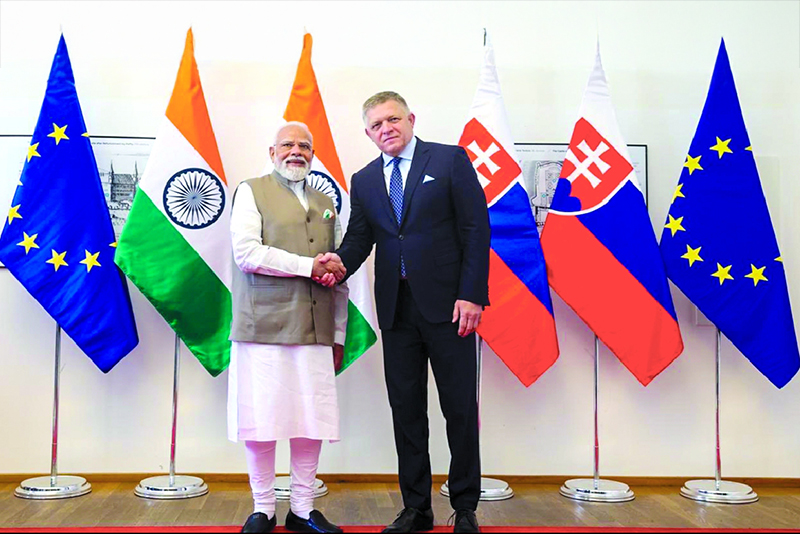
Modi held delegation-level talks with Prime Minister Robert Fico at the Castle and met President Peter Pellegrini at the Presidential Palace, where discussions ranged across manufacturing, energy, digital technology and the emerging frontier of artificial intelligence. The Indian delegation was weighted to signal seriousness: EAM Dr. S. Jaishankar, National Security Adviser Ajit Doval, Foreign Secretary Vikram Misri and Secretary (West) Sibi George, the last of whom framed the visit as conferring “renewed momentum” across diverse sectors. The presence together of the principal architects of India’s diplomacy, security and foreign-policy bureaucracy underscored that Bratislava was being treated not as a courtesy call but as a considered investment of scarce strategic attention.
Three propositions organise the analysis that follows. The first is that the partnership must be situated within India’s doctrine of strategic autonomy and multi-alignment, which seeks diversified European relationships precisely as insurance against the volatility of great-power competition. The second is that Slovakia, a small open economy navigating its own hedging between EU and NATO membership and a more accommodating posture toward Moscow, approached India as an instrument of economic and diplomatic diversification. The third is that the convergence, while genuine, rests upon a slender material foundation whose translation into substance will depend upon the unglamorous machinery of working groups, joint committees and follow-through. The argument proceeds by holding these three registers, the ideational, the strategic and the political-economic, in continuous tension rather than treating them as alternatives.
Institutionalising a Comprehensive Partnership
The centrepiece outcome was the elevation of the relationship to a Comprehensive Partnership, a designation that in Indian diplomatic practice sits below the Comprehensive Strategic Partnership reserved for its most consequential ties yet marks a clear escalation from the previous low-profile engagement. Modi characterised the upgrade as a reflection of “shared trust, common priorities, and a shared vision for the future,” a formulation whose constructivist content is unmistakable: it locates the relationship in shared meaning rather than in any single transactional deliverable.
The visit yielded fourteen announced outcomes, of which roughly eleven took the form of Memoranda of Understanding or agreements alongside a Letter of Intent and two new institutional mechanisms. Their substance is examined sectorally below. What merits emphasis at the outset is the conferment upon Modi of the Order of the White Double Cross, First Class, Slovakia’s highest state honour, presented by President Pellegrini. Such honours operate as instruments of symbolic capital in the Bourdieusian sense, converting a personalised gesture into a durable narrative resource that both governments can deploy domestically and internationally to authenticate the relationship’s seriousness.
The cultural register was equally deliberate. Performances of Vande Mataram by the Lúčnica ensemble, Sanskrit recitation, an exhibition evoking the sacred geography of Varanasi, and the celebrated Slovak translation of the Upanishads by Dr. Róbert Gáfrik furnished the visit with an epistemic bridge between two traditions. For a diaspora of roughly eleven thousand, these were not ornamental flourishes but the connective tissue of soft power, the terrain on which a relationship acquires affective depth that purely commercial ties seldom attain. Cultural diplomacy here functioned as norm entrepreneurship: the projection of yoga, Ayurveda and classical textual heritage as goods that Slovakia might willingly receive, thereby diffusing Indian normative content into a European setting without coercion.
Historical Foundations: Slovakia, Central Europe, and the Indian Gaze
An adequate reading of the 2026 inflection requires a sober account of Slovak political evolution. Since regaining statehood in 1993 Slovakia has anchored itself within the European Union and NATO while cultivating, particularly under Robert Fico’s successive governments, a pragmatic and at times dissenting foreign policy. Fico’s fourth administration, returned in 2023 atop a Smer–Hlas–SNS coalition, has governed amid acute domestic polarisation, fiscal consolidation and the lingering trauma of the 2024 assassination attempt upon the Prime Minister, while maintaining a posture toward the Russia–Ukraine conflict and toward energy procurement that diverges from the European mainstream. This hedging is the indispensable context for the Indian relationship: it is precisely Slovakia’s appetite for diversified partnerships, and its discomfort with monolithic alignment, that creates the opening India seeks to occupy.
The bilateral thread is older than the formal diplomatic ties of 1993. Czechoslovak–Indian contacts reach back to the early twentieth century, and a deeper imaginative connection runs through the Slovak Romantic literature of the nineteenth century, in which figures such as Šafárik, Kollár and Hollý construed India as a kind of ancestral homeland of the Slavs. That Romantic genealogy, however empirically fanciful, matters analytically because it supplies a pre-existing reservoir of affinity upon which contemporary cultural diplomacy can draw. The Upanishads translation is the modern continuation of this lineage, an epistemic bridge that converts antiquarian curiosity into living exchange.
Viewed through the Indian strategic lens, Slovakia is significant less as a discrete bilateral partner than as a gateway. It is a member of the Visegrád Four, an aspirant to a larger role within the Three Seas Initiative and the Slavkov format, and an integrated node in Central European manufacturing value chains. India’s engagement therefore reads as part of a graduated pan-European strategy that already encompasses an elevated Strategic Partnership with Poland and a Strategic Partnership on Innovation with the Czech Republic. Within this constellation Slovakia has lagged, and the 2026 visit is best understood as an attempt to close that gap and to render Central Europe a coherent theatre of Indian engagement rather than a patchwork of uneven bilateralisms.
Instruments of Partnership: A Critical Sectoral Evaluation
The substance of the visit resides in its instruments. What follows examines each principal agreement in turn, assessing its provisions, its implementation pathway, its constraints and its significance within the integrated theoretical frame. The recurring analytical caution is that signature is not implementation; the value of these instruments will be determined by the institutional follow-through they catalyse.
Defence: The Letter of Intent and the Logic of Trust
The Letter of Intent on defence cooperation, promoting joint development, joint production and collaboration between defence industries, is the visit’s most strategically freighted outcome. Modi described it as evidence of “deep mutual trust and strategic convergence,” and Fico undertook that Slovakia would take practical steps toward implementation. A Letter of Intent is, by design, an instrument of intent rather than obligation; it signals direction without yet binding either party to procurement or co-production. Its significance is therefore as much constructive as material. In a fractured European security environment, a defence-industrial handshake between a rising power pursuing Atmanirbhar Bharat and a Central European state seeking modernisation constitutes a trust-building exercise whose pathways might run through joint working groups, technology transfer aligned with India’s self-reliance agenda, and complementarity with the wider V4 modernisation cycle. The realist caveat is unavoidable: Slovakia’s nuanced posture toward Russia and its EU and NATO obligations will circumscribe how far defence-industrial intimacy can travel, and the instrument’s soft form reflects precisely that prudence.
Digital Technologies and the Quantum Frontier
Two technology instruments anchor the partnership’s forward-looking character. The MoU on Digital Technologies establishes a framework spanning Digital Public Infrastructure, artificial intelligence, semiconductors and next-generation connectivity, and Modi explicitly named technology “a key pillar of the India–Slovakia partnership.” India’s comparative advantage here is distinctive: its DPI stack, exemplified by Aadhaar and the Unified Payments Interface, constitutes an exportable model of population-scale digital governance whose normative appeal to a mid-sized European state is considerable. Cooperation tied to the momentum of the India AI Impact Summit 2026, which President Pellegrini attended, offers an immediate channel for exchange.
The separate MoU on Quantum Communication and Critical Infrastructure Protection signals an even more anticipatory ambition, addressing post-quantum cryptography, cybersecurity and the resilience of critical infrastructure against emergent quantum threats. The strategic logic is that of pre-emptive resilience: by collaborating on standards, training and joint research before the quantum transition matures, the two states position themselves as norm-shapers rather than norm-takers. The constraint is one of capacity asymmetry and the perennial difficulty of translating frontier-technology MoUs into operational institutional linkages, which depend upon sustained funding and the durable engagement of academies and laboratories on both sides.
Knowledge Diplomacy: Higher Education, the ICCR AI Chair, and Scientific Cooperation
The educational and scientific instruments constitute the partnership’s most plausibly self-sustaining dimension. The establishment of the first-ever Indian Council for Cultural Relations Chair in Artificial Intelligence at the Technical University of Košice is emblematic, fusing knowledge diplomacy with the technology agenda and embedding an Indian presence within a Slovak research institution. Modi’s gloss, that AI’s future should rest upon “trust, responsibility and human dignity,” positions India as an advocate of a humane and responsible AI governance, a normative stance with evident appeal in a European regulatory environment.
Complementing the Chair, the agreement between the Indian Institute of Technology Delhi and the Slovak Technical University provides for student exchange, scholarships and research collaboration, while the agreement on scientific cooperation between the Indian National Science Academy and the Slovak Academy of Sciences institutionalises exchange at the apex of both scientific establishments. These instruments matter disproportionately because academic mobility generates compounding returns: each cohort of exchanged students and each co-authored publication thickens the human infrastructure of the relationship in ways that survive electoral cycles and ministerial reshuffles. Their success is measurable, in mobility statistics and co-publication counts, and that measurability is itself a discipline upon implementation.
Mobility, Migration, and the Social Security Question
The MoU on Labour Migration addresses the orderly and legal movement of skilled professionals, and the two governments committed to conclude early a Social Security Agreement to protect the welfare of mobile workers. The political economy here is one of genuine complementarity. Slovakia, like much of Central Europe, confronts demographic contraction and labour shortages in its manufacturing and technical sectors; India possesses an abundant and increasingly skilled workforce seeking orderly channels abroad. The mobility instrument is thus a textbook case of win-win interdependence, but its realisation depends upon the unromantic apparatus of credential recognition, visa streamlining and the social-security portability that prevents mobile workers from being penalised twice. The early-finalisation pledge on social security is therefore the load-bearing commitment; without it, the mobility MoU risks remaining aspirational.
Culture, Wellness, and the Creative Economy
The MoU on Audio-Visual Creation, the wellness agreement between the National Institute of Naturopathy in Pune and the Slovak Health Spa Piešťany, and the tourism cooperation between associations of tour operators together constitute the partnership’s civilisational and people-to-people layer. The audio-visual instrument invites co-production and festival exchange, channels through which cultural affinity is rendered economically productive. The wellness agreement is the most quietly strategic of the three, for it operationalises the export of AYUSH and naturopathy into a European spa tradition with deep domestic roots, converting Indian traditional medicine from a curiosity into a structured object of cooperation. These instruments will not move the needle on aggregate trade, but they perform the indispensable function of sustaining the affective substrate upon which harder cooperation ultimately rests.
Security, Consular Architecture, and Multilateral Alignment
Two new mechanisms round out the institutional architecture. The Joint Working Group on Counter-Terrorism institutionalises cooperation against a threat both states treat with seriousness, and the leaders called for concerted international action and for progress toward a Comprehensive Convention on International Terrorism. The Consular Dialogue, meanwhile, supplies the procedural plumbing that eases people-to-people flows. Slovakia’s reaffirmed support for India’s permanent membership of a reformed United Nations Security Council situates the bilateral within India’s broader campaign for multilateral status, and the shared commitment to the early implementation of the India–EU Free Trade Agreement, concluded earlier in 2026, anchors the relationship within the larger continental economic architecture.
Political Economy of a Modest Baseline
Sober analysis must reckon with scale. Bilateral trade rests upon a modest baseline, of the order of one to two billion dollars, with the balance tilted toward Indian exports, and even the most generous reading of the visit’s outcomes cannot conjure a major economic relationship from a minor one overnight. The honest assessment is that the partnership’s economic significance is prospective rather than present. Its plausibility rests upon three structural complementarities: Slovakia’s position as a European manufacturing hub, particularly in automobiles and rail; India’s scale, talent and reform-driven market access; and the catalytic effect of the India–EU Free Trade Agreement, which lowers the transactional friction that has historically suppressed the relationship’s potential.
The strengthened Joint Economic Committee is the institutional vehicle through which these complementarities are meant to be realised, with priority sectors identified in automotive components, railways, green technology and electronics, and with public-private partnership frameworks invoked as the preferred mode of delivery. The existing presence of Indian and Slovak firms across one another’s markets supplies a foundation, but the binding constraints are familiar: regulatory asymmetry, low mutual awareness among business communities, and the absence, until recently, of the political signalling that mobilises private capital. The visit supplies that signalling; whether capital follows is the open question, and the answer will be legible in investment flows rather than in communiqués.
Slovakia within the V4 and the Central European Theatre
The bilateral cannot be abstracted from its regional setting. India’s engagement with the Visegrád Four is conspicuously asymmetric. Poland, elevated to a Strategic Partnership during Modi’s 2024 visit, and the Czech Republic, bound to India through a Strategic Partnership on Innovation, are the leading partners; Hungary and Slovakia have lagged in strategic depth. The 2026 elevation of the Slovak relationship narrows this asymmetry and advances the unrealised prospect of a more institutionalised V4-plus-India format, a mini-lateral architecture that does not yet exist but whose logic the references to the Three Seas Initiative and the Slavkov format in the bilateral statements clearly anticipate.
The obstacles to such institutionalisation are real and reside largely in the internal divergences of the V4 itself, most visibly over Russia and Ukraine, where the postures of Fico and Orbán diverge from those of Warsaw and Prague. India, pursuing its own multi-alignment, is in fact well positioned to engage a heterogeneous grouping precisely because it does not demand alignment as a precondition of partnership. The strategic prize, articulated in the analytical literature, is a sustainable technology corridor connecting Central Europe to the Indo-Pacific, in which Slovakia functions as a bridge rather than an endpoint. That vision remains embryonic, but the 2026 visit is a necessary step toward its realisation.
Constraints, Contradictions, and the Productivity of Crisis
Intellectual honesty requires that the partnership’s constraints be named without euphemism. Slovakia’s domestic polarisation and its deinstitutionalisation pressures introduce political risk; the divergence between Fico’s Russia-accommodating instincts and the EU mainstream complicates the defence and energy agendas; the modest trade baseline limits near-term economic returns; and the implementation lag endemic to MoU-driven diplomacy threatens to leave instruments unrealised. Public awareness of the relationship remains low on both sides, and investment barriers persist. None of this should be minimised, and a scholarship that elided these difficulties would forfeit its credibility.
Yet the present conjuncture also illustrates a paradox familiar to students of international relations: crisis is frequently the most powerful catalyst of convergence. The energy shocks of the Russia–Ukraine conflict, the imperatives of supply-chain de-risking, and the broader turbulence of US–China rivalry have generated precisely the demand for diversification that brings India and Slovakia together. Slovakia’s search for nuclear and geothermal alternatives to Russian energy dependence, and India’s search for resilient European partnerships beyond the western heavyweights, are mirror images of a single structural pressure. The partnership is, in this sense, a product of the very disorder it is designed to hedge against, and its durability will be tested by whether the institutional architecture erected in June 2026 can outlast the crises that occasioned it.
A Forward Horizon: Toward an Indo-European Pillar
The India–Slovakia Comprehensive Partnership should be assessed neither with the inflation of a press communiqué nor with the dismissiveness do that small baselines invite. It is, more accurately, an instance of calibrated statecraft: a rising power and a middle power, each pursuing diversification under conditions of systemic uncertainty, converting latent affinity into structured cooperation across defence, technology, knowledge, mobility and culture. The constructivist achievement of the visit, the narration of a shared civilisational identity, furnishes the affective foundation; the realist achievement, the defence and security instruments, supplies the strategic ballast; and the political-economic achievement, the mobility, trade and FTA commitments, sketches the material future toward which the relationship aspires.
Projecting toward the 2030s, the partnership’s trajectory will be determined by institutionalisation rather than by sentiment. The early conclusion of the Social Security Agreement, the activation of the defence joint working groups, the operationalisation of the ICCR Chair and the academic exchanges, the convening of a strengthened Joint Economic Committee, and the eventual emergence of a V4-plus-India format are the concrete tests against which progress should be measured. Should these mechanisms mature, Slovakia may become a genuine bridge between Central Europe and the Indo-Pacific, and the bilateral may graduate into a meaningful pillar of a wider Indo-European architecture.
The larger significance lies here. In a multipolar order increasingly defined by the contest between blocs, partnerships of this kind, voluntary, diversified, and unburdened by the demand for exclusive alignment, model an alternative grammar of international cooperation. They suggest that the Global South and a fragmenting Europe may find in one another not merely transactional convenience but durable convergence. Prime Minister Modi’s visit to Bratislava will be remembered, if the follow-through honours the ambition, as the moment a peripheral relationship was deliberately recentred, and as a small but instructive demonstration that in an uncertain world the patient construction of trust remains the most reliable form of strategic insurance.
Views: 1170

Dr. Maheep
Dr. Maheep is Director, Indian Perspective on Global Affairs (IPGA), and a leading analyst of India’s foreign policy and South Asian geopolitics. He earned his PhD in Arab and Islamic Studies. With more than a decade of teaching and research experience in International Relations and Global Politics, he contributes regularly on issues shaping national and global affairs.