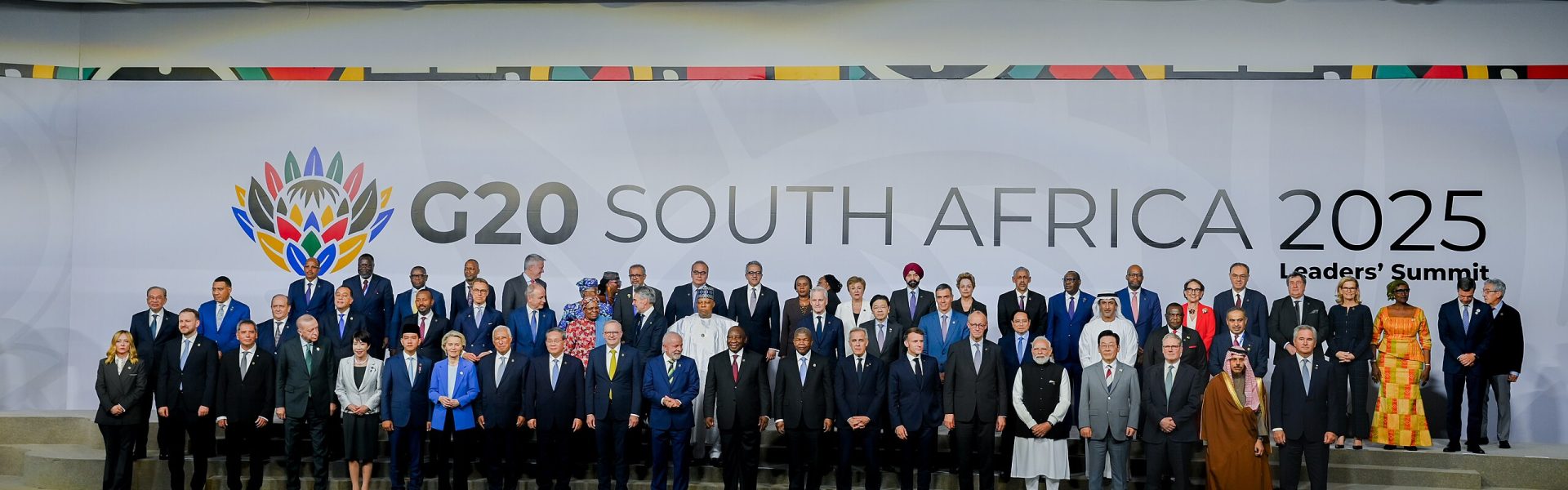







JOHANNESBURG: The 2025 G20 Leaders’ Summit in Johannesburg marked a critical turning point in the architecture of global governance. For the first time, the forum convened on African soil under the theme “Solidarity, Equality, Sustainability,” decisively shifting the moral and political centre of gravity towards Africa and the wider Global South. India used this moment not merely to represent developing societies within a pre-existing order, but to reshape how global authority is exercised and legitimacy is constructed. Through six interconnected initiatives concerning knowledge systems, human capital development, health security, counter-terror finance, digital public goods, and critical minerals, Prime Minister Narendra Modi advanced a blueprint that interrogated inherited asymmetries of global governance without lapsing into ideological rupture.
The United States’ boycott, far from weakening the summit, clarified a deeper structural shift. The most consequential debates on climate finance, sovereign debt, digital governance, and security proceeded not only without Washington’s participation but with India exercising unusual convening authority. Johannesburg thus underlined a foundational transformation in multilateral diplomacy: the capacity to generate outcomes is no longer indivisibly tied to Western leadership.
The summit also unfolded as a moment of recalibration within Europe and across the European Union. In the absence of the United States, European governments approached India not as a peripheral partner but as an indispensable systemic actor in emerging frameworks of economic resilience, green transition, digital regulation, and geopolitical balance. Johannesburg thus became a rare historical inflection point—where India acted not as a state seeking inclusion, but as one asserting institutional initiative in the remaking of world order.
India’s strategic community often describes such moments as alignments of power, purpose, and timing, and Modi’s visit reflected precisely that convergence. India approached Johannesburg not as a post-presidency formality after New Delhi’s 2023 tenure, but as a continuum of vision extending from Delhi to Africa. The Delhi Summit had secured the African Union’s permanent inclusion in the G20 and displaced a narrowly economic conception of multilateralism by elevating Global South priorities from the margins to the core of agenda-setting. Under African leadership but shaped by Indian diplomacy, Johannesburg became the site where those principles acquired continental depth and institutional gravity.
Johannesburg did more than confirm continuity; it revealed relocation. Norm-setting authority, long monopolised by North Atlantic institutions, displayed visible movement toward the Global South. For the first time, a summit conceived, led, and framed from the South shaped the language of sustainability, equity, technology, and finance in ways that resonated not as protest, but as principle. The centre of gravity did not merely tilt—it shifted.
India’s civilisational vocabulary at Johannesburg carried institutional authority. Vasudhaiva Kutumbakam—the world envisioned as a moral community—was deployed not as rhetorical embellishment but as governing logic, backed by economic scale, technological capacity, and diplomatic reach. The message was no longer aspirational: developing societies are now shaping actors within the global political economy.
Modi at Johannesburg: Recasting the Architecture of Global Order
Prime Minister Modi’s address must be interpreted as strategic authorship rather than diplomatic convention. The speech did not seek accommodation within the existing order; it challenged the very structural foundations of global governance on which that order rests. Modi diagnosed contemporary instability not merely as rivalry among states, but as the consequence of design—where accumulation has prevailed over equity, technological acceleration over ecological responsibility, and profit over dignity. India thereby positioned itself not as a moderator of inherited arrangements, but as a state prepared to reconstruct the operating philosophy of global systems.
The six initiatives unveiled constituted an integrated architecture. The Global Traditional Knowledge Repository asserted epistemic justice by recognising that sustainability, medicine, and ecological intelligence do not originate solely within Euro-American scientific traditions. The Africa Skills Multiplier placed human capital at the core of development—cultivating African trainers, technical cadres, and institutional leadership rather than exporting consultancy and perpetuating expertise dependency. The Global Healthcare Response Team responded to the catastrophic institutional failure exposed during the COVID-19 crisis, when vaccine nationalism and regulatory paralysis revealed the moral hollowness of global health governance.
India’s insistence on placing the drug–terror nexus at the centre of G20 discourse marked another conceptual rupture. By highlighting synthetic narcotics, financial opacity, and digital laundering, India insisted that terrorism cannot be reduced to geography. It is embedded in global financial architectures and must be confronted through systemic regulation and moral clarity. In this frame, security was redefined not as force alone but as financial governance, transparency, and institutional accountability.
The Open Satellite Data Partnership and Critical Minerals Circularity extended this critique into the domains of data and extraction. Climate intelligence, if enclosed, reproduces hierarchy in technological form. Critical minerals extraction risks replaying imperial supply chains beneath green rhetoric. Circular economies, urban mining, recycling frameworks, and shared satellite access redefined sustainability as political economy rather than environmental symbolism.
Taken together, these initiatives amounted to regime revision rather than reform. India did not confront the order from outside; it sought to re-engineer it from within.
India and the Global South: From Representation to Propulsion
Johannesburg marked India’s decisive transition from spokesman to architect within the Global South. Africa no longer appeared as a humanitarian theatre but as the future demographic engine, industrial axis, and energy frontier of the world.
Africa’s prominence at Johannesburg was not symbolic enlargement. It reflected structural recognition. The declaration referenced Africa not as a recipient of assistance but as a future fulcrum of growth: the world’s youngest labour force, emerging industrial geography, and green-energy frontier. India’s diplomacy reinforced this reframing. Africa was presented not as a development burden but as a geopolitical asset whose political centrality will expand as population, production, and energy converge.
India no longer operates as an advocate pleading inclusion into a closed order. It is increasingly a generator of policy vocabulary, institutional design, and normative framing. What Johannesburg displayed was not representation but propulsion: India acting as the directional force of a Global South that is now shaping agendas rather than reacting to them.
India’s posture diverged from both donor paternalism and extraction diplomacy. Where Western policy remains entangled in conditionality and China’s engagement in infrastructure leverage, India proposed architecture: digital citizenship platforms, skills ecosystems, health infrastructure, and governance models. Africa, in this approach, is not a recipient of benevolence but a participant in creation.
The philosophical departure was unmistakable. Development must be endogenous. Technology must preserve sovereignty. Cooperation must generate agency.
India–Europe at Johannesburg: Between Convergence and Constraint
If the G20 plenary articulated India’s global normative ambition, the sidelines revealed a deeper transformation: Europe’s steady accommodation of an India that now seeks recognition as a rule-shaper rather than a rule-taker. For the first time, major European leaders engaged India not primarily as a market or diplomatic partner, but as a strategic actor whose positions increasingly shape economic governance, security doctrine, technological norms, and climate architecture.
The meeting with Italian Prime Minister Giorgia Meloni illustrated this recalibration sharply. Beyond personal rapport, the India–Italy Joint Initiative to Counter the Financing of Terrorism marked a substantive elevation of Indo-European security cooperation into the domains of digital finance and cryptocurrencies. It acknowledged explicitly that contemporary terrorism cannot be dismantled by military instruments alone; it must be confronted through financial transparency, regulatory coordination, and digital governance.
Germany used the Johannesburg sidelines to deepen engagement with India on green transitions, critical minerals, and resilient supply chains, reflecting Berlin’s re-evaluation of its industrial and energy dependencies following strategic shocks in Europe. Chancellor Friedrich Merz’s discussions with Modi reinforced India’s growing centrality in Germany’s long-term economic strategy—not merely as an alternative manufacturing ecosystem, but as a climate and technology partner in Europe’s industrial renewal.
The interaction with British Prime Minister Keir Starmer gestured a clear departure from post-Brexit ambivalence. Advancing the implementation of the recently signed India–UK Free Trade Agreement—finalized in July 2025 during Prime Minister Modi’s visit to London—alongside deepened cooperation on green hydrogen and technological innovation, revealed Britain’s recognition that India is central to its economic realignment and relevance beyond Europe. For a fiscally constrained UK navigating post-imperial repositioning, partnership with India now appears integral rather than optional.
France reaffirmed its distinct position as India’s most consistent European strategic partner, with cooperation spanning defence production, nuclear energy, maritime security, and space systems. President Emmanuel Macron’s engagement reflected continuity joined to conviction: India and France continue to see each other as partners in sustaining a multipolar Indo-Pacific while resisting alignment into rigid blocs.
Yet alignment did not erase friction. Europe’s Carbon Border Adjustment Mechanism, regulatory assertiveness on digital platforms, and periodic moral posturing on rights continue to collide with India’s insistence on strategic autonomy and development policy space. Trade negotiations remain burdened by disagreements over market access, labour standards, and data governance. However, Johannesburg revealed a new pragmatism: on terrorism, climate technology, critical minerals, and artificial intelligence, Europe and India increasingly pursue issue-based convergence instead of ideological coordination—particularly in the vacuum created by American absence.
Concurrently, Brussels formalised this recalibration through the 11th India–EU Foreign Policy and Security Consultations and the 6th Strategic Partnership Review. The two sides reviewed the entire matrix of relations, including trade negotiations, supply-chain resilience, technology governance, innovation ecosystems, climate cooperation, and multilateral coordination. The reaffirmed commitment to finalising the Free Trade Agreement, advancing investment protection, and concluding the Geographical Indications framework underscored renewed political urgency.
The EU-India Trade and Technology Council, emerging as a principal coordinating platform, advanced regulatory coordination in semiconductors, clean-energy technology, and digital standards, institutionalising convergence beyond episodic diplomacy. Strategic cooperation now extends across scientific research, disaster resilience through the Coalition for Disaster Resilient Infrastructure, maritime security, cyber policy, and defence industrial collaboration. Brussels also acknowledged India’s upcoming BRICS Chairship in 2026, signalling alignment on global financial restructuring and crisis-response governance.
This convergence reframes India’s role fundamentally. It is no longer positioned as merely the “voice” of the Global South but increasingly as a stabilising bridge between Africa’s demographic future, Europe’s structural recalibration, and Asia’s economic velocity. Europe now engages India not simply to access markets, but to secure industrial resilience, climate partnerships, digital autonomy, and political legitimacy across emerging regions.
In Johannesburg, India’s six-pillar agenda—encompassing traditional knowledge systems, health security, satellite data access, critical mineral circularity, counter-terror finance, and skills architecture—presented not fragmented reform but institutional redesign. The digital commons challenged data enclosure. Circularity contested extractive capitalism. Health security rejected crisis philanthropy. Skill frameworks elevated Africa as a centre of human capital. Counter-terror initiatives treated financial opacity as a security threat.
The normative intervention extended into digital governance, where India advanced a third framework beyond Western data capitalism and Chinese state control: a democratic, development-oriented digital order grounded in civilisational plurality. Artificial intelligence was framed not merely as infrastructure but as a cultural force—one that must be governed politically before it governs societies invisibly.
Europe’s endorsement of this framework, reflected in the EU’s 2025 Strategic Agenda for India, confirmed the transformation from rhetorical alignment into strategic interdependence. The relationship now rests not only on trade flows but on designing systems—from climate technology and industrial policy to digital sovereignty and security architecture.
Together, Africa, India, and Europe outline a new geometry of power—one characterised not by concentration but connectivity; not by bloc politics but institutional layering. Authority is no longer monopolised; it is distributed through design.
Conclusion
The US absence from the Johannesburg G20 did not weaken the summit; it clarified the distribution of responsibility within the international system. What might have evolved into polarisation instead produced contrast. South Africa ensured procedural legitimacy. European governments upheld institutional continuity. India stabilised outcomes—not by confrontation, but by custodianship. This episode revealed how India’s strategic autonomy has matured: no longer a posture of distance, nor an exercise in ambiguity, but an operational commitment to preserving the functionality of multilateral order itself. India today does not merely operate within institutions; it acts as a systemic guarantor when others waver. Its autonomy is not exercised against the world order, but in its defence.
Yet the ultimate measure of this moment lies not in words but in institutional endurance. Vision must now confront the discipline of implementation. If the six initiatives announced in Johannesburg fade into communiqué language, the summit will be remembered as symbolic rather than transformative. The Knowledge Repository must be governed and funded, not merely invoked. The Skills Multiplier requires training ecosystems, accreditation networks and cross-border mobility. Health cooperation must become permanent architecture rather than episodic coordination. Counterterror finance must move from commitment to enforcement. Open satellite data must empower without dependency. Critical-mineral circularity must reshape industrial strategy, not remain confined to environmental rhetoric. Without institutionalisation, architecture dissolves into aspiration.
For Africa, this demands consolidation of institutions and deep investment in human capital. For Europe, it requires a cognitive shift from dominance to design. For India, it imposes the most demanding task of all: translating civilisational confidence into durable governance mechanisms. A civilisational state cannot subsist on symbolism alone; it must endure through structure.
Johannesburg will therefore endure in memory not because it was held on African soil, but because it signalled that the centre of global gravity has moved—quietly but decisively—towards the developing world. India did not perform diplomacy; it practiced construction. It did not merely participate; it co-authored. The age of authority by inheritance is receding. The era of legitimacy by architecture has begun. And if leadership in this century is measured not by coercion but by capacity to build, the future will not be ruled by empires. It will be shaped by architects. India has now announced itself as one of them—not by declaration, but by design.
Views: 1125

Dr. Maheep
Dr. Maheep is Director, Indian Perspective on Global Affairs (IPGA), and a leading analyst of India’s foreign policy and South Asian geopolitics. He earned his PhD in Arab and Islamic Studies. With more than a decade of teaching and research experience in International Relations and Global Politics, he contributes regularly on issues shaping national and global affairs.