






Sanctuary, Sovereignty and Security: India – Canada Diplomacy and the Renewal of Strategic Trust
The October 2026 Security Dialogue, the Counterterrorism Imperative and the Road Ahead
On 6 October 2026, National Security Adviser Ajit Doval received David Morrison, Senior Diplomatic and International Affairs Advisor to Canadian Prime Minister Mark Carney, in New Delhi for the third round of a renewed national security dialogue. The Privy Council Office in Ottawa recorded that Morrison travelled at Doval’s invitation and that the meeting formed part of an ongoing bilateral security dialogue at the level of national security advisers, following the New Delhi round of September 2025 and the Ottawa round of February 2026. Seasoned observers of diplomacy will appreciate the symbolism of the occasion. Two years earlier, in October 2024, Morrison sat among the Canadian officials who confronted Doval in Singapore with allegations of Indian state involvement in violence on Canadian soil, and he later told Canadian parliamentarians that he had confirmed the name of a senior Indian minister to an American newspaper. The arrival of the same official in New Delhi as an emissary of cooperation measures the distance the relationship has travelled. India and Canada have moved from accusation to architecture, from the theatre of parliamentary allegation to the disciplined grammar of liaison officers, work plans and implementation reviews.
This article advances a clear thesis. For nearly four decades, the principal impediment to a mature India–Canada partnership lay in Ottawa’s reluctance to confront Canada-based Khalistani violent extremism as the transnational security threat that its own institutions repeatedly identified. Political accommodation of extremist constituencies, permissive enforcement against terrorist financing and the public escalation of 2023–24 converted a manageable disagreement into the gravest crisis in the relationship’s history. The Carney government’s recognition of shared threats, together with New Delhi’s patient insistence on evidence, institutions and reciprocity, has created the conditions for renewal. The October dialogue consolidates that correction, and the strategic task ahead lies in converting a negotiated thaw into durable strategic trust.
The Long Road to Estrangement
India and Canada began as natural partners. Both emerged from the British imperial order as parliamentary democracies, and both embraced the Commonwealth as an association of sovereign equals. Canadian participation in the Colombo Plan from 1950 channelled development assistance to India, and Canadian engineering helped build the CIRUS research reactor at Trombay. Jawaharlal Nehru and Lester Pearson shared a liberal internationalist vocabulary that seemed to promise enduring convergence.
The Cold War gradually exposed divergent strategic priorities. Canada anchored its security in NATO and the North American alliance system, while India pursued strategic autonomy through non-alignment. The 1974 Pokhran test crystallised the divergence. Ottawa regarded the use of CIRUS-derived material as a breach of the peaceful purposes it had envisaged, suspended nuclear cooperation and froze much of the relationship for a generation. India regarded its programme as a sovereign response to a hostile neighbourhood and a discriminatory non-proliferation order. The episode established a pattern that would recur with remarkable consistency: Canada framed its position in the language of principle, while India experienced that position as a refusal to comprehend the security environment of a large democracy surrounded by nuclear and revisionist neighbours.
The 1980s introduced a far graver dimension. As militancy convulsed Punjab, transnational Khalistani networks found organisational space, fundraising capacity and ideological refuge in Canada. On 23 June 1985, a bomb placed aboard Air India Flight 182 exploded off the coast of Ireland, killing all 329 people on board, most of them Canadian citizens, while a second device killed two baggage handlers at Tokyo’s Narita airport. The Canadian Security Intelligence Service, marking the fortieth anniversary in its 2025 Public Report, recorded that the suspects were members of Canada-based Khalistani extremist groups and that the bombing remains the deadliest terrorist attack in Canadian history. Only one man, Inderjit Singh Reyat, was ever convicted. The alleged principal plotters were acquitted or died beyond the reach of Canadian justice, and that outcome left a wound in Indian strategic memory that successive Canadian governments underestimated.
The following decades brought partial restoration. The 2010 Nuclear Cooperation Agreement, the 2015 uranium supply arrangement with Cameco, expanding trade and a vast inflow of Indian students rebuilt the material foundations of the relationship. The security question nevertheless remained beneath the surface, and Justin Trudeau’s visit of February 2018 brought it into full view. The invitation extended to Jaspal Atwal, convicted in Canada for the 1986 attempted murder of a visiting Punjab minister, to a Canadian reception in New Delhi, hastily rescinded amid public embarrassment, signalled to New Delhi that the boundary between Canadian political outreach and extremist networks had become dangerously porous. The deterioration that followed grew from accumulated disagreements over security perceptions, diaspora politics, domestic electoral priorities and the line separating legitimate dissent from violent extremism.
Sanctuary and Its Discontents: Canada’s Security Contradictions
India’s grievance has always been precise. India accepts the right of every citizen in a democracy to advocate peacefully for any political cause. India’s objection concerns the promotion, financing and planning of violence against Indian citizens, institutions and territorial integrity from a foreign sanctuary, and the persistent reluctance of successive Canadian governments to act against that activity with the seriousness their own agencies prescribed. This distinction between advocacy and violence forms the foundation of democratic counterterrorism, and it strengthens India’s case.
The first dimension concerns terrorist networks and institutional shortcomings. Canada’s Criminal Code list of terrorist entities has included Babbar Khalsa International and the International Sikh Youth Federation since 2003. The Canadian Security Intelligence Service has been unusually candid. Its 2025 Public Report states that continued involvement in violent extremism by Canada-based Khalistani extremists poses a national security threat to Canada, and it observes that some of these actors are well connected to Canadian citizens who use Canadian institutions to advance their agenda and collect funds from unsuspecting community members, funds later diverted toward violence. The same report defines these extremists as a small group who “use Canada as a base to promote, fundraise, or plan violence primarily in India.” Canada’s Department of Finance went further in its 2025 Assessment of Money Laundering and Terrorist Financing Risks, recording that law enforcement and intelligence agencies had observed Babbar Khalsa International and the International Sikh Youth Federation receiving financial support originating from Canada, and placing them in the same category as Hamas and Hezbollah. When a state’s own intelligence service and finance ministry describe its territory as a base for organising violence against a friendly democracy, the burden of explanation shifts decisively to that state. The question becomes one of political will.
The second dimension concerns the enduring lessons of Air India Flight 182. Justice John Major’s Commission of Inquiry, in its 2010 final report, described “a cascading series of errors”: warnings that went unheeded, rivalry and poor information-sharing between CSIS and the Royal Canadian Mounted Police, the erasure of intercepted recordings, and a weak regime against terrorist financing. The Government of Canada’s formal response accepted the need to reform threat assessment, inter-agency coordination and financial controls. The moral lesson carries greater weight than any procedural reform. The victims were overwhelmingly Canadian, the perpetrators were Canada-based, and the target was an Indian national carrier. Flight 182 revealed the security of Indians and Canadians as a single, indivisible good. A state that internalises this lesson treats Indian warnings as early warning for its own citizens.
The third dimension concerns the political calculations of the Trudeau era. The electoral geography of Canadian federalism concentrates Sikh Canadian voters in a cluster of decisive ridings across Greater Toronto and Metro Vancouver, and from 2021 the Liberal minority government depended on a parliamentary arrangement with the New Democratic Party, whose leadership ranked among India’s most vocal critics. Within this environment, the record of inconsistency accumulated. Organisers of so-called referendum campaigns run by Sikhs for Justice, an organisation banned in India under counterterrorism law, operated openly in Canadian cities. A June 2023 parade float in Brampton depicted the assassination of Prime Minister Indira Gandhi. Posters calling for violence against named Indian diplomats circulated in July 2023. In November 2024, violence erupted outside the Hindu Sabha temple in Brampton during an Indian consular camp. Indian requests for extradition and mutual legal assistance concerning designated individuals languished for years. New Delhi’s Ministry of External Affairs, in its statement of October 2024, attributed Ottawa’s conduct to “vote bank politics” and observed that the Trudeau cabinet itself included individuals openly associated with an extremist and separatist agenda. Each of these episodes, taken alone, admits of explanation. Taken together, they reveal a governing coalition that consistently placed domestic electoral management above the security obligations owed to a strategic partner. The criticism belongs precisely to the persons, organisations and governmental decisions implicated. Sikh Canadians rank among Canada’s most accomplished citizens, many Sikh families in Punjab were themselves victims of militancy, and the overwhelming majority of the community rejects violence.
The fourth dimension concerns the convergence of terrorism and organised crime. Indian agencies have documented a hybrid ecosystem in which extremist networks, gangsters, extortion rackets, arms trafficking and narcotics proceeds reinforce one another. India’s Ministry of Home Affairs designated Canada-based Arshdeep Singh Gill, known as Arsh Dalla, and Lakhbir Singh Landa as individual terrorists in 2023, and designated Satinderjit Singh, known as Goldy Brar, in January 2024. Dalla was arrested in Ontario in late 2024 following a shooting incident, and India sought his extradition. National Investigation Agency charge sheets further allege that Pakistan-based Babbar Khalsa operative Harvinder Singh Rinda coordinates cross-border weapons and narcotics flows with the support of Pakistan’s Inter-Services Intelligence. These claims carry different evidentiary weights. Designations under the Unlawful Activities (Prevention) Act are executive determinations; charge sheets are prosecutorial allegations awaiting judicial test; convictions remain comparatively few. Analytical discipline requires that distinction, and the cumulative pattern of designations, investigations and Canada’s own September 2025 listing of the Bishnoi gang as a terrorist entity nonetheless confirms a criminal and extremist nexus that both states now formally acknowledge, even as they interpret its affiliations differently.
The fifth dimension concerns Canada’s own security. Extremist violence imported into Canadian streets endangers Canadian citizens first. Extortion targets Indo-Canadian businesses in Surrey and Brampton, communal confrontations polarise neighbourhoods, and the glorification of terrorists corrodes social cohesion. A G7 state that tolerates fundraising for listed terrorist entities also forfeits credibility in multilateral counterterrorism forums. United Nations Security Council Resolution 1373 of 2001 obliges every member state to deny safe haven to those who finance, plan, support or commit terrorist acts. Counterterrorism cooperation with India therefore represents a shared responsibility and a fulfilment of Canada’s own international obligations, and it carries no character of concession.
The Diplomatic Nadir, 2023–2024
On 18 June 2023, Hardeep Singh Nijjar was shot dead outside a gurdwara in Surrey, British Columbia. India’s Ministry of Home Affairs had designated him an individual terrorist under the Unlawful Activities (Prevention) Act in 2020, and the National Investigation Agency had registered cases against him, including RC-15/2018/NIA/DLI. These facts establish India’s long-standing security concern; a designation and an investigation remain legally distinct from a criminal conviction, and Nijjar was never tried. At the New Delhi G20 Summit on 9 and 10 September 2023, Prime Minister Narendra Modi conveyed to Trudeau India’s strong concerns about the continuing anti-India activities of extremist elements in Canada, a message recorded in the official readout of the meeting.
Eight days later, on 18 September 2023, Trudeau told the House of Commons that Canadian agencies were pursuing “credible allegations of a potential link” between agents of the Government of India and the killing. India rejected the statement as “absurd and motivated.” The two capitals expelled diplomats, India suspended visa services, and in October 2023 New Delhi secured parity in diplomatic strength, prompting the departure of forty-one Canadian diplomats. In May 2024, the RCMP charged four Indian nationals with the murder; they remain presumed innocent, and no court has made any finding connecting the Government of India to the crime.
The crisis deepened in October 2024. Canada declared India’s High Commissioner Sanjay Kumar Verma and other diplomats persons of interest in its investigation, and the RCMP publicly alleged links between Indian agents and violent criminality, including the Lawrence Bishnoi network. India withdrew its High Commissioner, expelled six Canadian diplomats and rejected what it called “preposterous imputations.” Two days later, testifying before the Public Inquiry into Foreign Interference, Trudeau acknowledged that when he addressed Parliament in September 2023 Canada possessed “primarily intelligence and not hard evidentiary proof.” New Delhi regarded that admission as vindication of its position that a sitting head of government had placed intelligence-grade suspicion before Parliament and the world while withholding actionable evidence from the state he accused.
Canada’s counter-narrative deserves fair statement. Ottawa maintained that it had pursued quiet engagement through senior channels, including the Singapore meeting, before going public; that it was defending the sovereignty of its territory and the safety of its citizens; and that India engaged in foreign interference and transnational repression, an assessment repeated by the Foreign Interference Commission in January 2025 and by CSIS in its subsequent public reports. India has rejected every such allegation as unsubstantiated and politically motivated. The principal analytical question therefore admits of a reasoned answer. The Trudeau government’s long neglect of India’s documented security concerns, combined with its decision to elevate unproven allegations to the floor of Parliament, transformed a serious but manageable disagreement into an exceptional bilateral crisis. September 2023 marked the political breakdown; October 2024 converted it into institutional rupture. In both moments, megaphone diplomacy displaced the quiet investigative cooperation through which mature partners resolve the most sensitive disputes.
From Trudeau to Carney: The Return of Strategic Pragmatism
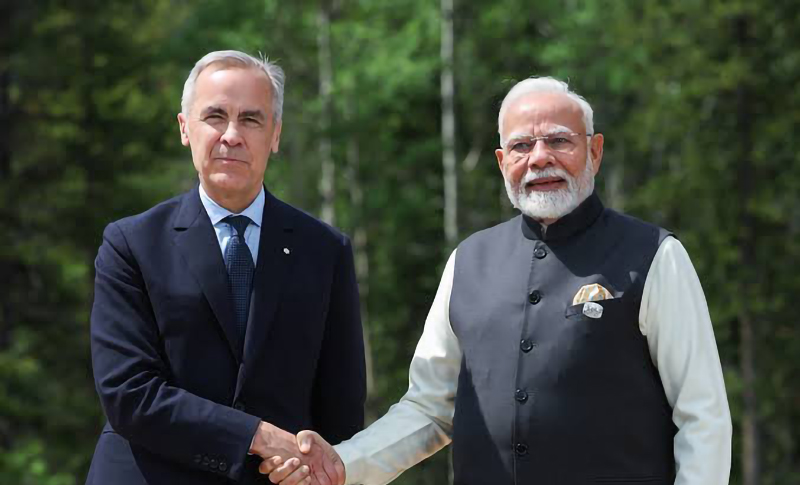
Mark Carney’s accession in March 2025 changed the strategic calculus in Ottawa. Confronting turbulence in Canada’s economic relationship with the United States and the imperative of trade diversification, the new government recognised that sustained estrangement from one of the world’s fastest-growing major economies imposed costs that Canada could ill afford. Carney invited Modi to the G7 Summit at Kananaskis in June 2025, where the two leaders agreed to restore High Commissioners. On 18 September 2025, Doval met Canada’s National Security and Intelligence Advisor Nathalie Drouin in New Delhi, and the Ministry of External Affairs reported productive discussions on counterterrorism, transnational organised crime and intelligence exchanges. The following day, pre-Foreign Office Consultations led by Secretary (East) P. Kumaran and Morrison, then Deputy Foreign Minister, agreed to reactivate dialogue mechanisms spanning trade, defence, energy, civil nuclear cooperation, security and law enforcement, critical minerals and space. Within weeks, Ottawa listed the Bishnoi gang as a terrorist entity, and its finance ministry published the terrorist financing assessment that confirmed Indian warnings.
In Ottawa on 6 and 7 February 2026, Doval met Drouin and Public Safety Minister Gary Anandasangaree. The Canadian readout recorded agreement on a shared work plan to guide cooperation on national security and law enforcement, a commitment by each country to establish security and law-enforcement liaison officers, and an undertaking to formalise cooperation on cybersecurity policy while continuing discussions on fraud and immigration enforcement. Indian officials described the central message as Canada’s assurance that violent extremist groups enjoy no support from the Government of Canada. Carney’s visit to India from 27 February to 2 March 2026 translated security confidence into economic substance: a strategic energy partnership, a C$2.6 billion uranium supply agreement with Cameco, ten commercial agreements valued above C$5.5 billion, agreed terms of reference for a trade agreement and a new strategy on talent and innovation. Even when a Canadian newspaper published fresh anonymous allegations about the Nijjar case on the eve of the summit, both leaders held their course, a striking demonstration of the new institutional ballast. At Évian on 16 June 2026, their fourth meeting in under a year, the two leaders reaffirmed the goal of concluding a Comprehensive Economic Partnership Agreement in 2026, and Modi announced India’s support for Canada becoming a Dialogue Partner of the Indian Ocean Rim Association.
Three concepts illuminate this reset. Strategic pragmatism captures the recognition that enduring national interests require functional diplomatic relationships, particularly when estrangement imposes material costs. Reciprocal security captures the recognition that terrorism, criminal syndicates, narcotics flows, cyber threats and violent extremism threaten both societies and demand sustained cooperation. Institutional resilience captures the recognition that liaison officers, work plans and regular NSA-level reviews insulate the relationship from the shocks of individual incidents and political rhetoric. The reset represents a negotiated transformation of priorities. Outstanding grievances remain, and both governments have chosen to manage them through institutions in place of public confrontation.
New Delhi, 6 October 2026: Security as the Foundation of Renewal
The October dialogue stands as the analytical culmination of this trajectory. According to the Canadian readout, both sides acknowledged the guidance of their prime ministers from the March 2026 New Delhi summit and the June 2026 Évian meeting, and noted with satisfaction a year of engagement guided by mutual trust and respect for each other’s concerns and sensitivities. That phrase carries particular weight in Indian diplomatic vocabulary. Respect for sensitivities has always signified, for New Delhi, respect for India’s sovereignty and territorial integrity, and its appearance in a Canadian government text marks a doctrinal convergence of real significance.
The dialogue advanced six priorities. On counterterrorism and violent extremism, the two sides agreed to deepen cooperation against terrorism and violent extremism, extending the February commitments into a sustained operational agenda. On transnational organised crime, they agreed to intensify action against human and drug trafficking, cybercrime and extortion, the precise activities through which extremist and criminal networks finance and sustain themselves. On intelligence and law-enforcement coordination, they reviewed implementation of the Security Work Plan formalised in February and agreed to strengthen existing institutional mechanisms and establish new channels for streamlined communication and timely information-sharing. On extradition and legal cooperation, the inclusion of the extradition of criminal offenders in an agreed text represents a meaningful advance, given the long history of pending Indian requests under the 1987 bilateral extradition treaty, and it signals Ottawa’s acceptance that judicial cooperation forms part of the security agenda. On cybersecurity and economic security, the two sides agreed to explore the establishment of structured dialogues, extending security cooperation into the domains where twenty-first-century vulnerability increasingly resides. On wider strategic cooperation, they welcomed progress towards the Comprehensive Economic Partnership Agreement and discussed the growing potential for a substantive defence relationship.
Analytical precision requires a clear sequencing of these commitments. The liaison-officer mechanism and the Security Work Plan, agreed in February, are operational instruments now under implementation review. The deepened cooperation on terrorism, organised crime, extortion and extradition represents an agreed agenda whose credibility will rest on cases, prosecutions and transfers. The structured dialogues on cyber and economic security, and the defence relationship, remain exploratory. This graduated architecture reflects sound statecraft: confidence built through verifiable delivery in the security domain provides the enabling condition for ambition in the economic and strategic domains.
Ajit Doval’s personal stewardship provides indispensable continuity. Having led India’s engagement through the Singapore confrontation of 2024, the restoration of 2025 and the Ottawa breakthrough of 2026, he embodies an Indian security doctrine that holds firm on sovereignty while remaining open to institutional partnership. Morrison’s presence, in turn, signals that the Canadian security and foreign policy establishment has internalised the logic of cooperation. The immediate achievement of the dialogue lies in its normalisation of security engagement as routine statecraft. Its potential dividend lies in a relationship in which security cooperation underwrites trade, energy and technology partnerships. Its limitation lies in the distance between agreed texts and delivered outcomes, a distance that only sustained implementation can close.
The Security of States and the Security of People
The October dialogue acquires its deepest meaning when the security of states is joined to the security of people. The United Nations Development Programme’s 1994 Human Development Report defined human security as freedom from fear and freedom from want, and violent extremism assaults both. It takes lives, inflicts lasting psychological trauma, polarises communities and replaces civic trust with fear. The families of the 329 victims of Flight 182 embody this truth across four decades; their grief belongs equally to Canada and to India.
India–Canada cooperation can protect citizens from terrorism, intimidation and organised violence; Indian and Canadian communities from extortion, trafficking, cybercrime and financial exploitation; the many thousands of Indian students and migrants in Canada from criminal victimisation and fraudulent recruitment; diplomatic personnel and democratic institutions from coercion; and economic livelihoods through secure trade, energy and technology partnerships. The United Nations Global Counter-Terrorism Strategy of 2006 affirms that effective counterterrorism and respect for human rights reinforce one another. Lawful political expression, due process and judicial independence remain essential, and accountable institutions provide the surest means of protecting them while denying violence its sanctuary. The responsibility to prevent violence transcends political differences, territorial boundaries and changes of government.
A Roadmap from Repair to Partnership
The renewal now requires a disciplined roadmap. In the immediate term, the priority lies in making the liaison-officer mechanism fully operational, establishing secure channels for real-time intelligence and law-enforcement exchange, accelerating pending investigations, and guaranteeing the protection of Indian diplomatic missions and personnel, which the Ministry of External Affairs has consistently identified as the host government’s responsibility. Coordinated action against violent extremism should follow, through joint financial-intelligence work against terrorist fundraising, scrutiny of non-profit and charitable channels identified in Canada’s own risk assessment, and firm action against cross-border intimidation and violent recruitment.
In the medium term, legal and institutional accountability should advance through the timely processing of extradition and mutual legal assistance requests, structured evidence-sharing that meets the standards of Canadian courts, and consistent application of domestic and international law. Human-security cooperation should protect students and migrants through joint action against fraudulent recruitment, community policing partnerships and coordinated responses to cyber-enabled extortion. Over the longer horizon, defence and economic convergence should mature through a regular Defence Dialogue, maritime-security cooperation in the Indo-Pacific, critical-mineral and energy partnerships, collaboration in emerging technologies and the conclusion of the Comprehensive Economic Partnership Agreement. Strategic continuity should be secured through regular summit and NSA-level meetings, annual implementation reviews and an agreed protocol for managing future disputes through confidential channels.
Several indicators will measure the success of the October dialogue: completed extraditions and prosecutions of individuals involved in terrorism and organised crime; demonstrable action against terrorist financing networks named in Canadian assessments; the absence of security incidents at Indian missions; the launch of the cyber and economic security dialogues; the conclusion of the trade agreement; Prime Minister Modi’s anticipated visit to Canada; and, above all, the management of any future disagreement through quiet diplomacy.
Findings and Conclusion
Five findings emerge from this analysis. First, Canada-based Khalistani violent extremism has generated enduring national security concerns for India, and Canada’s own intelligence service and finance ministry have officially recognised the core of that threat. Second, political accommodation, competing legal interpretations and gaps in counterterrorism cooperation sustained decades of mistrust; responsibility is demonstrable in Canada’s failures on terrorist financing, extradition and the protection of Indian missions, while the questions surrounding the Nijjar case remain before the courts and contested between the two governments. Third, the 2023–24 crisis exposed the diplomatic cost of weak institutional confidence and of competing narratives of sovereignty amplified through public accusation. Fourth, the 2025–26 reset demonstrates that strategic necessity, political leadership and institutional mechanisms can produce rapprochement even while historical grievances remain unresolved. Fifth, a sustainable partnership requires counterterrorism cooperation, human-security safeguards, defence engagement and economic interdependence to operate within a framework of reciprocal sovereignty and credible implementation.
The October 2026 dialogue thus marks a turning point in a relationship that once seemed destined for prolonged estrangement. India held to a consistent position throughout: terrorism admits of no justification, sanctuary for violence is incompatible with friendship, and sovereignty must be respected in both directions. Canada, under new leadership, has begun to align its conduct with the findings of its own security institutions. Two democracies bound by history, by a shared tragedy over the Atlantic in 1985 and by vast human connections now possess the institutional means to convert that alignment into strategic trust. The measure of their success will be the steady, verifiable denial of sanctuary to those who would kill in the name of a cause, and the quiet confidence of partners who have learned that security shared is security secured.
Views: 1148

Dr. Maheep
Dr. Maheep is Director, Indian Perspective on Global Affairs (IPGA), and a leading analyst of India’s foreign policy and South Asian geopolitics. He earned his PhD in Arab and Islamic Studies. With more than a decade of teaching and research experience in International Relations and Global Politics, he contributes regularly on issues shaping national and global affairs.