


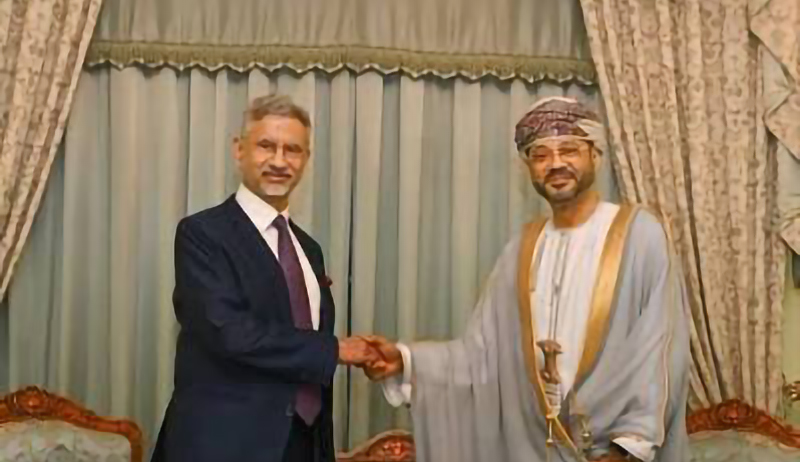







The Muscat Consummation: India, Oman and the Completion of Indo-Gulf Strategic Arc
Dr. S. Jaishankar’s Visit to the Sultanate of Oman as the Concluding Leg of India’s Four-Nation Gulf Diplomacy Amid the West Asian Conflagration
Diplomacy Under Fire
Great powers reveal their character in moments of crisis, and rising powers reveal their ambitions. In the second week of July 2026, as Iranian missiles struck military facilities in Bahrain and Kuwait, as an LNG tanker burned off the Omani coast near Limah, and as some 600 merchant vessels lay trapped within the Persian Gulf awaiting the reopening of the world’s most consequential maritime chokepoint, India’s External Affairs Minister moved calmly through four Gulf capitals. Dr. S. Jaishankar’s itinerary read like a wartime dispatch: Doha, Manama, Kuwait City and finally Muscat, traversed between 5 and 10 July 2026, with meetings conducted in cities standing within range of active hostilities. The tour constituted one of the most remarkable exercises of crisis diplomacy in the recent annals of Indian statecraft, and its concluding leg in Oman carried a significance far exceeding the sum of its formal deliverables.
The regional context is indispensable to understanding the significance of the visit. The war that erupted on 28 February 2026 between the United States, Israel and Iran transformed the Gulf from a theatre of commerce into a theatre of confrontation. Iran closed the Strait of Hormuz in early March; traffic through a waterway that had carried roughly a fifth of the world’s oil and gas collapsed, at the war’s height, to as few as two tankers a day. A fragile fourteen-point memorandum signed on 17 June promised de-escalation, yet fresh attacks on shipping in the first week of July, answered by Iranian strikes on more than 80 facilities in Bahrain and Kuwait, showed how thin the membrane between truce and conflagration had become. Nearly 6,000 seafarers remained stranded aboard hundreds of vessels, close to 18,000 Indian mariners remained in regional waters, and 14 commercial mariners, several of them Indian nationals, had already lost their lives.
Into this crucible stepped India’s most experienced diplomat, and his presence in Kuwait City during the very window of Iranian strikes, followed by his onward journey to Muscat rather than homeward to New Delhi, communicated three messages with a clarity no communique could match. First, India stands with its Gulf partners in adversity as in prosperity: strategic reassurance through physical presence. Second, India’s stakes in the region, 9 million citizens, over 60 per cent of its crude imports and the sea lines of communication carrying its trillion-dollar external trade, will be defended through engagement rather than evacuation. Third, and most subtly, the decision to conclude in Muscat affirmed Oman’s position as the keystone of the entire arch: the partner whose geography, temperament and diplomatic tradition make it indispensable precisely when the region burns.
The tour also marked a qualitative departure from every previous phase of India’s Gulf diplomacy. Earlier engagements, from Prime Minister Modi’s landmark bilateral visits to successive ministerial exchanges, proceeded as discrete bilateral tracks in conditions of relative calm. July 2026 represented India’s first integrated four-country crisis diplomacy conducted during an active regional conflict: a single choreographed circuit addressing one interlinked agenda of energy, shipping, citizen protection and de-escalation across four capitals in six days. The shift from serial bilateralism to integrated arc management is itself evidence that India now treats the Gulf as a single strategic theatre and itself as a resident power within it. The central question this article pursues follows directly: why does Oman occupy a uniquely irreplaceable place in India’s West Asia strategy, and how does this visit redefine the future architecture of the partnership amid regional instability? The answer converges on a single insight. Oman is the Gulf state with which India shares the deepest structural compatibility: geographic, for Oman alone possesses a long ocean-facing coastline lying substantially outside the Strait of Hormuz; historical, for the Omani littoral has traded with the Indian coast for five thousand years; temperamental, for both states practise a diplomacy of moderation and quiet effectiveness; and strategic, for Oman’s neutrality and India’s autonomy are cognate doctrines, two expressions of the conviction that sovereignty of judgement is the highest form of national power.
From Magan to Muscat: Monsoon Statecraft and the Civilisational Foundations
Long before the modern state system assigned borders to the lands around the Arabian Sea, the merchants of the Indus Valley knew Oman. Mesopotamian cuneiform records speak of Magan, the copper-bearing land identified with the Omani peninsula, and of Meluhha, the great riverine civilisation of the Indus; Harappan seals, carnelian beads and pottery excavated at Ras al-Jinz and Ras al-Hadd attest a sustained maritime commerce more than four millennia old, among the oldest continuous trading relationships on earth. The classical and medieval centuries deepened the exchange: frankincense from Dhofar moved eastwards to Indian temples and courts; Indian spices, cottons, gemstones and pearls moved westwards through Omani entrepots; Omani shipwrights built their ocean-going dhows of Malabar teak; and Gujarati merchant houses from Kutch and Mandvi wove themselves into the commercial life of Muscat and Muttrah across generations. This shared history, documented in the 2025 volume Mandvi to Muscat and released jointly by Dr. Jaishankar and Foreign Minister Sayyid Badr Albusaidi, stands as an act of civilisational self-recognition by both governments. The Omani maritime empire conducted much of its commerce through Indian intermediaries, the Indian rupee circulated along the Omani coast into the twentieth century, and diplomatic relations established in 1955 made Oman one of India’s oldest treaty partners in the peninsula, the 70th anniversary framing Prime Minister Modi’s landmark visit of December 2025.
The deep structure beneath this history is meteorological. The southwest monsoon carried lateen-rigged vessels from the Omani coast to Gujarat, Konkan and Malabar; the northeast monsoon carried them home. This seasonal respiration of the atmosphere created what historians describe as a single commercial civilisation, integrated by wind rather than by empire, dictating the rhythms of departure and return, the credit cycles of merchant houses and the very vocabulary of seafaring communities on both shores. Its consequences remain visible: Omani Arabic absorbed loanwords from Hindustani, Gujarati and Malayalam; cuisine, textiles and carved woodwork record centuries of aesthetic exchange; and the Shri Krishna and Motishwar temples of Muscat, among the oldest functioning Hindu temples in the Gulf, stand as monuments to Omani tolerance. For the strategist, monsoon statecraft carries a contemporary lesson of the first importance: the Indian Ocean was integrated for millennia by cooperative commerce, and its most prosperous eras were those in which no power sought to close its waters. India’s maritime vision, articulated as SAGAR and elevated in 2025 into the MAHASAGAR framework, consciously invokes this inheritance, and the freedom of navigation crisis of 2026 has given the memory an urgent operational edge.
The bond has always worn a human face, and no episode captures it better than the story of a teacher and his royal pupil. Sultan Qaboos bin Said, architect of modern Oman, received part of his education in Pune in the 1950s, where his tutors included Dr. Shankar Dayal Sharma, later President of India; when President Sharma visited Muscat in the 1990s, the Sultan set aside protocol and received his former teacher personally at the aircraft, explaining, by widely recounted accounts, that a student had come to welcome his guru. Few vignettes convey so economically a relationship in which the categories of guru and shishya have mattered as much as those of state and interest. The living bridge extends far beyond the palace: generations of Indian doctors, teachers, engineers, accountants and traders built and still sustain the professions and infrastructure of the Omani renaissance, Omani students and patients continue to choose Indian institutions, and the Indian community, now close to 700,000 strong and the largest expatriate presence in the Sultanate, is simultaneously a workforce, a knowledge network, an investment channel and a living archive of the shared past. Interacting with its members in Muscat on 10 July, Dr. Jaishankar observed that their enthusiasm for strengthening relations was palpable.
Indians who know the Gulf will say, almost uniformly, that Oman feels different, and the strategist should treat this intuition as a datum of international relations. Trust stands first: across seven decades, Muscat has never surprised New Delhi unpleasantly, maintaining a studied warmth through the Cold War, the oil shocks, the Gulf wars and the present conflagration alike. The Ibadi temperament of Omani society prizes moderation, consensus and institutionalised religious harmony; Indian professionals consistently report Oman among the most secure and law-governed environments in the region; royal goodwill, from Sultan Qaboos to Sultan Haitham bin Tarik, has treated the Indian connection as a patrimony to be cultivated. Decisive for the analyst is the absence of complicating entanglements: Oman’s relations with India’s adversaries have never been directed against India, and its celebrated balance among Washington, Tehran, Riyadh and Jerusalem makes its other friendships enlarge rather than constrain its value to New Delhi. The result is a relationship of remarkably low maintenance and remarkably high yield, whose worth becomes fully visible when trust, access and discretion become the region’s scarcest commodities.
The Visit: Conduct, Conversations and Outcomes
Dr. Jaishankar arrived in Muscat on 9 July, received by Sheikh Ahmed Al Maskari, Director General of the Omani Foreign Ministry, after consultations in Kuwait that included a call on Crown Prince Sheikh Sabah Al-Khaled Al-Sabah. The summit of the visit came on 10 July in extended talks with Foreign Minister Sayyid Badr Albusaidi, reviewing the full spectrum of a bilateral edifice elevated to a Strategic Partnership in 2018 and enriched by the December 2025 summit. Dr. Jaishankar recorded that the discussions focused on “trade, investments, connectivity, maritime, technology, defence and cyber & AI domains”, a formulation whose breadth maps precisely onto a twenty-first century comprehensive partnership rather than a legacy relationship of oil and manpower. The ministers took stock of the implementation of the December 2025 decisions and the roadmap for the Comprehensive Economic Partnership Agreement, in force barely five weeks; the sequence of signature in December, ratification by Royal Decree in February, entry into force in June and ministerial review in July testifies to an institutional tempo rare in economic diplomacy.
The regional register dominated the atmospherics. The ministers conducted a comprehensive exchange on Gulf developments and on efforts to ensure peace and stability, and Foreign Minister Albusaidi publicly pointed to the ongoing “intensive diplomacy to secure freedom of navigation” in the Strait of Hormuz while expressing gratitude for India’s support. The statement rewards close reading: the state sharing custodianship of the strait chose to acknowledge India as a partner in the diplomacy of reopening the world’s most important energy artery, a testimonial measuring the distance Indian maritime diplomacy has travelled. A moment of particular warmth concerned the men and women of the sea: Dr. Jaishankar formally conveyed India’s appreciation for Oman’s prompt assistance to Indian seafarers, gratitude referring to conduct of real operational consequence, for through the darkest weeks of the crisis Omani ports, above all Duqm, received diverted and distressed vessels, Omani authorities facilitated the welfare of stranded crews, and Omani waters served as the corridor for Indian naval escorts. The visit carried a forward-looking multilateral coda: from Muscat the minister proceeded to New York to launch India’s campaign for the United Nations Security Council for 2028-29, and thence to Brussels for the India-EU Trade and Technology Council, placing the Gulf, with Oman as its concluding emphasis, at the front of India’s global diplomatic calendar.
CEPA: The Economic Constitution of the Partnership
The Comprehensive Economic Partnership Agreement supplies the economic constitution within which the next generation of the relationship will be written. Signed in Muscat on 18 December 2025 in the presence of Prime Minister Modi and Sultan Haitham bin Tarik, ratified through Royal Decree No. 30 of 2026 and in force since 1 June 2026, it is Oman’s first comprehensive bilateral trade agreement in two decades, a fact that itself measures the trust Muscat reposes in New Delhi. India has secured duty-free access on 98.08 per cent of Oman’s tariff lines, covering 99.38 per cent of the value of its exports, among the most comprehensive market access outcomes India has achieved anywhere in the Gulf. As this author has argued elsewhere, the agreement is best understood as “the contemporary institutionalisation of a maritime partnership measured in millennia”, the translation of civilisational trust into the formal grammar of economic statecraft (Maheep, “From Dhow to Digital Corridor: Monsoon Diplomacy and the India-Oman CEPA”, The European Times, 4 June 2026).
Interpretation must go beyond tariff schedules. The agreement spans goods, services, investment facilitation, professional mobility, digital trade, intellectual property and geographical indications, with a fully digitalised certificate of origin framework. Its sectoral design aligns with India’s employment-intensive priorities: immediate zero-duty access across all 945 textile and apparel lines, binding zero-duty treatment for medicines and vaccines, and preferential access for gems and jewellery, engineering goods, electronics, marine products and handicrafts. Bilateral trade reached USD 11.18 billion in 2025-26, rising from USD 10.61 billion, with Oman already India’s second largest Gulf trading partner and a USD 28 billion import market opened on preferential terms to Indian micro, small and medium enterprises. For Oman, the agreement serves Vision 2040 with equal precision, securing privileged Indian market access for petrochemicals, urea and metals, strengthening the investment case for Duqm, Sohar and Salalah, and reinforcing joint ventures such as the Oman India Fertiliser Company, a pillar of Indian food security. The deeper logic emerged only with the war: an agreement negotiated in peacetime entered into force amid a chokepoint crisis, and Oman’s ports on the open Arabian Sea transformed the CEPA from a trade instrument into a resilience instrument. The July talks on implementation were, in substance, talks on the wartime and post-war economic architecture of the western Indian Ocean; economic statecraft and security policy have rarely converged so visibly.
The Hormuz Crucible: Maritime Security, Citizen Protection and the Duqm Factor
The 2026 crisis furnished a brutal tutorial in the geography of dependence. The Strait of Hormuz, 39 kilometres wide at its narrowest, proved capable of closure by a single determined actor; insurance premia surged, freight climbed, and the world watched a regional war become a global economic event. India’s response fused three instruments. The naval dimension came first: under Operation Sankalp, Indian warships escorted Indian-flagged energy carriers evacuated from the strait through the Gulf of Oman in March 2026 and sustained a protective presence thereafter, extending a decade of mission-based deployments anchored in the maritime domain awareness architecture of the Information Fusion Centre for the Indian Ocean Region, in which Oman participates. Oman’s role is quietly foundational: the bilateral defence relationship, India’s oldest with any Gulf state, spans the Naseem Al Bahr naval exercises conducted since 1993, the Eastern Bridge air and Al Najah army exercises, and, decisively, the 2018 memorandum granting the Indian Navy access to facilities at Duqm. Duqm stood during the crisis exactly as its planners intended: India’s secure oceanic anchorage beyond the reach of the strait’s closure. The normative position the two states share, that the ocean must remain an open commons governed by the law of the sea rather than an arena partitioned by coercion, now carries the weight of jointly endured crisis: chokepoint risk is permanent, presence is protection, and partnerships with littoral states of proven reliability outweigh any declaratory framework.
The seafarer dimension belongs to a larger doctrinal story: the emergence of overseas citizen protection as a core, institutionalised function of Indian statecraft. The lineage begins with Operation Rahat, which evacuated thousands from Yemen in 2015 and announced India as a first responder for the wider world. Operation Ganga in Ukraine, Operation Kaveri in Sudan, Operation Ajay in Israel and Operation Sindhu in Iran during the escalation of June 2025 followed, each refining the machinery of standing evacuation cells, pre-positioned naval assets and rehearsed coordination with partner governments. The 2026 crisis tested the doctrine in a new register, for the citizens at risk were dispersed across hundreds of vessels in contested waters rather than concentrated in a single territory, and the response fused Sankalp’s escorts, the diplomatic activation of every capital on the July itinerary, and the port and welfare cooperation of partners, Oman foremost among them. Dr. Jaishankar’s ministerial gratitude in Muscat therefore carried doctrinal weight: citizen protection has become a shared enterprise between India and its trusted littoral partners, and a state that can protect 9 million nationals across a burning region without evacuating them wholesale has crossed a threshold of capability few powers have crossed.
Energy security remains the load-bearing wall of the policy, and the war has redrawn its blueprints along three shifts in which Oman figures prominently. Routes that bypass Hormuz now command a premium, giving Omani crude and LNG, loadable on the open Arabian Sea, strategic value exceeding their volumetric share of Indian imports. The green transition opens a second frontier: Oman’s ambition to lead global green hydrogen and ammonia exports by the 2030s meets Indian enterprise under the National Green Hydrogen Mission as natural partner and offtaker for the electrolyser projects rising in Duqm and Salalah. The third shift is towards co-production: Duqm’s Special Economic Zone already hosts anchor Indian investment, the CEPA’s facilitation chapter is designed to multiply it, the extension of UPI and RuPay acceptance knits the two financial systems together at the level of daily remittances, and the July agenda of technology, cyber and artificial intelligence signals convergence on third markets across East Africa and the Indian Ocean, adjacent to the plural-route logic of the India-Middle East-Europe Economic Corridor. A partnership born in the age of the dhow is acquiring the full apparatus of twenty-first century geoeconomics.
The Trusted Middle: Oman’s Diplomatic Capital and the View from the Gulf
Every regional order requires a state that all parties can telephone, and in West Asia that state is Oman. The Sultanate’s independent foreign policy rests on principles applied with monastic discipline: no coalitions against neighbours, no hosting of hostilities, no severance of channels, and a readiness to carry messages between adversaries without publicity or price. This posture seeded the early US-Iran contacts of the previous decade and positions Muscat today as an indispensable facilitator in the diplomacy of the Hormuz reopening. For India the dividends accrue across three accounts: information, for Muscat’s situational awareness of Iranian, Arab and Western thinking constitutes the region’s most reliable clearing house of assessments; protection, for Oman’s good offices, ports and waters formed the safety architecture on which Indian shipping and citizens relied; and convergence, for Oman’s vision of a Gulf at equilibrium harmonises with India’s preference for a multipolar West Asia. Oman proves that neutrality, practised with integrity, is a form of power, and India, whose strategic autonomy is the same conviction at continental scale, recognises in Muscat a kindred diplomatic intelligence.
The perspective from the Gulf completes the picture, and academic balance requires its statement. Omani and wider Gulf strategic communities increasingly read India through four converging lenses: as a trusted long-term partner whose engagement carries no colonial residue and no ideological conditions; as an indispensable market anchoring Gulf energy demand and diversification alike, and the source of the professionals who staff the region’s hospitals, schools and ports; as a non-prescriptive power that deepens cooperation without lecturing on internal arrangements; and, increasingly, as a stabilising actor whose naval presence, evacuation capacity and evenhandedness contribute regional public goods. Foreign Minister Albusaidi’s public gratitude gave this perception official voice, and the willingness of four governments to receive the Indian minister in a week of missile exchanges gave it behavioural proof: the convergence is desired from both shores.
Theorising the Arc: Frameworks for a Consummated Partnership
These empirical observations invite broader theoretical interpretation, for the visit illuminates both an episode of diplomacy and the evolving logic of India’s engagement with the Gulf. It rewards reading through complementary lenses. Through strategic autonomy and multi-alignment, it exemplifies India’s practice of deep, simultaneous, non-exclusive partnerships across contending camps, engaging four capitals in a single week while maintaining channels to Tehran and coordination with Western partners. Through Regional Security Complex Theory, it registers the interpenetration of the South Asian and Gulf complexes: the Hormuz closure, the strikes on Bahrain and Kuwait and the fate of Indian seafarers demonstrate a single field of security interdependence within which India behaves as a resident stakeholder rather than an external balancer. Constructivist analysis, extending the argument of this author’s study of the December 2025 summit (Maheep, “Modi’s Visit to Oman, India’s Projection into the Gulf”, The European Times, 20 December 2025), illuminates the civilisational register: the invocation of monsoon-borne ties and the joint patronage of Mandvi to Muscat show identity operating as a structural force, lowering the costs of cooperation. Complex interdependence captures the CEPA era, in which trade, payments, diaspora and energy stabilise expectations amid war; neoclassical realism explains the timing, systemic chokepoint pressure translated by two capable executives into an acceleration of agreements already in train. And the Indo-Gulf Strategic Arc, developed across this author’s studies of the Qatar, Bahrain and Kuwait legs (The European Times, 7, 8 and 9 July 2026), finds in Muscat its completion. The arc runs from the gas partnership and mediation diplomacy of Doha, through the financial and security cooperation of Manama and the energy and food security convergence of Kuwait City, to its maritime pivot in Oman, where geography, history and trust give the entire structure its foundation in the open ocean. Middle power diplomacy, hedging and economic statecraft are the operating instruments; civilisational confidence is the operating system.
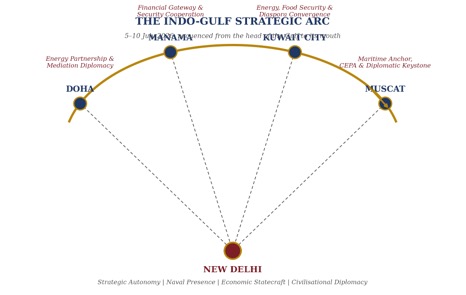
Figure 1. The Indo-Gulf Strategic Arc: the four stations of the July 2026 tour, their functional pillars, and their common anchor in New Delhi’s strategy of autonomy, presence and economic statecraft. Conceptualisation by the author.
The Sequencing Grammar: Why the Tour Concluded in Muscat
The sequencing of the tour was itself an act of strategic communication, and its grammar can be stated precisely. Doha, the first station, addressed the energy partnership and mediation diplomacy at the head of the Gulf; Manama consolidated the financial gateway and security cooperation of a partner in the direct path of escalation; Kuwait City affirmed a rapidly maturing relationship built on energy, food security and a million-strong community, engaged at the moment of maximum danger. Muscat, the final station, sits at the mouth of the Gulf, where the enclosed sea opens into the Indian Ocean, and its position marked the transition of the entire mission from crisis management to regional order-building. India entered the Gulf through its most contested waters and exited through its most trusted shore.
Oman’s distinctiveness within this company is architectural. It is the only Gulf partner whose principal geography faces the open Indian Ocean; the only one with which India maintains exercises across all three services and naval logistics access of proven wartime utility; the only one whose mediation channels reach every party to the conflict; and the one with which India has brought a comprehensive trade agreement into force. Where each other relationship supplies a pillar of India’s Gulf policy, Oman supplies the ground upon which the pillars stand: the maritime foundation, the diplomatic insurance and the civilisational depth. The journey moved from the zone of maximum danger to the coast of maximum resilience, and the last word of the sentence was Oman; last words are chosen for emphasis.
Challenges and the Road to 2047
Scholarly credibility demands that admiration be tempered by candour. CEPA implementation will strain institutional capacity, for preferential access is worthless to enterprises lacking the awareness, certification and logistics to use it, and non-tariff frictions can quietly erode what tariff schedules grant. Competition from China’s assiduous commercial and port diplomacy will contest every space India seeks to occupy; the India-Middle East-Europe Economic Corridor remains hostage to regional uncertainties; the Strait of Hormuz will remain structurally vulnerable whatever settlement concludes the war; Omanisation will gradually reshape the labour market, requiring the migration corridor to move up the skills ladder; and the energy transition will eventually erode the hydrocarbon revenues that finance Omani statecraft. None of these challenges negates the trajectory; together they define the agenda of vigilance that must accompany it.
The roadmap follows in three horizons. In the short term, the two states should institutionalise a standing mechanism on maritime security and seafarer welfare, converting the improvised excellence of 2026 into permanent procedure; drive early-harvest CEPA implementation through aggressive facilitation and MSME outreach; expand the Duqm arrangement into a fuller framework of naval sustainment; complete UPI and RuPay integration; and establish an energy security dialogue spanning crude, LNG and crisis-time supply assurance. In the medium term, the partnership should build the structures of co-production: a green hydrogen and ammonia corridor linking Omani production zones with Indian demand and technology; scaled Indian participation in the industrialisation of Duqm, Sohar and Salalah; defence industrial ventures; a mobility and skills compact converting the labour relationship into a knowledge corridor; and co-investment in regional public goods of maritime domain awareness and disaster response under the MAHASAGAR vision. On the horizon of India’s centenary vision for 2047 and Oman Vision 2040, the two states should aim at nothing less than co-authorship of the Indian Ocean order: a blue economy compact, a technology alliance in artificial intelligence, cyber and space, joint curation of the shared heritage from Magan to Mandvi, and sustained coordination in global governance, beginning with the Security Council candidature India launched in New York directly after the Muscat visit. The record of the past decade, in which every announced milestone from the 2018 elevation to the 2026 entry into force was delivered, offers grounds for measured confidence.
Conclusion: The Tour Ends, the Gulf Still Burns
When the aircraft carrying India’s External Affairs Minister lifted away from Muscat on the evening of 10 July 2026, it closed a week that historians of Indian foreign policy will study for decades. In six days, across four capitals, under the shadow of missile exchanges and burning tankers, India reaffirmed its Gulf partnerships one by one, concretised the agreements of the preceding year, thanked the friends who protected its citizens and positioned itself for the diplomacy of the post-war settlement. The tour vindicated a doctrine, strategic autonomy expressed as omnidirectional friendship sustained by economic weight, naval presence and civilisational self-assurance, and confirmed a regional design: the Indo-Gulf Strategic Arc, now complete from Doha to Muscat, stands as the organising achievement of India’s West Asia policy in the middle 2020s. Oman was the fitting culmination: the western anchor, the maritime sentinel and the diplomatic conscience of the arc, having spent the crisis doing what it has always done: keeping channels open, keeping ports open, keeping faith.
The visits have ended; the fire has yet to burn out. Even as the minister’s aircraft turned towards New York, missiles still answered missiles across the Gulf, hundreds of vessels waited at anchor for the strait to breathe freely, and the peace remained a document in negotiation rather than a fact on the water. India’s stakes in this burning region are permanent and personal: the goods that sustain its industries, the services and energy that power its rise, the trade now constitutionalised under the CEPA, and above all the people, 9 million citizens across the Gulf and nearly 18,000 mariners still upon its waters, whose safety is the first charge upon Indian statecraft. The monsoon still blows. The winds that once carried dhows from Muscat to Mandvi now carry electrons, molecules, capital and ideas, and the two nations that mastered those winds first are, fittingly, the ones now designing the sea lanes of the twenty-first century. Dr. Jaishankar’s journey through the storm ended on the shore where India’s western horizon has always rested, and the symbolism will endure: as the Gulf moves from conflict towards a still uncertain equilibrium, India and Oman stand together as two maritime civilisations whose shared past continues to shape the future architecture of the Indian Ocean order.
Views: 272

Dr. Maheep
Dr. Maheep is Director, Indian Perspective on Global Affairs (IPGA), and a leading analyst of India’s foreign policy and South Asian geopolitics. He earned his PhD in Arab and Islamic Studies. With more than a decade of teaching and research experience in International Relations and Global Politics, he contributes regularly on issues shaping national and global affairs.


