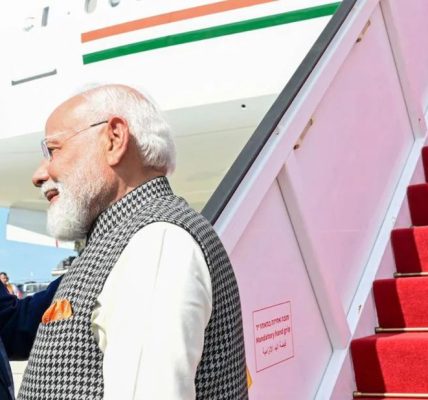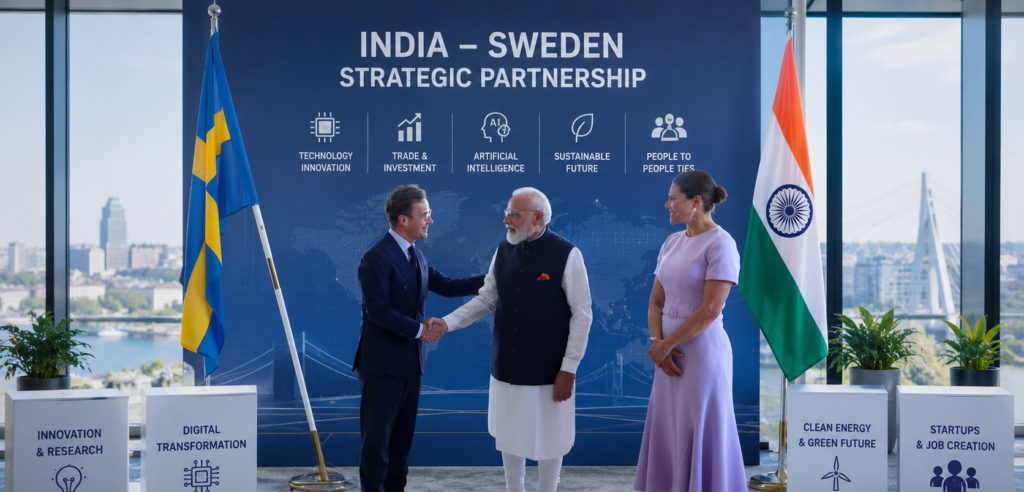







When Prime Minister Narendra Modi’s aircraft touched down at Landvetter Airport in Gothenburg on the afternoon of 17 May 2026, the Gripen fighter jets escorting it symbolised a bilateral relationship entering a qualitatively new strategic phase.
Marked by deeper institutional trust, technological convergence, and geopolitical alignment, the visit delivered tangible outcomes. These included the formal elevation of India–Sweden relations to a full Strategic Partnership, the adoption of an ambitious Joint Action Plan for 2026–2030, and the conferral upon PM Modi of the Royal Order of the Polar Star, Commander Grand Cross, Sweden’s highest honour for a foreign head of government.
This milestone reflects the international community’s recognition of India’s civilizational confidence, democratic resilience, and growing influence in shaping global governance.
Drawing on more than two decades of specialised research on Nordic–South Asian relations, EU–Asia diplomacy, normative power, and technology governance, this analysis examines the partnership as a sophisticated exercise in democratic alignment. It integrates civilizational memory, geo-economic complementarity, techno-political coordination, and ecological stewardship amid systemic transitions, including great-power rivalry, supply-chain reconfiguration, and contestation over digital and climate norms.
The partnership exemplifies how middle powers and rising civilizational states can co-author institutional solutions to transnational challenges in an era defined by technological fragmentation, ecological stress, and shifting balances of power.
Civilizational Memory and the Longue Durée of Eurasian Connectivity
The contemporary partnership rests on deeper historical foundations that extend far beyond the institutional frameworks of the modern nation-state.
The Helgö Buddha, a sixth-century CE bronze figurine of Kashmiri or Swat Valley origin discovered in a Viking settlement on Lake Mälaren, stands as compelling evidence of pre-modern trans-Eurasian exchange networks. Now housed in the Swedish History Museum, the artefact symbolises ancient patterns of Eurasian cultural exchange, spiritual interconnectedness, and commercial diffusion that challenge Eurocentric narratives of isolated civilizational development.
Its discovery in the 1950s during archaeological excavations of an eighth-century Viking site underscores the extraordinary reach of Indian Ocean and overland trade routes that connected the Indian subcontinent with Scandinavia through Central Asia and the Baltic region.
Rabindranath Tagore’s 1913 Nobel Prize in Literature, the first awarded to a non-European, and his 1926 audience with King Gustav V further embedded ethical and intellectual affinities into the bilateral tapestry. Tagore’s visit, during which he engaged deeply with Swedish intellectual circles, represented a profound moment of cross-civilizational recognition. It affirmed that the wellsprings of universal literary humanism flowed as richly in Bengal as in Europe.
The 2026 summit’s exchange of Tagorean epigrams represented deliberate civilizational statecraft. It transformed literary humanism into diplomatic symbolism and reaffirmed shared commitments to ethical universalism, democratic humanism, and cross-cultural dialogue.
Sweden’s mid-twentieth-century Social Democratic support for decolonisation movements, generous multilateral development assistance, and commitment to non-aligned diplomacy during the Cold War added another layer of normative convergence. These orientations aligned with India’s own foreign policy principles of strategic autonomy, peaceful coexistence, and the pursuit of a more equitable international order.
These historical layers are not merely ornamental. They provide the normative foundation that legitimises today’s institutional architecture and lend philosophical depth to what might otherwise appear as purely transactional diplomacy.
This fusion of civilizational memory and pragmatic statecraft demonstrates how historical narratives and shared identities continue to shape durable strategic partnerships. It also resonates with realist considerations of power in a multipolar world, where cultural resonance enhances trust and reduces the friction inherent in great-power competition.
Strategic Architecture: The Four Pillars of Comprehensive Partnership
The Joint Action Plan for 2026–2030, endorsed by Prime Ministers Modi and Ulf Kristersson, establishes a robust multi-domain framework organised around four interdependent pillars:
Strategic Dialogue for Stability and Security; Next-Generation Economic Partnership; Emerging Technologies and Trusted Connectivity; and Shaping Tomorrow Together: People, Planet, Health and Resilience.
This comprehensive structure reflects a sophisticated understanding of interconnected twenty-first-century challenges. National security, economic competitiveness, technological sovereignty, ecological sustainability, and democratic governance are treated not as isolated domains but as mutually reinforcing dimensions of a shared strategic future.
In the security domain, the partnership advances defence industrial collaboration, including potential synergies with the Gripen multirole aircraft programme, maritime domain awareness, resilient supply chains, and institutionalised high-level dialogue.
Sweden’s NATO accession in March 2024, while marking a historic departure from its long-standing policy of armed neutrality, preserves its distinctive tradition of diplomatic autonomy and principled internationalism. This evolution positions Stockholm as a valuable interlocutor for New Delhi in navigating Indo-Pacific dynamics, hybrid threats, maritime security in the Indian Ocean region, and the governance of global commons.
For India, collaboration with Sweden’s advanced defence electronics, cybersecurity systems, and aerospace technologies aligns seamlessly with New Delhi’s objectives of indigenous defence modernisation under the Atmanirbhar Bharat initiative and the pursuit of diversified strategic partnerships.
Such cooperation enhances mutual resilience against supply-chain vulnerabilities and coercive economic statecraft in an era of intensifying great-power rivalry.
Emerging Technologies and Democratic Technology Governance
Emerging Technologies and Trusted Connectivity constitutes the most strategically consequential pillar of the partnership.
The launch of the India–Sweden Joint Innovation Partnership 2.0, the establishment of a virtual India–Sweden Joint Science and Technology Centre, and especially the endorsement of the Sweden–India Technology and Artificial Intelligence Corridor, SITAC, represent institutional innovations of the first order.
Among these initiatives, SITAC stands out as potentially the most transformative. At a moment of accelerating technological fragmentation, where democratic and authoritarian governance models advance competing visions of AI development, data sovereignty, and digital infrastructure, SITAC positions India and Sweden as collaborative advocates of trusted, accountable, and human-centric digital governance.
India’s unmatched scale in AI deployment, digital public infrastructure, software ecosystems, and data-driven innovation pairs powerfully with Sweden’s longstanding leadership in responsible technology design, algorithmic accountability, ethical innovation frameworks, and high-trust regulatory environments.
Cooperation extends across quantum technologies, semiconductors, 6G connectivity, cybersecurity, and trusted digital infrastructure. These efforts generate durable strategic interdependencies that strengthen democratic resilience in the global technology domain.
The ISRO–Swedish National Space Agency Memorandum of Understanding concerning a future Venus orbiter mission further elevates the scientific dimension of the bilateral relationship. This proposed collaboration transforms scientific diplomacy into a shared civilizational enterprise rooted in curiosity, exploration, and long-term human advancement.
The EU–India Gravitational Field and Sweden as Nordic Gateway
No serious analysis of the India–Sweden Strategic Partnership can remain confined to a purely bilateral frame.
The relationship must be situated within the larger transformation underway in India–European Union relations, particularly following the conclusion of the landmark India–EU Free Trade Agreement in January 2026 after nearly two decades of intermittent negotiations.
This accord marks a qualitative shift from partnership-in-aspiration to partnership-in-consequence. It establishes deeper architectures of strategic interdependence linking trade liberalisation, technology coordination, resilient supply chains, investment flows, digital governance, and regulatory harmonisation.
Sweden occupies a uniquely advantageous position within this evolving landscape. As one of Europe’s most innovation-intensive economies, Sweden combines the market access and regulatory harmonisation advantages of full EU membership with specialised strengths in sustainability governance, advanced manufacturing, digital technologies, life sciences, telecommunications, and green industrial systems.
Stockholm therefore functions as a Nordic gateway for deeper India–Europe integration, serving as a transnational interface that links Indian ambitions in technology, trade, sustainability, and industrial modernisation with broader European innovation ecosystems.
People-to-People Foundations and Democratic Trust
The India–Sweden relationship’s most enduring structural asset remains neither a formal agreement nor an institution, but the vibrant community of people linking the two societies.
The Indian diaspora in Sweden, numbering in the tens of thousands and spread across sectors ranging from healthcare and engineering to information technology, academia, entrepreneurship, and scientific research, functions as a durable reservoir of social capital and tacit knowledge.
Diaspora communities create networks of familiarity, trust, and cultural understanding that outlast electoral cycles and geopolitical fluctuations. They embody the human dimension of bilateral engagement and generate the democratic trust upon which enduring institutional cooperation ultimately depends.
Prime Minister Modi’s engagement with the Indian diaspora in Gothenburg was therefore integral, not peripheral, to the summit’s strategic agenda. It furnished the human connective tissue that formal agreements alone cannot produce.
Swedish universities such as Uppsala, Stockholm, Lund, Gothenburg, and KTH Royal Institute of Technology have maintained sustained collaborations with Indian institutions across fields including linguistics, medicine, environmental science, biotechnology, materials engineering, climate studies, and advanced digital research.
The establishment of the virtual India–Sweden Joint Science and Technology Centre now transforms these previously dispersed collaborations into a more coherent strategic scientific network.
Conclusion
Prime Minister Modi’s visit to Gothenburg on 17–18 May 2026 will likely be remembered as a defining moment of democratic strategic convergence.
Two societies of vastly different demographic scale and historical experience recognised in each other a set of complementary strengths and convergent values uniquely suited to the demands of an era defined by geopolitical transition, technological disruption, ecological stress, and institutional uncertainty.
The India–Sweden Strategic Partnership, institutionalised through the Joint Action Plan for 2026–2030, represents one of the most comprehensive bilateral frameworks India has constructed with any European partner in the present decade.
Its significance derives not merely from the breadth of its agreements but from the civilizational depth and normative confidence from which those agreements draw legitimacy.
The transregional journey of the Helgö Buddha across Eurasian networks in the sixth century CE, Rabindranath Tagore’s Nobel recognition and his 1926 audience with King Gustav V, Sweden’s democratic solidarity with postcolonial societies, and India’s expanding technological capabilities and growing role in responsible global governance are not historical footnotes appended to diplomatic communiqués.
They are the foundational strata of a relationship whose institutional legitimacy derives precisely from the continuity of these deeper historical encounters.
At a moment when the international system is navigating technological fragmentation, climate emergency, energy transition politics, and geopolitical realignment, partnerships between democratic societies possessing complementary strengths acquire structural importance extending far beyond bilateral commerce.
The India–Sweden Strategic Partnership, embedded within the broader India–EU relationship and animated by the innovative energies of the SITAC corridor, scientific collaboration, sustainable industrial transition, and democratic technological governance, represents precisely such a partnership: geopolitically consequential, technologically ambitious, normatively grounded, and civilizationally resonant.
The Royal Order of the Polar Star conferred upon Prime Minister Modi therefore signifies more than ceremonial recognition. It reflects Sweden’s affirmation that India has emerged as a trusted democratic partner capable of contributing meaningfully to the shaping of a more balanced, humane, technologically responsible, and ecologically resilient international order.
In an era marked by geopolitical fragmentation and technological uncertainty, the India–Sweden Strategic Partnership stands as a compelling demonstration that democratic cooperation, civilizational confidence, and scientific imagination can together shape a more balanced and humane international order.
Views: 965

Dr. Maheep
Dr. Maheep is Director, Indian Perspective on Global Affairs (IPGA), and a leading analyst of India’s foreign policy and South Asian geopolitics. He earned his PhD in Arab and Islamic Studies. With more than a decade of teaching and research experience in International Relations and Global Politics, he contributes regularly on issues shaping national and global affairs.