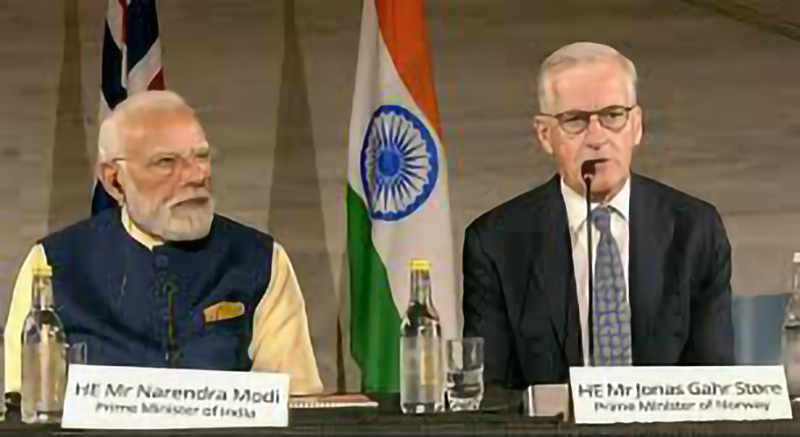







In a historic move that sent ripples across the global strategic landscape, Prime Minister Narendra Modi’s visit to Norway, Oslo on 18–19 May 2026, the first by an Indian Prime Minister in more than four decades, marked far more than a diplomatic courtesy. It was a bold declaration of intent. With unmistakable confidence, India signalled that its strategic horizons now stretch far beyond the traditional theatres of the Indo-Pacific and increasingly extend towards the High North.
The crowning outcome was the elevation of India-Norway relations into a full-fledged Green Strategic Partnership, alongside the transformative upgrading of the broader India-Nordic engagement into a Trusted Green Technology and Innovation Strategic Partnership during the 3rd India-Nordic Summit. This development represents one of the most significant structural shifts in India’s engagement with Europe since the landmark India-EU Strategic Partnership was forged in 2004. It reflects a decisive geopolitical repositioning that establishes India as a serious stakeholder in the Arctic future while simultaneously redefining its partnership architecture with the Nordic powers.
The conjuncture matters. Oslo 2026 was convened against a global order under compound stress: Russia’s continuing war on Ukraine fracturing European security architecture; the erosion of multilateral trade norms under renewed protectionist pressure; accelerating climate tipping points demanding unprecedented inter-state cooperation; and the weaponisation of technological supply chains reshaping the political economy of industrial interdependence. In this environment, Dr. Maheep, writing in The European Times, observed with analytical precision that the Oslo convergence represents ‘an instance of cooperative geopolitical balancing — the construction, by democratic middle powers, of issue-based coalitions that serve shared interests in sustainable development, technological resilience, and normative order without the ideological rigidity or zero-sum logic of great-power rivalry.’ That framing captures the essential character of the Oslo moment: not sentimentality about Nordic-Indian affinities, but structural rationality about complementary interests at a critical juncture of the international order.
The genealogy of the India–Nordic Summit architecture — Stockholm 2018, Copenhagen 2022, Oslo 2026 — traces a deliberate institutional deepening. Each iteration has expanded the thematic perimeter: from trade and climate toward technology, defence, Arctic governance, digital infrastructure, and artificial intelligence. The India–EFTA Trade and Economic Partnership Agreement (TEPA), which entered into force in October 2025 targeting USD 100 billion in investment and one million Indian jobs, provides the enabling economic architecture. Oslo provides the strategic framework within which that architecture is purposefully deployed. Forty-three years after Indira Gandhi’s 1983 Oslo visit, India returns to Norway not as a recipient of development assistance but as an architect of global norms — in green technology, digital governance, ocean management, and Arctic science. That transformation is itself the argument.
Why Norway Matters in India’s Strategic Calculus
Norway’s strategic relevance to India in 2026 is multi-dimensional in ways that standard bilateral accounts routinely underestimate. It rests upon four structural pillars: Arctic geography, maritime governance leadership, sovereign wealth capital of extraordinary scale, and technological depth in precisely the sectors that India’s developmental transformation most urgently requires.
The Arctic pillar is foundational. Norway is, in the most literal institutional sense, India’s gateway to the circumpolar north. India’s Himadri research station at Ny-Ålesund in the Svalbard archipelago — established in 2008, located 1,200 kilometres from the North Pole on Norwegian territorial jurisdiction — constitutes India’s most consequential permanent scientific presence beyond South Asia and Antarctica. Through Himadri and the IndARC underwater observatory deployed in the Kongsfjorden, Indian scientists monitor Arctic environmental changes whose effects are directly transmitted to the Indian monsoon, Himalayan glaciology, and coastal sea levels. The Arctic is not, for India, a distant ecosystem; it is a planetary regulator of existential relevance to the livelihoods of hundreds of millions of Indian farmers, fishermen, and coastal communities. Norway, as the sovereign host of India’s Arctic scientific infrastructure and as the Arctic Council’s most consequential institutional champion, is irreplaceable in India’s circumpolar strategic architecture.
The maritime pillar is equally structural. Norway is, by virtually every measure, one of the world’s premier maritime nations: the fourth-largest shipping nation globally, a world leader in offshore energy technology, the pioneer of sustainable aquaculture at industrial scale, and the architect of some of the most sophisticated ocean governance frameworks in international environmental law. India, with a coastline of 7,516 kilometres, an Exclusive Economic Zone of 2.3 million square kilometres, and a Sagarmala port-led development ambition of extraordinary scope, has a structural interest in Norwegian maritime expertise that spans shipbuilding, offshore engineering, green shipping decarbonisation, and sustainable ocean management. The 2025 India–Norway Green Maritime Partnership — reviewed and deepened at Oslo 2026 — operationalises this complementarity across the full spectrum of maritime decarbonisation.
The capital pillar is potentially transformative. Norway’s Government Pension Fund Global (GPFG) — assets exceeding USD 1.7 trillion, the world’s largest sovereign wealth fund — represents a pool of patient, ethically governed, long-horizon capital whose alignment with India’s renewable energy infrastructure, green hydrogen development, and circular urban economy investment requirements is structurally near-perfect. Nordic sovereign and institutional investment, characterised by ESG discipline and intergenerational governance standards, is uniquely suited to India’s infrastructure horizons. The TEPA’s USD 100 billion commitment is best understood as the formal mobilisation of this capital architecture toward India’s decarbonised growth paradigm. Finally, Norway’s technological depth — in floating offshore wind through institutions such as SINTEF, FME NorthWind, and NTNU; in polar science through the Norwegian Polar Institute; in digital health and AI through its advanced welfare state infrastructure — maps with remarkable precision onto India’s priority sectoral requirements for the coming decade.
Green Strategic Partnership: Architecture, Geoeconomics, and Structural Logic
The Green Strategic Partnership formalised at Oslo on 18 May 2026 is not a diplomatic label applied to existing cooperation; it is an institutional architecture designed to resolve what might be called the developmental decarbonisation paradox — the demand that India simultaneously achieve emissions reduction at civilisational scale while sustaining the growth trajectory demanded by 1.4 billion people and their legitimate developmental aspirations. Norway’s mastery of decarbonised industrial systems — offshore wind, green hydrogen, carbon capture and storage, circular industrial metabolism, sustainable maritime engineering — offers the technological toolkit that India’s renewable transition frameworks structurally require but cannot indigenously supply at the pace the climate emergency demands.
The twelve outcomes of the Oslo visit operationalise this logic across intersecting domains. The CSIR–SINTEF Collaboration Agreement for 2026–2029 — building upon a framework established in 2014 — advances joint work in ocean energy, floating offshore wind, carbon capture, bio-based materials, and waste valorisation. The project-specific agreement between CSIR’s Structural Engineering Research Centre, National Aerospace Laboratories, National Institute of Oceanography, and SINTEF institutions for cooperation in floating offshore wind technologies is of particular strategic significance: India’s Arabian Sea and Bay of Bengal carry an estimated 70–100 gigawatts of offshore wind potential in water depths that render fixed-foundation turbines technically non-viable. Norwegian floating wind expertise, developed through decades of North Sea operations, is precisely what India’s deep-water offshore wind programme requires to move from ambition to deployment.
| The analytical core of the India–Nordic green technology partnership lies in a structural complementarity that goes deeper than diplomatic goodwill: the convergence between Nordic mastery of decarbonised industrial systems and India’s imperative to execute one of history’s largest clean energy transitions without compromising the developmental aspirations of 1.4 billion people. |
The India–EFTA TEPA provides the geoeconomic superstructure within which these sectoral partnerships are embedded. Norway’s commitment, as EFTA’s largest member, to channel sovereign and institutional capital toward India’s clean technology, pharmaceuticals, maritime services, fintech, and digital trade sectors represents not a continuation of existing FDI trends but a qualitative restructuring of the bilateral investment relationship. The GPFG’s potential exposure to Indian clean energy and infrastructure assets — already growing through equity holdings — creates a sovereign capital alignment whose full implications for India’s green industrial policy remain to be realised but are analytically foreseeable as transformative.
The India–Norway Digital Development Partnership, launched at Oslo, extends the green partnership into the governance of twenty-first century development itself. India’s Digital Public Infrastructure ecosystem — Aadhaar, UPI, DigiLocker, ONDC — constitutes an architecturally distinctive model for harnessing digital technology to achieve inclusive development at scale through open-source, interoperable, publicly governed frameworks that limit platform monopoly concentration. This model resonates strongly with Nordic commitments to digital rights, institutional transparency, and public interest governance. The potential for India–Norway collaboration in developing transferable Digital Public Infrastructure frameworks for Global South economies represents one of the partnership’s most consequential long-term contributions to global developmental governance that is a form of South–North–South triangular digital cooperation with few contemporary precedents.
The space cooperation agreement between ISRO and the Norwegian Space Agency is analytically significant for its Arctic dimension as much as its technological one. Norway’s ground station infrastructure at Svalbard is uniquely positioned to support polar-orbit satellite operations, making Norwegian space infrastructure directly relevant to ISRO’s expanding Earth observation constellation. As India’s climate monitoring, maritime domain awareness, and Arctic scientific observation requirements expand through the 2030s, the ISRO–Norway institutional framework will prove of strategic value that currently receives insufficient analytical attention. Norway’s formal accession to the Indo-Pacific Oceans Initiative, welcomed at Oslo, extends the maritime partnership into India’s most significant multilateral framework for ocean governance — a convergence that links Arctic and Indo-Pacific maritime governance architecture in ways that map precisely onto the emerging Indo-Arctic strategic continuum.
Arctic Governance and India’s Northern Strategic Turn
The Arctic’s geopolitical transformation is among the most consequential territorial reconfigurations of the twenty-first century. Accelerating ice melt is opening the Northern Sea Route as a commercially viable trans-oceanic corridor; exposing previously inaccessible reserves of hydrocarbons, rare earth minerals, and strategic critical inputs to the clean energy transition; and elevating a once peripheral geography to the centre of great-power competition. Russia continues to militarise its Northern Fleet infrastructure. China, having designated itself a ‘near-Arctic state’, channels substantial investment into Arctic ports, research facilities, and infrastructure across the Eurasian High North. The Arctic Council’s governance architecture in which India holds permanent observer status secured in 2013 that simultaneously serves as a platform for vital scientific cooperation and a contested normative arena in which the rules of the future Arctic order are actively being negotiated.
India’s 2022 Arctic Policy, ‘India and the Arctic: Building a Partnership for Sustainable Development’ that formalises a strategic doctrine whose six pillars encompass science and research, climate and environmental protection, economic and human development, transportation and connectivity, governance and international cooperation, and national capacity building. The IndARC underwater moored observatory, deployed in the Kongsfjorden and hosted on Norwegian territorial waters, monitors precisely the ocean current changes and water temperature dynamics whose relationship to the Indian monsoon system makes Arctic science a matter of Indian food security and agricultural resilience that is not merely polar scientific curiosity. When Arctic warming disrupts the atmospheric circulation patterns governing the Indian monsoon — itself a system sustaining the agricultural livelihoods of several hundred million Indians — the connection between Oslo and the Indian Ocean ceases to be metaphorical and becomes operationally strategic.
The Northern Sea Route dividend amplifies this strategic logic. The NSR reduces maritime shipping distance between India’s western ports and European markets by approximately 40 per cent compared to the Suez Canal route that is a commercial advantage of structural significance for an economy whose external trade depends overwhelmingly on maritime freight. Norway’s ice-class shipbuilding expertise, Arctic navigation capability, and port infrastructure along the NSR positions it as India’s indispensable partner in developing the institutional, technical, and commercial architecture for Indian engagement with this emerging global trade corridor. As the NSR becomes commercially viable at scale through the 2030s, the India–Norway maritime partnership will acquire a geoeconomic dimension that current bilateral frameworks should be proactively architecting. The 3rd India–Nordic Summit’s commitment to joint Arctic research initiatives, and the Oslo agreements on maritime cooperation, begin that architecture — but only begin it.
The energy security dimension deserves direct acknowledgement. Following the disruption of Russian energy supply chains post-2022, Norway has emerged as Europe’s principal gas supplier, occupying a position of exceptional significance in the global energy security architecture. For India, which balances a complex energy relationship with Russia while pursuing supply diversification and long-term resilience, Norway’s emergence as a credible partner in both hydrocarbons and advanced energy technologies carries strategic value that extends the bilateral relationship well beyond the green transition agenda. This convergence strengthens India’s immediate energy security while reinforcing its broader climate resilience framework in a manner consistent with India’s net-zero 2070 trajectory and its sovereign developmental imperatives.
Structural Constraints and the Imperative of Implementation
Analytical honesty demands direct engagement with the structural impediments that stand between Oslo 2026’s ambitious framework and its realisation as a genuinely transformative partnership. The most fundamental is the implementation gap is the persistent tendency of high-level summitry to generate declarations whose conversion into concrete projects, technology transfers, investment flows, and institutional mechanisms proves considerably harder than the diplomatic encounter itself. The TEPA’s USD 100 billion investment target is aspirational in the best sense; its achievement requires resolute action on regulatory friction within India’s investment environment, intellectual property protection concerns that continue to shadow advanced technology transfer arrangements, and institutional limitations within the bilateral mechanisms tasked with operationalising summit commitments.
India’s maintenance of its strategic relationship with Russia including continued energy imports and legacy defence dependencies that creates periodic friction with Nordic partners whose security interests have been directly affected by Russian aggression. India’s strategic autonomy doctrine is a genuine expression of national interest and historical foreign policy philosophy, not diplomatic equivocation; but it requires continuous and sophisticated management to prevent it from being misread as indifference to the security concerns of democratic partners. The Oslo media environment itself illustrated this sensitivity: press freedom exchanges during the visit served as a reminder that even fundamentally value-aligned democratic partnerships carry fault lines requiring communicative sophistication and institutional maturity to navigate.
China’s expanding Arctic footprint through the Polar Silk Road, strategic investment in Greenlandic infrastructure, and scientific presence across the circumpolar north that directly complicates the governance architecture within which India’s Arctic ambitions are embedded. Arctic Council deliberations have grown more contested as great-power competition penetrates a region previously organised around scientific cooperation and environmental governance norms. India’s positioning as a responsible Arctic stakeholder committed to multilateralism will require active diplomatic investment, not merely declaratory commitment. NATO’s expanding Arctic military posture following Finland and Sweden’s accession while primarily directed at Russian threat perception that reshapes the strategic environment within which India, as a non-NATO democratic partner, must position itself with precision.
The existing institutional architecture of the India–Norway partnership has periodic summit mechanisms, sectoral working groups, bilateral chambers of commerce that remains insufficiently dense to sustain the momentum and implementation discipline that Oslo 2026’s ambition demands. Genuine strategic depth requires deliberate institutional densification: a dedicated India–Norway Technology and Innovation Council with binding annual deliverables; a joint climate finance working group with explicit capital mobilisation targets linked to TEPA timelines; a regular Track 1.5 strategic dialogue engaging officials, business leaders, and think tank scholars; and an expanded Arctic science cooperation framework connecting Himadri with Norwegian and Finnish polar research infrastructure. Without such architecture, the risk is not failure but attenuation — a partnership that underperforms its structural potential through institutional inertia rather than strategic misalignment.
Conclusion
Oslo 2026 marks the moment at which India–Norway relations ceased being a relationship of developmental goodwill and became a relationship of strategic intentionality. The Green Strategic Partnership is grounded in offshore wind complementarity, Arctic scientific collaboration, sovereign capital alignment, digital governance convergence, and shared commitment to a rules-based multipolar order that rests on structural foundations durable enough to sustain a genuinely transformative bilateral trajectory across the coming decade.
The partnership’s significance extends well beyond the bilateral domain. As Dr. Maheep argued in his article, “Between Fjords and Himalayas: 3rd India–Nordic Summit in the Arctic Century”, published in The European Times on 20 May 2026, the emerging India–Nordic strategic architecture reflects India’s evolving doctrine of pragmatic multi-alignment, namely the ability to deepen strategic partnerships with democratic powers across multiple geopolitical and technological domains while preserving sovereign strategic autonomy. Between Norway’s Arctic expertise, sovereign wealth architecture, maritime decarbonisation capabilities, and institutional leadership in green transition, and India’s market scale, technological talent, and developmental ambition, there exists a complementarity that is rare in contemporary international relations: structurally embedded, mutually reinforcing, and directed toward some of the most consequential challenges of the twenty-first century.
The policy prescription is clear: translate Oslo declarations into project agreements, investment vehicles, joint research programmes, and institutional mechanisms with explicit accountability frameworks and measurable timelines. Nordic sovereign capital must flow through the TEPA architecture into India’s renewable energy transition. The Arctic cooperation agenda must advance through coordinated Arctic Council engagement and maritime connectivity frameworks serving both partners’ geoeconomic interests. The digital governance dialogue must evolve into structured joint norm-setting initiatives at multilateral AI and digital governance forums. The imperative, as always in consequential diplomacy, is not the summit declaration but the patient institutional architecture that transforms strategic vision into developmental reality.
Between the fjords of Norway and the Himalayas of India lies not merely geographical distance but a convergence of interests, values, and capabilities whose full strategic potential Oslo 2026 has, at last, begun to systematically unlock. The Midnight Sun over the Oslofjord illuminates a partnership that, given the institutional discipline and sovereign commitment its ambitions demand, carries the potential to become one of India’s most consequential bilateral relationships in the northern hemisphere — and a meaningful contribution to the renewal of democratic multilateralism in an age of acute global uncertainty.
Views: 883

Dr. Maheep
Dr. Maheep is Director, Indian Perspective on Global Affairs (IPGA), and a leading analyst of India’s foreign policy and South Asian geopolitics. He earned his PhD in Arab and Islamic Studies. With more than a decade of teaching and research experience in International Relations and Global Politics, he contributes regularly on issues shaping national and global affairs.