


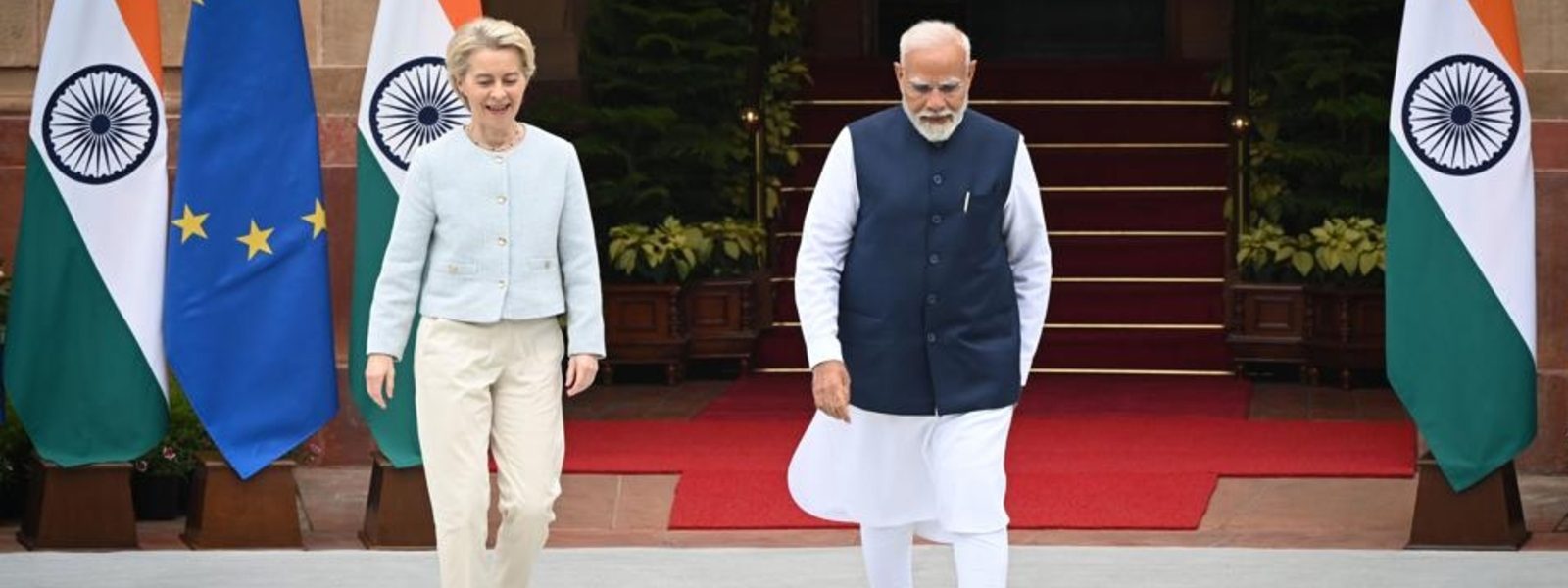







India–EU Relations at the Dawn of 2026: From the Legacy of 2025 to Strategic Consolidation
The year 2025 left a lasting legacy in India–European Union relations, transforming a long-evolving partnership into a strategically consolidated axis of cooperation at the dawn of 2026. Moving beyond episodic summitry and narrow trade-centric engagement, India and the EU reconstituted their relationship around economic security, technological sovereignty, climate governance, and shared responsibility in a fractured global order. This consolidation was catalysed by landmark political engagements—most notably the unprecedented visit of the EU College of Commissioners to New Delhi—and shaped by systemic disruptions ranging from the prolonged Russia–Ukraine war and renewed tariff coercion in global trade to cascading instabilities in West Asia.
This article contends that the strategic consolidation of India–EU relations rests on the institutionalisation of managed divergence rather than enforced convergence. Anchored in trade and technology cooperation, green industrial transition, and security dialogue, the partnership has emerged as a stabilising counterweight to isolationism, coercive economic statecraft, and geopolitical polarisation. As the legacy of 2025 is carried forward into 2026—marked by the 16th India–EU Summit and the participation of EU leaders in India’s 77th Republic Day celebrations—the partnership stands poised not merely for continuity, but for durable consolidation as one of the defining pillars of twenty-first-century multipolarity.
Recasting Partnership in an Age of Polycrisis
International partnerships rarely transform under conditions of comfort. For India and the European Union, 2025 constituted a moment of strategic awakening, forged in an environment of intersecting crises that laid bare the vulnerabilities of the contemporary international system. The Russia–Ukraine war entered its fourth year, fundamentally reshaping Europe’s security and energy calculus. Concurrently, renewed protectionist impulses within the global trading system and intensifying conflicts in West Asia disrupted supply chains, inflated energy prices, and heightened geopolitical risk.
Within this volatile strategic milieu, India and the EU recognised a shared imperative: resilience could no longer be constructed in isolation. Europe increasingly acknowledged India’s ascent as a pivotal node in the global political economy—a $4 trillion economy that crossed this milestone in early 2026 on the back of sustained 7%+ real growth, robust manufacturing expansion, and rupee strength—with unparalleled digital scale, demographic depth, and credibility as a Global South interlocutor. India, in turn, viewed the EU not merely as a market, but as a partner endowed with regulatory authority, innovation ecosystems, and normative influence capable of shaping global governance without hegemonic overreach.
This mutual recognition did not dissolve differences. India’s strategic autonomy—particularly in energy sourcing, defence partnerships, and geopolitical positioning—continued to diverge from European preferences. Yet 2025 demonstrated that divergence need not impede cooperation. Instead, it became the basis of a more mature partnership, grounded in realism, adaptability, and functional convergence rather than ideological alignment.
From Roadmap to Strategic Architecture
The transition from the EU–India Roadmap to 2025 to the New Strategic EU–India Agenda marked more than a procedural evolution; it signified a qualitative elevation of ambition. Structured around sustainability, technology and innovation, connectivity, security, and enabling ecosystems, the new framework institutionalised a “whole-of-partnership” approach, embedding regular summits, ministerial dialogues, and implementation mechanisms capable of withstanding political flux.
The catalytic moment of this transition was the February 2025 visit of the EU College of Commissioners to New Delhi, the first collective extraterritorial engagement of its kind. Accompanied by more than twenty ministerial-level interactions, the visit underscored Europe’s recognition of India as a strategic interlocutor across digital governance, resilient supply chains, defence cooperation, and climate transition. It also reflected a recalibrated European Indo-Pacific posture—less declaratory, more operational, and firmly anchored in partnerships.
This institutional deepening did not aspire to alliance formation. Rather, it embodied a constructive logic of strategic complementarity, wherein India’s scale, growth trajectory, and developmental experience intersected with Europe’s regulatory capacity, technological sophistication, and market depth.
Trade and Economic Interdependence: Commerce as Strategy
Economic interdependence provided the material substratum of this strategic recalibration. By 2025, the EU had consolidated its position as India’s largest trading partner in goods, with bilateral trade surpassing $135 billion and services trade expanding steadily. Yet the significance of this relationship lay not merely in aggregate volume, but in its evolving strategic function.
The India–EU Free Trade Agreement, frequently described as the most ambitious trade negotiation undertaken by either party, acquired renewed urgency in 2025. In a global environment marked by tariff weaponisation, sanctions spillovers, and supply-chain fragmentation, the FTA came to be perceived less as a commercial instrument and more as a strategic hedge—a framework for predictability, diversification, and economic security.
Negotiations reflected this shift. Convergence across services, digital trade, investment protection, and sustainable supply chains demonstrated a shared willingness to reconcile ambition with political economy realities. Simultaneously, India’s insistence on protecting agricultural livelihoods, MSMEs, and regulatory sovereignty underscored a development-sensitive approach that resisted asymmetrical liberalisation.
This strategic logic was powerfully illustrated by the parallel entry into force of the India–EFTA Trade and Economic Partnership Agreement (TEPA) on October 1, 2025. As Dr Maheep, Principal Investigator of a national project on India’s Soft Power Diplomacy, incisively observed in his article “European Free Trade Association’s India FTA Goes into Effect,” TEPA represents “a new strategic grammar in India’s economic diplomacy, blending state-led development with global market integration while respecting sovereignty and attracting high-value investment and advanced technology.” In the same analysis, he described the agreement’s commitment of USD 100 billion in FDI over fifteen years—explicitly tied to creating one million jobs in India’s manufacturing and technology-intensive sectors—as a model that “preserves sensitive industries like dairy and pharmaceuticals, safeguards India’s generic medicines ecosystem, and embeds sustainable development norms.” Dr Maheep further characterised TEPA as potentially “a blueprint for how rising powers can shape the next phase of globalisation itself: resilient in the face of protectionist politics, anchored in national strategy, and influential in shaping the rules of tomorrow’s global commerce.” This success with EFTA not only strengthens India’s leverage in the ongoing EU FTA talks but also signals a broader shift toward high-standard, development-sensitive trade diplomacy that aligns with the EU’s own priorities.
From an Indian foreign-policy perspective, the strategic value of the FTA lies in its capacity to anchor manufacturing and value-chain diversification, expand services and skilled mobility, cushion exogenous trade shocks, and embed India within global standards-setting processes without eroding policy space.
Technology, AI, and the TTC
If trade provides ballast, technology supplies strategic momentum. The India–EU Trade and Technology Council (TTC)emerged in 2025 as the partnership’s principal delivery mechanism, linking economic competitiveness with strategic trust. Its emphasis on artificial intelligence, semiconductors, digital public infrastructure, and next-generation telecommunications reflected shared concerns regarding technological sovereignty and systemic resilience.
Normative differences were evident. Europe’s risk-based regulatory approach to AI and India’s innovation-led, inclusion-oriented digital ecosystem do not align seamlessly. Yet the TTC demonstrated that regulatory divergence can be managed through dialogue, interoperability, and capacity-building rather than coercive harmonisation.
For India, the TTC offers a rare opportunity to shape global technology governance not as a rule-taker, but as a co-architect, drawing upon experience in population-scale digital public goods. For Europe, India represents a partner capable of translating ethical frameworks into scalable and socially embedded technological solutions. The strategic promise of India–EU technology cooperation thus lies in co-developing trust frameworks that balance innovation, accountability, and access.
Climate, Energy, and the Green Industrial Transition
Climate cooperation in 2025 moved decisively from declaratory alignment to green industrial strategy. The EU–India Clean Energy and Climate Partnership entered a new phase, prioritising green hydrogen, offshore wind, energy efficiency, and the decarbonisation of hard-to-abate sectors.
This evolution was driven by strategic necessity. Europe’s post-Ukraine energy recalibration and India’s rapidly expanding energy demand rendered collaboration on clean energy infrastructure imperative. Hydrogen corridors, renewable integration, battery recycling, and circular-economy initiatives became central to a shared vision of sustainable growth.
From an Indian perspective, the climate partnership is most valuable when it facilitates technology access and affordable finance, respects developmental trajectories, and links climate ambition with industrial upgrading and employment generation. In this sense, India–EU climate cooperation in 2025 signalled the emergence of a green industrial compactcapable of bridging Global North–South divides through pragmatism rather than conditionality.
Security, Defence, and Strategic Convergence
Security cooperation witnessed a qualitative evolution in 2025. The EU increasingly acknowledged that European and Indo-Pacific security theatres are interconnected, while India recognised the EU’s growing relevance as a security actor beyond its immediate neighbourhood.
Defence dialogues, maritime cooperation, and emerging defence-industrial collaboration reflected a gradual shift from symbolic engagement to capability-oriented partnership. India’s emphasis on indigenisation and co-development resonated with Europe’s search for reliable partners amid defence-industrial constraints.
Crucially, this convergence did not require alignment across all geopolitical theatres. India’s strategic autonomy, including its calibrated positions on major power conflicts, remained intact. What changed was the recognition that shared security interests—maritime stability, counterterrorism, cyber resilience, and the protection of global commons—outweigh persistent disagreements.
Geopolitical Stress Tests and Strategic Maturity
The resilience of India–EU relations in 2025 was tested by external shocks. Divergences over sanctions regimes, Middle Eastern conflicts, and trade coercion did not disappear. Yet the partnership demonstrated an ability to absorb disagreement without regression, reflecting strategic maturity.
For India, this validated a long-held doctrinal principle: strategic autonomy is compatible with deep cooperation. For Europe, engagement with India illustrated that normative influence is most effective when coupled with respect for plural pathways to stability. In an era of intensifying bloc politics, the India–EU relationship offered an alternative model—strategic cooperation without subordination.
The Way Forward: From Convergence to Enduring Partnership
As India and the EU approach the 16th Summit and the symbolic moment of Republic Day 2026, the imperative is no longer agenda-setting but implementation. Scaling technology co-development through the Trade and Technology Council will ensure that cooperation in AI, semiconductors, digital public infrastructure, and emerging technologies moves decisively from dialogue to delivery, translating shared commitments into interoperable standards, joint R&D pipelines, and real-world deployment that strengthens both partners’ technological sovereignty and global competitiveness. Institutionalising green industrial collaboration that links climate goals with manufacturing ecosystems, finance, and employment will create a structured framework for joint investment in green hydrogen, offshore wind, battery recycling, and circular economy initiatives, enabling Europe’s regulatory and financing depth to meet India’s scale and execution capacity in a manner that delivers sustainable jobs, industrial upgrading, and equitable energy transition for both sides.
Deepening defence-industrial and maritime cooperation, in recognition of the converging European and Indo-Pacific security interests, will foster co-production opportunities, maintenance and repair corridors, joint exercises, and shared domain awareness, allowing the two sides to build mutual capability in protecting global commons and countering hybrid threats without compromising India’s strategic autonomy. Finally, expanding people-to-people mobility in education, health, and research will anchor the partnership in societal trust, innovation networks, and long-term human capital formation by facilitating greater academic exchanges, mutual recognition of qualifications, joint research missions, and professional mobility pathways that embed durable societal stakes in the relationship.
These priorities gain added momentum from the India–EU sideline meeting during the G20 Summit in South Africa, where Prime Minister Modi outlined six concrete points for global cooperation that align closely with EU interests or can only be meaningfully advanced through this partnership: reforming multilateral institutions, accelerating green transitions, strengthening digital and AI governance, ensuring resilient supply chains, advancing counter-terrorism cooperation, and promoting inclusive development—each of which finds natural resonance with the EU’s own agenda for rules-based order, sustainability, and technological trust.
The deepening of ties was further exemplified by Chancellor Friedrich Merz’s visit to India, which recast India–Germany relations as a cornerstone of the broader EU–India compact, delivering 19 agreements that span defence industrial cooperation, green hydrogen, critical minerals, and advanced manufacturing, thereby reinforcing the strategic depth and operational momentum of the overall partnership.
Conclusion
India–EU relations in 2025 moved decisively beyond aspiration. They became strategic in function, resilient in structure, and constructive in intent. In an era of fragmentation, the partnership offers a template for cooperation grounded in realism, mutual respect, and shared responsibility.
As global politics enters a prolonged phase of uncertainty, India and the European Union stand uniquely positioned—not as allies bound by uniformity, but as partners united by purpose—to shape a more balanced, inclusive, and stable international order. In a century defined by fracture, India and the European Union have begun to show that convergence of purpose, not uniformity of view, may be the most durable form of alliance.
Views: 1547

Dr. Maheep
Dr. Maheep is Director, Indian Perspective on Global Affairs (IPGA), and a leading analyst of India’s foreign policy and South Asian geopolitics. He earned his PhD in Arab and Islamic Studies. With more than a decade of teaching and research experience in International Relations and Global Politics, he contributes regularly on issues shaping national and global affairs.


