






Strategic Autonomy and the Making of a Plural World Order
New Delhi · 11 September 2026, on the eve of the Eighteenth BRICS Leaders’ Summit
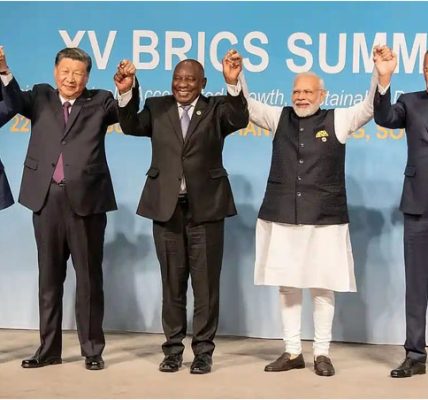
This weekend India welcomes the world to Bharat Mandapam under an extraordinary strain. When the Eighteenth BRICS Leaders’ Summit opens on 12 September 2026, Xi Jinping will set foot on Indian soil for the first time in seven years, and Vladimir Putin will arrive to sit across the table from a Prime Minister he counts a partner. Yet two members of this very club are on opposing sides of a shooting war. Since 28 February the United States and Israel have prosecuted a campaign against Iran, a BRICS member since 2024. Traffic through the Strait of Hormuz has slowed to a trickle, and in August the United Arab Emirates, struck by Iranian missiles, suspended trade and financial dealings with Tehran. Saudi Arabia, listed among the members yet never formally acceding, will send its foreign minister rather than its ruler. India, the host and the chair, must find language on this war that both Tehran and Abu Dhabi can accept. That is the immediate diplomatic problem, and it belongs to India to solve.
Behind the diplomacy sits a quieter economic paradox that is India’s to manage. Participation in BRICS widens India’s options even as it deepens certain dependencies. India’s goods trade with the ten other members has more than doubled since the pandemic, from roughly 203 billion dollars in FY2021 to about 417 billion in FY2026. Over the same span its deficit within that relationship tripled, to some 226 billion dollars. A grouping that promises voice can also deepen imbalance. This is the puzzle India inherits as chair. A coalition of eleven members and ten partners now commands nearly half of humanity and, by purchasing-power measures, output that rivals the industrial democracies. It also contains democracies, party-states, monarchies and a republic at war. The question is how such a body converts sheer participation into durable influence.
The argument of this article is straightforward, and it is unapologetically Indian in its vantage. BRICS draws its appeal from three forces working together: material scale, the demand for a fairer seat at the table, and the desire for strategic choice. India’s fourth chairship, after 2012, 2016 and 2021, can turn that appeal into cooperation that delivers. The right measure of the year is not the eloquence of a declaration. It is threefold: whether India builds workable cooperation among unequal members, whether it distributes tangible benefits, and whether it leaves commitments that survive the annual passage of the gavel. As External Affairs Minister S. Jaishankar has put it, BRICS has “evolved into a significant platform for cooperation among emerging markets and developing economies” (natstrat.org, June 2026). India’s task is to make that platform pay.
| WHY THIS SUMMIT MATTERS The Eighteenth Summit falls in the twentieth year of BRICS and closes India’s fourth chairship, after 2012, 2016 and 2021. It gathers eleven members and ten partners that together account for close to half of the world’s people and, by purchasing-power measures, output rivalling the industrial democracies. It convenes with Xi Jinping on Indian soil for the first time in seven years and Vladimir Putin at the table, even as a war involving a member state tests the grouping’s capacity to speak as one. The stakes are less about size than about whether such a house can act. |
From an Investment Idea to a Working Institution
The history of the acronym and the history of the grouping are distinct, and confusing them flatters the club. Jim O’Neill’s Goldman Sachs paper of November 2001 spotted a shift in growth momentum. It founded no diplomatic body. The politics came later, as an act of agency. Foreign ministers of Brazil, Russia, India and China first met in 2006. Leaders convened at Yekaterinburg in 2009. South Africa completed the founding five in 2010–11. The decisive institutional moment came at Fortaleza in 2014, where the members created the New Development Bank and the Contingent Reserve Arrangement. A forecast had become an institution that lives by consensus and a rotating chair.
How does a club of rivals cooperate at all? The answer lies in a distinction between the decisions that require unanimity and those that do not. A joint leaders’ declaration needs consensus, and it is exactly there, on the language of the Iran war, that agreement is hardest. Much of what BRICS does, however, moves through narrower coalitions. The New Development Bank lends to the members that borrow from it, under its own governance rather than by summit fiat. Local-currency settlement advances between the pairs of states that choose it. These are different tracks with different rules, and clarity about which is which matters. The Bank is a BRICS institution with a board of its own. A rupee–dirham settlement line is a bilateral arrangement between two governments. Neither should be mistaken for a collective decision of the eleven. The design intelligence of India’s chairship is to reserve the scarce currency of consensus for the few questions that truly need it, and to let the rest proceed with the willing.
One documented instance shows the pattern. Under India’s chairship the trade ministers met at Jaipur in August 2026 and finalised a Strategy for BRICS Economic Partnership 2030, advancing a work programme on supply chains and digital trade without waiting for agreement on the harder geopolitical questions that divide the members. Selected initiatives can move even when the room does not agree on everything. That is the mechanism on which a heterogeneous grouping depends.
The Bank, and the Promise of Climate Finance
The New Development Bank is India’s most tangible stake in the grouping, and it sits at the centre of the year’s most important question: climate finance. The original problem was concrete. Infrastructure-hungry economies faced long-term capital rationed by conditionality and by governance that underweighted their voice. The mechanism was a bank of their own, now led by Dilma Rousseff. By the end of December 2025 its board had cumulatively approved around 43 billion dollars for 139 projects, of which 115 remained in the active portfolio. Its General Strategy for 2022–2026 set a target of routing forty per cent of approvals to climate-related work and thirty per cent of financing in local currencies.
Two projects show what the Bank does and where the evidence ends. In India, it financed a tranche of the Mumbai Metro, an urban corridor whose benefits reach daily commuters and whose funds disburse across a multi-year construction schedule rather than at signing. In South Africa, it supported Eskom’s renewable-energy integration and transmission work, addressing the bottleneck that decides whether clean power is usable, namely the grid connection rather than the generation. The Bank’s own project record sets a planned target for that integration; its independent evaluation, not the approval document, is the proper basis for judging what was achieved. The distinction is the discipline the year demands. An approval is a promise. A disbursement is money released, not expenditure completed or a benefit delivered. The honest metric reads disbursement against each project’s construction schedule, so that the ordinary slow pace of building a metro is not mistaken for failure.
Climate finance is where India’s moral argument is sharpest and most its own. Prime Minister Narendra Modi framed the grievance plainly at the Rio summit in 2025, when he said the Global South had too often received “nothing more than token gestures” on climate finance, sustainable development and technology access (BRICS 2025, Rio). Brazil’s presidency linked the grouping to the COP30 agenda and to the goal of mobilising 1.3 trillion dollars a year by 2035 for developing-country climate finance. India’s chairship carries that thread forward, placing energy access, adaptation, resilient infrastructure and critical-mineral value chains at the centre of its sustainability pillar. The cost of capital, for much of the Global South, decides whether a solar park or a flood defence is ever built. A development bank that lends in local currency, at development horizons, is therefore not a technical footnote. It is the instrument through which recognition becomes benefit.
| THE BANK AND THE MONEY THAT REACHES THE GROUND By end-2025 the New Development Bank had approved close to 43 billion dollars for 139 projects, with a standing aim of routing forty per cent of approvals to climate work. For much of the Global South the cost of capital decides whether a solar park or a flood defence is ever built. A development bank lending in local currency, at development horizons, is therefore the pivot of India’s sustainability agenda, and the single clearest test of whether recognition turns into benefit that a citizen can see. |
The Contingent Reserve Arrangement teaches the opposite lesson. Conceived as a self-managed pool of central-bank commitments worth 100 billion dollars on paper, it lets a member under balance-of-payments stress draw a portion, while access beyond roughly thirty per cent of a country’s quota is linked to an International Monetary Fund programme. Even the delinked portion is not unconditional; the absence of an IMF programme requirement is not the absence of all conditions. The Arrangement has scarcely been drawn upon. It is an achievement of design more than of use, and the gap between the two is precisely what the delivery standard is meant to expose.
Expansion: Representation Gained, Coherence Tested
The enlargements since Johannesburg, Kazan and Rio have changed the club’s character. The Johannesburg II Declaration of 2023 opened the door. On 1 January 2024 Egypt, Ethiopia, Iran and the United Arab Emirates entered as full members. Indonesia followed in January 2025. Saudi Arabia is the standing ambiguity. India’s presidency and official BRICS materials list eleven members and include the kingdom. Riyadh, however, has not confirmed full membership, and it participates through lower-level delegations. The record is best described as a discrepancy with dates: official listings have counted Saudi Arabia as a member since January 2024, while Saudi statements from early 2024 onward have declined to confirm it, and its level of representation has stayed below that of the acceding states. One consequence is real. A large sovereign-wealth economy notionally at the table keeps deliberate optionality toward Washington, and the headline of eleven rests, in this case, on a listing rather than on a confirmed accession.
Kazan in 2024 added a partner tier: Belarus, Bolivia, Cuba, Kazakhstan, Malaysia, Nigeria, Thailand, Uganda, Uzbekistan and Vietnam. Partners take part in designated meetings; they do not hold the consensus veto that full members exercise over a joint declaration. Full and partner rights are therefore distinct, and the two should not be run together. What partners and smaller members do share is a quieter leverage: the option to deepen alternative partnerships, and the ability to shape the particular agendas where their own stakes are highest. Enlargement also demands a careful reading of the aggregates. Growth in the bloc’s output reflects two different things: genuine economic change within the founding five, and the mere arithmetic of adding economies. A constant-membership series and an expanded series are different objects, and the leap from roughly a quarter to two-fifths of global product depends on which measuring rod and which boundary one uses.
Why did so many states queue to join? The pull is recognition and insurance more than ideology. After the global financial crisis, after the weaponisation of finance and logistics, and after tariff shocks that turned supply chains into instruments of pressure, many governments judged a single institutional neighbourhood imprudent. BRICS offered a second address without the costs of alliance. The Bank offered capital without the full catechism of conditionality. To be admitted is to be seen as a maker of order rather than a taker of rules. The danger is equally plain. If every demand for recognition is met with further enlargement, the club grows capacious and loses the capacity to decide. India’s chairship therefore works to shift the currency of prestige from accession to delivery, and its success on that single axis is the truest measure of the year.
Weight Without Likemindedness: BRICS and the G7
Comparisons of BRICS and the Group of Seven are irresistible and usually badly posed, because they confuse mass with cohesion. The G7 is a club of high-income democracies bound by dense alliances, deep capital markets and a shared, if fraying, vocabulary of open markets and collective security. BRICS is a mosaic across four continents that binds energy exporters to importers, sanctioned states to American security partners, and continental land powers to maritime traders. To ask which is stronger is to demand a single ranking from indicators that measure different things. The useful comparison proceeds domain by domain, and it keeps the two measuring rods apart.
On output, the picture inverts with the rod. At purchasing-power parity the expanded BRICS now exceeds the G7; one recent estimate places BRICS-plus near 37 per cent of world product and around 54 per cent of world population (ISAS, NUS, Jan 2026). At market exchange rates the ordering reverses, and the G7 keeps the deep pools of reserve-currency finance, legal infrastructure and technological standard-setting that give network power its edge. India’s own talking points of forty per cent of global output are purchasing-power claims, true on their own terms and misleading only when moved into the exchange-rate world where debt is issued and reserves are held. The demographic contrast favours BRICS on scale, since it houses the two largest national populations on earth alongside the youthful societies of Egypt, Ethiopia and Indonesia. Yet scale becomes capability only under conditions the raw numbers do not guarantee. India’s dividend is a promise conditional on education, health and the absorption of young workers into formal jobs, not an entitlement.
Two cautions keep the comparison honest. Inequality within the two groupings differs in degree that country-level figures make plain: on the World Bank’s Gini measure of income, South Africa records one of the highest readings in the world, well above sixty, and Brazil sits above fifty, while the G7 economies cluster far lower; the bloc’s internal spread is therefore much wider than the G7’s. One should also resist collapsing the energy story into a single triumph. The enlarged club gathers a remarkable share of oil, gas and critical minerals, and two of the world’s largest sovereign-wealth pools now sit notionally at one table. The Iran war exposes the limit at once. With crude above 100 dollars and Hormuz throttled, a bloc containing both Tehran and Abu Dhabi cannot speak with one voice on the very commodity that supposedly unites it. Finance runs the asymmetry the other way. Reserve-currency depth, voting power and standard-setting remain concentrated in the advanced economies, and the BRICS response has been to build annexes beside the existing system rather than to rehouse it. Military indices, brandished in popular comparisons, are the least useful measure of all, since tonnage and headcount cannot be added across members who do not plan together and are, in several cases, rivals.
The Inner Geography of an Enlarged House
China is the unavoidable centre of gravity, holding by far the largest share of the grouping’s output, and its arrival in New Delhi carries weight. Xi Jinping’s first visit to India in seven years is a diplomatic fact of consequence, and India’s task is to keep status and interdependence on parallel tracks that do not collide in the communiqué. Here the trade balance needs decomposition, because a deficit alone establishes no single kind of vulnerability. India’s imbalance concentrates in three suppliers whose exposures differ. Dependence on China runs through manufactured intermediate inputs, from electronics to active pharmaceutical ingredients, where concentration is high and short-run substitution is hard; this is the strategically weighty case, because it touches the inputs of India’s own production. Dependence on Russia is chiefly discounted energy; the commodity is fungible and alternatives exist, yet the Hormuz disruption is a reminder that energy exposure can turn strategic in a crisis, so this is a serious vulnerability of a different type rather than a lesser one. Dependence on the United Arab Emirates runs largely through intermediation and re-export, gold and refined products moving through a trading hub; the strategic content is lower, though not nil. The point is to weigh different kinds of vulnerability, not to reserve significance for one supplier alone. Each calls for a different instrument: industrial policy and diversified inputs for the China exposure, supplier diversity and strategic reserves for the energy exposure, and better trade data for the entrepôt flows.
| THE ARRIVALS OF CHINA AND RUSSIA The presence of Xi Jinping and Vladimir Putin gives the summit its weight. For Beijing, the visit signals a managed thaw after seven years of frost along a contested border. For Moscow, isolated in the West, a seat at Bharat Mandapam is proof that isolation has limits. India gains from both, and is captured by neither. The chair’s craft this weekend is to let status and interdependence run on parallel tracks that do not collide in the communiqué. |
Russia arrives with a different urgency, converted by sanctions into a power preoccupied with payments and energy routes; for India the relationship is a long investment in defence supply, discounted oil and diplomatic room, valuable and yet not a blank cheque for an anti-Western platform. Brazil brings the development-and-climate instinct India shares, and the Rio legacy on climate finance and on the governance of artificial intelligence. South Africa is an industrialising middle power with its own agenda, pressing a beneficiation policy that would add value to its platinum-group metals and manganese rather than export them raw, and carrying the grouping’s highest inequality as a domestic constraint on every external choice. Ethiopia is a populous, fast-growing, landlocked economy for which access to development finance and to Red Sea trade matters more than any communiqué, and whose Nile-basin interests give it stakes that no great-power script contains. The interests of the smaller members are their own, and they are not India’s to speak for.
The decisive question about the enlarged house is distributional. Who sets agendas, who supplies finance, who determines standards, and who bears the costs of adjustment? Agenda-setting and finance remain concentrated among the largest economies, and standards are contested rather than set. Smaller members gain platform and recognition while accepting terms they did not write, yet they are not without leverage. The threat of deepening alternative partnerships is real, and on the sectoral questions where their stakes run highest their voice carries: Ethiopia on Nile and Red Sea matters, the Gulf states on energy and payments, South Africa on beneficiation and on Africa’s claim to reform. Expansion has broadened opportunity and complicated consensus at once. Both are true.
What India Brings
India’s contribution to this grouping is specific, and it is best shown rather than asserted. The first strength is digital public infrastructure. India has built, at population scale, an interoperable stack of identity, instant payments and consent-based data exchange, and its instant-payments system now processes more transactions each month than any comparable network. Three distinct things follow, and they should not be blurred: merchant acceptance of Indian payments abroad, the interconnection of payment systems between central banks, and the adoption of the underlying architecture by other states as a digital public good. India has pursued all three, integrating its payments interface with the United Arab Emirates and others, and offering the stack as a shared good rather than a proprietary export. The evidence lies in the systems already running, not in a claim of exclusivity.
The second strength is India’s standing across rival coalitions. It sits in the Quad and in BRICS. It buys discounted Russian oil and holds the Malabar naval exercises. It keeps working channels open to Washington, Moscow, Abu Dhabi and Beijing at once. This is multi-alignment in practice: a non-Western rather than an anti-Western posture, one that lets India deepen partnerships with the West even as it works inside BRICS, as I have argued at greater length elsewhere (NatStrat, 2026). As Dr. Raj Kumar Sharma of NatStrat has observed of this chairship, India has remained the moderating force that keeps BRICS from hardening into an anti-Western platform, offering the Global South development “without strings attached” rather than a bloc to enlist in (Indian Express, Sep 2026). Convening credibility across cleavages, joined to development experience and the digital stack, is the combination India offers. It also carries a price, which honesty requires naming. Leadership of a divided house means spending diplomatic capital to moderate outcomes India might prefer sharper, and satisfying no camp completely. Strategic autonomy is not free. It is paid for in the coin of deferred preference.
That posture has deep roots, and Indian statecraft has been rehearsing it all year. At the June 2026 gathering of BRICS security advisers in New Delhi, the National Security Adviser Ajit Doval opened with a diagnosis rather than a courtesy: the world faced a convergence of military conflict, economic volatility and disruptive technology, and the gravest danger was the growing incapacity of the institutions meant to manage it. Durable orders are made less by proclamation than by quiet institutional inflection, as I have suggested in earlier writing on that meeting (European Times, June 2026). The chairship is an attempt to supply exactly such an inflection, patiently and from within.
Money, Payments and the Myth of a Common Currency
Monetary questions attract the most rhetorical excess, so vocabulary must be exact. De-dollarisation collapses several distinct things: local-currency trade settlement, payment messaging, clearing and settlement, central-bank digital currencies, swap lines, reserve diversification, and the entirely separate idea of a common currency. India and Brazil have repeatedly declined to treat a single BRICS currency as policy, for the good reason that members too diverse to share a monetary policy cannot share a money. The realistic terrain is payment rails, not a phantom note.
The news makes the distinction urgent. India is reported to be pressing, at this summit, a proposal to interlink members’ central-bank digital currencies to ease cross-border payments. It is a reported proposal, attributed to sources, and not an adopted programme, and the difference is the whole point. A CBDC interlink is payments infrastructure. It is not a common currency. On the ground, local-currency settlement has advanced farthest where geopolitics made the dollar costly, above all in the China–Russia corridor, and more cautiously where India has preferred bilateral instruments such as the rupee–dirham line with the United Arab Emirates. Bilateral arrangements remain bilateral until formally adopted by the grouping. Claims that a large majority of intra-bloc trade already settles in local currency circulate in official-adjacent briefings and should be treated as political statistics, checked against reserve-share and messaging data before they are believed.
Precision about the Bank’s capital is indispensable, because authorised, subscribed, paid-in, approved and disbursed are five different quantities. The New Development Bank’s founders subscribed capital in equal shares, a deliberate departure from the weighted votes of the Bretton Woods institutions; voting power is still tied to shareholding under the Bank’s agreement, but the founders’ equality means no single member commands a controlling vote by size alone. The authorised ceiling stands near 100 billion dollars. Cumulative approvals reached roughly 43 billion by end-2025. Disbursements are smaller still, released as projects execute. Monetary diversification widens India’s choice only under conditions: where alternatives cut transaction costs without importing counterparty or currency risk, where the data governance and cybersecurity of payment rails meet Indian standards, and where interoperability does not become a channel for the very dependence it claims to reduce. Optionality is valuable. Optionality captured by the largest economy in the room is not.
Trade, Technology and Strategic Capability
The institutional character of BRICS must be stated plainly. It is not a customs union, not a free-trade area, and not the signatory of preferential agreements. Where liberalised trade occurs among members, it runs through bilateral or regional instruments credited to their actual signatories. To imply a BRICS-wide free-trade area is to misdescribe the object. This matters for India, whose widening deficit reflects comparative advantage and China’s manufacturing depth rather than any BRICS trade pact. The corrective lies in bilateral diplomacy and domestic industrial policy: better market access, lower non-tariff barriers, stronger logistics and higher-value exports. India should treat the grouping less as a bloc to join against the West than as an export market for its pharmaceuticals, engineering, autos, IT, food and textiles, while pushing local-currency payments under tight data and security rules, a case I have set out separately (Eurasia Review, Sep 2026).
Technology demands the sharpest differentiation, because a coherent account of techno-geoeconomic power separates mineral reserves from extraction, extraction from processing, processing from manufacturing, and manufacturing from the intellectual property that captures most of the value. Several members hold rich critical-mineral reserves. Processing, and the manufacture of batteries, magnets and drivetrains, is concentrated far more narrowly, predominantly in China. Cooperation that moved value up the chain, through technology transfer, skills and local processing, would be genuinely developmental, and here South Africa’s beneficiation agenda is India’s natural ally. Cooperation that merely secured raw-material flows to existing processors would entrench the distribution of value that development is meant to change. On artificial intelligence, the honest description is modest: compute access, research capacity, language inclusion for the Global South, data governance and energy demand are real questions, and the BRICS conversation on them remains a proposed avenue rather than a financed programme.
Ecology, Equity and Human Security
Sustainability is the pillar on which India’s legitimacy most depends, because it is where the enlarged bloc’s interests visibly collide. The grouping now holds major hydrocarbon exporters, industrialising economies for whom affordable energy is a development imperative, and renewable-energy leaders. A single line on energy is possible only in the language of nationally determined pathways. The substantive work sits below the headline, in adaptation, in resilient infrastructure, in food and water security, and in the public-health systems a warming climate will strain. India carries instruments into this argument, not sentiment alone: solar public goods through the International Solar Alliance, and biofuels cooperation, both anchored in its own record.
An honest account of climate stress notices whom it reaches first. Energy poverty, the burden of unpaid care under scarcity, insecure land and water rights, and displacement fall heavily and unevenly, and they fall differently on women divided by class, region and social position. Decisions taken without the participation of those who bear their consequences are both less just and less effective, which makes the presence of women’s and youth constituencies in BRICS forums a matter of policy quality. Indian ecological thought frames these near-term questions within a longer horizon of intergenerational responsibility and planetary stewardship, a horizon I have elsewhere termed “cosmic sustainability” in writing on India’s environmental wisdom (European Times, 2026). Civilisational vocabularies, the Indian claim that the world is one family among them, serve best as historically grounded resources for ethical reasoning, tied to institutions and choices rather than left to float.
Sea Lanes and Civilisational Ties
Enlargement toward the Gulf and the Red Sea makes maritime security a shared vulnerability rather than a shared command, and this year the vulnerability is acute. The throttling of Hormuz has raised insurance costs and crude prices across an economic geography on which most members depend. There is no collective BRICS naval arrangement, and inventing one in prose would be false. Yet the absence of a BRICS command is not the absence of maritime cooperation, which runs through other channels: the Indian Ocean Rim Association, the Indian Navy’s bilateral exercises and its role as a first responder in regional relief, and anti-piracy patrols joined outside any BRICS frame. For India, whose peninsula commands the northern Indian Ocean and whose imports transit Hormuz and the Bab-el-Mandeb, this is a domain of national capability and coalition diplomacy conducted largely beyond the grouping.
Civilisational connection works on a longer register, and it is a real resource for recognition even where politics diverges. Trade across the Indian Ocean, intellectual and scientific exchange, migration and pilgrimage and study created a familiarity among these societies that predates the acronym by millennia and lowers the affective cost of cooperation. Student mobility, tourism and cultural exchange convert that inheritance into present contact, and their value is best judged through participation and continuity. The caution is against homogenising the civilisations invoked, since each of these states contains a plurality within itself. Civilisational language earns its place only when it opens recognition rather than flattening difference.
The Tests, and India’s Choices
The argument must face its strongest objections. The gravest is internal asymmetry: a grouping in which one economy dwarfs the rest risks turning collective institutions into instruments of a single member’s preference. The second is weak implementation, visible in the Reserve Arrangement’s dormancy and in the lag between approval and disbursement, though that lag, read against construction schedules, is often the ordinary rhythm of building rather than proof of failure. The third is representation: a bloc that speaks for the Global South is led, in agenda and finance, by its largest members. To these the present moment adds the hardest test, a war between members that no draftsmanship may fully paper over. A serious analysis separates the positions of governments from the welfare of their populations, and asks of every initiative whose life improves and by what mechanism.
On institutional reform India must be candid, because members support redistributions of authority least when their own privileges are exposed. General endorsement of United Nations reform is cheap and near-universal; specific support for particular permanent Security Council seats is scarce, and China has never backed a permanent Indian seat. Modi has kept the demand alive for over a decade, noting as early as the 2014 summit that reform of the institutions of global governance had been on the BRICS agenda “since its inception” (BRICS 2014, Fortaleza). The distinction between rhetorical reformism and concrete concession is the one on which India’s own ambitions turn, and the grouping’s solidarity thins precisely where India needs it most.
Held against these tests, the argument survives in qualified form, and from the qualifications follow a few feasible priorities. Each has a responsible institution, a mechanism, a horizon and a measure. First, the New Development Bank should close the gap between approval and disbursement, judged by disbursement ratios against project schedules over the 2027–2031 strategy cycle, with the Bank accountable and execution reform the mechanism. Second, payment interoperability should be scoped narrowly around fast-payment linkage and, where members opt in, CBDC interconnection, with central banks responsible, pilots the mechanism, transaction volumes and cost savings the measure, and any common-currency ambition excluded. Third, climate adaptation and public-health cooperation should advance through existing tracks, measured by financed and completed projects, with the Bank’s climate window the natural vehicle. Each is a coalition of the willing rather than a demand for unanimity, which is why each can move even in a year when consensus on the largest questions fails.
The deepest priority is the least glamorous: continuity across presidencies. A chair holds the gavel for a year, and controls neither its predecessor’s commitments nor its successor’s agenda. The value of any framework India writes in 2026 depends on whether it survives the Chinese presidency of 2027. Handover protocols, standing secretariat functions and the disciplined tracking of compliance against past declarations are the quiet conditions on which every substantive priority rests. Institutions accumulate influence by repetition, by the reliable expectation that a commitment made in one year is honoured the next. India’s distinctive opportunity is to model that reliability, and to be the member whose word, given at Bharat Mandapam, is worth more for having been kept.
| THE MEASURE OF INDIA’S CHAIRSHIP Judge the year not by the eloquence of a declaration but by three plain questions. Did India build workable cooperation among unequal members? Did it distribute tangible benefits, in finance, payments, climate and health, that a citizen can see? Did it leave commitments that outlast the passage of the gavel to China in 2027? On the answers to these, and not on any recitation of population and product, this Indian moment will be judged. |
The Eighteenth Summit will not settle whether BRICS becomes a maker of order or remains a forum of grievance, and no single presidency could, least of all one convened while two members are at war. What New Delhi can do is change the metric by which the club measures itself, from the theatre of enlargement to the arithmetic of delivery, and to show that a rising power can host dissimilar coalitions without becoming the instrument of any of them. Strategic autonomy, understood not as neutrality but as the retention of independent judgement, including the freedom to align on one question and to decline on the next, is India’s contribution to a plural world order. The right standard for its chairship is three plain questions. Did it build workable cooperation among unequal members? Did it distribute tangible benefits? Did it leave commitments that outlast the passage of the gavel? On the answers to those, and not on any recitation of population and product, this Indian moment will be judged.
Views: 669

Dr. Maheep
Dr. Maheep is Director, Indian Perspective on Global Affairs (IPGA), and a leading analyst of India’s foreign policy and South Asian geopolitics. He earned his PhD in Arab and Islamic Studies. With more than a decade of teaching and research experience in International Relations and Global Politics, he contributes regularly on issues shaping national and global affairs.