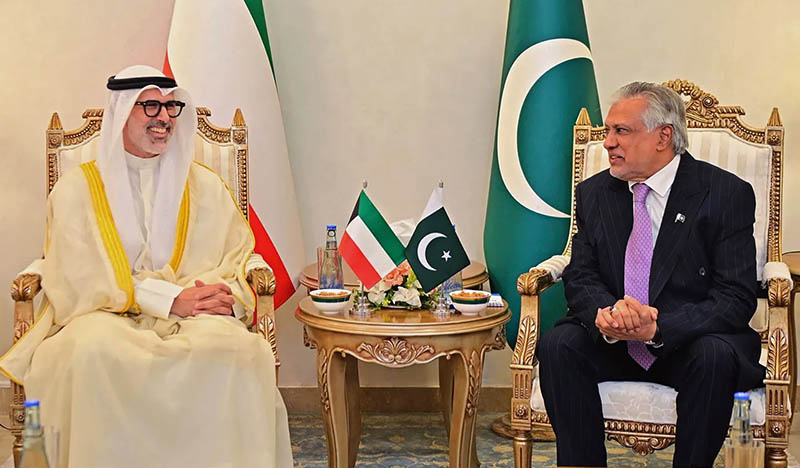







A defence agreement announces an intention. Its ratification records a decision. Its implementation reveals a strategy. On 26 July 2026, Kuwait ratified its Defence Cooperation Agreement with Pakistan through Amiri Decree-Law No. 73 of 2026, three years after its signature in June 2023. That interval is more than bureaucratic delay. It is the first and perhaps the most revealing measure of the agreement’s strategic priority.
The instrument establishes a five-year, automatically renewing framework for military training, education, intelligence sharing, logistics, defence technology, research, manufacturing, and the exchange of expertise under the supervision of a Joint Military Committee. It contains no mutual-defence clause, commits neither party to troop deployment, and creates no automatic security guarantee. It institutionalises cooperation without establishing collective defence. During the same period, Saudi Arabia and Pakistan concluded a Strategic Mutual Defence Agreement whose defining commitment treated aggression against one as aggression against both. Kuwait deliberately chose a different path: cooperation without guarantee, a committee rather than a covenant.
This distinction frames the central question of this assessment. Does the agreement represent a meaningful strategic realignment in Gulf security architecture, or is it a carefully calibrated instrument of defence diplomacy whose practical significance will remain limited? This article argues that the pact belongs to the realm of institutional signalling rather than strategic transformation. Its ultimate significance will depend less on the symbolism of its signature than on the credibility of its implementation. That credibility, in turn, must be assessed against Pakistan’s historical record of defence commitments, regional conduct, and treaty implementation. The true measure of any defence agreement lies not in the ceremony of its signing or the legality of its ratification, but in its capacity to shape strategic behaviour when circumstances demand. By that standard, the Kuwait–Pakistan Defence Pact remains an agreement to be tested rather than a partnership to be assumed.
The Analytical Frame
Three theoretical lenses illuminate Kuwaiti behaviour, and each yields the same conclusion. The first is strategic hedging. Kuwait sits in the most exposed geography of the Gulf, a small state wedged between larger powers, dependent on an American security umbrella whose reliability its planners now question. Hedging theory predicts exactly what Kuwait has done, which is to diversify its security relationships without committing fully to any single patron. A cooperation framework with Pakistan is a classic hedge. It costs little, commits nothing irreversible, and signals to Washington, Tehran, and Riyadh alike that Kuwait retains options.
The second lens is Regional Security Complex Theory, associated with Buzan and Waever. The Gulf forms a tightly interlinked security region in which the security of each state is bound to the security of its neighbours. Within such a complex, minor instruments acquire meaning as signals. Kuwait ratifying a Pakistani agreement in the same season that Saudi Arabia deepened its own Pakistani ties is a message about alignment within the Gulf Cooperation Council, addressed as much to fellow members as to external powers.
The third lens is omnibalancing, the recognition that leaders balance against internal and external threats simultaneously. For Kuwait, whose parliamentary experiment has been repeatedly suspended and revived, external partnerships also serve internal legitimacy. A visible defence relationship with a large Muslim military power carries domestic symbolic value quite apart from any battlefield utility. These three frames converge on a single reading. The agreement is an instrument of insurance, signalling, and diversification. It is not an instrument of collective defence, and it was never designed to be one.
A Relationship Older Than the Agreement
The agreement formalises a relationship that is four decades old, and honest analysis must acknowledge the continuity even while questioning the novelty. Pakistan has supplied military manpower, trainers, and advisers to the Gulf since the 1980s. Pakistani officers instructed Gulf militaries, Pakistani engineers cleared mines after the Gulf War, and Pakistani personnel filled the ranks of Gulf security forces across the peninsula. Pakistan cultivated a role as the Gulf’s reservoir of trained soldiery, and Gulf capitals cultivated Pakistan as a dependable, deniable, and affordable source of martial labour.
Kuwait fits this pattern. Pakistani military cooperation with Kuwait predates the 2023 signature by a generation. The 2023 agreement gathered long-standing practice into a single document, and the 2026 ratification gave that document legal effect. Much of what the agreement describes was already happening. This is the first substantive finding of the clause-by-clause reading that follows. A significant portion of the agreement formalises the existing rather than creating the new.
The clauses, weighed individually
Training and military education. Long-established practice. The clause codifies decades of Pakistani instruction in Gulf academies. Genuinely new content is minimal.
Intelligence sharing. Potentially significant, and the least verifiable. Intelligence cooperation lives in classified channels, and a treaty clause tells an analyst little about actual depth.
Logistics and military manufacturing. Aspirational. Pakistan seeks defence-export markets, and Kuwait represents a prospective buyer, yet Kuwait procures overwhelmingly from Western suppliers. Realisation depends on procurement decisions the agreement cannot compel.
Research, development, and joint production. The most ambitious language and the least likely to mature. Joint defence production requires industrial ecosystems and sustained capital that neither the text nor the record guarantees.
The Joint Military Committee. The institutional heart of the pact, and the correct place to look for evidence of seriousness. A committee that meets, exercises, and reviews would signal substance. A committee that convenes rarely would confirm the sceptical reading.
The verdict of the clause-by-clause reading is that the genuinely novel content is narrow, the aspirational content is broad, and the binding content is absent. This is an agreement whose ceiling is high and whose floor is low, and whose eventual altitude depends entirely on political will that lies outside the document.
Where the Agreement Sits Among Its Peers
Placing the Kuwait agreement beside other Gulf defence instruments locates it precisely on the spectrum from symbolic cooperation to binding alliance. The table below arranges the principal comparators by the depth of commitment each embodies.
| Instrument | Character | Depth of commitment |
| Saudi Arabia–Pakistan SMDA (Sept 2025) | Strategic mutual defence agreement | Highest. Aggression against one treated as aggression against both. |
| US–Kuwait Defence Cooperation Agreement | Bilateral security guarantee with basing | High. Underpinned by forward-deployed forces and hardware. |
| Pakistan–Qatar / Pakistan–UAE cooperation | Training, secondment, logistics | Moderate. Institutional, non-binding on mutual defence. |
| Kuwait–Pakistan DCA (signed 2023, ratified 2026) | Institutional cooperation framework | Lower. No mutual-defence clause. Committee-led implementation. |
The pattern is unambiguous. Instruments anchored by forward-deployed forces or mutual-defence pledges occupy the upper tier, and the Kuwait–Pakistan agreement sits well below them. The United States maintains troops and materiel in Kuwait, and that presence constitutes a security relationship of an entirely different order. The Saudi–Pakistan agreement, whatever its own implementation questions, at least commits its language to mutual defence. Kuwait’s agreement with Pakistan is institutionally narrower than a collective-defence treaty by design, and comparison confirms that its authors chose the lighter instrument deliberately.
The Question of Credibility
A defence agreement is a promise about the future, and the reasonable way to assess a promise is to examine the promiser’s record. Here the analysis turns to Pakistan, and it does so on the basis of evidence rather than assertion. The central concept is the capability–commitment gap, the recurring distance between what Pakistan pledges to Gulf partners and what Pakistan delivers when the pledge is tested.
Pakistan carries a long and documented history of commitments made and commitments abandoned, and that history is the single most important context for reading any new Pakistani undertaking. The pattern recurs across seven decades and across every category of partner. Pakistan accepted American security assistance for years while its territory sheltered the networks that assistance was meant to defeat, a contradiction that the discovery of Osama bin Laden beside its premier military academy in 2011 laid bare. Pakistan took Saudi financial support for decades and then declined the one direct military request Riyadh ever pressed, over Yemen in 2015. Pakistan signs frameworks with ceremony and implements them selectively, and its treaty behaviour has earned it a reputation, among the very partners it courts, as a state whose signature secures the announcement rather than the outcome. A partner assessing a Pakistani commitment must therefore weigh not merely the text before it but the ledger behind it, and that ledger records more promises deferred than promises delivered.
The defining case remains Yemen. In April 2015, Saudi Arabia, Pakistan’s most generous long-term benefactor and the provider of repeated financial deposits, oil facilities, and political cover, formally requested troops, ships, and aircraft for the coalition against the Houthis. The request came after the campaign had already begun and after Riyadh had publicly signalled that it expected Pakistani participation. Pakistan’s parliament debated the request for five days and then voted unanimously to remain neutral, urging a mediating role instead of a fighting one. Riyadh had underwritten Pakistan financially for decades, and when Riyadh asked for military weight at a moment of high regional stakes, Islamabad declined. The Emirati minister of state responded that Pakistan would pay a heavy price for what he called ambiguous stances. The episode is documented, unambiguous, and directly relevant. It demonstrates that Pakistani commitment to Gulf security bends sharply when Pakistan’s own calculations, particularly its long border and delicate balance with Iran, point the other way. This was not a peripheral favour declined. It was the central request of Pakistan’s foremost Gulf patron, refused at the decisive moment.
This is the heart of the credibility question. Pakistan positions itself as friend to Washington, partner to Beijing, client to Riyadh, brother to Doha, and careful neighbour to Tehran, and it sustains these relationships simultaneously by keeping each commitment shallow enough to abandon. A state that is friend to all reserves the capacity to be ally to none at the decisive moment. The Yemen vote is the proof of the proposition, and it hangs over every subsequent Pakistani defence undertaking in the Gulf, including this one.
The credibility question deepens when one turns from external commitment to internal governance, because a state’s treatment of its own institutions forecasts its reliability as a partner. Pakistan has not permitted a single elected prime minister to complete a full parliamentary term since independence in 1947. Governments fall to coups, to judicial dismissals, to engineered defections, and to the persistent supervision of a military establishment that treats civilian authority as provisional. Defence agreements are frequently advanced under military-dominated dispensations and then quietly deprioritised when civilian governments change or when the army recalibrates its external priorities. This record of policy discontinuity is not a rhetorical charge. It is a structural feature with direct consequences for treaty implementation, because agreements signed by one dispensation are inherited, and often quietly abandoned, by the next. A five-year, automatically renewing framework is precisely the kind of instrument that is vulnerable to the next political upheaval or the next shift in the army’s Gulf strategy. Institutional inertia and leadership turnover together produce an implementation deficit that no clause can cure.
Two further strands complete the picture, and each rests on documented record. The first is Bahrain. During the crackdown of 2011, Bahrain recruited former Pakistani soldiers into its National Guard and riot police, and human-rights organisations have long alleged that such recruitment forms part of a wider policy of political naturalisation intended to alter the kingdom’s sectarian balance. Credible mid-range estimates place Pakistani nationals in Bahrain’s security forces in the range of ten thousand, with advocacy bodies citing far larger cumulative naturalisation figures across fifteen years that remain contested. Pakistan supplied the manpower that a Sunni monarchy used to police a Shia majority, and it did so as a commercial and strategic transaction. The episode illustrates the transactional core of Pakistani military diplomacy in the Gulf, in which martial labour is a service rendered for strategic and financial return.
The second strand is Pakistan’s broader reputation for strategic double-dealing, and it must be stated with care and confined to the record. The most authoritative single verdict came from within Pakistan’s own alliance with the United States, when American officials concluded that elements of the Pakistani state maintained ties to militant networks even while receiving American security assistance. The killing of Osama bin Laden in a garrison town beside Pakistan’s premier military academy crystallised that suspicion. The relevant point for Gulf partners is narrow and evidenced. Pakistan has a documented history of running parallel and contradictory alignments, and a prudent partner prices that history into every new agreement.
These patterns, the Yemen refusal, the chronic discontinuity of civilian authority, the transactional use of military manpower, and the record of parallel alignments, converge on a single structural conclusion. The implementation credibility of a Pakistani defence commitment is limited by financial dependence, civil–military instability, policy discontinuity, and a demonstrated willingness to subordinate a partner’s request to Pakistan’s own regional calculus. Pakistani defence commitments in the Gulf are credible for as long as they remain cost-free or profitable, and they bend when costs rise. This assessment holds alongside the genuine record of Pakistani contribution, the decades of training Gulf officers, staffing Gulf academies, and sustaining defence ties across the peninsula, because that contribution is precisely the transactional service the argument describes rather than a rebuttal of it. None of this renders the Kuwait agreement worthless. All of it renders the agreement’s transformative interpretation implausible.
The strongest recent confirmation comes from the Saudi case. In Saudi Arabia–Pakistan Security Pact, an Illusive Mirage? (European Times, 17 October 2025), Dr. Maheep read the Saudi–Pakistan Strategic Mutual Defence Agreement as a compact of convenience in which Riyadh commits capital and Islamabad commits blood, and he identified the Pakistan–Afghanistan border war as its litmus test. When Pakistani forces clashed with the Afghan Taliban along the Durand Line through late 2025, Riyadh offered no condemnation, no diplomatic intervention, and no material assistance, exactly the passivity a mutual-defence clause is meant to preclude. The Saudi agreement carries the mutual-defence language that the Kuwait agreement lacks, and even that stronger instrument produced silence when the clause was tested. The Kuwait pact, weaker by design, inherits the same credibility question in sharper form.
Kuwait’s Calculus
Kuwait acted rationally, and understanding its motives requires no recourse to naivety. The Gulf that Kuwait surveys in 2026 is more dangerous and more uncertain than at any point since 1991. American commitment is debated in Washington and doubted in the Gulf. Iranian pressure is constant, and the waters of the Gulf carry the risk of drone and missile disruption that no Kuwaiti planner can ignore. The Red Sea is contested, the Strait of Hormuz is a permanent vulnerability, and the regional order that once rested on unquestioned American primacy now rests on a multipolar bargain among Washington, Beijing, Moscow, Riyadh, and Tehran.
Against this backdrop, Kuwait diversifies. The Pakistani agreement is one strand in a wider hedge that also includes the enduring American relationship, deepening ties with China, and careful coordination within the Gulf Cooperation Council. Ratifying the Pakistani pact costs Kuwait almost nothing and buys it optionality, alignment with Saudi precedent, and a visible signal of strategic autonomy. The ratification arrived alongside high-level exchanges, including the visit of Kuwait’s foreign minister to Islamabad. For a small state, insurance is rational even when the policy is unlikely ever to pay out. Kuwait bought insurance. It did not enter an alliance.
A caution attends the hedge. The Gulf’s underlying vulnerability is precisely that its security has been rented rather than built. In Rented Security, Revealed Fragility: The Arab Gulf States’ Strategic Reckoning (European Times, 8 April 2026), Dr. Maheep described the Gulf model as one of rentier militarism, in which external security rents allow states to sidestep the harder task of constructing durable indigenous defence cultures, and he drew the lesson that security cannot be rented but must be built. A cooperation framework with Pakistan, an external partner supplying martial labour for transactional return, sits squarely within the rented model rather than the built one. It diversifies Kuwait’s sources of rented security without advancing the institutional depth that the same analysis identifies as the true measure of strategic resilience. The hedge is rational, and it does not resolve the deeper fragility.
Pakistan’s Calculus
Pakistan’s motives are equally rational and considerably more revealing, because they expose the transactional engine beneath the diplomatic language. Pakistan approaches the Gulf as a theatre of economic rescue and strategic relevance. Gulf remittances sustain the Pakistani economy, Gulf investment is courted continuously, and Gulf defence markets offer Pakistan’s struggling industry a rare export prospect. Every defence agreement Pakistan signs in the Gulf is, at one level, an instrument of economic diplomacy conducted through military means.
Strategic relevance is the second driver. Pakistan competes with India across every Gulf capital, and it seeks to persuade Gulf states that Pakistani manpower and military expertise remain indispensable even as India’s economic weight in the region grows. Under Field Marshal Asim Munir, Pakistan’s military leadership has pursued an energetic Gulf outreach that recasts the army as the country’s principal diplomatic actor. A defence agreement with Kuwait serves this project by presenting Pakistan as the Gulf’s security partner of choice. The presentation is ambitious, and the Yemen precedent is the reason to doubt that Pakistan would honour the role when it counted.
The synthesis is straightforward. Pakistan offers martial labour, training, and the appearance of strategic partnership, and it seeks investment, relevance, and advantage over India in return. This is a rentier logic applied to security, in which military cooperation is the coin exchanged for economic and diplomatic reward. The logic is not disreputable in itself, for many states monetise strategic assets. The logic does, however, define the ceiling of the commitment, because a partnership entered for transactional reasons will be honoured only so far as the transaction continues to pay.
How India Reads It
India observes the agreement with composure, and the composure is well founded. India’s Gulf position in 2026 rests on foundations that a Pakistani cooperation framework does not touch. India is the largest source of expatriate labour across the Gulf, a top energy customer for Saudi Arabia, Qatar, and the United Arab Emirates, and a strategic partner whose relationships with Gulf capitals have deepened across two decades. The scale of India’s Gulf presence is structural, and structural advantages are not dislodged by a committee-led defence pact between a Gulf state and Pakistan.
India’s own Gulf diplomacy through 2026 demonstrates the asymmetry. National Security Adviser Ajit Doval visited Riyadh repeatedly during the year, holding talks on energy security and the protection of maritime corridors with Saudi Arabia’s foreign minister and national security adviser, in what Indian officials described as a standing dialogue mechanism between the two national security establishments. That engagement sat within a coordinated Indian outreach that included the external affairs minister’s visit to the United Arab Emirates and the petroleum minister’s visit to Qatar. India engages the Gulf as a peer whose concerns are energy, sea lanes, and the safety of millions of its nationals, and it does so through sustained high-level dialogue rather than through episodic signalling.
Seen from New Delhi, the Kuwait–Pakistan agreement is symbolic concern rather than strategic threat. It does not alter India’s maritime strategy, it does not disturb the India–Middle East–Europe Economic Corridor, and it does not weaken India’s strategic partnership with Kuwait or with the wider Gulf Cooperation Council. Indian analysts note the agreement, assess it, and move on, because the fundamentals of India’s Gulf position rest on economic weight and human presence that Pakistan cannot match through defence diplomacy. The correct Indian posture is watchful equanimity, and that is the posture India has adopted.
Four Futures
Rigorous forecasting distinguishes between what is possible and what is probable, and it identifies the indicators that would confirm each path. Four scenarios span the plausible range.
Best case for the agreement
The Joint Military Committee convenes regularly, joint exercises begin, Pakistani training deepens, and modest defence-industrial cooperation takes root. The agreement matures into a working partnership. The confirming indicator would be a schedule of exercises and committee meetings within twenty-four months. This scenario is possible and, on the historical record, unlikely.
Most likely case
The agreement functions as a low-intensity institutional relationship. Some training occurs, some visits take place, the committee meets occasionally, and the pact endures as a modest fixture of Kuwaiti hedging without ever approaching strategic significance. The confirming indicator is precisely the absence of dramatic development, an agreement that persists quietly and delivers little. This is the central expectation of this assessment.
Worst case
A regional crisis tests the agreement, Kuwait looks to Pakistan for meaningful support, and Pakistan hedges as it hedged over Yemen in 2015. The pact is exposed as hollow, and Kuwait absorbs the lesson that a cooperation framework is not a guarantee. The confirming indicator would be Pakistani reticence during a live Gulf contingency. The Yemen precedent makes this scenario more than hypothetical.
Wild card
A sharp deterioration in the American security guarantee, or a dramatic Iranian escalation, pushes Kuwait to seek deeper commitments and pulls the agreement toward genuine substance faster than any party currently intends. The confirming indicator would be a move to amend the pact toward mutual-defence language. This path is low in probability and high in consequence, and it deserves monitoring precisely because it is discontinuous.
Policy Recommendations
Recommendations follow the analysis, and each is addressed to a specific actor.
For Kuwait. Treat the agreement as one strand of a diversified hedge and refuse to mistake it for a security guarantee. Retain the American relationship as the foundation of national defence, and measure the Pakistani pact by committee activity rather than by declarations.
For Pakistan. Convert signature into substance by delivering training and exercises on a published schedule, because credibility is earned through implementation and Pakistan’s Gulf credibility carries the burden of the Yemen precedent.
For India. Maintain watchful equanimity, continue the sustained high-level Gulf dialogue that the national security establishment has built, and decline to overreact to a symbolic instrument that leaves India’s structural advantages intact.
For the Gulf Cooperation Council. Recognise that bilateral defence pacts with external partners diversify risk but fragment collective posture, and invest in integrated Gulf mechanisms that no single external partner can substitute.
For the United States. Read the agreement as a signal of Gulf anxiety about American reliability, and respond by clarifying rather than contesting commitments, because hedging accelerates when guarantees appear to weaken.
Conclusion: The Test Is Implementation
The Kuwait–Pakistan Defence Cooperation Agreement is a real diplomatic act, a rational hedge for a small and exposed state, and a modest instrument whose strategic significance its own language keeps deliberately low. It formalises a relationship four decades old, it omits the mutual-defence commitment that would make it consequential, and it rests on a partner whose record in the Gulf reveals a persistent gap between what Pakistan promises and what Pakistan delivers when the promise is tested. The three-year interval between signature and ratification is the agreement’s most honest feature, because it measures the priority that Kuwait itself assigned to the instrument.
The abiding lesson stands clear. The true test of any defence agreement lies not in its signing and not in its ratification but in sustained implementation, measurable institutionalisation, and demonstrated strategic outcome. By that test the Kuwait–Pakistan agreement remains unproven, and the weight of historical evidence counsels the analyst to expect an instrument that endures quietly and delivers little. The committee has been created. The covenant has not. The distance between the two is the distance between diplomacy and strategy, and it is a distance this agreement has yet to travel.
Views: 1573

Dr. Maheep
Dr. Maheep is Director, Indian Perspective on Global Affairs (IPGA), and a leading analyst of India’s foreign policy and South Asian geopolitics. He earned his PhD in Arab and Islamic Studies. With more than a decade of teaching and research experience in International Relations and Global Politics, he contributes regularly on issues shaping national and global affairs.