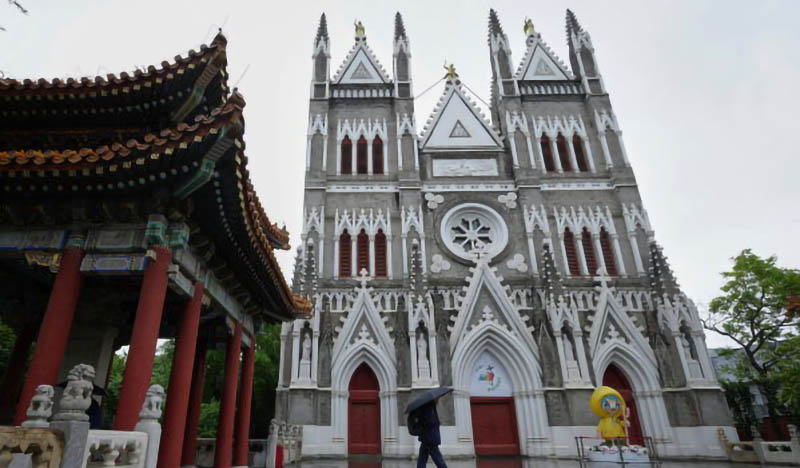







The Chinese Communist Party (CCP) has long seen religion not as a matter of conscience but as a potential rival to state authority. Its current campaign to rebrand Tibetan Buddhism as “Chinese Buddhism” is part of a broader project: the domestication of all faith traditions under the Party’s ideological umbrella.
The CCP insists that all religions must adapt to “Chinese characteristics,” meaning they must align with Party doctrine and national identity. This is not cultural integration but political subordination. Every faith is required to operate under state-run associations that monitor clergy, doctrine, and practice. Independent religious authority is forbidden. Monasteries, churches, and mosques are monitored, with clergy forced to undergo political training. Sermons are censored, and religious gatherings outside state control are criminalized.
Tibetan Buddhism represents more than a spiritual tradition; it embodies a cultural identity and historical memory that resists assimilation. By labeling it “Chinese Buddhism,” Beijing attempts to erase its distinct lineage and tether it to the state’s narrative of national unity. This linguistic shift is not benign. It is a calculated move to delegitimize Tibetan identity and sever ties with the Dalai Lama, who remains a powerful symbol of spiritual independence.
The campaign against Tibetan Buddhism reflects a broader pattern. Crosses have been removed from churches, pastors have been detained, and scripture has been rewritten to reflect Party values. Mosques have been demolished, Uyghur imams have been silenced, and Qur’anic study has been restricted. Local folk rituals have been rebranded as “cultural heritage” rather than living faith, stripping them of their spiritual legitimacy.
The CCP fears any allegiance that competes with loyalty to the Party. Religion offers moral authority, community, and transnational connections, all of which challenge the state’s monopoly on truth. By redefining Tibetan Buddhism as “Chinese Buddhism,” Beijing seeks to neutralize its power, absorb its identity, and present it as a domesticated faith loyal to the nation rather than to its own traditions.
This is not about theology. It is about sovereignty. Beijing’s project is to ensure that no pulpit, monastery, or altar speaks with authority beyond the Party. The renaming of Tibetan Buddhism is a symptom of a deeper ambition: to make belief itself a state-controlled resource.
Views: 25

Khedroob Thondup
Khedroob Thondup is the son of Gyalo Thondup, elder brother of the Dalai Lama. Educated at St. Stephens College Delhi University and the University of San Francisco. He was a personal assistant to the Dalai Lama and accompanied him on his first trip to the U.S. in 1979. He was sent by the Dalai Lama to Beijing from 1980 till 1993 for dialogue talks where he interacted with Xi Zhongxun and Hu Jintao. He has served as Member of the Tibetan Parliament in Exile for three terms and is the President of the Tibetan Refugee Self Help Centre Darjeeling since 1987. He has edited two books, Dalai Lama My Son and Tibet in Turmoil and presently lives in Taipei, Taiwan.