






External Affairs Minister Dr S. Jaishankar’s visit to Brussels on 14–15 July 2026 for the third India–European Union Trade and Technology Council (TTC) marked the transformation of India–EU relations from episodic summit diplomacy into a mature institutional partnership organised around implementation. Convening six months after the Sixteenth India–EU Summit concluded the Free Trade Agreement celebrated as the ‘mother of all deals’, and coinciding with the entry into force of the India–United Kingdom Comprehensive Economic and Trade Agreement, the ministerial delivered dateable commitments across research association, innovation infrastructure, strategic technologies and resilient value chains. This article interprets the visit through the integrated lenses of economic statecraft, techno-geopolitics and complex interdependence, and argues that the partnership now rests on the institutionalisation of managed divergence, in which the strategic autonomy of both parties functions as an enabling condition of cooperation rather than an impediment. The analysis traces the fusion of trade, technology, energy, climate and maritime security into a single strategic system, and assesses the partnership’s significance as a load-bearing pillar of an emerging multipolar order.
Brussels Moment
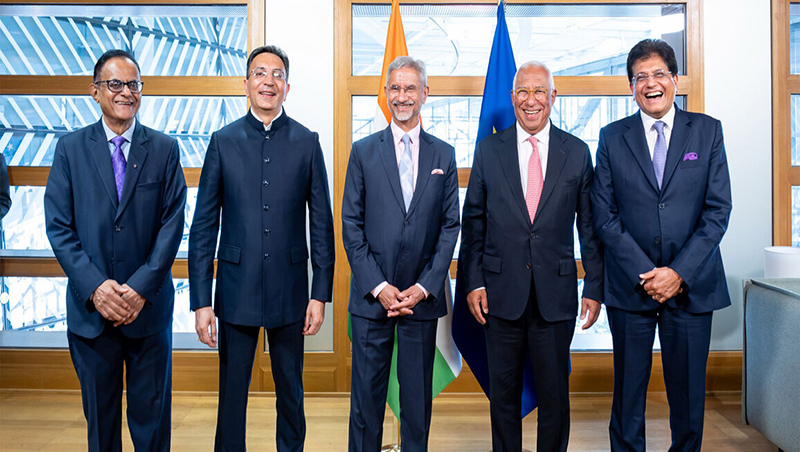
Diplomatic visits acquire historical weight when they compress structural change into a single frame. Dr S. Jaishankar’s presence in Brussels on 14 and 15 July 2026, alongside Commerce and Industry Minister Piyush Goyal, Minister of State Jitin Prasada and Principal Scientific Adviser Professor Ajay K. Sood, for the third ministerial meeting of the India–EU Trade and Technology Council, was precisely such a frame. The visit concluded an itinerary that carried the External Affairs Minister through Qatar, Bahrain, Kuwait, Oman and New York before terminating in the capital of Europe, a sequencing that narrated India’s contemporary statecraft in miniature: consolidation of the Gulf strategic arc, engagement with the multilateral system, and operationalisation of the European partnership as the newest frontier of Indian diplomacy. The composition of the delegation performed its own argument. The presence of the Principal Scientific Adviser in calls on the President of the European Council announced that science and technology have migrated from the periphery of the relationship to its constitutional core.
The timing invested the visit with unusual significance. On 27 January 2026, at the Sixteenth India–EU Summit in New Delhi, Prime Minister Narendra Modi, Commission President Ursula von der Leyen and European Council President António Costa had concluded the India–EU Free Trade Agreement after nearly two decades of intermittent negotiation, an accord von der Leyen characterised as “the mother of all deals” and which created a preferential trading space of almost two billion people. The Summit simultaneously adopted the Towards 2030 Comprehensive Strategic Agenda and exchanged instruments on security and defence partnership, mobility, disaster risk management and green hydrogen. The Brussels TTC was the first full ministerial mechanism to convene after that watershed, and it therefore carried the burden of demonstrating institutional traction. A second synchronicity deepened the moment: on 15 July 2026, the day the Council convened, the India–United Kingdom Comprehensive Economic and Trade Agreement entered into force, granting duty-free access to nearly 99 per cent of Indian exports and completing, together with the India–EFTA agreement in force since October 2025, a comprehensively liberalised Indian trading relationship across virtually the entire European economic space.
This article contends that Brussels marked the passage of India–EU relations from the politics of declaration to the discipline of implementation. The interpretative key is supplied by Dr Maheep, whose January 2026 essay in The European Times identified the partnership’s animating principle as “the institutionalisation of managed divergence rather than enforced convergence” (18 January 2026). Managed divergence, this article argues, has matured from description into method: a repertoire of institutional practices through which two polities committed to strategic autonomy convert convergent interests into administrative fact while treating residual disagreement as a parameter to be governed rather than a defect to be eliminated. Read through the combined lenses of liberal institutionalism, which explains the density of mechanisms; complex interdependence, which explains the multiplicity of channels; and geoeconomics, which explains the strategic instrumentalisation of commerce and technology, the Brussels visit becomes legible as the moment the partnership demonstrated that it could govern its own success.
Trade and Technology Council as Institutional Method
The Council that convened on 15 July is only the second such mechanism the European Union maintains with any partner, the first being the United States, and its third ministerial displayed the deadline discipline that distinguishes institutions from dialogues. The two sides committed to finalising a structural upgrade of the TTC by the end of 2026, as foreseen in the Comprehensive Strategic Agenda, and agreed a set of concrete, dateable outcomes: the launch of formal negotiations on India’s association to Horizon Europe, with conclusion targeted before the end of 2026; the establishment of the first EU–India Innovation Hub, devoted to electric vehicle charging technologies and testing; an EU–India Startup Partnership in deep-tech clean technologies; intensified cooperation across semiconductors, high-performance computing, quantum technologies, artificial intelligence and 6G; and strengthened work on resilient value chains in agri-food, active pharmaceutical ingredients and clean energy technologies.
Each instrument answers a specific structural problem, and their design rewards institutionalist reading. Horizon Europe association attacks the oldest asymmetry in India–EU scientific relations, episodic project collaboration without systemic access: association would entitle Indian universities, laboratories and firms to participate in the Union’s flagship research programme on terms comparable to European entities, converting scientific cooperation from gesture into infrastructure. The Innovation Hub creates a permanent site of joint standard-setting in a sector where interoperability decisions taken within three years will structure automotive value chains for decades, and it quietly advances the shared interest of ensuring that the standards of the electric age are written in democracies rather than inherited from a dominant supplier. The Startup Partnership addresses the scale-up gap that has historically pushed promising deep-tech ventures from both geographies towards American or Chinese capital, with the attendant migration of intellectual property; it therefore belongs to economic security policy as much as to innovation promotion. The value-chain workstreams translate the vocabulary of de-risking into sectoral programmes, and the pharmaceutical strand carries particular weight: Europe’s pandemic-era recognition of concentrated API dependence meets India’s standing as the pharmacy of the world in a relationship of genuine mutual reliance.
The visit’s diplomatic texture reinforced the institutional substance. Jaishankar’s deliberations with High Representative Kaja Kallas ranged across West Asia, the safety of maritime commerce and supply-chain resilience, and Kallas, describing 2026 as “a historic year for EU-India relations”, publicly urged deeper coordination between the EU naval operations ATALANTA and ASPIDES and the Indian Navy. The call on President Costa recorded the progress achieved since January and projected, before at least three audiences, a calibrated systemic message: for Washington, evidence that India’s diversification strategy possesses substance; for Beijing, proof that democratic economies can construct de-risked value chains at scale; and for the Global South, demonstration that development-sensitive diplomacy and high-standard integration are compatible.
The Economic Constitution: Trade Agreements as Strategic Hedge
The Free Trade Agreement concluded in January is the gravitational centre around which the Brussels visit orbited, and its history is a study in strategic patience. Negotiations launched in 2007 stalled over automobiles, agriculture, mobility and procurement and were suspended in 2013; the relaunch of 2022, accompanied by parallel tracks on investment protection and geographical indications, reset the enterprise within a transformed geopolitical context; and the concluding round of January 2026 delivered the most comprehensive agreement either party has ever concluded. India liberalised 92.1 per cent of its tariff lines, covering 97.5 per cent of EU exports by value, with 49.6 per cent subject to immediate duty elimination, while European markets opened reciprocally to India’s labour-intensive strengths in textiles, footwear, marine products and processed foods. The agreement’s chapters extend beyond goods into services, investment, digital trade, sanitary cooperation, geographical indications and sustainable development, and its architecture consciously shields India’s agricultural livelihoods, dairy sector and small enterprises, embodying the development-sensitive approach that has become the signature of Indian trade diplomacy.
The strategic function of the accord exceeds its commercial arithmetic, and here economic statecraft supplies the appropriate analytical register. Bilateral merchandise trade already stood near 136.5 billion US dollars in 2024–25, with services adding a further 83 billion, making the EU India’s largest goods trading partner; yet both sides framed the agreement in the vocabulary of economic security rather than commercial gain, von der Leyen presenting it as an instrument for reducing strategic dependency at a time when trade is being weaponised. In a system marked by tariff coercion, sanctions spillovers and supply-chain fragmentation, the FTA operates as a strategic hedge: an insurance architecture purchasing predictability, diversification and policy space for both economies. India’s crossing of the four-trillion-dollar threshold in early 2026, on growth sustained above seven per cent, transformed the material basis of the bargain, and the parallel entry into force of the India–EFTA agreement, with its commitment of 100 billion US dollars of investment over fifteen years tied to one million Indian jobs, demonstrated that development-sensitive liberalisation can mobilise capital at scale.
The United Kingdom track completed this economic constitution. The India–UK Comprehensive Economic and Trade Agreement, concluded in May 2025, signed that July and operationalised on 15 July 2026 alongside the Double Contribution Convention, extends zero-duty access across nearly the whole of bilateral trade and exempts Indian professionals in Britain from social security contributions for up to five years. Its significance for the present analysis is structural rather than bilateral: together, the EU, UK and EFTA agreements restore in liberalised form the unity of India’s European market that Brexit had administratively divided, generate competitive dynamics in which each European negotiating partner observes the concessions obtained by the others, and position India as the rare major economy holding preferential access simultaneously across the entire continent. The task the Brussels visit inaugurated is administrative: rules-of-origin systems, customs cooperation, equivalence procedures and business-facing guidance will determine whether preference utilisation flourishes, and the TTC’s value-chain machinery constitutes precisely the connective tissue between legal text and traded goods. Trade agreements, on this reading, are the constitution of the partnership; the TTC is its executive.
Techno-Geopolitics: Sovereignty through Co-Development
Technology supplies the partnership’s strategic momentum, and Brussels consolidated a distinctive Indo-European model of techno-geopolitics: co-development among democracies as the route to technological sovereignty for both. The TTC’s portfolio, spanning semiconductors, artificial intelligence, quantum, high-performance computing, 6G and digital public infrastructure, maps onto the technologies that will distribute power across the coming quarter-century. In semiconductors, European strengths in lithography, materials and design tools meet India’s expanding fabrication, packaging and design-talent base under the India Semiconductor Mission, embedding both parties in trusted value chains. In telecommunications, the alignment of Bharat 6G Vision with Europe’s Smart Networks programme encodes the lesson both drew from the 5G era, that standards abstinence is strategic self-harm, and directs joint research towards international standards bodies so that the next generation of connectivity embeds openness and security by design.
Artificial intelligence cooperation proceeds along a philosophically richer axis. Europe’s risk-based regulatory approach and India’s innovation-led, inclusion-oriented ecosystem differ in method while converging in purpose: both seek AI governance that is human-centric, democratic and resistant to concentration. The TTC functions here as a translation chamber in which regulatory divergence is managed through interoperability and mutual learning rather than harmonisation by pressure, allowing India to participate in global technology governance as co-architect rather than rule-taker. India’s Digital Public Infrastructure, from Aadhaar and UPI to DigiLocker and ONDC, offers Europe a working demonstration that digital inclusion at civilisational scale can rest on open, interoperable, publicly governed foundations, and the joint extension of this model to third countries constitutes one of the partnership’s most consequential contributions to global development governance. Techno-geopolitics of this kind is inseparable from geoeconomics: the Innovation Hub, the Startup Partnership and the semiconductor workstreams are simultaneously instruments of industrial policy, economic security and normative influence, and their integration within a single Council is itself the innovation.
The Material Partnership: Energy, Minerals and the Green Industrial Compact
The green agenda binds the partnership to the physical world, and its evolution from declaratory alignment to green industrial strategy exemplifies the integration of climate diplomacy with industrial policy. The green hydrogen instruments exchanged at the January Summit orient cooperation towards the technologies of the post-carbon economy, and the structural complementarity is exact: India’s National Green Hydrogen Mission positions it as a competitive producer of green molecules, while Europe supplies electrolyser technology, certification frameworks and offtake demand, with prospective hydrogen corridors linking Indian production hubs to European ports and lending the energy partnership a concrete maritime geography. Critical minerals constitute the harder edge of the same agenda. The clean transition is mineral-intensive, and the concentration of rare earth processing and battery-chemical refining in a single country exposes both partners to supply coercion; their response encompasses joint processing and recycling ventures, circular-economy capacity and coordinated partnership with resource-endowed third countries, connecting minerals diplomacy directly to the TTC’s clean-technology value chains and the EV-focused Innovation Hub, where mineral security, technology cooperation and trade access reinforce one another.
Carbon governance remains the compact’s most delicate frontier and its clearest test of managed divergence. The EU’s Carbon Border Adjustment Mechanism touches Indian exports of steel, aluminium and cement, and New Delhi has consistently articulated its objection to unilateral trade-related climate measures; the mature response, visible in the technical dialogues accompanying the FTA and the TTC, is to treat carbon measurement, mutual recognition of pricing trajectories and technology transfer as negotiable engineering rather than immovable principle. The deeper logic is distributional: climate cooperation is most valuable to India when it delivers technology access, affordable long-horizon finance and industrial upgrading, and most valuable to Europe when it brings green technologies down the cost curve through partners of scale. The resulting green industrial compact, linking climate ambition to manufacturing ecosystems, finance and employment on both sides, models how North and South can share a planetary agenda through pragmatism rather than conditionality, and it extends the partnership’s reach into third countries through connectivity and infrastructure executed to shared standards.
Security Convergence and the Maritime Commons
Security cooperation supplied the visit’s most striking imagery and its clearest evidence that European and Indo-Pacific theatres have fused. Kallas’s public call for deepened coordination between operations ATALANTA and ASPIDES and the Indian Navy, in defence of freedom of navigation from the Western Indian Ocean through the Red Sea, articulated a doctrine formed since the disruption of Red Sea shipping demonstrated that the security of European commerce is decided in Indian Ocean waters. The Indian Navy’s sustained escort and anti-piracy operations earned India recognition in European chancelleries as a net security provider, and the Security and Defence Partnership concluded in January converted recognition into framework, encompassing maritime security, counter-terrorism, cyber defence and defence-industrial cooperation. Information fusion through the Gurugram centre, where European liaison officers are embedded, coordinated naval presence, and convergent approaches to undersea cables and critical maritime infrastructure give the maritime strand institutional depth, while hybrid threats and foreign information manipulation constitute the newest workstream between two polities targeted by similar state-linked campaigns.
Defence-industrial cooperation carries the greatest transformative potential precisely because it fuses security with trade and industrial policy: India’s co-development imperative under Atmanirbhar Bharat meets a rearming European defence industry in search of scale and trusted partners. Crucially, the convergence proceeds without demanding alignment across all theatres. India’s calibrated position on the Russia–Ukraine war remains distinct from Europe’s, and the partnership treats that distinctness as a managed parameter rather than a disqualification, the security-domain expression of the principle that strategic autonomy is compatible with deep cooperation. Complex interdependence explains why the arrangement holds: the multiplicity of channels, naval, industrial, informational and diplomatic, distributes the relationship’s weight so that no single disagreement can capsize it.
Brussels, Belgium and the Architecture of Concentric Engagement
The Belgian dimension of the visit illustrates a general principle of India’s European strategy: Union-level architecture and member-state relationships operate as a single system of concentric engagement rather than competing channels. Belgium is at once the permanent stage of India–EU diplomacy and a bilateral partner of considerable substance, anchored in the diamond corridor binding Antwerp to Surat and Mumbai, the gateway function of the Port of Antwerp-Bruges for Indian goods entering the continental market, and complementarities in pharmaceuticals, chemicals, port engineering and microelectronics, where Flanders hosts research capabilities of direct relevance to the TTC’s semiconductor agenda. The same concentric logic runs through Germany’s nineteen-agreement compact following Chancellor Merz’s visit, France’s Year of Innovation partnership and the Nordic green partnerships elevated at Oslo in May 2026, of which Dr Maheep observed that India returns to Europe as “an architect of global norms” (The European Times, 22 May 2026). Member-state relationships thicken the Union-level partnership from below; the FTA and the TTC empower them from above; and the resulting lattice gives the relationship a redundancy and resilience that summit-dependent partnerships lack.
Managed Divergence as Method: A Critical Assessment
An honest assessment begins with the scale of achievement. Within eighteen months the partnership concluded the largest trade agreement in the history of either party, adopted a strategic agenda to 2030, established a security and defence framework, convened three ministerial TTCs, launched association negotiations to Europe’s flagship research programme and synchronised its progress with parallel British and EFTA tracks. This momentum rests on genuine structural convergence between two continental economies, each committed to strategic autonomy, each scarred by coercive interdependence, each convinced that the other supplies capabilities it cannot generate alone. Yet the constraints deserve equally direct statement. The first is the implementation gap, the persistent distance between declaration and delivered project: the FTA must traverse ratification, expected in early 2027, and then the harder terrain of preference utilisation; Horizon association must conclude on an ambitious timeline; the upgraded TTC must produce working groups that decide rather than convene. The second is regulatory friction, from carbon border adjustment to data adequacy and mobility administration, each capable of cumulative irritation that erodes political capital faster than communiqués replenish it. The third is the Russia divergence, managed with maturity but persisting as a live parameter under sanctions regimes of extraterritorial reach.
Two further constraints are institutional. The Union negotiates with the deliberate tempo of twenty-seven ratifying democracies and a supranational Commission; India moves with the concentrated speed of a single executive; each experiences the other’s pace as friction, for which deadline discipline of the kind displayed at Brussels is the available remedy. And the enlargement of agenda risks outrunning the administrative capacity, on both sides, to service it: the density of dialogues now exceeds the supply of officials and negotiators available to staff them, making capacity investment itself a strategic act. None of these constraints is disqualifying; all are the ordinary pathologies of ambition. The theoretical significance lies in how they are governed. Managed divergence, as practised in this partnership, is neither balancing nor bandwagoning but a third repertoire: issue-based, institutionally dense cooperation among autonomous powers, in which liberal institutionalist machinery domesticates geoeconomic competition and residual disagreement is compartmentalised rather than litigated. Dr Maheep’s formulation that the relationship offers strategic cooperation without subordination captures the doctrinal core, and Brussels demonstrated the corresponding practice.
Conclusion
The trajectory from Brussels points towards a partnership that could, by 2030, function as an organising axis of the multipolar order. The near-term milestones are dated: entry into force of the FTA, conclusion of Horizon association, completion of the TTC upgrade, and the maturation of the Innovation Hub and Startup Partnership from announcement to operation. The medium horizon extends to an investment protection agreement completing the relationship’s economic constitution, hydrogen corridors carrying Indian molecules to European ports, co-developed semiconductor and 6G capabilities, a defence-industrial relationship spanning co-production and maintenance architectures across the Indian Ocean, and financial integration deep enough that Indian infrastructure and European institutional capital hold each other in mutual obligation. The systemic significance exceeds the bilateral: in a trading system under duress, the compact demonstrates that comprehensive, development-sensitive integration between North and South remains achievable; amid technological bipolarity, it constructs a third pole of democratic technology governance; in an era of maritime contestation, it pairs the two naval presences most committed to the freedom of the commons between Gibraltar and Malacca.
Dr Jaishankar’s Brussels visit will accordingly be remembered as the moment the India–EU partnership demonstrated that it could govern its own success. The January Summit created expectations that only sustained institutional performance could satisfy; the third Trade and Technology Council answered with dated commitments, sectoral instruments and self-improving machinery, while the simultaneous operationalisation of the United Kingdom agreement completed the European lattice of India’s economic diplomacy. Across every domain the visit displayed one consistent method: convert strategic convergence into administrative fact, and govern the remainder. Two civilisational polities, each guarding its autonomy, have built a comprehensive partnership grounded in mutual capability rather than hierarchy and in the patient accumulation of institutions rather than the theatre of alignment. As the mother of all deals passes into operation, India and the European Union stand positioned to demonstrate that a multipolar world need not be a fragmented one, and that convergence of purpose among democracies of scale can supply the stability the age demands. The road from summit to system runs through Brussels, and in July 2026 it was travelled with distinction.
Views: 692

Dr. Maheep
Dr. Maheep is Director, Indian Perspective on Global Affairs (IPGA), and a leading analyst of India’s foreign policy and South Asian geopolitics. He earned his PhD in Arab and Islamic Studies. With more than a decade of teaching and research experience in International Relations and Global Politics, he contributes regularly on issues shaping national and global affairs.