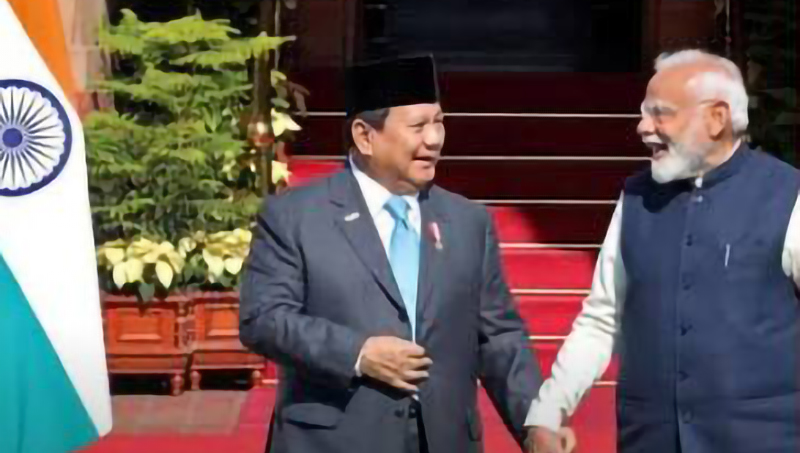







Prime Minister Narendra Modi’s visit to Indonesia from 6 to 8 July 2026 marks the moment at which the India-Indonesia Comprehensive Strategic Partnership passes from declaratory convergence to operational alignment. The visit is the Prime Minister’s fourth journey to the archipelago and his first bilateral visit since the two countries elevated their relationship to the level of a Comprehensive Strategic Partnership in May 2018. That interval of eight years matters analytically, because the partnership that Prime Minister Modi encounters in Jakarta in 2026 is qualitatively different from the one he helped inaugurate in 2018. In 2018 the relationship rested principally on shared vocabulary: the Shared Vision of Maritime Cooperation in the Indo-Pacific, the language of ASEAN centrality, and the comfortable idiom of civilisational fraternity. In 2026 the relationship rests increasingly on shared capability: a maturing supersonic missile partnership, a hardening architecture of coordinated patrols and naval interoperability, an emerging critical minerals compact, and a deliberate programme of civilisational restoration at Prambanan that converts heritage into statecraft.
This research article advances an original argument in three movements. First, it contends that the July 2026 visit resolves, in Indonesia’s favour, a question that has divided the scholarly literature for more than a decade: whether India and Indonesia are capable of translating geographic proximity and normative affinity into substantive strategic cooperation. Second, it argues that the visit crystallises a new model of Indian statecraft in Southeast Asia, one that fuses defence industrial diplomacy, geoeconomic supply chain realignment, and civilisational cultural diplomacy into a single integrated instrument. Third, it demonstrates that the deepening of the Jakarta-New Delhi axis carries systemic consequences that exceed the bilateral frame: it strengthens ASEAN centrality precisely when that centrality is under strain, it thickens the connective tissue of the Global South, and it accelerates the consolidation of a genuinely multipolar maritime order in the Indo-Pacific.
The timing of the visit reinforces each of these claims. Jakarta constitutes the opening leg of a three-nation Indo-Pacific tour that carries the Prime Minister onward to Melbourne for the third India-Australia Annual Summit and then to Auckland for the first Indian prime ministerial visit to New Zealand in four decades. The Ministry of External Affairs has framed the tour explicitly as an expression of the eastern maritime turn in Indian diplomacy under the Act East policy and the MAHASAGAR vision. Indonesia’s position at the head of this itinerary is a deliberate act of strategic sequencing. India’s road to the wider Pacific runs, geographically and conceptually, through the Indonesian archipelago.
Long Arc from Bandung: Civilisational Foundations of a Modern Partnership
Every serious analysis of India-Indonesia relations begins with the recognition that this is among the oldest continuous civilisational relationships in the international system. The narrative traditions of the Ramayana and the Mahabharata, the Hindu-Buddhist temple complexes of Borobudur and Prambanan, the Sanskrit substrate of Bahasa Indonesia, and the maritime trade networks that bound the Coromandel coast to the Srivijayan and Majapahit thalassocracies together constitute a reservoir of shared meaning that predates the modern state system by more than a millennium. Suranjan Das and Subhadeep Bhattacharya, in their study of the relationship then and now, rightly insist that this civilisational inheritance is a structural feature of the relationship rather than decorative rhetoric. It supplies the two states with a grammar of familiarity that most strategic partnerships must painstakingly construct.
The modern political relationship compounded this inheritance. The 1951 Treaty of Friendship gave the newly independent republics an early juridical anchor. The Nehru-Sukarno partnership then transformed bilateral affinity into a joint project of international order-making, culminating in the 1955 Bandung Conference, where the two leaders co-authored the vocabulary of Afro-Asian solidarity that would evolve into the Non-Aligned Movement. Ambassador Gurjit Singh’s survey of seventy-five years of the relationship documents how this founding partnership subsequently weathered estrangement during the Konfrontasi period, drift during the Cold War’s later decades, and gradual rediscovery through the Look East policy of the 1990s. The essential point for the present analysis is that Bandung’s legacy has been repurposed rather than retired. The solidarity of the 1950s, which was defensive and anti-colonial in character, has matured into the Global South agency of the 2020s, which is affirmative and order-shaping. When President Prabowo Subianto attended India’s Republic Day celebrations in January 2025 as chief guest, replicating President Sukarno’s presence at the first Republic Day in 1950, the symbolism completed a deliberate seventy-five year circle. The July 2026 visit is the reciprocal gesture that converts that symbolism into programme.
From Sceptical Realism to the Convergent Mandala
The academic literature on India-Indonesia relations has long been organised around a productive tension between scepticism and expectation. David Brewster’s influential intervention posed the defining question directly in its title: is this an evolving security partnership, or a relationship condemned to perpetual potential? Brewster’s scepticism rested on solid empirical foundations. He observed that the two states, despite adjacency across the Andaman Sea and despite rhetorical warmth, had historically maintained shallow defence ties, divergent threat perceptions, and mutual strategic inattention. Indonesia’s foreign policy tradition of bebas dan aktif, free and active, generated a reflexive wariness towards alignment with any major power, India included. India, for its part, long treated Southeast Asia as a secondary theatre subordinate to its continental preoccupations.
Ristian Atriandi Supriyanto offered the most sophisticated rejoinder in his conception of a convergent mandala. Drawing on the indigenous Southeast Asian and Indic political geometry of the mandala, in which power radiates outward through concentric and overlapping circles of influence, Supriyanto argued that Indian and Indonesian strategic space had begun to overlap in the maritime domain, and that this overlap would generate cooperation organically as both states developed genuinely maritime strategic cultures. Udai Bhanu Singh’s sustained work on the Comprehensive Strategic Partnership traced the institutional expression of this convergence through the defence cooperation architecture assembled after 2018. Analyses from the National Maritime Foundation, MP-IDSA, the Observer Research Foundation, CSIS Jakarta, RSIS Singapore, and the Lowy Institute have progressively documented the thickening of this architecture, even as many retained Brewster’s caution about the gap between agreement and implementation.
The July 2026 visit permits a considered adjudication of this debate. The evidence now supports the convergence thesis, with an important amendment. Convergence has arrived, but it has arrived through a mechanism that neither school fully anticipated: the intersection of Indonesia’s acute maritime insecurity in the North Natuna Sea with India’s emergence as a credible exporter of advanced defence systems. The mandala has converged around a missile. Structural pressure, in the form of Chinese assertion in Indonesia’s exclusive economic zone, supplied the demand. Indian defence industrial maturation supplied the capacity. Civilisational familiarity supplied the trust that permitted the transaction. This triadic mechanism, in which threat, capability, and identity interact, is precisely the kind of causal pathway that neoclassical realism predicts and that constructivism renders intelligible, and it constitutes this article’s principal theoretical contribution.
Maritime Geography and the Strategic Logic of Partnership
Geography remains the silent author of the partnership’s strategic logic. India and Indonesia are maritime neighbours whose territories approach within roughly 150 kilometres of one another, the distance separating India’s Andaman and Nicobar Islands from Indonesia’s Aceh province across the northern approaches to the Malacca Strait. This proximity places the two states in joint custody of the world’s most consequential maritime chokepoint, through which a substantial share of global trade and East Asian energy imports must pass. The Ministry of External Affairs has been explicit that Indonesia’s position astride the Malacca Strait anchors its strategic importance to India, and the developing conversation on connectivity between the Andaman and Nicobar Islands and Aceh, encompassing shipping, logistics, fisheries, tourism, and maritime infrastructure, gives that abstraction concrete economic form.
The defence relationship built upon this geography has accumulated genuine institutional depth. The framework agreement of 2001 and the Defence Cooperation Agreement of 2018 established the juridical scaffolding. The Joint Defence Cooperation Committee and the Defence Ministers’ Dialogue provide apex direction, most recently through the November 2025 Defence Cooperation Dialogue in New Delhi between Defence Minister Rajnath Singh and his Indonesian counterpart Sjafrie Sjamsoeddin, which laid the formal groundwork for the missile partnership examined below. Beneath this apex, the operational lattice has thickened steadily: the coordinated patrols of the India-Indonesia CORPAT series along the international maritime boundary, the Samudra Shakti bilateral naval exercise, Naval Staff Talks, the White Shipping Agreement enabling the exchange of merchant shipping information, and expanding cooperation in maritime domain awareness. Each of these instruments is individually modest. Collectively they constitute the connective tissue of interoperability, the quiet infrastructure that transforms two navies operating in adjacent waters into two navies capable of operating together.
Indonesia’s strategic circumstances have given this infrastructure new urgency. The waters surrounding the Natuna Islands, which Jakarta has pointedly designated the North Natuna Sea, fall within the reach of China’s expansive maritime claims, and Chinese coast guard and fishing fleet activity in the Indonesian exclusive economic zone has recurred with increasing frequency. President Prabowo, a retired general and former defence minister who assumed office in October 2024, has responded with a doctrine of armed self-reliance, declaring that a nation unwilling to invest in its defence will find its independence stolen away, and backing that conviction with a 2026 defence budget of approximately 19.9 billion United States dollars. It is within this context of accelerated modernisation, which also encompasses the acquisition of Turkish KAAN fighters, that Indonesia has turned decisively towards India for the capability that anchors its coastal defence.
BrahMos Moment
The BrahMos partnership deserves treatment as the analytical centrepiece of the visit, because it condenses every strand of the article’s argument into a single programme. The sequence of events is now clear. Formal ministerial discussion of the sale occurred at the November 2025 Defence Cooperation Dialogue. In March 2026 the Indonesian Ministry of Defence publicly confirmed that it had partnered with India for procurement of the BrahMos system as part of its coastal defence modernisation, a preliminary agreement centred on a shore-based battery of the supersonic cruise missile. On the eve of the July 2026 visit, Jakarta signalled its intention to scale the acquisition upward, seeking an additional battery in a transaction estimated at around 300 million dollars and requesting a concessional Indian line of credit to finance it. The subject stands squarely on the summit agenda in Jakarta.
The strategic rationale on the Indonesian side is compelling. A BrahMos coastal defence battery integrates mobile autonomous launchers, surveillance and fire-control radars, and command-and-control systems into a network capable of detecting and destroying hostile surface combatants at ranges approaching 290 kilometres and at speeds near Mach 3. The missile’s sea-skimming flight profile and terminal manoeuvring render interception exceptionally difficult for existing naval air defences. Deployed along the approaches to the North Natuna Sea, such batteries provide Indonesia with a credible anti-access and area denial capability, a sea denial instrument perfectly matched to the defensive requirements of an archipelagic state that must deter intrusion across an immense exclusive economic zone without matching an adversary’s fleet hull for hull. BrahMos thus offers Jakarta deterrence by punishment at archipelagic scale, purchased at a price that preserves fiscal space for the broader modernisation programme.
The rationale on the Indian side is equally consequential, for the transaction certifies India’s arrival as a serious defence exporter. The Philippines inaugurated the export pathway with its 375 million dollar acquisition of the shore-based anti-ship variant in 2022, with deliveries to the Philippine Marine Corps commencing in April 2024. India’s Defence Secretary confirmed in May 2026 that a further BrahMos agreement with Vietnam had been signed and that the Indonesian negotiation stood in its final stages. The emerging pattern is unmistakable. India is assembling what may fairly be described as a BrahMos belt across maritime Southeast Asia, a chain of allied coastal deterrence stretching from Luzon through the Indochinese littoral to the Indonesian archipelago, resting on Indian technology, Indian training, Indian maintenance ecosystems, and long-term Indian logistical relationships. Defence exports of this character are not mere commerce. They are durable strategic bonds, because a missile system binds buyer to supplier for decades through spares, upgrades, munitions, and doctrine.
The comparative dimension repays attention. The Philippine acquisition was undertaken by a United States treaty ally and could be read, in Beijing, as an extension of an existing alliance architecture. The Indonesian acquisition permits no such reading. Indonesia is the founding custodian of non-alignment, the anchor state of ASEAN, and a power constitutionally averse to bloc politics. When Jakarta selects an Indian missile for the defence of its most sensitive maritime frontier, it demonstrates that Indian defence partnership is compatible with, and indeed protective of, strategic autonomy. This is the deeper signalling function of the transaction: it establishes India as the armourer of the non-aligned, the supplier of choice for states that seek capability without clientelism. Analysts who warn that the diffusion of advanced missiles could accelerate regional arms competition raise a legitimate concern, and New Delhi will need to manage the escalation dynamics its exports set in motion. The stronger reading, however, is that distributed defensive capability among Southeast Asian coastal states raises the cost of coercion, stabilises deterrence at the regional level, and thereby reinforces rather than erodes the maritime order that ASEAN’s own Outlook on the Indo-Pacific envisions.
Economic Statecraft: Nickel, Critical Minerals, and the Geoeconomics of Trust
The economic agenda of the visit displays the same movement from generality to precision that characterises the defence relationship. Bilateral trade stands at approximately 23 billion dollars, a figure that both governments acknowledge to be far beneath the potential of economies of this scale, and the two sides are actively discussing a preferential trade agreement alongside the ongoing review of the ASEAN-India Trade in Goods Agreement. The five pillars framing the summit conversation, defence and security, trade and investment, food security, energy security together with downstreaming and critical minerals, and capacity building in health and education, reveal a deliberate architecture of complementarity rather than a miscellaneous wish list.
Critical minerals constitute the geoeconomic heart of this architecture. Indonesia commands the world’s largest nickel reserves and is projected to account for some 44 per cent of global refined nickel production by 2040, a period in which global demand is expected to nearly double under the pressure of electric vehicle and clean energy expansion. India currently imports more than four fifths of its ferronickel requirements from Indonesia and depends entirely on imports for battery-grade materials, even as Chinese firms control roughly three quarters of Indonesia’s nickel refining capacity. The strategic problem is therefore symmetrical. India requires diversified and secure access to the minerals that will power its energy transition and its battery ecosystem. Indonesia requires diversified investment in its downstreaming programme so that resource nationalism does not collapse into single-customer dependence. An India-Indonesia critical minerals compact, encompassing Indian investment in processing, joint ventures in battery ecosystems, and long-term offtake arrangements, answers both problems simultaneously. It converts a vulnerability shared by both states into an instrument of mutual resilience, and it does so through the logic of geoeconomics rather than the logic of confrontation.
Beyond minerals, the economic agenda extends into digital public infrastructure, where India’s stack model holds evident relevance for an archipelagic state seeking inclusive digitalisation, into renewable energy and the blue economy, into pharmaceutical and health cooperation of the kind that India’s pandemic-era diplomacy foreshadowed, and into food and energy security arrangements that speak directly to President Prabowo’s domestic priorities. The prospective connectivity corridor between the Andaman and Nicobar Islands and Aceh gives the entire economic relationship a physical spine. Taken together, these initiatives illustrate what may be called the geoeconomics of trust: the use of economic interdependence not to create leverage over a partner but to create resilience with a partner. The distinction is fundamental, and it is the distinction upon which India’s entire economic offer to Southeast Asia now rests.
Prambanan and the Grammar of Civilisational Diplomacy
The Prime Minister’s journey to Yogyakarta and the Prambanan temple complex will strike some observers as the ceremonial appendix to a strategic visit. That reading inverts the truth. Prambanan is the conceptual key to the entire enterprise. The ninth-century complex, a UNESCO World Heritage Site dedicated to the Trimurti, stands as the most magnificent Hindu monument in Southeast Asia and a permanent stone archive of the civilisational commerce between the subcontinent and the archipelago. The 2025 Joint Statement committed India to support the restoration of the temple, and the Archaeological Survey of India has since been working alongside the Indonesian Ministry of Culture and the Indonesian Heritage Institute to give that commitment effect. The Prime Minister’s presence at the site consecrates a programme already under way.
Civilisational diplomacy of this kind performs three distinct functions in the partnership. First, it supplies legitimacy: cooperation framed as the renewal of a millennial relationship is politically inoffensive in a way that cooperation framed as balancing never can be, and it therefore protects Indonesia’s non-aligned sensibilities while deepening substantive alignment. Second, it builds constituencies: temple restoration, Ramayana performance traditions, Buddhist circuit tourism, academic partnerships, yoga diplomacy, and diaspora engagement, the latter on vivid display in the Prime Minister’s address to the Indian community in Jakarta, create societal ballast beneath the intergovernmental relationship, insulating it from the turbulence of electoral cycles in two large democracies. Third, it advances a shared philosophical claim about international order itself. Two civilisational states, in the sense that the theoretical literature on civilisational polities has developed, are jointly asserting that the deepest foundations of partnership lie in shared meaning rather than shared threat. Constructivist theory holds that identities shape interests. At Prambanan, that proposition is enacted as policy.
Middle Powers, Strategic Autonomy, and the Realised Mandala
The partnership consolidated in July 2026 rewards analysis through several theoretical lenses simultaneously, and its distinctiveness emerges precisely from their intersection. Through the lens of neoclassical realism, systemic pressure generated by Chinese maritime assertion is being filtered through the domestic strategic cultures of two states, producing in each a maritime reorientation: India’s progression from Look East through Act East to the MAHASAGAR vision, and Indonesia’s evolution from the Global Maritime Fulcrum to President Prabowo’s doctrine of defended sovereignty. Through the lens of regional security complex theory, the partnership marks the progressive fusion of the South Asian and Southeast Asian security complexes into a single Indo-Pacific formation, with the Bay of Bengal and the Malacca approaches as the zone of fusion. Through the lens of complex interdependence and geoeconomics, the critical minerals compact demonstrates that supply chain statecraft has become the continuation of strategy by other means.
The most illuminating frame, however, remains middle power theory conjoined with the doctrine of strategic autonomy. India and Indonesia are the two great exponents of multi-alignment in contemporary international politics, states that refuse the binary of bloc discipline and instead cultivate overlapping partnerships calibrated to issue and interest. Their alignment with one another is therefore an alignment of autonomies: each partner strengthens the other’s capacity to resist subordination to any external pole, including, crucially, to one another. This is the mature meaning of Supriyanto’s convergent mandala. The mandala converges without collapsing into hierarchy. It is an alignment architecture native to Asian political thought, older than Westphalia and better suited than alliance theory to the realities of the multipolar Indo-Pacific. The July 2026 visit gives this architecture its clearest institutional expression to date.
Indonesia in Comparative Perspective
Situating Indonesia within the constellation of India’s Indo-Pacific partnerships clarifies its distinctive weight. The partnership with Vietnam shares the defence industrial dimension, including BrahMos, yet Vietnam’s strategic predicament is narrower and its economic complementarity with India shallower. Singapore offers unmatched institutional density and financial connectivity but commands neither Indonesia’s scale nor its resource endowment. The Philippine relationship is advancing rapidly on the deterrence axis yet operates within the gravitational field of the American alliance. Australia and Japan are indispensable partners of the first rank, bound to India through the Quad and through annual summitry of the kind Prime Minister Modi will conduct in Melbourne immediately after departing Jakarta, yet both are developed economies embedded in the American alliance system, which places natural limits on their utility as partners in Global South coalition-building. France brings genuine Indian Ocean equities and a shared vocabulary of strategic autonomy, but from a position external to the region’s civilisational fabric.
Indonesia alone combines every attribute that Indian grand strategy requires of a principal partner: continental scale, with the world’s fourth largest population and Southeast Asia’s largest economy; custodial geography astride the Malacca Strait; leadership of ASEAN and co-leadership of the Global South; genuine non-alignment, which makes partnership with Jakarta a certificate of Indian intentions rather than a provocation; resource complementarity of the most strategic kind; and civilisational kinship of the deepest historical register. Indonesia is, in short, the one partner through which India can simultaneously pursue deterrence, development, and order-building without contradiction. The July 2026 visit reflects a New Delhi that has fully internalised this arithmetic.
Conclusion
The Jakarta Summit of July 2026 will produce a substantial portfolio of strategic outcomes: joint statements advancing cooperation in health, space, science and technology, education, food security, maritime governance, and digital connectivity; memoranda institutionalising collaboration in digital public infrastructure, UPI linkages, and maritime safety; decisive progress towards the phased expansion of BrahMos supersonic cruise missile cooperation; and a transformative critical minerals partnership centred on nickel downstreaming, battery ecosystems, and resilient supply chains for the clean energy transition. The enduring significance of the Jakarta Moment, however, resides in the strategic transformation these agreements embody. India and Indonesia have forged a comprehensive strategic convergence uniquely suited to the multipolar age: a convergence built upon shared capability, sustained by resilient interdependence, anchored in strategic autonomy, and ennobled by the enduring strength of civilisational affinity.
The consequences of this transformation radiate outward through three concentric circles, recalling the enduring geometry of the mandala that has long informed Asian strategic thought. Within ASEAN, a strengthened India-Indonesia partnership reinforces the organisation’s centrality by advancing the ASEAN Outlook on the Indo-Pacific and positioning India as a trusted partner in building an open, inclusive, rules-based, and resilient regional order. Across the wider Global South and the expanding landscape of South-South cooperation, the partnership exemplifies a new generation of practical and forward-looking collaboration, extending from defence-industrial cooperation, critical mineral value chains, and digital innovation to educational partnerships, the restoration of Prambanan, cultural diplomacy, and sustainable development. Across the broader Indo-Pacific, the Jakarta-New Delhi axis emerges as a vital pillar of regional stability, strengthening maritime security, supply-chain resilience, technological co-creation, and collective prosperity while expanding the strategic space for cooperative security under India’s Act East Policy and the MAHASAGAR vision.
From the 1951 Treaty of Friendship and the Bandung Spirit to the Comprehensive Strategic Partnership of 2018 and the institutional momentum of 2026, India and Indonesia have steadily transformed centuries of civilisational affinity into enduring geopolitical agency. The Jakarta Moment therefore marks the maturation of one of the Indo-Pacific’s most consequential strategic partnerships. It demonstrates that the future of the region will be shaped above all by the capacity of responsible regional stakeholders to strengthen resilient institutions, deepen strategic trust, preserve the maritime commons, secure critical supply chains, and advance shared prosperity.
As Prime Minister Narendra Modi’s aircraft descends towards Jakarta, it heralds the institutional realisation of the convergent mandala: an emerging grammar of Indo-Pacific statecraft in which strategic autonomy, maritime cooperation, technological innovation, economic resilience, and civilisational confidence converge to shape a more secure, connected, and inclusive regional order. In this defining moment, India and Indonesia are co-authoring that grammar together, and they are helping to build a balanced, resilient, and genuinely multipolar international order for the twenty-first century.
Views: 629

Dr. Maheep
Dr. Maheep is Director, Indian Perspective on Global Affairs (IPGA), and a leading analyst of India’s foreign policy and South Asian geopolitics. He earned his PhD in Arab and Islamic Studies. With more than a decade of teaching and research experience in International Relations and Global Politics, he contributes regularly on issues shaping national and global affairs.