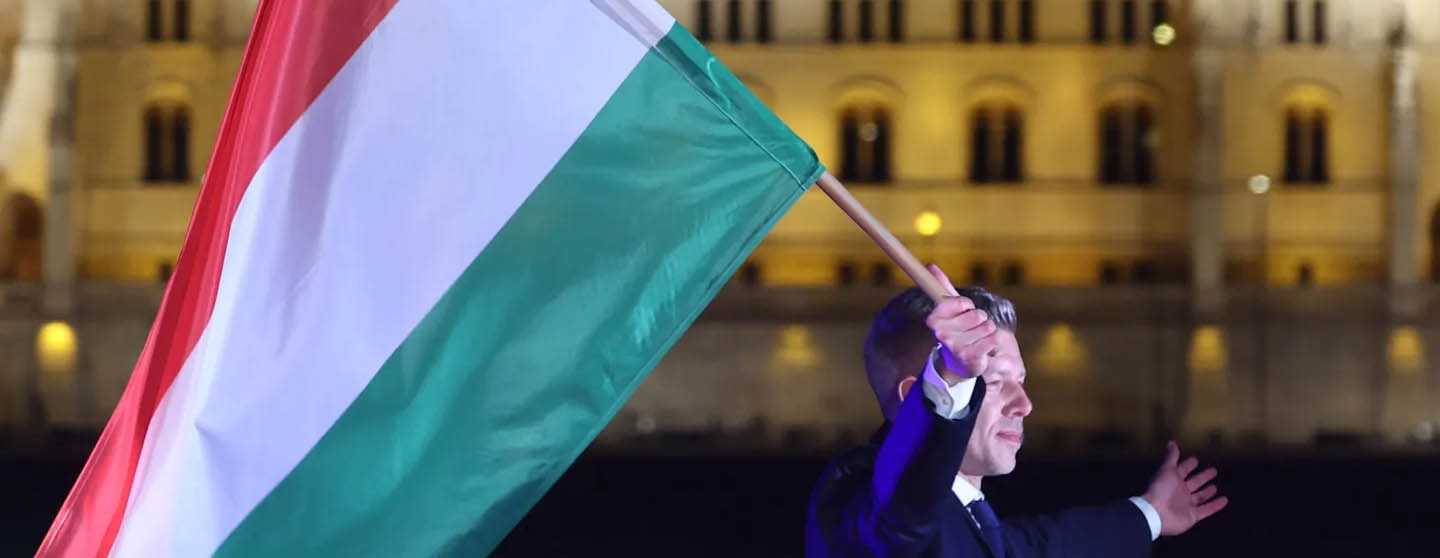







On the night of 12 April 2026, the banks of the Danube in Budapest became a cathedral of democratic catharsis. Viral clips captured what no opinion survey had dared to fully predict: tens of thousands of Hungarians — young and old, former Fidesz loyalists and lifelong dissenters alike — dancing in the amber glow of a spring evening as Péter Magyar’s Tisza Party swept to a constitutional supermajority of 138 of 199 seats on a record turnout of nearly 79.5 per cent. Viktor Orbán, who had governed Hungary with unchecked authority for sixteen years, conceded with characteristic brevity and characteristic bitterness — departing not merely an office but an era. The crowds chanted Ruszkik haza — “Russians, go home” — the battle cry of Hungary’s 1956 anti-Soviet revolution, repurposed now as a declaration of democratic sovereignty against a different form of external capture.
From New Delhi’s vantage, this spectacle resonates at a register deeper than European electoral arithmetic. India — the world’s largest democracy and a civilisation that has for millennia enshrined dharma and satya as the lodestars of governance — recognises in the Hungarian verdict a powerful affirmation of accountable governance, institutional integrity, and the citizen’s sovereign right to demand honesty and responsiveness from those entrusted with power. The mandate arrives at a propitious confluence in New Delhi’s maturing relationship with Europe: a landmark India-EU Free Trade Agreement concluded in January 2026, a Special Global Strategic Partnership elevated with France in February, Chancellor Friedrich Merz’s industrial mission to India marking twenty-five years of the India-Germany Strategic Partnership, and Finnish President Alexander Stubb’s keynote address at the 2026 Raisina Dialogue — delivered under the theme Samskara: Assertion, Accommodation, Advancement — that explicitly identified India’s multi-alignment doctrine as a model worthy of global emulation. Hungary’s democratic reset strengthens European cohesion at precisely the moment this partnership is transitioning from aspiration into architecture.
That architecture is being forged against the backdrop of a visibly fracturing world order: an ongoing Middle East war that has strained global energy markets and claimed Indian lives in the Gulf of Oman; Canada’s recalibration of security-related budgetary allocations away from Washington’s strategic preferences; Europe’s institutional coolness toward American rhetorical overreach on Greenland and NATO burden-sharing; and a Trump administration whose intervention in Hungary’s election — including a personal Vice-Presidential campaign visit and a telephone call from the President himself — failed to move the Hungarian electorate. In this turbulent context, the Budapest verdict is not merely Budapest’s story. It is a structural data point in the global argument about whether illiberal governance can sustain itself against the organised will of an informed citizenry — and, viewed through India’s strategic lens, a timely indicator of the direction in which a genuinely multipolar order is being shaped.
“The world is one family” —vasudhaiva kutumbakam—is not merely a civilisational aspiration. As Hungary’s voters have now affirmed, it is a living political imperative whose vindication ultimately rests in the sovereign will of the people.
Hungarian Mandate and Its Domestic Meaning
The 2026 Hungarian parliamentary election delivered results that analysts have described, with considered justification, as the most consequential political transition in Central Europe since the fall of communism. Tisza secured 53.6 per cent of the vote, yielding 138 of 199 parliamentary seats — a constitutional supermajority sufficient not merely to govern but to amend the very institutional architecture Orbán spent sixteen years constructing. Fidesz’s seat count collapsed from its previous 135 to 55, a net loss of eighty seats. Turnout at 79.5 per cent was the highest recorded in any Hungarian election since 1985, the last held under communist rule, surpassing even the 2002 contest that had ended Orbán’s first premiership.
Péter Magyar — a former Fidesz insider who broke with the party in 2024 following revelations of institutional corruption and later joined Tisza — forged a broad-based coalition that transcended traditional ideological lines. His campaign was disciplined, moderate in register, and surgically focused on material grievances: rising living costs, crumbling public services, and a crony capitalist model that concentrated economic rewards within a narrow Fidesz-aligned network while Hungary endured three consecutive years of near-zero growth and the eurozone’s highest inflation rates. His reform agenda is constitutionally empowered by the supermajority: restoring judicial independence, dismantling captured media structures, joining the European Public Prosecutor’s Office, unlocking the billions in EU funds frozen over rule-of-law violations, and introducing term limits on the prime ministership — a direct architectural response to the pathology of personalised power that Orbánism embodied.
The Atlantic Council’s senior fellow Daniel Fried, assessing the result from Brussels, observed that “Hungarian democrats right, left, and centre have turned back an authoritarian cycle that many thought unstoppable.” What makes this domestically remarkable is the cross-sectional breadth of Magyar’s coalition — not an alliance of parties, in German Marshall Fund analyst Zsuzsanna Vegh’s formulation, but a coalition of voters united across ideological divides by the common desire to reclaim institutional integrity and national agency. From India’s perspective — rooted in constitutional democracy, the rule of law, and the understanding that citizens must be the ultimate arbiters of governance — this is both familiar and inspiring.
Global Ripples: Power Centres Reassessed
The geopolitical reverberations of April 12 radiate from Budapest with the force of a structural correction long suppressed. They must be read simultaneously across four critical theatres of global power.
For the Trump administration, the outcome represents a measurable setback to the assumption of automatic ideological alignment. The MAGA movement had cultivated Orbán as both symbol and template; Washington dispatched Vice President JD Vance to Budapest mid-campaign, Secretary of State Rubio visited, and President Trump personally telephoned a Fidesz campaign event. None of it moved the Hungarian electorate. Atlantic Council experts Daniel Fried, Emerson Brooking, and Emma Nix collectively conclude that the “Trump administration and MAGA movement” must be counted among the election’s most consequential losers — a judgement that compounds broader indicators of frayed American leverage, from transatlantic friction over NATO burden-sharing to the rhetorical overreach on Greenland, to Canada’s sharp reduction of security-related budgetary allocations tied to Washington’s strategic preferences. The Budapest verdict empirically falsifies the proposition that transactional populism, backed by state resources and external patronage, can indefinitely override the democratic preferences of sovereign electorates.
For Putin’s Russia, the loss is strategically severe. Orbán had functioned as Moscow’s most reliable interlocutor within the EU, facilitating energy leverage, obstructing sanctions, and vetoing the €90 billion EU loan to Ukraine — a position the Kremlin reinforced through a coordinated Telegram disinformation operation exposed just two days before polling. As Chatham House analysts have observed in their assessments of “Orbánism’s” structural vulnerabilities, the Hungarian model of illiberal governance within a democratic alliance depended on a unique confluence of institutional capture, energy dependence, and geopolitical positioning that cannot be easily replicated or restored. The Kremlin loses not merely a bilateral ally but its most sophisticated instrument for fracturing European unity from within — an asset that took a decade to cultivate and cannot be reconstituted with equivalent efficacy.
Beijing confronts a corresponding recalibration. China’s divide-and-rule approach within Europe relied on outlier governments such as Orbán’s Hungary to fragment consensus on trade policy, technology governance, and strategic investment review mechanisms. A more cohesive, rules-based Budapest narrows these opportunities, complicating Belt and Road initiatives in Central Europe while reinforcing the EU’s collective bargaining position in its increasingly complex strategic engagement with China. A Magyar-led Hungary, committed to EU institutional norms, reduces the available surface area for Beijing’s intra-European manoeuvring.
The EU and NATO emerge as the election’s clearest structural beneficiaries. The Atlantic Council’s Europe Center concludes that a Magyar-led government will remove the Hungarian veto on EU support for Ukraine, return Budapest to constructive engagement on core European issues, and restore Hungary to the mainstream of democratic governance. European Commission President von der Leyen’s formulation on election night — “Europe’s heart is beating stronger in Hungary tonight” — captured the institutional relief with characteristic precision. The Guardian’s comparative analysis with Poland’s post-authoritarian democratic transition, and the CSIS four-scenario framework for Central European democratic recovery, both converge on a significant finding: that while institutional reconstruction in post-authoritarian polities is generational rather than electoral, the precedent established by peaceful democratic correction is irreplaceable. Carnegie Endowment scholarship on institutional rupture further affirms that democratic civic memory, once activated, proves remarkably durable — that the mechanisms of accountability, though suppressed, retain their reconstitutive power.
In the broader context of the fracturing world order — an ongoing Middle East war straining global energy markets and the humanitarian architectures of the Global South; overlapping conflicts rewriting the norms of interstate conduct; the diminishing credibility of unipolar governance — Hungary’s verdict reinforces the accelerating shift toward genuine multipolarity. It demonstrates, as the New York Times’ post-election analysis of populism’s limits persuasively argues, that the structural conditions for democratic correction remain latent even in deeply entrenched authoritarian-adjacent polities: what is required is a credible challenger, material grievance, and the institutional residue of civic mobilisation capacity.
India’s Strategic Stake and Concrete Opportunities
India’s relationship with this unfolding European reconfiguration is neither peripheral nor passive. New Delhi occupies a position of remarkable strategic advantage in the post-Orbán European landscape — provided it moves with the purposeful agility that its tradition of strategic autonomy demands and its civilisational ethos of vasudhaiva kutumbakam inspires.
The India-EU Free Trade Agreement, concluded in January 2026 after nearly two decades of negotiation, establishes what Prime Minister Modi has rightly characterised as “a turning point in the relations between India and Europe” — creating one of the world’s largest free trade zones across nearly two billion consumers, introducing phased tariff reductions, expanded market access in pharmaceuticals, engineering goods, textiles, digital services, and green technologies, and enhanced regulatory cooperation. A more cohesive EU — no longer paralysed by Hungarian vetoes on institutional decisions — is a more reliable implementation partner for these ambitions. Magyar’s commitment to unlocking frozen EU funds and joining the European Public Prosecutor’s Office signals deeper regulatory alignment that will strengthen the institutional trust on which FTA implementation depends.
India’s bilateral architecture with individual European partners has simultaneously deepened with historic velocity. The elevation of India-France ties to a Special Global Strategic Partnership in February 2026 — encompassing the procurement of 26 carrier-based Rafale-M jets, the inauguration of joint innovation centres in AI and digital science, the confirmation of the Scorpène submarine programme continuation, and the launch of the India-France Year of Innovation — reflects the breadth and depth of a defence and technology partnership that now extends from aerospace to health diplomacy, from semiconductor supply chains to the joint manufacture of high-altitude helicopters. Chancellor Merz’s January 2026 visit to India, anchored in the India-Germany CEO Forum and the 25th anniversary of the strategic partnership, positioned Berlin as a critical industrial gateway for India’s integration into European advanced manufacturing and Industry 4.0 supply chains, with bilateral trade exceeding $50 billion in 2024. Both relationships gain structural depth from a Hungary that is returning to the EU’s institutional mainstream.
Perhaps the most symbolically resonant diplomatic event in this consolidating India-Europe axis was furnished by Finnish President Alexander Stubb’s role as Chief Guest at the 11th Raisina Dialogue. In an address of notable intellectual candour, President Stubb declared the end of the Western-led world order as an operational reality, proposed a “New Delhi moment” for rebuilding global governance, and explicitly recognised India’s multi-alignment doctrine — its principled refusal to accept false binaries of great-power alignment — as a model worthy of emulation. Prime Minister Modi’s subsequent bilateral discussions with Stubb encompassed the full range of India-Finland cooperation: trade and commerce catalysed by the India-EU FTA, technology, infrastructure, defence, space, artificial intelligence, semiconductors, and education. Finnish Prime Minister Petteri Orpo’s earlier attendance at the AI Impact Summit in New Delhi had already signalled the Nordic dimension of this strategic deepening. Taken together, these engagements constitute not merely diplomatic courtesy but a coherent architecture of partnership between India and a Europe that is — not least because of the Budapest verdict — becoming a more reliable, coherent interlocutor.
India’s role in India-Middle East-Europe Economic Corridor, the International North-South Transport Corridor, and the SCO’s multilateral architecture positions New Delhi as a natural bridge between the Global South and European institutional frameworks. Its G20 Presidency legacy — establishing the African Union’s institutional voice within global governance — and its BRICS+ stewardship further consolidate India’s identity as an indispensable node in a genuinely multipolar order. The Budapest verdict strengthens this positioning: a Europe less fractured by internal populist vetoes can engage more coherently on the Middle East stabilisation efforts in which India, as the Finnish President’s own remarks at Raisina affirmed, commands trusted mediatory credibility.
Democratic Renewal and the Architecture of Multipolarity
Intellectual honesty demands that the euphoria of Budapest’s Danube celebrations be calibrated against structural realities. As Professor Gulshan Sachdeva, Jean Monnet Chair in European Studies at Jawaharlal Nehru University, perceptively argued in his Indian Express analysis of 14 April 2026, Orbán’s defeat simultaneously represents a loss for Trump and Putin — underscoring how illiberal populism’s transnational network of mutual reinforcement has encountered its first significant structural reversal in Central Europe, with implications that cascade from Washington to Moscow to Beijing. This framing is analytically precise: the defeat of Orbánism is not the defeat of conservative nationalism, which Magyar himself partly inhabits, but the defeat of a specific governance model predicated on institutional capture, external dependency, and the systematic subordination of citizens’ material interests to the perpetuation of elite networks.
Yet the Atlantic Council’s sober post-election assessment — that Brussels and Kyiv should “have realistic expectations about Magyar’s Hungary” — is equally important for Indian strategic analysts. Magyar retains scepticism about fast-tracked Ukrainian EU accession, insists on maintaining Russian energy imports for genuine economic reasons, and leads a party whose institutional reconstruction project will span years rather than months. A hollowed-out judiciary, captured media regulators, a gerrymandered electoral map, and the institutional inertia of a sixteen-year administrative monoculture will not dissolve with one electoral supermajority, however historically impressive. Carnegie Endowment scholarship on democratic transitions in post-authoritarian polities confirms that institutional reconstruction is generational work, requiring sustained civic mobilisation, international support, and the patient rebuilding of independent institutional capacity.
From India’s constructivist standpoint, this nuance is not cause for pessimism but for calibrated engagement. India’s own democratic experience — navigating constitutional crises, institutional contestations, and the perpetual tension between majoritarian impulse and minority rights across eight decades of republic — provides precisely the civilisational wisdom required to engage a reforming Hungary with realistic optimism rather than either uncritical celebration or premature disillusionment. The lesson India draws from Budapest is not that illiberal populism has been definitively vanquished — it has not, and will not be by a single election — but that the mechanisms of democratic correction remain operational, that sovereign electorates retain their agency, and that governance predicated on institutional capture and external dependency carries structural vulnerabilities that no amount of gerrymandering can permanently suppress.
This insight has direct implications for India’s diplomatic positioning. In a multipolar order where no single power can sustain hegemonic assumptions, the Budapest verdict reinforces New Delhi’s conviction that its own doctrine of strategic autonomy — maintaining working relationships across power blocs without subordinating sovereign judgment to any single patron — is not merely a pragmatic hedge but a principled model for the twenty-first century. The Finnish President said as much at Raisina. The Hungarian electorate demonstrated it at the ballot box. India’s civilisational tradition anticipated it millennia ago.
Conclusion
Hungary’s democratic reckoning of 12 April 2026 stands as a beacon of renewal in a turbulent age — and as a precise reminder that no power, however entrenched, can indefinitely take allied governments, sovereign electorates, or the Global South for granted. The crowds dancing on the Danube’s banks were not celebrating ideology but dignity: the dignity of citizens who refused to accept that their country’s democratic character was irretrievable, who mobilised in record numbers against structural odds, and who delivered a verdict that reverberates from Washington to Moscow, from Brussels to Beijing.
For India, this moment is both affirmation and invitation. It is an affirmation that the values New Delhi has long championed — democratic accountability, the rule of law, institutional integrity, and the sovereign right of every people to determine their own governance free from external manipulation — are not Western impositions but universal aspirations whose denial generates its own democratic correction. It is an invitation to deepen, with renewed strategic imagination, India’s engagement with a Europe that is emerging from a period of internal fracture into renewed cohesion and purpose.
Guided by vasudhaiva kutumbakam — the world as one family — New Delhi should seize this inflection point with both hands. The India-EU FTA’s implementation must be accelerated with the same creative energy that concluded its negotiation; the EU-India Security and Defence Partnership must be translated from signature into operational cooperation across the defence-industrial, space, cyber, and maritime domains; and the people-centric architecture of student exchanges, research collaborations, health partnerships, and cultural diplomacy must be invested in as the long-term connective tissue of a civilisational relationship. Germany’s industrial depth, France’s defence and innovation partnership, the Nordic democracies’ expertise in digital governance and sustainable development, and a reforming Hungary’s own eventual contribution to a more representative Central Europe — all constitute dimensions of a European partner whose strategic reliability is enhanced by the Budapest verdict.
India’s trusted role as bridge-builder between the Global South and the Euro-Atlantic institutional architecture — a role explicitly affirmed by the Finnish President at Raisina, and implicitly validated by the EU’s own recognition of India as an indispensable partner in the Middle East stabilisation dialogue — is strengthened, not merely symbolically but structurally, by a more cohesive European interlocutor. The IMEC connectivity vision, the North-South Corridor, and India’s multilateral platform leadership in BRICS+ and the SCO all gain strategic depth from a Europe less distracted by internal populist vetoes and more capable of coherent global engagement.
Péter Magyar told his supporters on the banks of the Danube that “tonight, truth prevailed over lies.” It is a formulation that India, with its ancient understanding of satya as both ethical principle and political force, recognises instinctively. Truth prevails not automatically, and not without the organised civic courage to assert it — but it prevails. Hungary’s democratic reckoning is proof of this. India, ever the principled bridge-builder and the world’s most enduring democracy, is uniquely positioned to help realise the world that this proof makes possible: a genuinely multipolar order defined not by the dominance of any single power but by the shared commitment of sovereign, accountable states to the governance of integrity that their citizens deserve and demand.
Views: 1252

Dr. Maheep
Dr. Maheep is Director, Indian Perspective on Global Affairs (IPGA), and a leading analyst of India’s foreign policy and South Asian geopolitics. He earned his PhD in Arab and Islamic Studies. With more than a decade of teaching and research experience in International Relations and Global Politics, he contributes regularly on issues shaping national and global affairs.