






Walking the Border: India’s New Envoy and the Unresolved Contradictions of South Asian Diplomacy
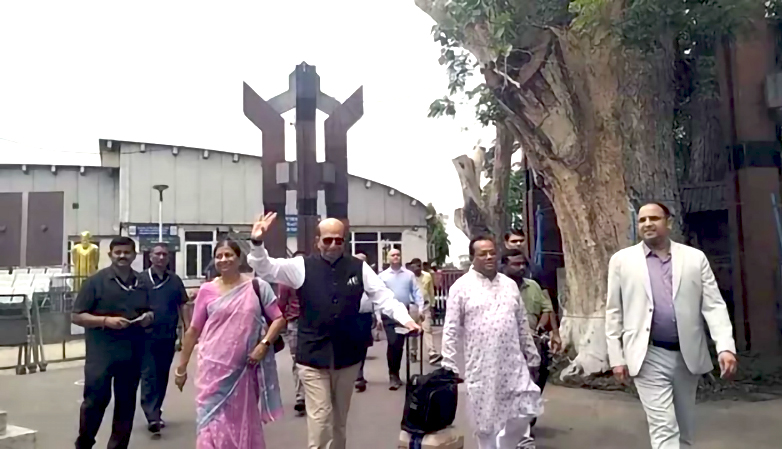
When Dinesh Trivedi stepped across the Benapole Land Port on foot to assume his duties as India’s new High Commissioner to Bangladesh, he did something no Indian envoy had ever done before. He bypassed the ceremonial formality of an airport arrival and chose instead to walk literally across a land border shared by two nations whose relationship has grown increasingly complicated, contested, and consequential. In diplomatic circles, where every gesture is deliberate and every symbol is carefully chosen, this was no casual eccentricity. It was a choreographed statement, and the world was meant to take note.
Standing before journalists at the border, Trivedi spoke of unity: “Our population is 1.4 billion. Add Bangladesh’s 200 million people, and together we become 1.6 billion. We share the same sky, the same air.” The words were evocative, even poetic. But poetry, however sincere, cannot substitute for policy. And on the very day Trivedi made his symbolic crossing, the contradictions of Indo-Bangladesh relations revealed themselves with brutal clarity twelve individuals were pushed back by India’s Border Security Force (BSF) at the Kushtia frontier, and a Bangladeshi national was shot dead by BSF personnel at the Moulvibazar border. Same sky. Same air. Different realities.
A Gesture in Search of Substance
To understand the full weight of Trivedi’s arrival, one must first understand the depth of the rupture it is meant to address. Since the fall of Sheikh Hasina’s government, the carefully constructed architecture of Indo-Bangladesh relations has been under severe strain. For nearly fifteen years, New Delhi had effectively conflated its relationship with a particular political government with its relationship with the Bangladeshi state itself a strategic miscalculation of considerable magnitude. When that government collapsed under the pressure of a mass uprising in August 2024, India found itself diplomatically exposed, its influence diminished, and its credibility among ordinary Bangladeshis at a historic low.
The appointment of Trivedi a former Union Minister, a politician rather than a career diplomat, a Bengali-speaking son of West Bengal who grew up near the very border he crossed signals that New Delhi recognises the depth of the problem. Routine diplomacy, conducted through the conventional channels of foreign service professionals, is no longer sufficient. What is required is political engagement at the highest level, and Trivedi has been dispatched as precisely that: a political emissary carrying a personal mandate.
His profile is not incidental. A man who knows the language, the culture, the geography who can speak to Bangladeshis not as a distant functionary of the Indian state but as someone who shares a civilisational inheritance carries a different kind of authority. This proximity is an asset. But it is also a test. Familiarity without fairness is merely a more sophisticated form of condescension.
The Ledger of Grievances
No honest assessment of this diplomatic moment can ignore the accumulated weight of Bangladesh’s unresolved grievances against India. The Teesta River water-sharing agreement has been promised, drafted, and deferred for over a decade. The river itself, once a lifeline for millions of farmers in northern Bangladesh, has been reduced to a seasonal trickle, its flow controlled upstream by Indian infrastructure. This is not a technical dispute about hydrology. It is a question of sovereignty, of agricultural survival, and of whether India treats its smaller neighbour as a partner or a subordinate.
The trade imbalance tells a similar story. Bangladesh runs a substantial deficit in bilateral trade with India, importing far more than it exports, while Indian goods enjoy preferential access to Bangladeshi markets that is not reciprocated with equivalent generosity. Transit facilities have been extended to India allowing it to move goods through Bangladeshi territory to its northeastern states but the promised reciprocal benefits have largely failed to materialise.
And then there is the border. The BSF’s record of lethal force against Bangladeshi civilians is not a matter of occasional aberration. It is a pattern, documented by human rights organisations over many years, that has claimed hundreds of lives. On the day Trivedi walked peacefully across the Benapole crossing with cameras rolling and journalists recording his words about shared skies and common aspirations, a Bangladeshi was being shot dead by Indian border forces a few hundred kilometres away. This juxtaposition is not merely ironic. It is the defining contradiction of the entire diplomatic enterprise.
The Geopolitical Stakes
India’s urgency in repairing this relationship is not driven by sentiment alone. The broader geopolitical context makes Bangladesh’s strategic alignment a matter of pressing national interest for New Delhi. China has been systematically expanding its footprint in Bangladesh through Belt and Road Initiative infrastructure projects, port development, defence cooperation, and diplomatic engagement that has grown warmer as Indo-Bangladesh relations have cooled. Beijing’s presence in Dhaka is no longer a distant concern for Indian strategic planners; it is an immediate and growing reality.
Simultaneously, the United States has been deepening its engagement with Bangladesh as part of its broader Indo-Pacific strategy, seeking to draw Dhaka closer to its security architecture. Bangladesh, positioned at the confluence of South Asia and Southeast Asia, with access to the Bay of Bengal and proximity to the critical Malacca Strait corridor, is a geopolitically significant actor that no major power can afford to ignore.
For India, the calculus is stark. To its west, the Pakistan relationship remains frozen in permanent hostility. To its north, Nepal and Sri Lanka have both demonstrated a willingness to engage China when Indian relations sour. Myanmar is engulfed in civil conflict that threatens to spill across India’s northeastern borders. Afghanistan remains under Taliban control. In this environment, losing Bangladesh or allowing it to drift into a posture of strategic ambiguity that tilts toward Beijing would represent not merely a diplomatic setback but a fundamental failure of India’s neighbourhood policy.
Trivedi’s mission, viewed through this lens, is less a gesture of friendship than a strategic imperative dressed in the language of fraternity.
The Regional Architecture in Decay
Beyond the bilateral dimension lies a larger failure that deserves acknowledgement. SAARC, the South Asian Association for Regional Cooperation, is for all practical purposes a dormant institution. The organisation that was meant to bind together nearly two billion people in a framework of economic integration and political cooperation has been paralysed by the India-Pakistan conflict for years. The potential of South Asia its demographic dividend, its growing middle class, its strategic location remains almost entirely unrealised because its two largest powers cannot find a path beyond mutual hostility.
BIMSTEC has been offered as an alternative framework, but it too has struggled to generate the political momentum necessary for genuine regional integration. If Trivedi is serious about his vision of 1.6 billion people forming a collective force, he must reckon with the institutional vacuum at the heart of South Asian regionalism and advocate, from his position in Dhaka, for a more ambitious architecture of cooperation.
Bangladesh’s Sovereign Moment
For Bangladesh, this moment presents both an opportunity and a responsibility. The interim government has the chance to establish a foreign policy that is genuinely balanced, genuinely independent, and genuinely oriented toward national interest rather than the preferences of any external patron. Good relations with India are not optional geography, economics, and history make them essential. But good relations must be built on equality, mutual respect, and reciprocal benefit. They cannot be premised on deference.
Bangladesh should engage Trivedi’s mission with openness and without prejudice. But it should also engage with clarity presenting its grievances with precision, demanding concrete timelines on Teesta, insisting on accountability for border killings, and negotiating trade arrangements that reflect genuine parity. Symbolic gestures deserve a symbolic welcome. Substantive change demands substantive negotiation.
The Distance Still to Travel
Walking across a border is, in its own way, a courageous act for a diplomat accustomed to the insulated world of official protocol. It signals a willingness to engage at the human level, to acknowledge the lived reality of the millions who cross that border not as dignitaries but as workers, patients, families, and traders. That willingness is genuine and it matters.
But the distance between Benapole and a genuinely transformed relationship is measured not in kilometres but in political will. Trivedi has crossed the physical border. The harder crossings lie ahead across the wall of distrust built by years of asymmetric engagement, across the gap between India’s stated commitment to regional partnership and its actual conduct at the border, across the chasm between the poetry of shared skies and the prose of equitable water-sharing agreements.
Diplomatic history is littered with powerful opening gestures that faded into irrelevance because the institutions and interests behind them remained unchanged. Trivedi’s walk will be remembered as meaningful only if it is followed by water in the Teesta, by an end to BSF killings, by trade agreements that benefit both sides, and by a relationship between two peoples that is finally, genuinely, built on dignity.
Until then, it remains what it is today: a promise made at a border crossing, witnessed by cameras, and awaited with cautious hope and hard-earned scepticism by the people on both sides.
Views: 34

Shahidul Alam Swapan
Shahidul Alam Swapan is aSwitzerland-based Private Banking & Financial Crime Compliance Expert, Columnist and Poet.