


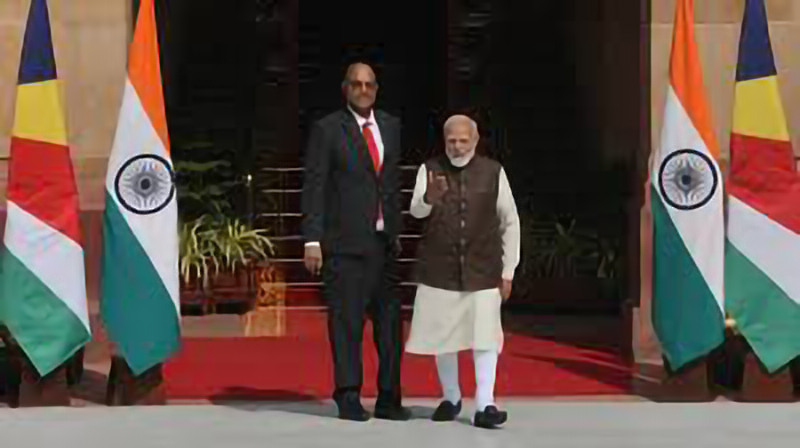







NEW DELHI: In early 2026, the state visit of Seychelles President Dr Patrick Herminie to India from 5 to 10 February quietly underscored one of the defining realities of twenty-first-century geopolitics: geography is regaining primacy. While Seychelles occupies barely 455 square kilometres of land and hosts a population of just over 100,000, its exclusive economic zone spans nearly 1.4 million square kilometres of strategically vital ocean space. Positioned astride the western Indian Ocean’s principal sea lanes linking the Persian Gulf, East Africa, and South Asia, the archipelago now sits at the heart of maritime competition, supply chain security, and ocean governance.
The 2026 Joint Vision for Sustainability, Economic Growth and Security through Enhanced Linkages (SESEL)—adopted during President M. Patrick Herminie’s inaugural overseas engagement following his October 2025 electoral victory—elevates the bilateral relationship from developmental cooperation into a comprehensive strategic partnership. Coupled with India’s newly announced $175 million Special Economic Package, comprising $125 million in a rupee-denominated Line of Credit and $50 million in grants, and accompanied by seven Memoranda of Understanding (MoUs) across maritime research, digital transformation, meteorology, pharmacopoeial standards, civil service training, food security, and cultural exchange, the visit institutionalised a forward-looking compact. Spanning Chennai, Mumbai, and New Delhi, with engagements involving President Droupadi Murmu and senior political leadership, the visit coincided with the golden jubilee of diplomatic ties and Seychelles’ independence—symbolism layered upon strategy.
Anchored in India’s SAGAR doctrine and its evolving MAHASAGAR vision, the partnership reflects a shift from episodic engagement to structured interdependence. It strengthens India’s role as a net security provider in the Indian Ocean Region (IOR) while affirming Seychelles’ agency within a crowded multipolar seascape.
Islands as Strategic Pivots
To understand the weight of this partnership, one must adopt the lens of the maritime pivot state. Islands such as Seychelles derive influence not from territorial mass but from jurisdictional reach and geographic centrality. An EEZ nearly 3,000 times its landmass confers regulatory control over fisheries, seabed resources, and maritime transit corridors through which roughly 80 percent of global seaborne oil trade and a substantial share of container shipping passes. In an era where supply-chain resilience and energy security dominate strategic calculations, such positioning translates into leverage.
India’s engagement recognises this asymmetry. Rather than seeking permanent basing arrangements that might provoke domestic backlash—as demonstrated by Seychelles’ 2018 decision not to proceed with infrastructure plans on Assumption Island—New Delhi has pursued a cooperative security architecture. Capacity building, hydrographic collaboration, surveillance integration, and training partnerships collectively create what might be termed a distributed maritime security network. This approach preserves Seychelles’ sovereignty while enhancing India’s situational awareness and regional reach.
The comparison often drawn with Diego Garcia is instructive. Just as that remote atoll underpins American logistical and surveillance depth in the Indian Ocean, Seychelles represents for India a strategic node in the western maritime theatre. Yet the models differ fundamentally: where Diego Garcia reflects hard basing, the India–Seychelles partnership is premised on consent-based interoperability. Strategic depth, in this formulation, is derived from shared capability rather than exclusive control.
Cooperative Security as Infrastructure
Maritime security forms the structural backbone of the bilateral relationship. Over the past decade, India has provided patrol vessels, Dornier maritime reconnaissance aircraft, coastal radar systems, and hydrographic expertise. Joint EEZ patrols and coordinated surveillance have significantly contributed to the dramatic reduction in piracy incidents since their 2011 peak, when Somali piracy imperilled commercial shipping across the western Indian Ocean. Cooperative patrols, information sharing, and expanded maritime domain awareness have helped reduce piracy by over 95 percent from peak levels.
The 2026 hydrography and ocean research MoU deepens this architecture. Shared seabed mapping, tidal analysis, and navigational charting enhance port modernisation, disaster preparedness, and submarine cable routing. Technical data, often overlooked in strategic discourse, constitutes a core instrument of maritime sovereignty. Through integration with India’s broader surveillance grid, Seychelles strengthens its capacity to monitor illegal, unreported, and unregulated fishing, narcotics trafficking, and grey-zone activities.
This architecture aligns with principles embedded in the United Nations Convention on the Law of the Sea, reinforcing a rules-based maritime order at a time of intensifying Sino-Indian competition in the Indian Ocean. Rather than mirror rival infrastructural penetration strategies, India’s model privileges transparency and institutional interoperability—hallmarks of cooperative security communities rather than alliance blocs.
Geoeconomic Statecraft and Developmental Legitimacy
The $175 million economic package marks India’s most ambitious developmental engagement with Seychelles. Directed towards social housing, e-mobility, vocational training, healthcare, renewable energy, and maritime infrastructure, the package blends concessional credit with grants, mitigating debt vulnerability while delivering tangible public goods.
Bilateral trade, estimated at approximately $100 million annually, remains modest but diversified. Indian exports include pharmaceuticals, machinery, food products, and ICT services, while Seychelles exports marine products and niche agricultural commodities. Given Seychelles’ GDP of roughly $2 billion and India’s $3.5 trillion economy, asymmetry is structural. Yet this asymmetry has not translated into dependency. India’s development financing is demand-driven and project-specific, contrasting with debt-heavy models that have burdened other small states in the Indo-Pacific.
Energy vulnerability remains acute: Seychelles imports over 85 percent of its energy requirements. Collaboration through renewable energy initiatives and solar micro-grid projects, supported in part by India’s broader solar diplomacy, enhances climate resilience while reducing fiscal exposure to global price volatility. Economic engagement thus reinforces strategic stability; developmental legitimacy underwrites geopolitical alignment.
Blue Economy and Climate Security
For Seychelles, whose oceanic territory dwarfs its landmass, the blue economy is not an abstraction but an existential imperative. Fisheries—particularly tuna—form a significant portion of export revenue. Climate change, sea-level rise, and coastal erosion pose structural risks to livelihoods and infrastructure.
The SESEL framework integrates marine research, ocean observation, and climate adaptation into the strategic partnership. Marine spatial planning and conservation initiatives align economic utilisation with ecological preservation. For India, such cooperation advances a vision of ocean governance that fuses sustainability with security. Resource militarisation and seabed competition are emerging features of global geopolitics; by embedding environmental stewardship within strategic collaboration, the partnership offers an alternative paradigm.
Digital Connectivity and Human Capital
Strategic depth is not solely naval. Digital governance and human capital linkages provide societal ballast to bilateral relations. Agreements on digital transformation draw upon India’s digital public infrastructure experience to streamline welfare delivery, financial inclusion, and administrative transparency in Seychelles. Scholarships, technical training under the ITEC programme, and cultural exchange initiatives foster elite networks and professional communities that anchor long-term trust.
Such societal embeddedness mitigates volatility. In small states, domestic political sensitivities can recalibrate foreign policy direction; enduring human linkages buffer strategic ties against episodic turbulence.
Small-State Realism in a Multipolar Ocean
Seychelles exemplifies small-state realism: calibrated multi-alignment, diversified partnerships, and strategic autonomy. It engages India, China, Europe, and the United States while resisting exclusive commitments. India’s attractiveness lies in its restraint. New Delhi neither demands exclusivity nor imposes coercive conditionalities. Strategic influence accrues through partnership rather than patronage.
For India, the western Indian Ocean constitutes a theatre of competitive coexistence rather than outright containment. By empowering littoral states, India constructs a regional order resistant to domination by any single external actor. Seychelles, in turn, enhances its bargaining power by leveraging its maritime centrality within this equilibrium.
Reordering the Western Indian Ocean
The implications extend beyond bilateralism. Integration of Seychelles into the Colombo Security Conclave consolidates a minilateral maritime framework linking India with Sri Lanka, Maldives, Mauritius, and now Seychelles. This distributed network enhances surveillance coverage across critical sea lanes, facilitates humanitarian assistance, and strengthens collective responses to transnational threats.
Yet implementation will determine durability. Lines of credit must translate into operational capacity; surveillance networks require sustained maintenance; developmental projects must yield visible dividends for citizens. Strategic crowding in the Indian Ocean will intensify. External actors will test the resilience of this cooperative model.
The India–Seychelles partnership therefore represents both achievement and wager: achievement in institutionalising a multidimensional compact, wager in assuming that consent-based interoperability can endure amid intensifying geopolitical competition.
A New Grammar of Maritime Power
The evolution of India–Seychelles relations illustrates a broader transformation in the exercise of power. Influence now flows through infrastructure, data, environmental governance, and human connectivity as much as through naval tonnage. Islands once deemed peripheral have become maritime pivots. Continental powers once strategically continental have matured into oceanic actors.
In a global system fractured by zero-sum rivalries, the India–Seychelles compact offers a countervailing model—cooperative, capacity-driven, and sovereignty-conscious. Whether this model can scale across the Indo-Pacific remains uncertain. But in the western Indian Ocean, it is already reshaping the balance between autonomy and alignment.
What began as diasporic familiarity has become strategic interdependence. What once appeared marginal now anchors a vital maritime corridor. In the quiet waters between Africa and South Asia, a new grammar of power is taking form—less about domination than about durable partnership, less about bases than about balance, and increasingly about shared stewardship of the seas.
Views: 1288

Dr. Maheep
Dr. Maheep is Director, Indian Perspective on Global Affairs (IPGA), and a leading analyst of India’s foreign policy and South Asian geopolitics. He earned his PhD in Arab and Islamic Studies. With more than a decade of teaching and research experience in International Relations and Global Politics, he contributes regularly on issues shaping national and global affairs.


