






In an epoch marked by accelerating climate destabilisation, widening energy asymmetries, and the erosion of multilateral environmental effectiveness, India’s leadership of the International Solar Alliance (ISA) represents a substantive reconfiguration of global climate governance. Conceived at COP21 and institutionalised as the world’s first treaty-based intergovernmental organisation dedicated exclusively to solar energy, the ISA reframes the energy transition as an equitable, developmental, and civilisational enterprise rather than a narrowly technocratic undertaking. Anchored in India’s own solar transformation—surpassing 135 GW of installed capacity by late 2025—and extended through structured South–South cooperation, the ISA mobilises finance, technology, and institutional capacity across Asia, Africa, Latin America, and Small Island Developing States. Drawing on institutional analysis and comparative case studies, this article demonstrates how ISA-led solar governance advances decarbonisation, energy access, and geopolitical agency for the Global South, even amid contemporary geopolitical disruptions such as the United States’ withdrawal from the ISA in early 2026. The analysis situates India’s solar diplomacy within G20, COP, and BRICS processes and advances a normative framework of ecological custodianship that integrates technological innovation with distributive justice and planetary responsibility.
Energy, Equity, and the Limits of Climate Governance
The contemporary international system is increasingly shaped by the convergence of three structural crises: accelerating climate change, persistent global energy inequality, and the diminishing efficacy of multilateral environmental governance. Energy systems remain the principal source of anthropogenic greenhouse gas emissions. The International Energy Agency records that global energy-related carbon dioxide emissions reached a historic peak of 37.4 billion tonnes in 2023, with electricity and heat generation accounting for the dominant share. Despite decades of negotiations under the United Nations Framework Convention on Climate Change, global mitigation trajectories remain misaligned with the Paris Agreement’s 1.5 °C objective, exposing a widening gap between declaratory ambition and material implementation.
At the same time, energy poverty persists as a deeply embedded injustice within the global political economy. As of 2023, approximately 666–675 million people—overwhelmingly concentrated in Sub-Saharan Africa and South Asia—remain without access to electricity, while hundreds of millions more experience unreliable or unaffordable supply. This duality—carbon-intensive abundance in the Global North alongside structural deprivation in the Global South—underscores the inadequacy of climate strategies that decouple mitigation from development.
It is within this context that India’s stewardship of the International Solar Alliance assumes both analytical and normative significance. Launched at COP21 in Paris in 2015 and formalised as a treaty-based organisation in 2017, the ISA transcends conventional climate institutions by repositioning clean energy as an instrument of equity, development, and sovereignty. This article argues that India’s leadership of the ISA represents a paradigmatic shift in global climate governance—one that situates the Global South not as a passive recipient of climate finance but as an active architect of planetary sustainability.
Solar Sovereignty and the Emergence of a New Governance
The International Solar Alliance emerged against the backdrop of entrenched North–South cleavages in climate diplomacy, where disputes over historical responsibility, mitigation burdens, and financial transfers have repeatedly constrained collective action. In contrast, the ISA articulated a pragmatic and forward-looking agenda centred on solar energy—an abundant, decentralised, and rapidly declining-cost resource.
Institutionalised in 2017 with its headquarters in Gurugram, India, the ISA expanded to over 125 member states by early 2026, with a pronounced concentration in tropical and developing regions across Asia, Africa, Latin America, and Small Island Developing States. The withdrawal of the United States from the ISA in January 2026, while geopolitically notable, did not fundamentally weaken the alliance; rather, it reinforced its Global South–centric orientation and its insulation from fluctuations in great-power politics.
The ISA’s institutional design consciously departs from donor–recipient paradigms. Its operational pillars—finance mobilisation, regulatory harmonisation, technology deployment, standards development, and capacity building—are structured around national ownership and South–South cooperation. The flagship Towards-1000 framework articulates a scale commensurate with the climate challenge: mobilising one trillion US dollars in investment, enabling one thousand gigawatts of solar capacity, and delivering clean energy access to one billion people by 2030. This ambition rejects incrementalism and asserts that existential climate risks demand systemic transformation.
Domestic Transformation and Global Credibility
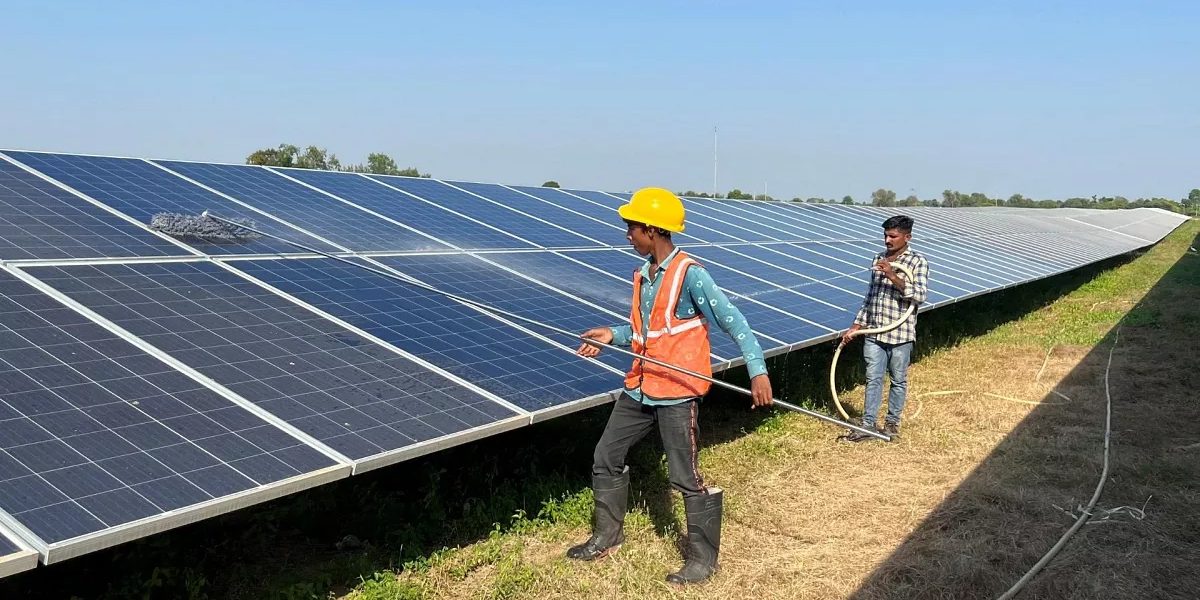
India’s international solar leadership derives its credibility from the depth and scale of its domestic energy transition. From less than 3 GW of installed solar capacity in 2014, India surpassed 135.8 GW by December 2025, encompassing large-scale utility projects, rooftop systems, and off-grid installations. Over the same period, solar tariffs declined by nearly 80 per cent, positioning solar among the cheapest sources of new electricity generation in the country.
This transformation rests on a coherent and multi-layered policy architecture. The Jawaharlal Nehru National Solar Mission established market confidence through competitive auctions and regulatory clarity. The Production-Linked Incentive scheme strengthened domestic manufacturing across the solar value chain, addressing supply-chain vulnerabilities and advancing energy sovereignty. Large solar parks captured economies of scale, while decentralised systems extended access to rural and peripheral regions.
Critically, India embedded solar energy within agrarian livelihoods and household economies. The PM-KUSUM scheme replaced diesel irrigation pumps with solar alternatives and enabled farmers to sell surplus electricity to the grid, transforming cultivators into energy producers. By late 2025, over one million solar pumps had been deployed, generating substantial income savings while reducing emissions and subsidy burdens. Complementing this, the PM Surya Ghar Muft Bijli Yojana expanded residential rooftop solar, dramatically lowering household electricity costs and enhancing energy autonomy.
Energy Democracy and Decentralised Transitions
Despite near-universal electrification, many remote, tribal, and border regions continue to experience unreliable power supply. Decentralised solar systems—off-grid installations, mini-grids, and hybrid microgrids—have emerged as structural correctives, converting nominal access into functional energy security.
Capital subsidies, concessional finance, and viability-gap funding have reduced entry barriers for marginalised communities. The socio-economic impacts are substantial: electricity expenditures have declined sharply, diesel dependence has been eliminated, and new rural enterprises have emerged. Renewable energy expansion has also generated significant employment multipliers, particularly in rural areas.
The experience of Ladakh illustrates the transformative potential of community-owned solar systems. Decentralised microgrids implemented by the Global Himalayan Expedition have electrified dozens of high-altitude villages, enabling education, healthcare, livelihoods, and gender empowerment in an ecologically fragile region. By contrast, the case of Dharnai village in Bihar demonstrates the institutional challenges facing decentralised energy. While a solar microgrid initially transformed local livelihoods, its economic viability was undermined by subsidised grid extension, highlighting the need for regulatory frameworks that integrate decentralised systems with central grids rather than displacing them.
Operationalising South–South Solar Cooperation
The ISA internationalises India’s domestic experience through structured South–South cooperation. Instruments such as the Ease of Doing Solar assessments, Country Partnership Frameworks, and blended finance platforms provide tailored pathways for regulatory reform and investment mobilisation. These mechanisms operationalise the principle of common but differentiated responsibilities by translating normative commitments into institutional practice.
Comparative experiences across ISA member states reinforce this model. In Ghana, ISA-supported solar irrigation and rooftop programmes have enhanced agricultural productivity and energy reliability. In Fiji, off-grid solar systems have strengthened climate resilience in cyclone-prone island communities. In Bangladesh, flood-resilient solar parks and decentralised systems reconcile energy access with adaptation needs. In Kenya, mini-grids and corporate power-purchase agreements have expanded industrial and commercial solar uptake. In Rwanda and Comoros, capacity-building through STAR-C centres has strengthened institutional and technical capabilities in fragile contexts.
Across these cases, decentralisation, affordability, and institutional capacity emerge as decisive success factors, while financing constraints and grid integration remain persistent challenges.
Multipolar Climate Governance: G20, COPs, and BRICS
India’s G20 Presidency in 2023 mainstreamed solar cooperation within global economic governance. The New Delhi Leaders’ Declaration explicitly recognised renewable energy expansion—and institutions such as the International Solar Alliance—as central to inclusive and sustainable growth. At COP27 and COP28, the Global Stocktake and the operationalisation of the Loss and Damage Fund further legitimised development-oriented approaches to climate action.
India’s BRICS Chairship in 2026 provides an additional platform to scale solar cooperation among major emerging economies. In this context, the United States’ withdrawal from the ISA underscores the alliance’s institutional autonomy and reinforces the relevance of South-led multilateralism in an increasingly fragmented global order. India has also formally expressed its intention to host the Thirty-Third Conference of the Parties (COP33) to the UNFCCC in 2028, signalling an ambition to shape the future trajectory of global climate governance from the perspective of the Global South. In July 2025, the Ministry of Environment, Forest and Climate Change established a dedicated institutional mechanism to coordinate preparatory and consultative processes for the proposed summit. Taken together, this prospective hosting bid underscores India’s intent to consolidate its role not merely as a norm-taker, but as an agenda-setter capable of foregrounding the developmental dimensions of decarbonisation within multilateral climate negotiations.
Political Economy and Civilisational Stewardship
The rapid decline in solar photovoltaic costs has fundamentally altered the political economy of energy. Solar now offers developing economies enhanced energy security, fiscal stability, and growth without carbon lock-in. Yet high capital costs and risk perceptions persist, underscoring the importance of ISA-led blended-finance and risk-mitigation mechanisms.
Beyond economics, India’s solar diplomacy integrates an ethical dimension. Lifecycle sustainability, solar-waste management, and circular-economy principles increasingly shape ISA engagement. Initiatives such as Lifestyle for Environment embed behavioural change within technological transition, framing sustainability as a collective moral responsibility rooted in civilisational ethics.
India and the Future of Global Energy Governance
India’s stewardship of the International Solar Alliance exemplifies a distinctive form of twenty-first-century leadership—empirically grounded, normatively innovative, and solid in orientation. By embedding solar energy within domestic development strategies and extending this experience through South–South multilateralism, India reframes the global energy transition as an instrument of equity, resilience, and dignity.
The ISA demonstrates that climate action need not replicate dependency or constrain development. Instead, it offers a cooperative governance model in which technological innovation, community agency, and ethical responsibility converge. In an era of geopolitical fragmentation and ecological urgency, solarising the planet under Indian leadership emerges not merely as a technological pathway, but as a civilisational commitment to inclusive and enduring planetary stewardship.
Views: 1561

Dr. Maheep
Dr. Maheep is Director, Indian Perspective on Global Affairs (IPGA), and a leading analyst of India’s foreign policy and South Asian geopolitics. He earned his PhD in Arab and Islamic Studies. With more than a decade of teaching and research experience in International Relations and Global Politics, he contributes regularly on issues shaping national and global affairs.