


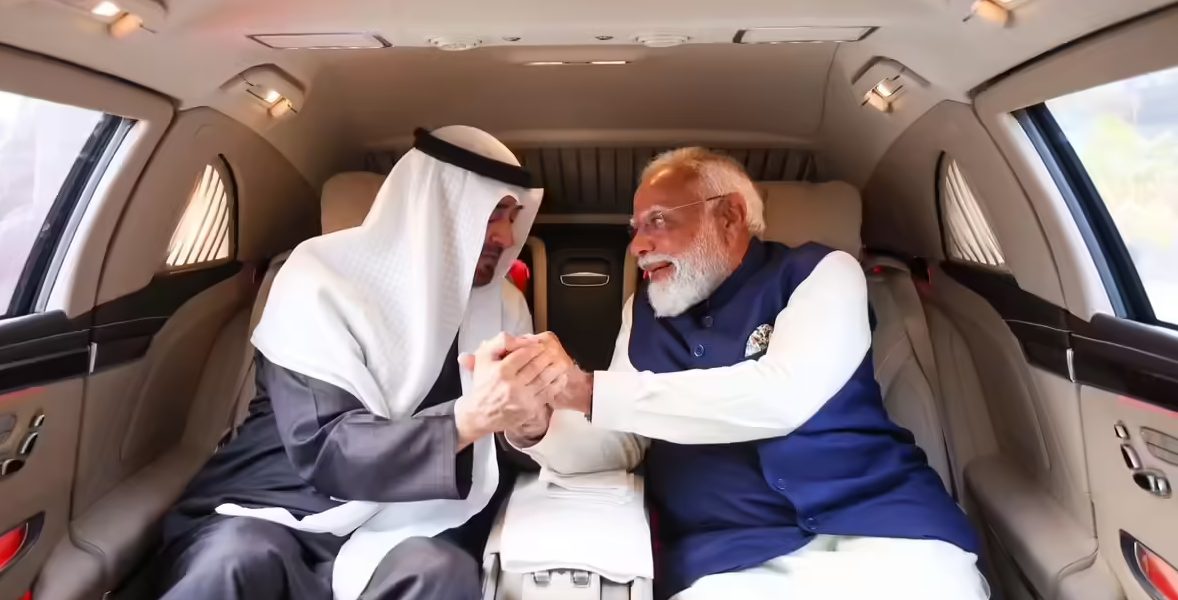







President Sheikh Mohamed bin Zayed Al Nahyan’s working visit to India on 19 January 2026 represented a moment of rare strategic clarity and convergence in contemporary international politics. It was an engagement shaped by security imperatives, strategic autonomy, and a shared commitment to long-term stability, sustainable development, and the responsible promotion of shared prosperity. At a time when West Asia is being reconfigured by shifting power balances, recalibrated deterrence, and the expanding use of economic and technological instruments as tools of statecraft, the India–UAE interaction reflected diplomacy informed by foresight, restraint, and strategic confidence.
The visit was explicitly oriented toward strengthening the core pillars of modern state power: defence cooperation, energy security, advanced technologies, financial governance, and multilateral alignment. These domains no longer operate in isolation. Together, they define strategic stability in an era where security is as much about resilient supply chains, sovereign digital ecosystems, climate-sensitive growth, and trusted financial architectures as it is about conventional deterrence. The Modi–MBZ engagement articulated a shared understanding that strategic autonomy today rests on integrated national capabilities and high-trust partnerships that advance collective well-being rather than zero-sum competition.
Its timing further amplified its significance. India had just assumed the BRICS Chairship for 2026, reinforcing its position as a central voice of the Global South and a proponent of reform-oriented global governance. Concurrently, West Asia was witnessing accelerated realignments shaped by evolving Gulf equations, Iran-centric proxy dynamics, and a United States foreign policy increasingly defined by tariffs, sanctions, and calibrated military postures. In this fluid environment, the India–UAE convergence underscored a common strategic judgement: durable security and shared prosperity flow from autonomy-enhancing partnerships that combine deterrence with economic resilience, technological responsibility, and sustainable growth.
This visit—MBZ’s fifth to India in a decade and his third as UAE President—was framed around three interlinked objectives. First, to institutionalise defence and security cooperation within a future-ready framework responsive to regional volatility. Second, to consolidate economic, energy, and digital integration at a time when global markets and financial systems are increasingly politicised. Third, to align perspectives on emerging multilateral architectures, particularly in the context of India’s BRICS leadership and the evolving grammar of multipolar order.
Through the lens of classical realism, the engagement reflected calibrated alignment based on converging interests and strategic foresight. From a constructivist perspective, it revealed the evolution of a partnership shaped by shared norms—sovereignty, pragmatism, and non-intrusive engagement—rooted in historical interdependence and reinforced by contemporary trust. Taken together, these dimensions position the India–UAE relationship not merely as a successful bilateral arrangement, but as a fascinating model of security-oriented, sustainability-conscious, autonomy-driven diplomacy in a reordering world.
Civilisational Continuity and the Ethos of Trust
India–UAE relations are grounded in a civilisational continuum that predates the modern international system by millennia. Long before the emergence of contemporary nation-states, maritime trade across the Indian Ocean connected the Indian subcontinent with the Gulf littoral. Archaeological and textual records from the third millennium BCE attest to exchanges between the Indus Valley civilisation and Dilmun, encompassing present-day Bahrain and adjoining Gulf regions. These interactions facilitated not only commerce in timber, spices, grains, copper, and pearls, but also the circulation of ideas, cultural practices, and social norms.
Over centuries, these linkages matured through monsoon navigation routes, embedding Indian influences in Gulf society and vice versa. Linguistic borrowings, culinary traditions, artisanal practices, and commercial ethics continue to reflect this shared past. This deep historical familiarity has translated into a contemporary relationship marked by confidence, predictability, and mutual respect.
In the modern era, this civilisational depth has been institutionalised through a Comprehensive Strategic Partnership that privileges strategic autonomy and non-intrusive engagement. Initiatives such as the BAPS Hindu Mandir in Abu Dhabi and the proposed House of India are emblematic of this ethos, reinforcing pluralism and people-centric diplomacy. These are not peripheral cultural gestures, but core elements of a trust-based partnership that transcends episodic political cycles.
Economic Interdependence: From Trade Expansion to Digital Sovereignty
Economic cooperation forms a central pillar of India–UAE relations. The Comprehensive Economic Partnership Agreement (CEPA), signed in 2022, has transformed bilateral engagement from an energy-dominated exchange into a diversified, future-oriented economic ecosystem. With bilateral trade exceeding US$100 billion and an agreed target of US$200 billion by 2032, the partnership reflects both scale and sophistication.
CEPA has expanded cooperation across manufacturing, logistics, gems and jewellery, chemicals, food processing, and high-technology exports, while integrating MSMEs into regional and global supply chains. Platforms such as Bharat Mart, the Virtual Trade Corridor, and Bharat–Africa Setu extend India’s entrepreneurial ecosystem through UAE-led connectivity into West Asia, Africa, and Eurasia. These initiatives reinforce economic resilience in an era of global fragmentation.
Digital public infrastructure has emerged as a defining feature of this partnership. The interoperability of India’s Unified Payments Interface with the UAE’s AANI platform, along with RuPay–JAYWAN integration, has enhanced cross-border financial efficiency while reinforcing sovereign control over payment ecosystems. Discussions on Digital Embassies and interoperable digital governance frameworks further reflect joint leadership in shaping inclusive, secure, and autonomy-preserving financial architectures.
Human Capital, Migrants, and Social Embeddedness
The Indian migrants in the UAE—numbering approximately 3.5 million—constitutes the human backbone of bilateral relations. As one of the most professionally diverse expatriate communities in the Gulf, it contributes significantly to the UAE’s economic dynamism while remitting close to US$20 billion annually to India. This sustained flow of human capital, skills, and remittances creates stabilising interdependence, reinforcing cooperation at both elite and societal levels.
Educational and knowledge partnerships further deepen this embeddedness. Offshore campuses of leading Indian institutions, youth exchanges, professional mobility, and digital credential verification platforms such as DigiLocker foster long-term intellectual and human connectivity. Cultural pluralism and institutional accommodation ensure that people-to-people ties remain resilient, anchoring strategic cooperation in social legitimacy.
West Asia in Strategic Transition and the India–UAE Alignment
West Asia is undergoing a phase of profound strategic transition marked by fluid alignments, recalibrated deterrence, and the search for new security equilibria. Intra-Gulf divergences, particularly over Yemen, have revealed competing conceptions of regional order and post-conflict governance, with ripple effects extending into adjacent theatres. At the same time, the intensified use of tariffs, sanctions, and economic coercion by the United States has further accelerated hedging behaviour across the region, compelling regional actors to reassess the durability and scope of traditional security arrangements.
Within this evolving landscape, Saudi Arabia’s diversification of its security partnerships has acquired renewed salience. The signing of the Strategic Mutual Defence Agreement (SMDA) between Saudi Arabia and Pakistan in September 2025, incorporating a collective defence understanding akin to NATO’s Article 5, reflects Riyadh’s effort to broaden its deterrence options amid strategic uncertainty. Parallel discussions involving Türkiye and periodic references to an “Arab NATO”–type framework illustrate a wider regional debate on collective security mechanisms, even as their precise contours remain fluid and contested.
For the United Arab Emirates, these developments reinforce a strategic preference for flexibility, balance, and autonomy rather than formalised collective defence commitments. Abu Dhabi’s approach has consistently emphasised calibrated partnerships that enhance security cooperation without constraining diplomatic manoeuvrability or entangling the state in rigid alliance structures. In this context, the deepening engagement with India assumes particular significance. India’s consistent, non-intrusive, and credibility-driven engagement across West Asia positions it as a stabilising partner whose strategic outlook aligns closely with the UAE’s emphasis on moderation, equilibrium, and cooperation-driven regional stability.
Defence, Energy, and Strategic Depth
Defence cooperation has emerged as a core pillar of the India–UAE partnership. The elevation of ties through a Strategic Defence Partnership framework reflects shared priorities in counter-terrorism, maritime security, intelligence sharing, and defence-industrial collaboration. Convergence on combating terrorism and financial extremism underscores a shared threat perception and commitment to regional and global security norms.
Energy security further reinforces strategic depth. Long-term LNG supply arrangements, collaboration in civil nuclear energy under India’s SHANTI framework, and exploration of advanced and small modular reactor technologies align economic growth with sustainability and resilience. These initiatives secure energy futures while strengthening technological cooperation in sensitive domains.
The India–Middle East–Europe Economic Corridor (IMEC) complements this vision by linking connectivity with strategic stability. By integrating infrastructure, trade, and logistics, the corridor offers a cooperative model of regional integration grounded in transparency and shared growth.
Beyond defence and energy, the visit advanced cooperation in frontier domains shaping twenty-first-century power. Alignment on artificial intelligence governance, advanced computing, and sovereign digital norms—supported by collaboration with UAE technology leaders such as G42—signals joint intent to shape global technology governance. Cooperation in space applications, food security, climate-resilient agriculture, critical minerals, FATF coordination, and GIFT City financial integration institutionalises the partnership within global regulatory and governance frameworks.
Strategic Autonomy through Realism and Constructivism
Analytically, the India–UAE partnership reflects a synthesis of classical realism and constructivism. From a realist perspective, it represents calibrated alignment driven by converging interests, risk mitigation, and strategic foresight. From a constructivist standpoint, it is sustained by shared norms of sovereignty, pragmatism, and non-intrusive engagement shaped by historical familiarity and contemporary trust.
This dual foundation enables both states to expand strategic space without entangling alliances, enhancing resilience amid systemic uncertainty and multipolar competition.
Conclusion
President Sheikh Mohamed bin Zayed Al Nahyan’s January 2026 visit reaffirmed the India–UAE relationship as one of the most consequential and forward-looking partnerships in West Asia. Rooted in civilisational depth, strengthened by economic and technological integration, and guided by strategic autonomy, this partnership offers a captivating template for cooperative statecraft in a reordering world.
As India advances its BRICS Chairship agenda and the UAE consolidates its role as a global economic and diplomatic hub, their convergence demonstrates how trust-based diplomacy, institutional depth, and strategic clarity can contribute to regional balance and global governance. In an international system defined by transition rather than equilibrium, enduring influence flows not from spectacle, but from deliberate, confidence-driven partnerships that align security with shared prosperity and sustainable development.
Views: 1628

Dr. Maheep
Dr. Maheep is Director, Indian Perspective on Global Affairs (IPGA), and a leading analyst of India’s foreign policy and South Asian geopolitics. He earned his PhD in Arab and Islamic Studies. With more than a decade of teaching and research experience in International Relations and Global Politics, he contributes regularly on issues shaping national and global affairs.


