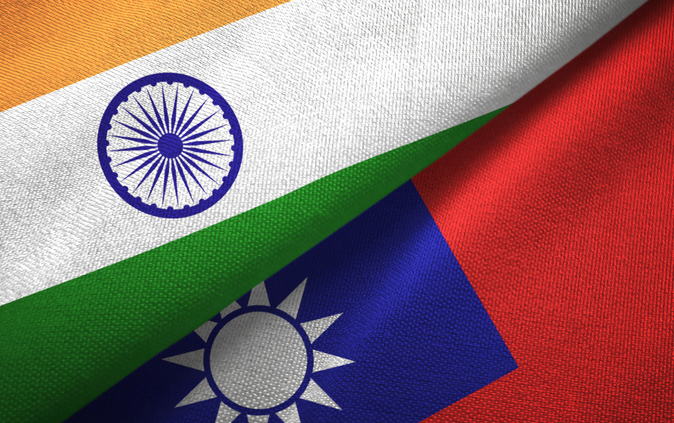







Thirty years after the establishment of representative offices in 1995, India–Taiwan relations have evolved into one of Asia’s most consequential yet deliberately understated partnerships. Embedded in economic pragmatism, technological convergence, and calibrated strategic ambiguity, the relationship exemplifies India’s distinctive approach to Indo-Pacific statecraft: deep engagement without alliance, cooperation without recognition, and leverage without provocation.
From an Indian perspective, Taiwan today is neither a diplomatic abstraction nor a proxy in great-power rivalry. It is a structural partner in supply-chain resilience, semiconductor ecosystems, talent mobility, and Indo-Pacific stability, even as China’s sensitivities impose political ceilings. The challenge for India in the coming decade is not whether to engage Taiwan, but how to institutionalise depth without triggering escalation, and how to convert quiet diplomacy into durable strategic capacity.
Phase I (1995–2005): Functionalism under Strategic Constraint
When India and Taiwan established the India–Taipei Association and the Taipei Economic and Cultural Center in 1995, the move reflected deliberate strategic calculation rather than commercial opportunism. New Delhi sought to widen engagement in East Asia without crossing Beijing’s diplomatic red lines at a time when India’s economic liberalisation was nascent and its continental relationship with China remained fragile. From the outset, therefore, India–Taiwan relations were designed to be useful but unobtrusive—substantive in practice, deniable in form.
This first phase was dominated by functional cooperation in trade, education, and limited cultural exchange, while political symbolism was carefully avoided. Bilateral trade remained modest, reaching roughly USD 1–1.2 billion by the mid-2000s, but the emphasis lay on building familiarity rather than momentum. Taiwan viewed India as a long-term economic partner amid diplomatic isolation, while India treated Taiwan as a diversification option rather than a political signal.
As Dr Prashant Kumar Singh has argued, India’s Taiwan policy during this period was shaped by a hierarchy of risks.Border stability with China, strategic autonomy, and escalation avoidance took precedence over symbolic engagement with Taiwan. Within this framework, Taiwan functioned as a strategic variable—valuable for economic hedging and technological access, yet deliberately insulated from overt political signalling. This explains why early engagement privileged functionalism and deniability not as hesitation, but as rational statecraft in an asymmetric regional environment.
The resilience of this approach was evident during the 1996 Taiwan Strait Crisis, when India–Taiwan ties remained unaffected despite heightened tensions. Yet its limitations were also clear. Taiwanese investment and institutional outreach outpaced India’s reciprocal presence, producing early asymmetries and thin institutionalisation. By 2005, the relationship had achieved stability without depth—a constrained but durable foundation that subsequent phases would cautiously seek to expand.
Phase II (2006–2015): Quiet Expansion and Strategic Hesitation
The second phase marked a gradual broadening of engagement, coinciding with India’s Look East Policy and a temporary easing of cross-strait tensions. Trade expanded, labour mobility increased, and cooperation in information technology, higher education, and renewables deepened. This was a period of quiet expansion marked by economic optimism but strategic caution.
India’s Taiwan policy during this phase continued to be shaped by strategic autonomy rather than ideological alignment. Official rhetoric on One China remained unchanged even as engagement expanded incrementally. Policy research from Carnegie India and ORF highlights that New Delhi viewed Taiwan less as a sovereignty question and more as a risk variable intersecting with China’s behaviour, U.S. strategy, and regional supply chains.
As Dr Manoj Mishra observes in India and Taiwan: A Reality Check, this caution also produced under-institutionalisation. Engagement deepened across sectors, but strategic mechanisms lagged behind, creating a relationship dense in activity yet thin in architecture. Economic gains masked the absence of durable institutional frameworks, rendering the partnership vulnerable to shifts in the regional environment.
Phase III (2016–2025): Silicon Statecraft and Structural Relevance
The most consequential transformation occurred after 2016. China’s coercive turn, the consolidation of the Indo-Pacific framework, and the geopolitics of semiconductors collectively elevated Taiwan from a functional partner to a strategic node in India’s external engagement.
Taiwanese investments in electronics, chip design, and packaging aligned directly with India’s Atmanirbhar Bharat and Make in India priorities. ORF’s Taiwan–India @30 assessment characterises this shift as a move from transactional engagement to structural relevance. India increasingly began to view Taiwan as a partner in deterrence by denial, achieved not through military alignment but through supply-chain resilience and technological depth.
Yet structural limits persist. India remains dependent on mature-node manufacturing and downstream integration, while Taiwan retains control over cutting-edge fabrication, advanced process technologies, and ecosystem orchestration. From a policy standpoint, this asymmetry underscores the limits of an investment-led approach divorced from knowledge co-creation. As strategic analyst Dr. Raj Kumar Sharma has persuasively argued, this imbalance should not be read as a structural weakness but as a sequencing challenge—India’s strategic risk lies not in beginning downstream, but in failing to move upstream over time through co-development, institutionalised R&D, and sustained talent circulation. Without such progression, semiconductor cooperation risks plateauing into contract manufacturing rather than maturing into technological partnership. Managed deliberately, however, this asymmetry can become a ladder rather than a ceiling—allowing India to convert scale into capability while preserving Taiwan’s confidence in India as a long-term strategic production partner.
Semiconductors as Strategic Currency
Few sectors illustrate the new phase of India–Taiwan relations more clearly than semiconductors. Taiwan’s dominance in advanced chip manufacturing and India’s ambition to emerge as a global electronics hub have created a mutually reinforcing political economy.
Analyses from Carnegie India, ORF, and Nikkei Asia converge on a critical point: India is no longer viewed in Taipei merely as a market, but as a strategic diversification partner amid U.S.–China technological decoupling. India offers scale, political stability, and talent; Taiwan offers process knowledge, ecosystems, and industrial discipline.
Structural limits nevertheless endure. India remains dependent on mature-node manufacturing and downstream integration, while Taiwan retains control over cutting-edge fabrication. From a policy standpoint, this asymmetry underscores the need for co-development rather than contract manufacturing, and for deeper R&D linkages that move beyond investment announcements toward technological co-ownership.
The China Constraint: Coercion without Collapse
China remains the most significant external variable shaping India–Taiwan relations. Beijing’s responses, ranging from diplomatic protests to selective economic pressure, are designed to signal red lines without forcing rupture.
Indian analysts across think tanks converge on a sober assessment: China tolerates India–Taiwan engagement so long as it remains non-political and non-militarised. This tolerance creates space but also tempts complacency. The greater risk lies not in provocation but in self-deterrence. Excessive caution risks converting strategic ambiguity into strategic stagnation. India’s challenge is to transform Chinese sensitivity into calibrated leverage, using economic and technological depth as instruments of autonomy rather than allowing Beijing’s preferences to define the outer limits of engagement.
The United States and Japan: Enablers, Not Architects
Unlike Washington and Tokyo, New Delhi has resisted framing Taiwan in ideological or alliance terms. This restraint is deliberate. Analyses from Brookings and the Lowy Institute suggest that India’s value within the Quad lies precisely in its non-allied posture, which lends credibility to supply-chain and technology cooperation without militarising the Taiwan question.
Japan plays a particularly important catalytic role. Its deep technological ties with Taiwan and strategic convergence with India create triangular synergies in semiconductors, critical minerals, and maritime logistics. Yet India has carefully avoided being drawn into explicit contingency planning for a Taiwan Strait conflict, a position articulated repeatedly by Dr S. Jaishankar. The resulting architecture is layered rather than linear: cooperation without commitment, alignment without alliance, and deterrence through economic resilience rather than military signalling.
The Strategic Deficit: Institutions Lag Behind Interests
Despite impressive growth, India–Taiwan relations remain institutionally thin. There is no regularised strategic dialogue, limited defence-adjacent exchanges, and insufficient academic and linguistic infrastructure. Scholars at the Global Taiwan Institute and the Maritime India Foundation have argued that reliance on markets and personalities without institutional ballast leaves the relationship vulnerable to shocks and discontinuities.
Quiet diplomacy, without institutional depth, risks remaining episodic rather than cumulative. The absence of routinised mechanisms constrains the translation of economic interdependence into long-term strategic resilience.
Conclusion
At thirty, India–Taiwan relations are no longer peripheral to Asia’s strategic landscape. They are embedded at the intersection of technology, geopolitical risk management, and the evolving Indo-Pacific order. What has distinguished this relationship over three decades is not symbolism but discipline, privileging material depth over declaratory politics.
India does not need to abandon strategic ambiguity, nor should it dilute the One-China framework that has underwritten regional stability. But ambiguity can no longer remain passive or reflexive; it must be managed deliberately. The next phase of India–Taiwan engagement will be defined by whether functional cooperation is translated into institutional resilience through routinised semi-official dialogues, sustained co-development in critical technologies, reciprocal academic and linguistic ecosystems, and discreet preparedness for economic and maritime contingencies.
Such steps do not constitute escalation; they represent maturation. If pursued with consistency and restraint, India–Taiwan relations can evolve from a relationship sustained by caution into one sustained by capacity, quiet in posture, calibrated in ambition, and consequential in shaping India’s strategic autonomy in a contested Indo-Pacific.
Views: 1362

Dr. Maheep
Dr. Maheep is Director, Indian Perspective on Global Affairs (IPGA), and a leading analyst of India’s foreign policy and South Asian geopolitics. He earned his PhD in Arab and Islamic Studies. With more than a decade of teaching and research experience in International Relations and Global Politics, he contributes regularly on issues shaping national and global affairs.