


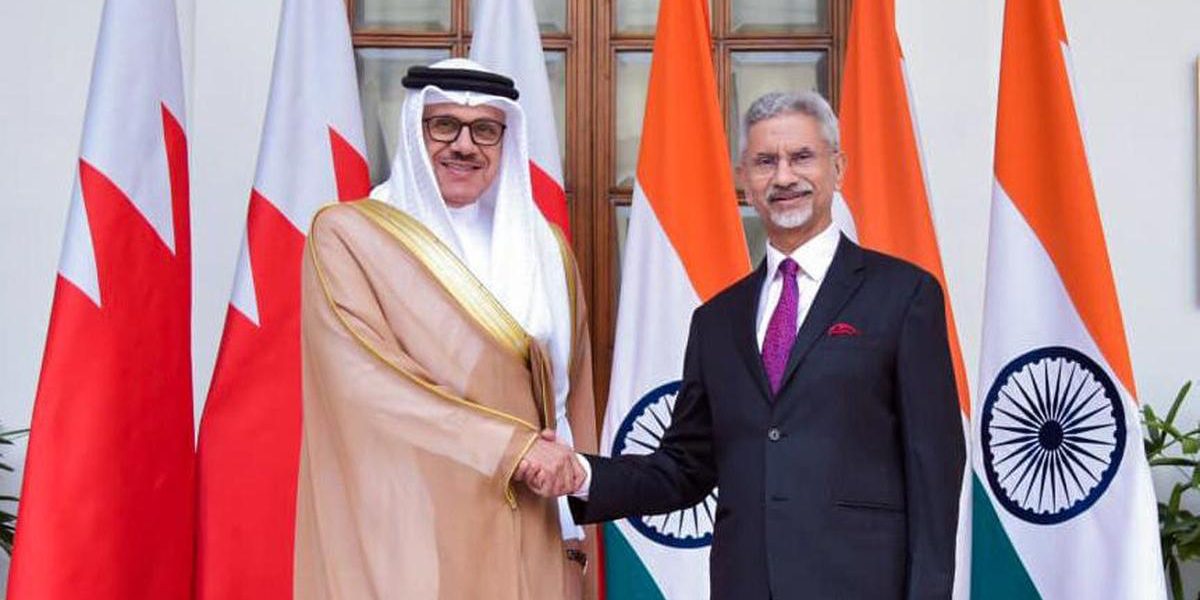







The recent visit of Bahrain’s Foreign Minister, Dr. Abdullatif bin Rashid Al-Zayani, to New Delhi in early November 2025, infused new vitality into India-Bahrain relations. Co-chairing the Fifth India-Bahrain High Joint Commission Meeting with India’s External Affairs Minister, Dr. S. Jaishankar, he presided over discussions that redefined the contours of bilateral cooperation in trade, investment, technology, and regional security. The meeting’s outcomes reflected an intense strategic maturity, with both sides agreeing to accelerate negotiations for a Comprehensive Economic Partnership Agreement (CEPA), advance the Bilateral Investment Treaty (BIT), and prepare the groundwork for a Double Taxation Avoidance Agreement (DTAA). The engagement underlined a broader diplomatic vision that seeks to harmonize economic pragmatism with geopolitical foresight, positioning Bahrain as a vital anchor of India’s evolving West Asia policy.
The two-day dialogue in New Delhi carried strategic weight far beyond its formal protocols. The joint statement issued by the Ministry of External Affairs delineated a comprehensive framework for cooperation in fintech, healthcare, space, renewable energy, and defence. It highlighted a commitment to counter-terrorism, maritime security, and digital innovation; areas where both nations’ capabilities intersect meaningfully. Dr. Jaishankar’s remarks during the talks captured the essence of contemporary diplomacy: “Since our last HJC meeting, we have made significant progress bilaterally in defence, security, trade and commerce, health, culture and people-to-people ties. But there are new areas such as space, fintech and technology that hold considerable promise for our partnership.” He further sought Bahrain’s support in strengthening India’s engagement with the Gulf Cooperation Council (GCC), acknowledging the kingdom’s growing regional leadership role and its assumption of the GCC Supreme Council presidency in December 2025.
India’s engagement with Bahrain is rooted in ancient maritime linkages, cultural affinity, and shared civilizational values. The Dilmun civilisation of Bahrain once traded with the Indus Valley, weaving the earliest threads of a relationship grounded in trust and commerce. During the colonial period, Bahrain’s political and economic interactions with the Indian subcontinent were deeply intertwined; as a British Protectorate, Bahrain was governed indirectly through the British Indian administration, which supervised much of the Gulf’s political, economic, and maritime affairs from Bombay. This administrative arrangement positioned India as the functional hub of British influence across the Gulf, giving rise to early patterns of political familiarity and bureaucratic coordination that would later facilitate postcolonial diplomacy.
The Indian rupee circulated as legal tender throughout the Gulf for decades, and Indian merchants, civil servants, and professionals played pivotal roles in Bahrain’s early modern economy. These interactions nurtured a distinctive relationship rooted in trust, cultural coexistence, and shared prosperity. With Bahrain’s independence in 1971, these historical linkages transformed into an enduring state-to-state partnership, institutionalized through India’s establishment of its embassy in Manama two years later. What began as an administrative and commercial connection under colonial oversight evolved into a sovereign, equal partnership founded on mutual respect, strategic cooperation, and shared aspirations for regional stability.
The 2025 meeting came at a crucial juncture in India’s larger West Asia policy. For the past two decades, India has been pursuing a free trade agreement with the GCC. A Framework Agreement on Economic Cooperation was signed in 2004, though subsequent negotiation rounds in 2006 and 2008 remained inconclusive. The GCC’s secretary-general announced earlier this year that the bloc intends to resume formal negotiations with India. The anticipated pact would give India enhanced access to a lucrative market and open pathways for smoother visa processes in a region that serves as a second home to over nine million Indian expatriates. Against this backdrop, Bahrain’s forthcoming GCC presidency offers New Delhi a strategic opportunity to reenergize its long-pending trade talks through a trusted partner whose diplomatic vision aligns with India’s own pursuit of balanced multipolar engagement.
In his remarks, Dr. Al-Zayani emphasized Bahrain’s resolve to “enhance greater connectivity between India and our broader region,” reaffirming that the leadership in Manama remains committed to translating historical goodwill into forward-looking cooperation. His statement was an acknowledgment of the depth of shared vision and the mutual recognition that both nations’ destinies are increasingly intertwined within the changing dynamics of the Gulf.
In the modern era, the relationship has evolved through the interplay of economic interdependence, political goodwill, and cultural proximity. Over 332,000 Indians now reside in Bahrain, forming a vibrant community that contributes substantially to the kingdom’s economy and social fabric. This diaspora remains an enduring symbol of people-to-people diplomacy, one that complements formal state relations with a living human bridge of shared aspirations and mutual respect.
On the economic front, the trajectory of India-Bahrain relations reflects a shift from transactional trade to structural partnership. Bilateral trade reached USD 1.64 billion in FY 2024-25, underscoring steady diversification into sectors like fintech, education, and technology-driven industries. Upon its conclusion, the CEPA will lay the groundwork for a comprehensive framework for regulatory coordination, investment protection, and broader market access, allowing both economies to harness shared strengths rather than engage in competitive overlap. The participation of Bahrain’s sovereign wealth fund, Mumtalakat, in prospective investments across India’s infrastructure, renewable energy, and startup ecosystem reflects a growing confidence in India’s economic dynamism and institutional stability.
Defence and security cooperation have emerged as defining features of this new phase. Indian naval visits to Manama and dialogue on maritime domain awareness and cyber security mark a transition toward a comprehensive security partnership. The proposed collaboration between the Bahrain Space Agency and NewSpace India Limited in satellite applications for climate monitoring and coastal security encapsulates the spirit of twenty-first-century strategic cooperation which is functional, adaptive, and forward-looking. As the Gulf undergoes a complex transformation driven by shifting energy markets, technological disruption, and emerging regional realignments, India and Bahrain have found convergence in their approach to peace, stability, and diversification.
Bahrain’s assumption of the GCC presidency in December positions it to shape the bloc’s future direction amid evolving regional geopolitics. Its leadership of the Supreme Council offers a platform to project collective Gulf perspectives on economic integration, digital innovation, and cooperative security. India’s renewed outreach to the GCC through Bahrain thus carries larger strategic implications, consolidating its presence within a region that remains critical for energy security, trade connectivity, and diaspora engagement.
Bahrain’s foreign policy, shaped by a pragmatic vision under its leadership, seeks to engage multiple global partners while maintaining its traditional alignments. This strategy of calibrated diversification aligns seamlessly with India’s approach of strategic autonomy and multipolar engagement. For New Delhi, Bahrain offers both geographic advantage and diplomatic access within the GCC, serving as a pivotal node for India’s West Asia outreach. The convergence between India’s “Extended Neighbourhood Policy” and Bahrain’s Vision 2030 is underpinned by shared priorities like economic diversification, energy transition, digital transformation, and maritime security.
The strategic resonance of Dr. Al-Zayani’s visit goes beyond bilateral relations. It reinforces the idea that India’s partnership with the Gulf is no longer confined to hydrocarbons or expatriate welfare but is expanding into domains of strategic governance, technological innovation, and global diplomacy. In this context, Bahrain’s endorsement of India’s call for dialogue and peace in the Middle East, especially amid the turbulence surrounding Gaza and the Red Sea, demonstrates mutual trust and normative convergence on key international issues.
The cultural dimension of India-Bahrain relations continues to serve as a bridge of mutual understanding and shared identity. The restoration of the Shreenathji Temple in Manama, a two-hundred-year-old site of Indian heritage, illustrates Bahrain’s respect for diversity and its historical friendship with India. This gesture transcends heritage preservation. It embodies a deeper recognition of India’s civilizational outreach and its ethos of pluralism that resonates across West Asia. India’s cultural diplomacy, advanced through the Indian Council for Cultural Relations (ICCR), the India@75 initiatives, and vibrant cultural exchanges hosted by the Embassy of India in Manama, has reinforced this narrative of mutual respect. Academic and cultural exchanges, film festivals, and educational collaborations have added soft power to an already resilient partnership. With nearly 332,000 Indian nationals residing in Bahrain, the Indian community forms an integral part of the kingdom’s socio-economic fabric and its multicultural mosaic. These engagements reaffirm that diplomacy extends beyond treaties and trade; it thrives in shared values, human connectivity, and mutual recognition. In this sense, Bahrain has evolved into a vital node of India’s soft power engagement in the Gulf; a living testament to the coexistence of economic pragmatism and cultural harmony that underpins the spirit of India-Bahrain relations.
From an analytical perspective, the present trajectory of India-Bahrain relations exemplifies the logic of functional institutionalism in International Relations. Cooperation across specific policy domains viz. trade, fintech, and defence, creates momentum for broader trust and stability. The bilateral dynamic also illustrates strategic hedging, as both countries navigate global realignments by diversifying partnerships and minimizing dependency on any single power bloc. This synergy of interests ensures that the partnership remains adaptable to geopolitical shifts, particularly as Asia and the Gulf reconfigure their external engagements amid the retreat of Western hegemony and the rise of new regional architectures.
Challenges remain, yet they are manageable within the discipline of institutional diplomacy. Bahrain’s compact market size necessitates targeted economic strategies focusing on high-value sectors, while India’s vast and diversified economy offers scalable platforms for collaboration. Coordination between sovereign funds, regulatory bodies, and private investors will determine the pace of implementation. Similarly, the regional complexities of Gulf politics require careful calibration to ensure that India’s engagement with Bahrain complements, rather than competes with, its partnerships with Saudi Arabia, the UAE, and Qatar.
As both nations advance their cooperation in energy transition, digital economy, and maritime stability, the partnership assumes a significance that transcends bilateralism. It embodies the emerging architecture of India’s global diplomacy which is anchored in history, guided by pragmatism, and elevated by shared values. In a multipolar world, where middle powers increasingly shape the international order through collaboration rather than confrontation, India and Bahrain exemplify how strategic foresight and mutual respect can forge a sustainable path of growth and peace.
The essence of the India–Bahrain relationship lies in its evolution from the ancient maritime routes of the Indus and Dilmun civilisations to the digital corridors of the twenty-first century. The recent High Joint Commission Meeting has crystallized this continuum into a vision for the future. A vision where economic integration, security cooperation, and cultural empathy form the trinity of partnership. It reflects an understanding that diplomacy is no longer the art of balancing interests but the science of creating shared destinies.
As India and Bahrain move ahead with renewed purpose, their collaboration stands as an exemplar of how nations can translate historical goodwill into modern relevance. It is a relationship that resonates with the spirit of global interdependence grounded in mutual respect, sustained by pragmatic engagement, and illuminated by the promise of collective advancement. The seeds of this strategic partnership, nurtured through centuries of connection, are now flowering into a future of inclusive progress and enduring friendship. A legacy for generations to come!
Views: 678

Dr. Maheep
Dr. Maheep is Director, Indian Perspective on Global Affairs (IPGA), and a leading analyst of India’s foreign policy and South Asian geopolitics. He earned his PhD in Arab and Islamic Studies. With more than a decade of teaching and research experience in International Relations and Global Politics, he contributes regularly on issues shaping national and global affairs.


