









From the Alps to the Himalayas: The Swiss President’s Visit to India and the Transformation of Trust into Partnership
India and Switzerland are turning a historic friendship into a test of geoeconomic statecraft, productive capability and strategic autonomy.
In international politics, the deepest transformations often begin with relationships whose value has been patiently accumulated rather than dramatically announced. The friendship between India and Switzerland belongs to this category. Forged in the earliest years of Indian independence and sustained across successive changes in the global order, it has acquired renewed significance at a moment when technology, capital, supply chains and regulatory influence have become instruments of national power. What was once a durable diplomatic understanding is increasingly becoming a framework for productive cooperation.
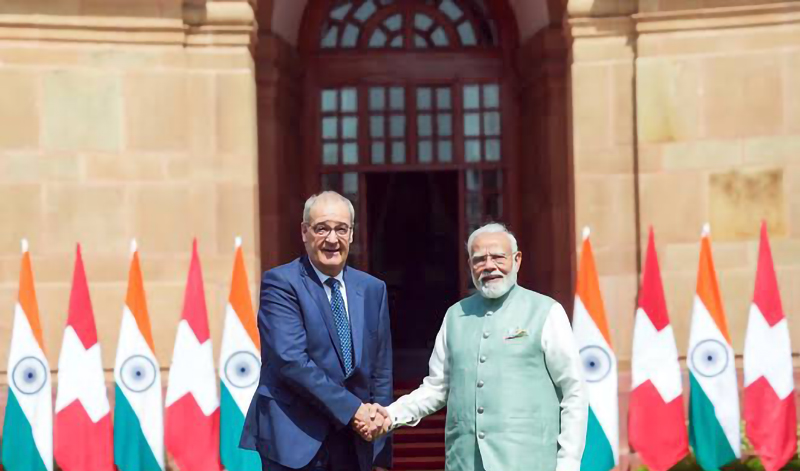
The state visit of Guy Parmelin, President of the Swiss Confederation, from 5 to 7 October 2026, at the invitation of Prime Minister Narendra Modi, gave this transition a distinct political form. Accompanied by Mrs Caroline Parmelin and a delegation of business and scientific representatives, the Swiss President met President Droupadi Murmu and Prime Minister Modi, engaged with Indian institutions and industry, and participated in the second India–European Free Trade Association (EFTA) Prosperity Summit on 7 October. The visit coincided with the first anniversary of the Trade and Economic Partnership Agreement (TEPA), which entered into force on 1 October 2025.
Its importance lies in the convergence of three forces: an inherited reservoir of trust, an economic agreement linking market access with investment and employment objectives, and a new agenda extending into research, mobility, infrastructure and technological governance. Read through a constructivist lens, the relationship demonstrates how repeated interaction creates expectations of reliability; viewed through geoeconomics, it illustrates how that reliability can support industrial upgrading and reciprocal opportunity. For India, the organising principle is strategic autonomy: the freedom to engage widely while strengthening the domestic capabilities that make independent choices sustainable.
An Inheritance of Trust
The Treaty of Friendship signed in New Delhi on 14 August 1948 gave formal expression to a relationship founded on sovereign equality, mutual regard and a commitment to enduring peace. Its language of perpetual peace and unalterable friendship emerged when independent India was defining its international identity and Europe was reconstructing its political and economic order. Nearly eight decades later, the treaty has become more than an archival symbol. It supplies a historical vocabulary through which both democracies understand the continuity of their engagement.
India’s tradition of non-alignment and Switzerland’s neutrality emerged from different intellectual, political and security experiences. India’s preference for independent judgement grew through anticolonial struggle, postcolonial state-building and resistance to exclusive Cold War alignments. Swiss neutrality evolved within European history and remains shaped by distinct legal obligations and domestic institutions. Their significance lies in compatibility rather than equivalence: both place value on diplomatic discretion, sovereign decision-making and the capacity to cooperate across geopolitical divisions.
Constructivist scholarship helps explain why this distinction matters. As Alexander Wendt’s account of socially constructed international relationships suggests, states interpret one another through patterns of interaction, shared expectations and accumulated experience. Trust is sustained by institutions and conduct, rather than by declarations alone. India and Switzerland have developed that confidence through political dialogue, science and education agreements, investment, development cooperation and sustained social contact. Swiss commercial activity in India predates independence; the bilateral science and technology agreement of 2003, Swissnex India and successive research partnerships have given the relationship an increasingly practical foundation.
The visits of Prime Minister Modi to Switzerland in 2016 and 2018, Swiss President Doris Leuthard to India in 2017 and President Ram Nath Kovind to Switzerland in 2019 added political continuity. Cultural familiarity, from Indian cinema’s Alpine landscapes to educational and professional exchanges, helped build a constituency for the partnership beyond diplomatic establishments. Such familiarity cannot substitute for economic results, but it can diminish political uncertainty and create the confidence needed for long-term investment.
Translating Trust into Tangible Commitments
President Parmelin arrived with unusual institutional authority over the partnership’s economic foundations. Alongside the annually rotating Swiss presidency, he leads the Federal Department of Economic Affairs, Education and Research and has been closely associated with TEPA. His engagements at Rashtrapati Bhavan, Rajghat and Hyderabad House conveyed the symbolic importance of the visit; the discussions and agreements demonstrated its operational promise.
India’s official outcomes recorded five instruments. A Migration and Mobility Partnership addresses lawful movement, educational access and cooperation against irregular migration and trafficking, with provisions for multiple-entry visas valid for up to five years, stays of up to six months on each visit, and renewable one-year student permits. The Young Professionals Agreement provides for exchanges of 300 participants annually from each country, potentially rising to 500, creating structured opportunities for professional and linguistic development.
An infrastructure memorandum identifies electric mobility, ropeways, tunnels, circular-economy systems and related transport technologies. A letter of intent between India’s Department of Science and Technology and the Swiss National Science Foundation seeks to encourage research partnerships. An implementation arrangement with the Zurich University of Applied Sciences advances the Indo-Swiss Academia–Industry Training programme, connecting early-stage enterprises with innovation, entrepreneurship and technology transfer. An Indo-Swiss research flagship event was also announced.
These outcomes should be understood at their respective levels of commitment. A mobility agreement establishes a legal and administrative avenue; a research letter creates a platform for future projects; an industrial investment becomes transformative when it develops production, skills and enduring technological competence. The leaders also discussed defence-related cooperation, military exchanges, civil nuclear energy, healthcare, clean energy, space and advanced technologies. These are promising areas for further engagement, subject to future arrangements and to Switzerland’s laws governing neutrality, strategic exports and licensing.
A particularly practical development was the understanding between India and EFTA to establish a group for addressing trade and investment constraints. Such mechanisms matter because the life of an agreement unfolds in customs procedures, certification systems, regulatory decisions and business negotiations. Diplomatic ambition acquires credibility when an identifiable institution can resolve the obstacles that prevent firms from using the opportunities already negotiated.
Trade as Statecraft
TEPA is the economic centrepiece of the relationship. Signed on 10 March 2024 by India and the four EFTA states, Switzerland, Norway, Iceland and Liechtenstein, and brought into force on 1 October 2025, it reflects a maturing Indian understanding of trade policy as an instrument of developmental strategy. Its distinctiveness rests on the connection between preferential market access and quantified ambitions for investment and employment.
Under Article 7.1, EFTA states aim to facilitate an additional US$50 billion in investment from their investors into India during the first ten years and a further US$50 billion over the subsequent five years. The agreement also sets an objective of facilitating one million jobs over fifteen years. The language establishes an investment-promotion objective, rather than certifying that US$100 billion has already been invested or contractually secured. The distinction is fundamental to any credible appraisal of progress.
India’s Commerce Ministry reports that EFTA’s concessions cover 92.2 per cent of tariff lines, encompassing 99.6 per cent of Indian exports, while India has offered concessions on 82.7 per cent of tariff lines, covering 95.3 per cent of EFTA exports. The calibrated treatment of sensitive sectors reflects India’s effort to align external openness with domestic development priorities. TEPA thus embeds a strategic bargain: access to affluent markets and innovation-intensive investment in exchange for carefully negotiated commercial opportunities.
Writing in The European Times on 5 October 2025, Dr Maheep described TEPA as a ‘new strategic grammar of India’s economic diplomacy’, an arrangement connecting state-led development with international market integration while preserving national sovereignty. A year later, President Parmelin’s visit provides the first serious occasion to examine that formulation against institutional practice. The agreement’s originality now needs to find expression in factories, research facilities, competitive exporters, employment and durable technology partnerships.
Switzerland has a particularly strong place in this bargain. Its capabilities in pharmaceuticals, medical technology, speciality chemicals, precision engineering, advanced manufacturing and financial services correspond to sectors in which India seeks greater technological depth. For Swiss enterprises, India provides access to scale, a talented workforce, opportunities for diversification and an expanding innovation ecosystem. Reciprocity is therefore central: the partnership advances when investment strengthens Indian capability while also meeting the long-term commercial interests of Swiss firms.
The First-Year Test
An agreement with a fifteen-year horizon deserves to be judged by evidence appropriate to its first year. Initial implementation can reveal emerging business interest and regulatory use, while the full scale of investment and employment outcomes requires sustained observation. It is consequently essential to distinguish market access from market penetration, a promised investment from a completed project, and an export opportunity from an actual sale.
The bilateral commercial base is considerable. Switzerland’s Federal Department of Foreign Affairs records Swiss exports to India of CHF 13.2 billion in 2025 against imports from India of CHF 2.4 billion, a Swiss direct-investment stock in India of CHF 10.2 billion at the end of 2024, and a presence of approximately 350 Swiss enterprises. Yet precious metals account for a substantial share of headline trade, making gold prices and bullion flows influential in aggregate comparisons. A more illuminating account would distinguish non-gold goods, services, productive investment and changes in sector-specific exports.
The early Indian export numbers introduce a necessary note of realism. Reporting ahead of the October summit indicated that India’s merchandise exports to the EFTA bloc declined by 10.77 per cent to approximately US$1.75 billion in financial year 2025–26. In April–June 2026, exports declined by 22.72 per cent to about US$461.64 million compared with the corresponding period a year earlier. These movements cannot be attributed automatically to TEPA: external demand, currency conditions, commodity composition and commercial cycles all influence trade. They nevertheless establish that preferential access had yet to produce an aggregate export recovery.
Operational indicators reveal another side of the picture. By July 2026, Indian government figures recorded 7,885 preferential certificates of origin issued under TEPA. These show that exporters had begun to claim its benefits, even as aggregate export performance remained subdued. At the 7 October Prosperity Summit, Commerce Secretary Rajesh Agrawal emphasised practical market development, country-specific export strategies and greater use of available preferences. The task is to turn procedural utilisation into sustained competitiveness.
For smaller exporters, tariff reduction is only an entry point. Rules of origin, quality certification, technical standards, logistics, market information and established distribution channels determine whether a product reaches consumers. India therefore needs an export-enablement strategy that gives industry associations, state governments and MSMEs usable intelligence about Swiss and EFTA demand. Success should be tracked by new exporters entering the market, product-level market share, preference utilisation and growth in domestic value addition, rather than by tariff coverage alone.
Capital and Confidence
The investment dimension raises questions of regulatory trust. Swiss officials have identified the importance of a modern bilateral investment-protection agreement and predictable dispute resolution. India’s interest is equally legitimate: its regulatory authority must protect public health, environmental standards, domestic industrial development and wider social obligations. A workable settlement would create clear legal processes without diminishing the state’s capacity to govern in the public interest.
Intellectual property requires a similarly balanced approach. Strong and predictable protection encourages research-intensive investment, especially in pharmaceuticals and biotechnology. India also has a globally significant interest in affordable medicines, technology diffusion and its generic pharmaceuticals ecosystem. A sustainable partnership will reconcile innovation incentives with accessibility and developmental needs. The objective is to make regulatory reliability and sovereign policy space mutually reinforcing.
President Parmelin’s announcement on 2 October that he would leave the Swiss Federal Council at the end of 2026 brings an additional institutional dimension into focus. Switzerland’s collective executive and annually rotating presidency provide continuity beyond individual officeholders, yet successful implementation will still require political attention and administrative ownership. The resilience of TEPA will be demonstrated in how effectively its mechanisms function through this transition and as both countries approach eighty years of diplomatic relations in 2028.
Technology and Talent
The most promising dividends may emerge beyond conventional trade. Parmelin’s visit to Noida International Airport at Jewar highlighted a tangible Indian-Swiss commercial undertaking involving a subsidiary of Zurich Airport International. The project shows what sustained cooperation can look like when Swiss expertise meets India’s infrastructure requirements. Its broader importance will be realised where such partnerships build local design competence, maintenance skills, supplier networks and industrial capacity.
The geographical contrast between the Alps and the Himalayas offers a compelling area of practical convergence. Switzerland’s experience in mountain engineering, glacier research, hazard monitoring, tunnelling and complex mobility systems could support India’s priorities in resilient connectivity, hydrology and disaster-risk management. A jointly designed Alpine–Himalayan research and resilience initiative would connect environmental knowledge with infrastructure planning and the protection of vulnerable mountain communities. It is a strategic proposal rather than an existing signed programme, and its promise lies in the possibility of translating comparative expertise into public benefit.
Scientific collaboration can extend into joint laboratories, industry-linked doctoral training, startup exchanges, specialised manufacturing and applied research. The Switzerland–India innovation relationship becomes more consequential when knowledge moves in both directions: advanced research and process expertise strengthening Indian industry, and Indian engineering capabilities, digital scale and entrepreneurial dynamism enriching Swiss innovation networks.
The professional mobility agreements are particularly important in this context. Their value extends beyond temporary employment or easier travel. Well-designed exchanges can connect universities, companies, research institutions and technical training centres, enabling skills to circulate and return in productive forms. Transparent eligibility, recognition of qualifications, mentoring and opportunities for returnee entrepreneurship could ensure that mobility enriches India’s human capital while meeting Swiss demand for specialised talent.
Life sciences and health technology offer a natural industrial complementarity. Switzerland’s research-intensive pharmaceutical ecosystem and India’s production scale, scientific workforce and extensive experience in affordable medicines can support cooperation in biotechnology, clinical research, diagnostics, advanced manufacturing and medical devices. Financial services and cross-border investment can further facilitate innovation, supported by the two countries’ experience of financial-information exchange and regulatory engagement.
Autonomy through Partnership
The deeper significance of the visit lies in the evolving meaning of strategic autonomy. In a world of contested technology, vulnerable supply chains and expanding economic-security concerns, sovereignty cannot be measured solely by freedom from formal alliance obligations. It also depends on whether a country possesses reliable access to capital and knowledge, a diversified industrial base, resilient infrastructure and sufficient technological choice to act without disabling dependence.
Dr Maheep’s September 2026 analysis, ‘From Sindoor to RAKSHA: India’s Quest for Strategic Autonomy’, sharpened this distinction by treating autonomy as a capacity produced through reliable partnerships, technological control and industrial endurance. Applied to Switzerland, the argument has a geoeconomic expression: preferential tariffs offer access, while research collaboration, supplier development and domestic manufacturing competence build the capacity to use that access on India’s own terms. A partnership strengthens autonomy to the extent that it enlarges future choices.
India’s wider engagement with Europe illustrates the logic. TEPA sits alongside diversified commercial arrangements and economic diplomacy with the United Kingdom, European Union and other partners, while New Delhi continues to work across the Gulf, the Indo-Pacific, BRICS and the G20. These relationships need not require identical geopolitical positions. They gain value through specific complementarities, institutional dependability and a shared willingness to pursue mutual benefit.
In his January 2026 study of the India–France strategic dialogue in The European Times, Dr Maheep similarly argued that sustained political trust becomes consequential when it produces cooperation in technology, industry and other strategic sectors while preserving autonomy. India–Switzerland relations belong to a different security and diplomatic category, yet the underlying measure is comparable: the quality of a partnership is best assessed by the capabilities and choices it makes possible.
Swiss neutrality and Indian strategic autonomy remain distinct traditions, and their selective convergence is a strength. It enables cooperation on infrastructure, investment, science and multilateral governance without presuming agreement on every contested international issue. Such an approach captures a central feature of a plural world order: states can cultivate deep, productive relationships while retaining independent perspectives and strategic priorities.
Geneva and Global Governance
The partnership also reaches into the institutions and norms shaping global politics. International Geneva hosts major forums of trade governance, humanitarian diplomacy and multilateral negotiation. India’s growing voice on reform, developmental equity and Global South priorities creates scope for dialogue with Swiss institutions on representation, practical multilateralism and the governance of emerging technologies.
Artificial intelligence presents a particularly timely opportunity. Parmelin participated in the AI Impact Summit hosted by India in February 2026, while Switzerland plans to continue the international conversation through a Geneva AI summit in 2027. Their engagement could connect India’s experience in deploying digital systems at scale and across linguistic diversity with Switzerland’s research expertise and institutional environment for international norm-setting. The central question is whether the resulting standards will be inclusive, accessible and responsive to developmental needs.
Joint work on responsible AI, climate adaptation, equitable technological access and open scientific cooperation could also help diversify whose experiences shape global rules. India’s outreach to the Global South and Switzerland’s diplomatic convening capacity offer complementary assets. Cooperation on the conflicts in Ukraine and West Asia, and the wider importance of peaceful dialogue, further illustrates an overlapping commitment to diplomacy without suggesting identical positions on every crisis.
The civilisational dimension deserves a place within this modern agenda. Indian cultural diplomacy and Switzerland’s long familiarity in Indian public imagination provide an enabling social environment for academic partnerships, tourism, creative exchange and public understanding. From the Alps to the Himalayas, geography can become an invitation to cooperation rather than a measure of distance.
The 2028 Test
The eightieth anniversary of diplomatic relations in 2028 provides a natural milestone for moving from declarations to delivery. By that point, the two countries should be able to report more than meetings held and instruments signed. The evidence should include operating projects, productive investment, new export relationships, skilled workers trained, research partnerships sustained and technologies adapted for practical use.
A standing strategic economic dialogue, linked with the India–EFTA mechanism for resolving investment and trade constraints, could give the relationship administrative coherence. A transparent TEPA implementation ledger should identify actual investment flows, sectoral commitments, jobs supported, preference utilisation and progress in project execution against clearly defined baselines. Such reporting would serve Indian and Swiss interests alike by strengthening confidence and revealing where corrective action is needed.
Industry-linked innovation platforms should connect Swiss universities and companies with Indian manufacturing clusters, MSMEs, vocational institutions and research centres. Infrastructure collaboration should incorporate local sourcing, skills and maintenance capabilities. The mobility arrangements should be supported by accessible procedures, recognition of qualifications and institutional pathways for returning expertise. A balanced investment-protection framework should combine legal predictability with public-interest regulation.
A targeted export programme can deepen market penetration by helping firms understand standards, certification and distribution requirements. Complementary Alpine–Himalayan resilience cooperation and an India–Switzerland initiative on inclusive AI governance would broaden the relationship’s public value beyond immediate commercial returns. Each priority requires responsible institutions, achievable milestones and a clear understanding of benefits on both sides.
By 2047, when India seeks to realise its developed-country aspirations, the durable contribution of such partnerships will be assessed through the quality of national capabilities they helped create. Switzerland’s interests in economic diversification and high-value collaboration make this a genuinely reciprocal enterprise. The purpose is not merely to trade more, but to build better forms of economic cooperation.
Conclusion
President Guy Parmelin’s October 2026 state visit brought together the principal elements of a relationship entering a more consequential phase. The treaty of 1948 supplied historical trust; TEPA established a developmental economic framework; the October agreements created new channels for talent, research and infrastructure cooperation; and the Prosperity Summit connected public ambition with business opportunity. The visit did not complete this transformation. It clarified the institutions and choices through which transformation can occur.
Its most important lesson concerns the relationship between independence and interdependence. Strategic autonomy grows when international cooperation strengthens domestic capacity, diversifies choices and makes long-term national development more resilient. Constructivism explains why trust and shared expectations endure. Geoeconomics explains why capital, technology and markets matter. Effective institutions determine whether the two become tangible prosperity.
The next chapter of India–Switzerland relations will therefore be written as much by researchers, engineers, entrepreneurs, skilled professionals and public institutions as by presidents and prime ministers. As the two democracies approach 2028, the promise of their partnership is the conversion of diplomatic memory into measurable capability and of mutual confidence into shared advancement. Between the Alps and the Himalayas, trust has acquired a new purpose: to become the foundation of transformation.
Views: 1034

Dr. Maheep
Dr. Maheep is Director, Indian Perspective on Global Affairs (IPGA), and a leading analyst of India’s foreign policy and South Asian geopolitics. He earned his PhD in Arab and Islamic Studies. With more than a decade of teaching and research experience in International Relations and Global Politics, he contributes regularly on issues shaping national and global affairs.


