


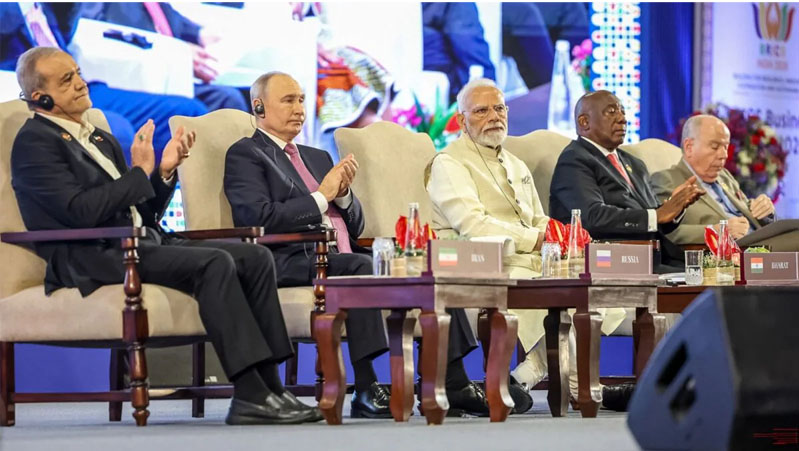







At the BRICS Business Forum in New Delhi, the relationship between economic power and political vulnerability supplied the underlying tension. Vladimir Putin’s emphasis on sanctions and alternative trade corridors placed Russia’s search for dependable commercial relationships at the centre of his intervention. For India, the gathering raised a wider question: how could countries with divergent strategic interests build economic arrangements that businesses would find reliable enough to use?
India’s answer deserves examination through the practical conditions of exchange. Market size becomes commercially consequential when firms can secure finance, navigate regulations, receive payments and deliver goods with reasonable predictability. The Forum’s significance therefore lies in whether its proposals can reduce those frictions across markedly different economies. This is also a substantive test of strategic autonomy: the capacity to widen economic choice while managing the dependencies that closer cooperation creates.
The Forum met at Bharat Mandapam on 11 September 2026, the day before the eighteenth BRICS Leaders’ Summit, and drew what organisers called the largest gathering of its kind in the grouping’s twenty-year history: some 2,000 delegates, roughly 1,100 from India and 900 from abroad, whose use of a same-day matching portal produced more than 600 business-to-business meetings within a few hours. Converting that density of contact into the density of contract this article’s title names is the question the remainder of it pursues, and the honest answer, stated at the outset, is that a review twelve months out will show it more reliably than the proceedings of the day itself.
Two Decades, and What They Have Not Yet Built
BRICS began as an analytic label before it became a political fact. Jim O’Neill’s 2001 paper for Goldman Sachs grouped Brazil, Russia, India and China as the economies whose growth would reshape the following decades of world output; the term entered diplomacy in 2006, when the four countries’ foreign ministers met on the margins of the United Nations General Assembly. The first leaders’ summit convened at Yekaterinburg in 2009, and South Africa’s accession the following year gave the grouping its fifth founder and its final letter. A Business Council, formed in 2013, gave the private sector its first standing channel into the summit process; the following year, at Fortaleza, the leaders agreed the New Development Bank and the Contingent Reserve Arrangement, the two institutions that still supply the grouping’s balance sheet. A Women’s Business Alliance was added in the years after.
The 2024-25 enlargement changed the grouping’s scale more than any single summit before it. Egypt, Ethiopia, Iran, Saudi Arabia and the United Arab Emirates joined as full members in January 2024, and Indonesia followed in 2025, bringing full membership to eleven: the five founders and the six that have joined since.2 A wider partner tier, agreed at Kazan, surrounds this membership without belonging to it, and official Indian language has described the two tiers together as a family of twenty or twenty-one; this article uses the eleven-member count for every aggregate figure that follows, since it is the count the Indian government itself used in confirming the New Delhi Declaration’s unanimous adoption.
What the eleven have built is real without being what a customs union or a security alliance would recognise as its own achievement, and the comparison is worth making only to set it aside, since BRICS never proposed to become either. Measured instead against what its own summits have repeatedly declared as intent, resilient supply chains, deeper local-currency trade, a stronger development bank, a voice for the Global South, the record is a habit of summitry that has survived a border clash between its two largest members and a war involving a third; a development bank whose lending remains modest against its founders’ ambitions but whose existence supplies a standing alternative to Bretton Woods conditionality; and, as of 11 September 2026, a Business Council carrying a set of proposed benchmarks, not yet a mandate, from the grouping’s convening chair. What draws states to the table, more than any institution individually, is a triad of pressures: the Global South’s appetite for a forum that asks no alliance discipline as the price of a seat; the utility, for governments hedging against a fraying order, of a table with no binding obligation attached; and a demographic and output arithmetic no chancellery can now dismiss.
A Parallel Grammar, Not a Rival Alliance
The comparison with the Group of Seven is more useful once the temptation to moralise is set aside. The Seven’s members share a political form, and issue between them the currencies in which most world trade is invoiced and most reserves are held; the eleven of BRICS share no political form at all, spanning a one-party state, a competitive-authoritarian federation, the world’s largest electoral democracy, a theocratic republic and several monarchies, and are, with partial success, experimenting with local-currency settlement that has yet to produce a payment rail rivalling SWIFT or a reserve asset rivalling the dollar. On a purchasing-power-parity basis the eleven’s combined output has exceeded the Seven’s for several years, and BRICS-plus economies have lifted their share of global merchandise exports from roughly a tenth to close to a quarter since 2000, a trajectory some analysts expect to overtake the Seven’s own share before the decade is out; at market exchange rates the Seven remain the larger grouping, a divergence that reflects different price levels and currency regimes rather than settling any argument about power. Demographically the populations diverge unevenly rather than uniformly: China’s population is ageing rapidly and Russia’s is contracting, while India’s, Indonesia’s and Ethiopia’s remain considerably younger, so that whatever labour-supply advantage the grouping holds belongs to some of its members rather than to the bloc as a whole.
India’s own position within this heterogeneity is genuinely peculiar: a founding member that also sits in the Group of Twenty’s outreach to the Seven, that has signed free-trade agreements with close to forty countries since 2014, and that treats its BRICS chairship as one instrument among several rather than a civilisational enclosure. The honest judgement is more modest than either bloc’s partisans would prefer. BRICS functions less as a counter-G7 than as a second vocabulary through which states that were absent when the older rules were written can make claims about order, local-currency settlement, supply-chain resilience, Global South voice, without first securing an invitation to use the first one.
India’s Chairship, Reported as a Range
India assumed its fourth BRICS chairship on 1 January 2026, after 2012, 2016 and 2021, under the theme Building for Resilience, Innovation, Cooperation and Sustainability. The Government of India’s own account, issued through the Press Information Bureau, records more than 350 meetings and high-level engagements across twenty-five cities;5 other government statements, including the Prime Minister’s own remarks, have cited nearly thirty cities as host, a divergence this article reports rather than resolves, since it most plausibly reflects differing cut-off dates rather than any substantive disagreement. The dispersal itself, hosting delegations in Jaipur, Nagpur, Gurugram, Varanasi and elsewhere rather than confining the year to New Delhi, served a stated purpose: demonstrating federal capacity and connecting the chairship to more of the country than its capital. Several of the Forum’s own reference points, the Incubator Network, the MSME Portal, the Start-Up Innovation Fund and a Global Value Chains Action Plan running to 2030, originated in this dispersed calendar rather than in the Forum itself. China assumes the chairship in 2027 under a continuity mechanism India has proposed to carry momentum across the transition; whether the Business Council’s benchmarks survive that handover is itself a question for the next review.
What Was Proposed, and by Whom
Prime Minister Modi’s own address, in the government’s English text, framed the day against two decades: a grouping of four founding states in 2006 now representing, with its partners, half the world’s population, forty per cent of global output and more than a quarter of global trade. He asked the Business Council to consider three benchmarks rather than announcing them as settled commitments: a report on removing the ten leading intra-BRICS trade barriers; support for one hundred start-ups scaling into other BRICS markets each year; and one thousand new business partnerships annually, with progress reviewed each year against these three measures. The distinction matters. A council can be asked to consider a benchmark and fail to adopt it, and the transcript records a request rather than a ratified mandate; this article therefore treats the ten barriers, the hundred start-ups and the thousand partnerships as proposed benchmarks throughout, and treats their annual review, when it comes, as the point at which the language can honestly graduate to mandate. Modi paired this with two further claims worth testing rather than repeating: that half of the world’s real-time payments now run on India’s Unified Payments Interface, and that India’s start-up ecosystem, more than 200,000 ventures and over 120 unicorns, supplies the evidentiary base for his Make in India, Innovate with India, Scale for the World formula. Both are the chair’s own figures, offered from the podium; neither is independently audited here, and both are reported as claims rather than as settled fact.
President Putin used the same platform for a narrower argument: that mutual investment among BRICS members had grown roughly sixfold over the preceding decade, that the grouping’s exports now approach a fifth of the world’s, and that Russia’s own trade with its partners had risen by some forty per cent past $230 billion, a rise he attributed substantially to adaptation under what he counted as some thirty thousand sanctions measures since 2022. These are Putin’s own figures, offered with the confidence a podium invites; none is independently audited here, and the thirty-thousand count in particular belongs to Russian accounting rather than to any external tally. His proposal, an investment platform anchored to the New Development Bank, alongside the Arctic and International North-South corridors as routes around Western chokepoints, is a financing question before it is a logistics one: an investment platform mobilises private capital only if it can price the currency, project and political risk a bank would otherwise absorb alone, and the address named the ambition without naming the guarantee structure that would let private capital actually take that risk on. President Pezeshkian pressed the same financing question from Iran’s more constrained position, proposing that the New Development Bank act as principal financier for BRICS infrastructure through local-currency lending and guarantees, and floating a jointly capitalised BRICS reinsurance company with $10 billion in initial capital to underwrite major projects, a proposal that would require the eleven members to agree not only the currency of settlement but the allocation of insured risk before a single project could draw on it.
Commerce Minister Goyal’s address supplied the day’s most specific ask: link payment systems, trade in one another’s currencies, and digitise trade documentation, citing India’s Unified Payments Interface, now accepted in eleven countries and past 250 billion transactions a year, as a model. The rhetoric of linking payment systems compresses four distinct problems a firm making a cross-border sale must actually solve: the currency in which the invoice is denominated; the messaging system that carries payment instructions between banks; the clearing arrangement that nets obligations between them; and the final settlement that discharges the debt. UPI solves a domestic version of the second and third of these; extending it, or anything like it, across eleven jurisdictions with different capital-account rules requires each pair of central banks to agree correspondent arrangements, and each exporter to accept exposure to a currency it cannot easily hedge in London or New York, since the deepest hedging markets remain built around the dollar. Trading in rupees or roubles reduces one exposure while creating another, unless the two central banks also agree a facility for converting accumulated balances back into a currency the exporter can spend, and neither Goyal’s address nor the Forum’s own communiqué named such a facility. Jaishankar’s own keynote supplied the criterion by which this and every other proposal should be judged: BRICS, he said, will be measured by whether firms encounter fewer obstacles, not by the breadth of its agenda, and FICCI’s Harsh Pati Singhania made the same point from the industry side, calling for interoperable trade-document standards, e-invoices, e-bills of lading, e-customs, ahead of any grander settlement architecture, on the grounds that these unglamorous fixes would help a small exporter sooner than a new currency ever would.
Modi’s own address tied global trade to secure sea lanes, open supply routes and protected seafarers, and the sentence is worth reading for its economics rather than its symbolism: a cargo that cannot be insured, or a crew that cannot be guaranteed safe passage, makes every other Forum commitment, a local-currency settlement, a start-up partnership, academic, since none of it moves without a ship that can sail. Putin’s Arctic and North-South corridors, and Pezeshkian’s account of Iran’s own energy reserves as a partnership basis, both answer the same insurance-and-chokepoint problem from the supply side, offering alternative routes rather than cheaper cover on the existing ones; whether either route actually lowers the premium that prices the risk, as opposed to merely offering an alternative to running it, is a question the day’s speeches did not reach.
What India Wants From the Arrangement
India’s own role across the day was described more often than its own interest was. The country appears throughout as host, convenor, bridge-builder and provider of digital infrastructure; what it expects to receive in return deserves the same specificity. Four objectives recur across Goyal’s and Modi’s remarks and the wider chairship record: diversified export markets for engineering goods, electronics and pharmaceuticals, the categories Goyal named as India’s largest manufactured exports; investment in the domestic manufacturing capacity, from semiconductors to critical minerals, that Modi’s address listed as the strategic base for Make in India; technology and standards partnerships that let Indian firms help set terms rather than simply adopt them, the interoperable trade-document standards Singhania pressed being one small instance; and openings for India’s services exporters, information technology, healthcare and professional services among them, into markets where recognition of Indian qualifications and licences remains inconsistent. Each objective carries a cost the chairship’s own language does not advertise. Wider market access for Indian exporters is also wider market access for BRICS exporters into India, and a domestic producer competing against a lower-cost import from a partner economy experiences that access as pressure rather than opportunity; the same trade-barrier report the Business Council has been asked to prepare will, if it is honest, list barriers that protect Indian producers alongside barriers that constrain them. A mature account of India’s strategic autonomy holds both halves of that sentence at once.
China and the Shape of the Dependence
No relationship in this account does more work, and receives less scrutiny in most treatments of the Forum, than India’s economic tie to China, the partner named most often in the speeches and examined least as an economic actor in its own right. In the year ending in 2026, India’s ten BRICS partners together supplied close to 42 per cent of its merchandise imports while absorbing only 22 per cent of its exports, a gap that left India with a $226.1 billion trade deficit against the grouping as a whole; intra-BRICS merchandise trade overall has grown roughly thirteenfold since 2003, from $84 billion to above $1.17 trillion by 2024, on the Indian Commerce Ministry’s own accounting, the statistical backbone against which Modi’s claim of a fourfold-and-a-half expansion in the grouping’s combined economic strength should be read as the chair’s own framing rather than an independently audited figure. China supplies most of the asymmetry inside that total: in 2024, India imported some $109 billion in goods from China against exports of roughly $15 billion, a gap that has widened faster than almost any of India’s other trading relationships. The question a Forum built around resilience and diversification has to answer, and did not, is whether local-currency settlement, linked payment systems and a Business Council’s list of trade barriers would diversify this dependence or simply reprice it. A rupee-yuan settlement corridor makes a large bilateral imbalance easier to finance without making it smaller; it does not, by itself, give an Indian pharmaceutical firm an alternative supplier of active ingredients, or an Indian electronics assembler an alternative source of components, any more than a new invoice currency changes what is actually inside the box. Where cooperation and competition genuinely diverge is easier to specify than to resolve: the two economies can cooperate on green-technology manufacturing, since Chinese capital and Indian assembly capacity remain complementary for now, while their industrial ambitions compete directly in semiconductors, telecommunications equipment and, increasingly, the batteries and critical-mineral processing both have named as strategic. A more multipolar international system, the Forum’s own premise, does not by itself produce a more balanced economic relationship inside the bloc that claims to represent it; that balance, if it comes, will come from India’s own investment in alternative suppliers and from bilateral negotiation with Beijing, not from a BRICS communiqué.
The Rest of the Table
Russia, India and Iran carry recognisable interests through this account because their leaders spoke to them directly; the remaining seven supply more of the Forum’s geographic breadth than its argument, and a brief corrective is owed. Brazil’s interest runs through agriculture and the New Development Bank, whose next capital round it will help shape as a founding shareholder. South Africa supplies the grouping’s African anchor and a financial sector sophisticated enough to have hosted serious discussion of the Bank’s own governance in earlier years, though its small economy limits how much of the Forum’s ambition it can itself absorb. Indonesia, the newest full member, brings the nickel reserves that every electric-vehicle battery supply chain now prices, a resource India, China and Gulf capital markets all have reason to court on different terms; whether Jakarta continues to sell processed nickel rather than ore will decide who captures the value in that chain. The Gulf members, Saudi Arabia and the United Arab Emirates, bring capital and energy and a diplomatic style that treats BRICS membership as one hedge among several, exactly as India treats its own; both continue to price oil and hold most of their reserves in dollars regardless of what a Forum panel recommends about local-currency settlement, and nothing said on 11 September suggested that calculation was about to change. Egypt brings a canal whose tolls depend on the same freedom of navigation the Forum discussed in the abstract, and a debt position that constrains how much of the New Development Bank’s lending it can itself absorb; Ethiopia brings a growth story and a comparable constraint. None of the seven is merely a market or merely a supplier, and an account of the Forum that treats them as scenery around Russia, India and Iran understates how much of BRICS’s future bargaining will run through exactly these seven capitals.
The Meetings Are Not the Contract
The Forum’s most quoted statistic, more than 600 business-to-business meetings generated from a matching portal within four or five hours, demonstrates engagement at genuine scale; it does not, by itself, demonstrate a single completed transaction, and holding that distinction is what this article’s own title asks of its readers.1 No independently reported agreement between named firms, with financing, an implementation date and an expected commercial benefit, has surfaced from the day’s proceedings at the time of writing, and that absence deserves to be stated rather than smoothed over. The one verified conversion the chairship year can point to sits a level above individual firms: a BRICS Agreement on Cooperation and Mutual Administrative Assistance in Customs Matters, which members confirmed their in-principle willingness to sign, aimed at faster clearance and lower transaction costs, and a Memorandum of Understanding on standardisation actually signed by the heads of the members’ national standards bodies, both recorded in the Government of India’s own account of the chairship’s outcomes.These are intergovernmental instruments rather than commercial contracts, and they matter for the reason Singhania’s own remarks identified: a shared customs procedure and a common standard lower the cost of every transaction that follows in a way no single deal, however large, would. What the record does not yet show is whether that lowered cost has produced a transaction any business could point to. A hypothetical makes the mechanism concrete without pretending it is fact: a Gujarati textile exporter, quoting a Brazilian buyer in rupees under a settlement corridor the payments task force has not yet built, using an e-bill of lading the standardisation MoU has not yet been implemented to require, clearing customs under an agreement still awaiting signature, would be the transaction the Forum’s rhetoric describes. This is offered as illustration of the plumbing that does not yet exist, not as report of plumbing that does, and the twelve-month review the Business Council owes the grouping should be judged by how many such transactions it can actually name.
Financing the wager, in the end, is a question of who bears which risk. Trade credit, needed to bridge the gap between an invoice and its payment, sits naturally with the commercial banks each exporter already uses; equity investment in new manufacturing capacity, the kind Modi’s address invited into shipbuilding and semiconductors, needs patient capital willing to hold currency and political risk for years rather than months; and the guarantees that would let a private investor take on a BRICS infrastructure project at all are precisely what Putin’s investment platform and Pezeshkian’s reinsurance proposal both gesture toward without yet pricing. The New Development Bank’s own lending book remains modest against these ambitions, which is an arithmetic fact rather than a criticism: a bank capitalised by developing economies cannot, by itself, absorb the risk that eleven governments and several thousand exporters are being asked to take on faith.
Services, and the People Who Supply Them
Goods, ships and industrial inputs dominated the Forum’s own vocabulary; services appeared mainly in the list Goyal read out, agriculture, pharmaceuticals, engineering, electronics, automobiles, and services as a single further category, rather than in any developed treatment of their own. The gap matters because India’s comparative advantage runs at least as strongly through services, information technology, professional services, healthcare and education among them, as through the manufacturing the Forum’s language foregrounded, and none of these travels without the people who supply them. An Indian doctor, architect or accountant seeking to practise in Brazil or South Africa faces a licensing and qualification-recognition regime that a customs agreement does nothing to simplify; a services exporter negotiating an outsourcing contract in the Gulf faces business-mobility rules a trade-barrier report focused on goods will not touch. If the Business Council’s promised report on the ten leading barriers concerns itself only with tariffs and customs delay, it will have measured the easier half of the problem and left the harder half, the recognition of a foreign qualification, the right to send a consultant across a border for a fixed engagement, for a future review to discover.
Whose Interdependence
Women-led enterprise and small firms recur across the Forum’s own record, the Women’s Business Alliance’s parallel programming, Goyal’s attention to invoice-discounting for women exporters, the chairship’s Jaipur Consensus, and that recurrence should be read as a description of intent rather than as evidence of inclusion already achieved. The test a woman-led exporter actually faces is whether she can secure credit on the same terms as a comparable firm, meet the same technical standards, reach the same buyers and be paid on the same schedule, and the Forum’s speeches proposed instruments, invoice-discounting, a Women’s Advancement Fund, without yet reporting whether either has reached a firm outside the delegates already in the room. The same caution applies to the chairship’s own hospitality: hosting ministerial meetings in Jaipur, Nagpur and Varanasi demonstrates federal capacity, as this article has already argued, but it does not by itself establish that a manufacturer in one of those cities, rather than in Delhi or Mumbai, has gained anything from the year’s calendar. Humanity First, the chairship’s own branding, is a normative claim best judged against enterprise survival, employment and affordability rather than repeated as description.
What the Institutions Are Actually For
The vocabulary this article and the Forum’s own speeches both reach for, resilience, interoperability, transactional density, needs a causal argument underneath it, and the strongest available one is a modest one: repeated engagement, of the kind a Business Forum, a standards MoU and an annual review supply, can improve the information firms and governments hold about one another, reduce the uncertainty that keeps a cautious investor on the sidelines, and make the commitments a chairship extracts more credible than a single summit’s declaration would be on its own. Whether this mechanism actually operates depends on conditions the Forum’s speeches did not examine: the administrative capacity of eleven differently resourced bureaucracies to implement a shared customs agreement at the same pace; the commercial incentive an individual firm has to use a new settlement corridor rather than the dollar-denominated one it already trusts; and the political trust between capitals that have, within the same grouping, fought a border skirmish and disagreed sharply over a war in West Asia. A further question deserves to be asked and rarely is: how much of whatever cooperation follows from 11 September would have happened through ordinary bilateral relationships regardless of BRICS’s existence? Two firms in India and Brazil that find each other through the Forum’s matching portal might equally have found each other through an existing trade fair or a chamber-of-commerce introduction; the honest test of the grouping’s institutional value is the cooperation that would not otherwise have occurred, and that is precisely the figure the Business Council’s promised report cannot, by its own design, isolate.
A Framework for the Next Review
Modi’s own proposal, a report on ten trade barriers, a hundred start-ups scaled annually, a thousand partnerships, already invites an annual test; the test needs evidence categories, and a responsible party, attached to each of its terms.
| Area | Evidence worth examining | Primarily responsible |
| Trade barriers | A specific rule changed, and its measured effect on cost or clearance time | National regulators and customs authorities |
| Start-up scaling | Entry into a named second BRICS market, customers acquired, revenue sustained | The Business Council and national incubator networks |
| Business partnerships | Signed, operational agreements with a stated financing and delivery date | Individual firms, reported through chambers of commerce |
| Payment cooperation | Completed cross-border transactions, their cost and settlement time against the dollar-denominated alternative | Central banks and the cross-border payments task force |
| Investment | Capital actually committed and disbursed against a project’s milestones | The New Development Bank and co-financing partners |
| Inclusion | Credit, standards compliance and payment terms reaching firms outside the Forum’s own delegate list | The Women’s Business Alliance and national MSME ministries |
A Business Council can recommend a reform; it cannot itself change a customs rule, disburse a loan or extend credit to a small exporter, and the table above is meant to keep that separation visible. The chairship passes to China in 2027 under the continuity mechanism already noted; whether it holds is one more item for the same review.
The Test That Remains
The Forum’s wager was stated more honestly than it was tested: that eleven members, speaking for nearly half of humanity and something over a quarter of world trade, can turn weight into invoices rather than into another communiqué. India placed that wager in a usable form—ten barriers to be named, a hundred start-ups to scale, a thousand partnerships to be counted—and then, correctly, left the counting to a review that has not yet occurred. That restraint is the chairship’s real contribution. A mandate announced from the podium would have been cheaper than a benchmark that can fail in public.
The inclusive claim of the day is still only a claim. Women-led exporters, MSMEs outside Delhi and Mumbai, and the services professionals whose licences no customs MoU will recognise were present in the vocabulary and thin in the record. Brazil’s claim on the Bank, Indonesia’s nickel, the Gulf’s capital, Egypt’s canal, South Africa’s financial depth, Ethiopia’s growth under constraint—these are not scenery around three speeches. They are where the next bargains will be struck. A review that cannot name a firm in Campinas, Jakarta, or Sharjah has not reviewed the grouping it describes.
Nor is the vision exhausted by suspicion. Secure sea lanes and protected seafarers are not ornament; without a ship that can sail, local-currency settlement is a footnote. Interoperable documents, a signed standards MoU, and a customs text waiting for signature are unglamorous and, if implemented, more useful to a small exporter than a new reserve asset. Digital public infrastructure, offered as India’s exhibit, becomes a public good only when a partner’s bank can use it without surrendering a capital-account rule it is not ready to yield. Cooperation with China on green assembly can sit beside competition in semiconductors; the $226 billion intra-BRICS deficit is not dissolved by a rupee-yuan rail that merely refinances the same box.
Strategic autonomy, on this evidence, is not the hoarding of options. It is the capacity to widen markets for engineering goods, pharmaceuticals, electronics and services while accepting that every opened Indian tariff is also an opened Indian market, and that dependence on Chinese components, dollar clearing, and sea lanes no member owns is managed rather than wished away. The next review should be brief and numbered: which rule changed; which start-up crossed a border and stayed; which partnership drew finance and a date; which payment cleared cheaper or faster than the dollar alternative; which woman-led or small firm outside the delegate list was paid on time. Meetings assembled the room. Commerce will have advanced when those five answers can be given without another Forum to say so.
Views: 345

Dr. Maheep
Dr. Maheep is Director, Indian Perspective on Global Affairs (IPGA), and a leading analyst of India’s foreign policy and South Asian geopolitics. He earned his PhD in Arab and Islamic Studies. With more than a decade of teaching and research experience in International Relations and Global Politics, he contributes regularly on issues shaping national and global affairs.


