









India and Qatar: Civilisational Affinity, Strategic Trust and Humanitarian Diplomacy
Long before the vocabulary of strategic partnership entered the lexicon of modern diplomacy, the waters of the Arabian Sea had already woven India and Qatar into a shared civilisational fabric. For centuries, dhows laden with textiles, spices, grain and timber sailed from the ports of Gujarat and Malabar towards the pearling harbours of the Qatari peninsula, returning with pearls, dates and the accumulated trust of countless commercial exchanges. The Indian rupee circulated as legal tender in Doha well into the twentieth century, a remarkable testament to an economic intimacy that preceded formal statehood itself. Upon this inheritance, the establishment of diplomatic relations in 1973, commemorated in its fiftieth year in 2023, built a steady architecture of political engagement: institutionalised Foreign Office Consultations, expanding trade, high-level exchanges and an Indian community that grew into the largest expatriate population in Qatar. Under Prime Minister Narendra Modi, this maturing relationship acquired fresh strategic vision, culminating in its formal elevation to a Strategic Partnership during the State Visit of the Amir of Qatar, Sheikh Tamim bin Hamad Al Thani, to New Delhi in February 2025.
It was against this backdrop, and at one of the most consequential geopolitical moments in recent West Asian history, that External Affairs Minister Dr. S. Jaishankar arrived in Doha on 5 July 2026. The region he entered was in the midst of profound transformation: Qatar was actively mediating the delicate negotiations between the United States and Iran that followed the ceasefire in the Gulf, energy markets were recalibrating around the security of the Strait of Hormuz, and governments across West Asia were rediscovering the value of diplomacy after a period of acute volatility. His presence in Doha at precisely this hour carried a message of strategic clarity: India regards Qatar as an indispensable partner in the construction of a stable, prosperous and dialogue-centred West Asia, and it intends to deepen that partnership across every dimension of statecraft.
From Maritime Commerce to Institutional Trust
The evolution of India-Qatar relations offers an instructive study in how patient diplomacy converts historical affinity into institutional resilience. The visit of Prime Minister Manmohan Singh to Doha in 2008 yielded a defence cooperation agreement and signalled the deliberate broadening of the relationship beyond commerce, while successive Amiri visits to New Delhi deepened political comfort between the two capitals. Qatar’s emergence as a global liquefied natural gas power coincided providentially with India’s accelerating energy requirements, and the first LNG shipment from Ras Laffan to the Dahej terminal in 2004 inaugurated an energy relationship that became the material spine of the partnership. Two decades of uninterrupted, reliable energy flows created habits of dependability that spilled over into every other domain, teaching both establishments that the other could be counted upon in fair weather and foul alike. This accumulated reliability would later prove decisive when the relationship confronted its most delicate diplomatic tests.
The Modi Era: Strategic Vision and the Elevation of Partnership
The advent of Prime Minister Modi’s government in 2014 brought to India’s West Asia policy an unprecedented combination of personal diplomacy, economic ambition and strategic coherence, within which Qatar occupied a place of distinct importance. The Prime Minister’s visit to Doha in June 2016 produced agreements spanning defence, investment, information technology and skill development, and articulated a shared vision of the Gulf as an extension of India’s strategic neighbourhood. The philosophical compatibility between New Delhi’s strategic autonomy and Doha’s calibrated independence gave the partnership an intellectual coherence transcending transactional convenience.
The Amir’s State Visit to India on 17 and 18 February 2025 crowned this decade of intensified engagement with the Agreement on the Establishment of a Strategic Partnership, consolidating the entire bilateral architecture within a single forward-looking framework. The visit yielded a revised Double Taxation Avoidance Agreement, memoranda on financial and economic cooperation, youth affairs and sports, and documents and archives, together with institutional linkages between Invest India and Invest Qatar and between the Confederation of Indian Industry and the Qatar Businessmen Association. The two governments committed to doubling bilateral trade to approximately twenty-eight billion United States dollars within five years, agreed to explore a comprehensive free trade agreement, welcomed the Qatar Investment Authority’s decision to open an office in India, operationalised India’s Unified Payments Interface at Qatar National Bank points of sale, and announced a Year of Culture, Friendship and Sports.
| FEBRUARY 2025 ELEVATION AT A GLANCE Strategic Partnership Agreement signed during the Amir’s State Visit to India (17-18 February 2025); revised Double Taxation Avoidance Agreement; commitment to double bilateral trade to about USD 28 billion in five years; exploration of a comprehensive Free Trade Agreement; QIA office in India; UPI operationalised in Qatar; Year of Culture, Friendship and Sports announced. |
July 2026 Visit: Diplomacy at a Consequential Hour
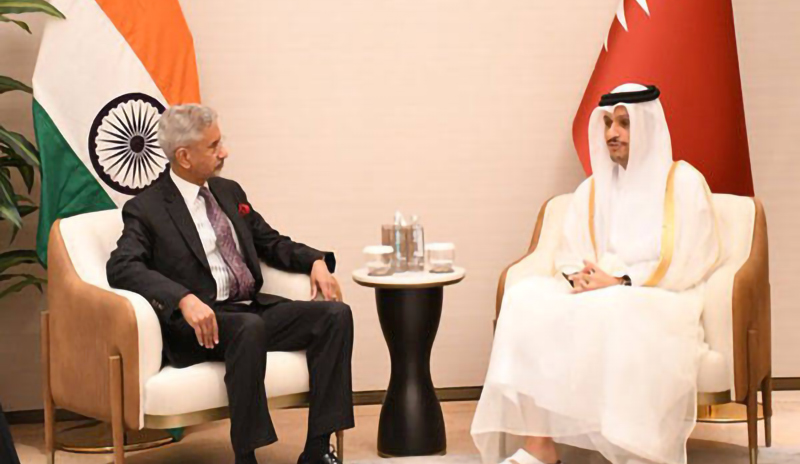
Dr. Jaishankar’s engagement in Doha on 5 July 2026 must be read as both a consolidation of the Strategic Partnership and a sophisticated exercise in regional statecraft. The first leg of the visit, from 5 to 10 July, focused on the Gulf region, where the External Affairs Minister held talks with the leadership and foreign ministers of Qatar, Bahrain, Kuwait and Oman, before proceeding to New York and Brussels. In Doha, his meeting with Sheikh Mohammed bin Abdulrahman Al Thani, Prime Minister and Minister of Foreign Affairs of the State of Qatar, reviewed the entire spectrum of bilateral relations with particular emphasis on energy, trade, investments, connectivity, security and people-to-people ties, while exploring new opportunities for deepening the partnership. He thanked the Qatari leadership for ensuring the safety and well-being of the Indian community during a period of regional conflict, and, as the Ministry of External Affairs recorded, commended the prominent and active mediation role played by Qatar in the ongoing negotiations between the United States and Iran.
The sequencing of the tour carried its own strategic grammar. By commencing in Doha and continuing to New York, where India formally launched its campaign for a non-permanent seat on the United Nations Security Council for the 2028-29 term, Dr. Jaishankar wove Qatar into the opening chapter of a diplomatic narrative connecting Gulf stability with India’s global multilateral aspirations. His warm interaction with representatives of the Indian community, whose resilience during the recent conflict he commended and whose contributions to Qatari society he described as widely appreciated, reaffirmed the people-centric philosophy animating India’s Gulf engagement. The visit thus operated on three registers at once: bilateral consolidation, regional reassurance and global positioning.
| DOHA ENGAGEMENT, 5 JULY 2026 Meeting with Prime Minister and Foreign Minister Sheikh Mohammed bin Abdulrahman Al Thani; full-spectrum review of energy, trade, investments, connectivity, security and people-to-people ties; India’s public commendation of Qatar’s mediation in the US-Iran negotiations; interaction with the Indian community; first leg (5-10 July) covering Qatar, Bahrain, Kuwait and Oman, followed by the launch of India’s UNSC 2028-29 campaign in New York. |
Qatar as Mediator: The Statecraft of Dialogue
Qatar’s evolution into one of the world’s most trusted mediators represents a signal achievement of contemporary middle power diplomacy, and India’s public appreciation of this role during the July 2026 visit constitutes a meaningful act of normative endorsement. Doha’s diplomatic portfolio encompasses facilitation in Afghanistan, sustained humanitarian negotiation in Gaza, quiet good offices in numerous disputes and, most consequentially, the hosting and advancement of the indirect negotiations between Washington and Tehran that followed the ceasefire in the Gulf. Qatari mediation combines geographic position, financial capacity, relationships of confidence with otherwise estranged parties and a national conviction that dialogue constitutes a strategic asset of the first order. For India, whose civilisational instincts and declared foreign policy consistently favour dialogue and de-escalation, this bridging role aligns naturally with its own vision of regional order. The stability of the Strait of Hormuz, through which flows a decisive share of India’s energy imports, and the safety of more than eight million Indian nationals across the Gulf give New Delhi a direct and material stake in the success of Qatari diplomacy, elevating the bilateral partnership into an instrument of regional public goods.
Humanitarian Statecraft: Operation Sindhu and the Diplomacy of Care
Among the most distinctive features of India’s contemporary foreign policy is the elevation of citizen welfare into a first-order strategic priority, a doctrine that found vivid expression during the recent conflict involving Iran and Israel. Through Operation Sindhu, launched in June 2025, India orchestrated the safe evacuation of thousands of its nationals from zones of active hostilities, coordinating air corridors, land transit and consular assistance in the proud lineage of the Kuwait airlift of 1990, Operation Rahat in Yemen, Operation Ganga in Ukraine and Operation Kaveri in Sudan. Gulf partners, Qatar among them, facilitated this humanitarian statecraft through airspace cooperation, consular coordination and the steady protection of Indian communities within their own territories. This diplomacy of care operates as a continuous practice: standing mechanisms for labour welfare and emergency assistance, bilateral protections for workers, and Qatar’s own pioneering labour reforms together create a shared normative space in which both governments treat the dignity of migrants as a matter of mutual pride. Dr. Jaishankar’s public gratitude in Doha for Qatar’s care of the Indian community acknowledged precisely this convergence, affirming that humanitarian responsibility has become a load-bearing pillar of the Strategic Partnership.
Quiet Diplomacy Vindicated: The Homecoming of the Naval Veterans
The resolution of the case involving eight former Indian Navy personnel stands as a landmark illustration of mature diplomatic engagement built upon strategic trust. The veterans, employed by a private company in Doha, faced capital sentences following judicial proceedings in Qatar in 2023, a development that would have strained a lesser relationship to breaking point. India’s response exemplified the discipline of quiet diplomacy: sustained legal engagement through the appellate process, respectful acknowledgement of Qatari sovereignty and judicial procedure, calibrated public communication that preserved space for negotiation, and personal engagement at the highest levels, including the meeting between Prime Minister Modi and the Amir on the margins of COP28 in Dubai in December 2023. The commutation of the sentences that month and the release and repatriation of the veterans in February 2024 vindicated this patient statecraft in the most complete manner possible.
The episode reveals the operating logic of the entire relationship. Both governments chose discretion over theatre, engagement over recrimination and the preservation of long-term trust over short-term posturing, converting a moment of acute sensitivity into a demonstration of diplomatic maturity. Prime Minister Modi’s return to Doha within days of the veterans’ homecoming in February 2024, and the Amir’s transformative State Visit to India the following year, flowed directly from the confidence this episode consolidated. Few case studies in contemporary diplomacy illustrate so clearly that strategic trust, patiently constructed, functions as the ultimate insurance of a bilateral relationship.
| STRATEGIC TRUST IN ACTION December 2023: Capital sentences of eight former Indian Navy veterans commuted following high-level engagement, including the Modi-Amir meeting at COP28. February 2024: veterans released and repatriated; Prime Minister Modi visits Doha within days. June 2025: Operation Sindhu evacuates thousands of Indians from conflict zones with Gulf cooperation. July 2026: Dr. Jaishankar thanks Qatar for the safety and well-being of the Indian community. |
The Living Bridge: The Indian Community in Qatar
The Indian community in Qatar, exceeding eight hundred thousand persons and constituting the largest expatriate group in the country, forms the most vibrant bridge between the two nations. Indian engineers, physicians, educators, bankers, entrepreneurs and skilled workers participate in every sector of the Qatari economy, contributing visibly to Qatar National Vision 2030 while sustaining families across India through substantial remittances. Indian schools in Doha educate tens of thousands of students, community organisations animate a rich cultural calendar, and the community’s reputation for competence, integrity and social harmony has earned the consistent appreciation of the Qatari leadership. Qatar’s exemplary care of this community, particularly during the COVID-19 pandemic and the recent regional conflict, has woven a fabric of gratitude that no formal agreement could replicate. Extended e-Visa facilities, the Unified Payments Interface in Qatar and expanding air connectivity are progressively thickening the human and commercial circulation between the two societies; in the fullest sense, the diaspora functions as a permanent ambassador corps, renewing the relationship daily.
Energy Security: The Architecture of Resilient Interdependence
Energy constitutes the material foundation of the strategic edifice, and its logic is best understood through the framework of complex interdependence, in which mutual reliance generates mutual restraint, stability and shared prosperity. Qatar supplies a commanding share of India’s liquefied natural gas imports, in the range of thirty-five to forty per cent in recent years, anchoring India’s ambition to raise natural gas to fifteen per cent of its primary energy mix by 2030. The landmark agreement of February 2024 between QatarEnergy and Petronet LNG, providing 7.5 million tonnes per annum for twenty years from 2028 and valued at approximately seventy-eight billion United States dollars, ranks among the largest energy contracts in the history of both nations, guaranteeing supply security and pricing stability for India while assuring Qatar of durable demand from the world’s fastest-growing major energy market. The partnership is simultaneously evolving beyond hydrocarbons: Qatar’s North Field expansion and interest in green hydrogen converge with India’s National Green Hydrogen Mission, its renewable energy programme and its leadership of the International Solar Alliance, positioning the relationship to remain central to each other’s energy security across successive technological eras.
| THE ENERGY COMPACT QatarEnergy-Petronet LNG agreement, February 2024: 7.5 million tonnes per annum for twenty years from 2028, valued at about USD 78 billion. Qatar supplies roughly 35-40 per cent of India’s LNG imports, anchoring the national target of 15 per cent natural gas in the energy mix by 2030, with green hydrogen and sustainability technologies as the next frontier. |
Trade, Investment and the Geo-economics of Complementarity
The economic relationship exhibits the classic profile of complementarity between a capital-rich, energy-exporting economy and a rapidly expanding, talent-rich market of continental scale. Bilateral trade of approximately fourteen billion United States dollars at the time of the 2025 State Visit is targeted to double within five years, supported by the revised taxation framework, the Invest India-Invest Qatar bridge and the prospective free trade agreement. The Qatar Investment Authority, with global assets exceeding five hundred billion United States dollars, has deepened its Indian portfolio across technology, telecommunications, retail, renewable energy and financial services, while Qatar National Bank’s presence in Gujarat International Finance Tec-City and the operationalisation of the Unified Payments Interface illustrate financial connectivity acquiring twenty-first century form. Beyond the headline figures lies a deliberate strategy of diversification into the knowledge economy: India’s strengths in information technology, artificial intelligence, fintech, pharmaceuticals and space applications align with Qatar’s aspiration to build a diversified, knowledge-based economy, moving economic statecraft from the management of trade flows to the co-creation of value.
Defence, Maritime Security and Cooperative Order at Sea
The security dimension of the partnership, conducted with characteristic discretion, has acquired steady depth across training, exercises, port calls and institutional dialogue. The bilateral naval exercise Za’ir-Al-Bahr, inaugurated in 2019, symbolises a maturing pattern of maritime cooperation between two nations whose prosperity depends upon the security of the northern Indian Ocean and the Gulf. Dialogue on counter-terrorism, cyber security and maritime domain awareness continues within established joint mechanisms, and for India, whose western maritime approaches connect directly to the Gulf, and for Qatar, whose entire economic life moves through sea lanes converging on the Strait of Hormuz, cooperative maritime security is an existential common interest. Within India’s doctrine of Security and Growth for All in the Region, the safety of energy shipments, the resilience of supply chains and the maintenance of open sea lanes constitute shared public goods to which both navies contribute, a quiet but consequential contribution to a rules-based maritime order stretching from the Gulf to the wider Indo-Pacific.
Multipolarity, Strategic Autonomy and the Voice of the Global South
The India-Qatar partnership flourishes within, and actively contributes to, the emerging multipolar international order. Both nations practise strategic autonomy as a first principle: India through multi-alignment and its leadership of the Global South, exemplified by its G20 presidency and the Voice of the Global South summits; Qatar through diversified partnerships and mediation diplomacy across geopolitical divides. Each recognises in the other a fellow practitioner of calibrated diplomacy that converts autonomy into agency and influence. Their cooperation across multilateral forums expresses a shared commitment to reformed multilateralism, and Dr. Jaishankar’s journey from Doha to New York to launch India’s Security Council campaign embodied the continuity between Gulf partnership and global aspiration. The partnership also occupies a meaningful place within trans-regional connectivity: the India-Middle East-Europe Economic Corridor envisions the Gulf as the hinge between South Asia and Europe, and Qatar’s world-class ports, logistics capacity and financial resources position it advantageously within this architecture, alongside food security and digital corridors built upon India’s digital public infrastructure.
Soft Power and Civilisational Diplomacy
The cultural dimension draws upon reservoirs of affinity accumulated over centuries and renewed through deliberate public diplomacy. The Qatar-India Year of Culture in 2019 showcased the breadth of artistic, culinary, sporting and intellectual exchange between the two societies, and the Year of Culture, Friendship and Sports announced in 2025 promises a still richer season of engagement. Yoga flourishes across Qatar, Indian cinema and cuisine occupy a cherished place in Qatari popular culture, and cooperation in documents and archives will illuminate the shared maritime past preserved in the records of both nations. Educational and knowledge partnerships represent the frontier of this engagement, with academic exchanges expanding and both governments identifying education, research and innovation as priority domains. Public diplomacy of this kind performs an essential function: it translates strategic partnership from the language of governments into the lived experience of societies, ensuring the relationship rests upon affection as well as interest.
The Road Ahead: A Partnership for the Asian Century
The forward horizon of India-Qatar relations is defined by the convergence of two national trajectories of transformation: India’s advance towards Viksit Bharat 2047 and Qatar’s pursuit of the diversified, knowledge-driven future charted in its National Vision 2030. The Strategic Partnership provides the institutional vessel through which these journeys reinforce one another: Qatari capital and energy powering Indian growth, Indian talent, technology and markets accelerating Qatari diversification, and both nations collaborating in artificial intelligence, green hydrogen, food security, the blue economy, space applications and the industries of sustainability. Equally significant is the partnership’s contribution to regional peace. India’s balanced engagement across West Asia and Qatar’s mediation diplomacy converge upon the same strategic conclusion: the prosperity of Asia requires a Gulf at peace, sea lanes that are secure and disputes resolved through dialogue. As the negotiations hosted in Doha continue to shape regional security, India-Qatar cooperation stands as a stabilising constant amid transformation, a partnership whose steadiness is itself a strategic asset for the wider world.
Conclusion: Confidence, Consistency and Common Vision
India–Qatar relations today represent far more than the sum of their bilateral instruments. They embody a mature strategic partnership founded upon civilisational affinity, mutual trust, humanitarian responsibility, energy interdependence, economic complementarity, and a shared commitment to regional stability within an inclusive multipolar order. The journey from the pearling dhows of the Arabian Sea to the Strategic Partnership Agreement of 2025, from the first LNG shipment of 2004 to the landmark seventy-eight billion dollar energy compact of 2024, and from quiet consular diplomacy to the successful homecoming of the former Indian naval veterans through patient statecraft, traces a consistent arc of deepening confidence, reaffirmed by External Affairs Minister Dr. S. Jaishankar’s July 2026 visit at a moment of profound regional transformation.
The deeper lesson of this relationship belongs to the study of diplomacy itself. Enduring partnerships are ultimately sustained by confidence, consistency, and a shared vision for peace, prosperity, and human dignity—qualities that agreements may codify but only enlightened statesmanship can cultivate. Across five decades of formal diplomatic relations and many centuries of civilisational interaction, India and Qatar have patiently nurtured these qualities, enabling them to shape a West Asia defined by dialogue, an Indian Ocean sustained by cooperation, and a multipolar international order enriched by the constructive agency of the Global South. In an era remembered as much for geopolitical turbulence as for strategic realignment, the India–Qatar partnership offers the international community something rarer and more enduring than power itself: the quiet, compounding authority of trust.
Views: 214

Dr. Maheep
Dr. Maheep is Director, Indian Perspective on Global Affairs (IPGA), and a leading analyst of India’s foreign policy and South Asian geopolitics. He earned his PhD in Arab and Islamic Studies. With more than a decade of teaching and research experience in International Relations and Global Politics, he contributes regularly on issues shaping national and global affairs.


