






President Min Aung Hlaing’s 2026 Visit: India-Myanmar Relations in a Reordering Asia
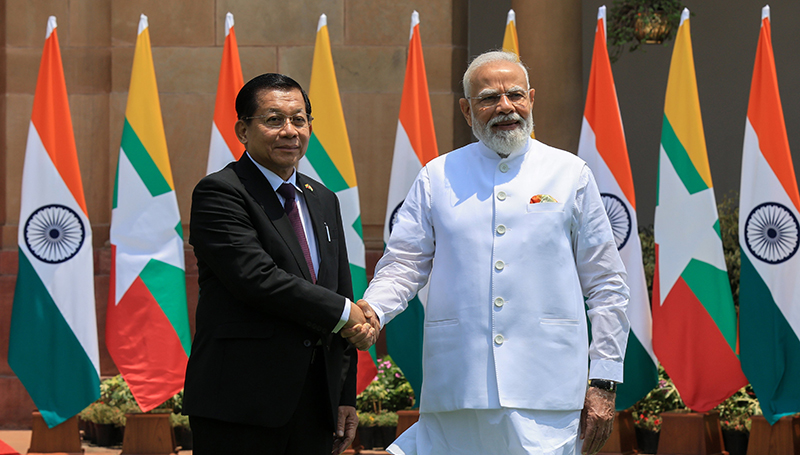
The dawn that broke over the Mahabodhi Temple at Bodh Gaya on 30 May 2026 carried profound resonance. As the first light touched the sacred Bodhi Tree, silent witness to the Buddha’s enlightenment more than two and a half millennia ago, President U Min Aung Hlaing of Myanmar knelt in prayer at the outset of his first foreign visit since assuming the presidency in April. In that deliberate gesture at the civilisational fountainhead of the faith that has shaped Myanmar’s spiritual and cultural identity for centuries, the new president conveyed a message that transcended protocol. Before any agreement was signed or communiqué issued, the visit had already acquired deep strategic and symbolic meaning.
This choice of India as the destination for his inaugural journey abroad, following weeks after the Chinese foreign minister’s visit to Naypyidaw, highlighted Myanmar’s pursuit of strategic space and diversified partnerships. As Morgan Michaels of the International Institute for Strategic Studies observed, India had maintained consistent channels of engagement with Myanmar, recognising the Tatmadaw’s enduring role in the country’s political landscape. The decision to begin in Bodh Gaya and proceed to New Delhi, as former Indian ambassador Gautam Mukhopadhaya noted, reflected Myanmar’s search for regional legitimacy, balanced relationships, and strengthened autonomy in a complex regional environment.
This visit represented far more than a routine diplomatic engagement. It stood at the intersection of civilisational heritage, strategic necessity, developmental partnership, and regional connectivity. The article argues that President Min Aung Hlaing’s 2026 visit embodied the convergence of shared Buddhist heritage, connectivity diplomacy, humanitarian solidarity, security cooperation, clean-energy collaboration, and critical-mineral partnerships. This framework strengthens Myanmar’s strategic autonomy and offers a model of regional conduct grounded in sovereign equality, mutual benefit, and long-term capacity building. In a reordering Asia shaped by evolving power dynamics and competing visions of connectivity, the India–Myanmar partnership demonstrates how historical trust, developmental cooperation, and strategic prudence together create a durable foundation for stability and shared prosperity. Its significance extends well beyond the bilateral relationship, speaking directly to the future of partnership, connectivity, and order across the Indo-Pacific.
Civilisational Foundations
To grasp why the relationship rests on such uncommonly solid ground, one must begin not in the negotiating rooms of 2026 but in the long traffic of monks, merchants, and manuscripts across the Bay of Bengal. The deepest tie is the Dhamma itself. Buddhism, born in the Gangetic plain, travelled eastward to root itself in the Irrawaddy valley until it became inseparable from Myanmar’s identity, and Bodh Gaya remains the most sacred horizon of its Buddhists, a pilgrimage no political rupture has ever severed. This is what distinguishes the relationship from so many others: it carries no colonial residue of subjugation between the two peoples, no inheritance of grievance, but the memory of a gift freely given and gratefully received.
The colonial era bound the two in a different register. Administered as a province of British India until its separation in 1937, Burma shared a common architecture of law, administration, and commerce, and absorbed communities of Indian origin still woven into its social fabric. Independence in 1948 brought early warmth before the 1962 coup and the autarkic “Burmese Way to Socialism” drew a long curtain of distance, nationalising assets and straining the human ties that had bound the two economies. Strategic logic, however, proved more durable than ideological estrangement. The Look East Policy of the 1990s, deepened into Act East, rekindled engagement through connectivity, trade, and defence cooperation, propelled by the unavoidable fact of a porous frontier of some 1,643 kilometres binding Myanmar to India’s sensitive northeastern states. The pragmatism of that re-engagement is often misread as a retreat from principle; it was, more accurately, the recognition that a stable frontier and an inclusive politics in Myanmar were complementary Indian interests rather than competing ones, a judgement that has structured every subsequent phase of the relationship. Historical memory, in this relationship, is not ornament; it is the very substance from which present trust is fashioned, an inheritance that financial investment alone can never replicate.
A Contested Transition and Its Human Costs
Intellectual honesty requires a clear-eyed account of the circumstances against which this engagement unfolds. The takeover of February 2021 deposed an elected government, detained State Counsellor Aung San Suu Kyi and the elected leadership, and inaugurated a civil conflict of attritional ferocity. The human toll has been grievous: several million displaced, the economy contracted, and large tracts of the country governed by ethnic armed organisations and resistance forces beyond the writ of the centre. Min Aung Hlaing consolidated authority through the State Administration Council and, in a carefully engineered sequence, transformed himself from commander into civilian president. A phased election held across roughly a third of constituencies amid active war, with the principal opposition excluded and Aung San Suu Kyi’s party barred, produced the presidency now on display; the Council was subsequently reconstituted as the State Security and Peace Commission. The rebranding is the point, and it should be named as such: this is the continuity of military-guided governance in civilian attire, not a democratic transition.
Nor can the regional dimension be set aside. ASEAN’s Five-Point Consensus of April 2021, with its calls for an immediate cessation of violence, inclusive dialogue, and humanitarian access, remains substantially unimplemented, a standing rebuke to the assumption that time alone resolves such impasses. Any serious partner must hold two truths together: that the suffering of Myanmar’s people is a humanitarian emergency of the first order, and that the architecture of reconciliation has yet to be built. The analytical task, however, is to determine the wisest response, not merely to lament. Here a neoclassical realist sensibility instructs: structure presents constraints, but prudent interpretation of those constraints distinguishes effective statecraft. The judgement guiding engagement is that the armed forces remain, for the foreseeable horizon, a durable feature of the landscape, and that isolating Naypyidaw would neither hasten reconciliation nor relieve the suffering, but would surrender the field to a single external power. As India’s foreign secretary put it, disengagement would only create a vacuum to be filled to our detriment. Engagement, on this reading, is neither endorsement nor indifference; it is the preservation of leverage and the maintenance of conduits through which inclusive dialogue and humanitarian access may be urged, paired with steady advocacy of a Myanmar-led path to reconciliation that the 2026 Joint Statement itself preserved.
Strategic Calculus
Myanmar’s place in regional strategic thinking is singular. It is the sole ASEAN state with which India shares a land border, and therefore the indispensable land bridge between South and Southeast Asia, the terrain across which the Act East vision must travel if it is to mean anything at all. President Murmu captured the matter exactly in describing Myanmar as India’s gateway to Southeast Asia: without a stable and cooperative Myanmar, the integration of India’s northeast with the dynamic economies to its east remains an aspiration rather than an artery. The security dimension is equally consequential, for the shared frontier runs through some of the least governed terrain in Asia, long exploited by cross-border insurgents and by traffickers in narcotics and arms. The reciprocal assurance exchanged during the visit, that neither side would permit its territory to be used against the other’s security interests, addresses precisely this vulnerability, even as it carries acknowledged complexities for humanitarian access into resistance-held areas. The economic and geopolitical strata complete the calculus: Myanmar sits astride the eastern approaches to the Bay of Bengal, a maritime space of mounting salience in the Indo-Pacific contest, and commands resources whose importance the technologies of the present age have transformed. Disengagement from such a neighbour is not a policy available to a serious power; the only meaningful question is the character of the engagement, and it is to the substance of that engagement that the analysis turns.
The 2026 Visit: Deliverables and the Discipline of Implementation
The Joint Statement of 1 June 2026 translated long-standing intentions into concrete momentum. Both sides agreed to enhance bilateral trade through the Rupee–Kyat settlement mechanism operational since May 2024, whose rising transaction volumes were expressly welcomed, and pledged closer cooperation in agro-processing, petroleum, energy, and mining. The president’s keynote at the India–Myanmar Business Conclave, jointly convened by the Confederation of Indian Industry and its Myanmar counterpart, and the breadth of a delegation spanning agriculture, pharmaceuticals, energy, banking, construction, information technology, and logistics, signalled a partnership reaching beyond government to the enterprise that must ultimately animate it. A genuinely fresh dimension emerged in clean energy: the president’s tour of the NTPC Energy Technology Research Alliance complex outside the capital, where he was briefed on green hydrogen, energy storage, carbon capture, and grid resilience, and where Myanmar specialists are already trained under India’s technical cooperation programme, lent a forward-looking texture to a relationship too often described solely in the idiom of pulses and pipelines. Here was developmental partnership pointed toward the energy transition rather than the hydrocarbon past.
Connectivity occupied the strategic core of the deliberations. The two flagship undertakings, the Kaladan Multi-Modal Transit Transport Project and the India–Myanmar–Thailand Trilateral Highway, were reaffirmed as priorities to be advanced as swiftly as circumstances permit. The Kaladan project, linking Kolkata by sea to Sittwe Port, thence by the Kaladan river to Paletwa and onward by road to Mizoram, offers a maritime–riverine–road corridor of transformative potential; its port and waterway segments are complete, and Sittwe has handled more than a hundred and fifty vessels since its inauguration in May 2023. The candour the subject demands is that the final road segment to Zorinpui, traversing terrain in Rakhine and Chin under the de facto control of the Arakan Army, remains the unfinished link, and that the Trilateral Highway’s western sectors lag for the same reason. It is precisely here that the discipline of implementation, rather than the romance of signature, becomes the true measure of the partnership. The realistic pathway lies in phased delivery and localised security arrangements, much as patient diplomacy once persuaded the Arakan Army to set aside its initial opposition to Kaladan on the calculation that it would benefit the Arakanese people. The Mekong–Ganga scholarships for Myanmar students will meanwhile rise from thirty-six to one hundred from 2026, a modest sum yet a substantial investment in the goodwill on which the next generation of the relationship will rest. The wisest reading treats 1 June 2026 not as a destination but as a starting line.
Substance of Partnership: Commerce and the First Responder
A constructive partnership is sustained not by sentiment but by the prosaic substance of mutual benefit, and the commercial record repays attention. Bilateral trade reached approximately 2.1 billion dollars in the 2024–25 financial year, an appreciable advance on the 1.74 billion of the year before, restoring India to its place among Myanmar’s foremost trading partners. The composition is itself instructive. India’s imports from Myanmar, exceeding 1.5 billion dollars, are dominated by pulses and beans, a flow India’s open import policy has deliberately encouraged and which speaks directly to the food security of the Indian consumer; India’s exports, of the order of 614 million, are led by pharmaceuticals and refined products. This reveals a complementarity of unusual depth: Myanmar supplies the agricultural commodities a vast population requires, while India supplies the medicines, manufactured goods, and technical services a reconstructing economy needs. The structural asymmetry that has lately seen Myanmar’s exports outpace its imports is less a flaw to be corrected than evidence of an open and supportive policy environment, for which Myanmar’s own commerce officials have expressed appreciation. With the Joint Trade Committee setting its sights on a figure approaching five billion dollars, and with Indian enterprises and banks already established in Yangon furnishing the financial scaffolding, the instruments to approach that target are now in place, from the Rupee–Kyat mechanism that insulates commerce from third-currency volatility to the reopening of border posts and the maritime conversation pursued in Mumbai. Pharmaceuticals exemplify the trajectory: rather than merely exporting finished medicines, the discussion has turned to Indian investment in Myanmar’s own manufacturing, the difference between selling a product and building a capacity.
Nowhere is the philosophy animating this commerce more vividly expressed than in India’s conduct in Myanmar’s hour of catastrophe. When a 7.7-magnitude earthquake tore through the Sagaing region in March 2025, levelling much of the area around Mandalay, the response was immediate. Under Operation Brahma, named for the deity of creation to signify a commitment to rebuilding, India delivered some 705 tonnes of relief within days, dispatched naval vessels and air-force transports, and established a sixty-bed field hospital in Mandalay staffed by a specialised army medical task force. It was no accident that the Indian prime minister, receiving the president fourteen months later, described his country as Myanmar’s steadfast and trusted partner and first responder in times of crisis; the phrase was earned, not asserted. Operation Brahma was the latest expression of a settled disposition that has manifested across the years in vaccine assistance, in capacity-building through the technical and economic cooperation programme that has trained generations of Myanmar professionals, and in connectivity conceived as a public good rather than a lever to be pulled in moments of pressure. Articulated through Neighbourhood First, Act East, and the maritime vision of MAHASAGAR, at whose confluence the prime minister expressly located Myanmar, this is developmental statecraft whose constructivist logic treats trust not as a soft adornment to power but as the very material from which durable order is built.
Northeast and the Strategic Logic of Connectivity
No dimension of the relationship is more freighted with consequence, yet more often overlooked, than its bearing on the future of India’s northeast. The states of Mizoram, Manipur, Nagaland, and Arunachal Pradesh share with Myanmar not merely a border but a tapestry of ethnic, linguistic, and kinship ties that render the frontier a zone of human continuity rather than mere separation. For decades the region’s development has been constrained by its near-encirclement, connected to the Indian heartland only through the slender Siliguri corridor, whose vulnerability has long preoccupied strategic planners.
It is this geography that invests Kaladan with a significance far exceeding its tonnage. By opening a maritime–riverine–road route from Kolkata through Sittwe to Mizoram, the corridor promises to relieve the northeast of its dependence on a single overland passage and, by some estimates, to halve transit times for goods moving to and from the region. The Trilateral Highway, reaching onward to Thailand, would convert the northeast from a landlocked periphery into a bridgehead of the Act East vision, a forward platform for commerce with the whole of Southeast Asia. Connectivity here is not an abstraction of trade statistics; it is the difference between marginalisation and integration for a region whose stability bears directly on the cohesion of the union. The reciprocal security assurance, and the visible follow-through on border management in the days after the visit, are inseparable from this developmental logic: a pacified and well-managed frontier is the precondition for the corridors that would transform the northeast’s prospects.
China Factor: Public Good against the Geopolitics of Dependence
No analysis of Myanmar’s predicament is complete without a rigorous reckoning with the role of its most powerful neighbour, and the contrast that emerges is structural rather than rhetorical. China’s engagement, pursued through the Belt and Road Initiative and the China–Myanmar Economic Corridor, is anchored in the Kyaukphyu deep-water port and special economic zone and in the oil and gas pipelines carrying energy from the Bay of Bengal across Myanmar to Yunnan, securing for Beijing a coveted overland route that circumvents the Malacca chokepoint. The architecture is impressive in scale, and its strategic intent unmistakable: an outlet to the Indian Ocean that lessens China’s exposure to maritime interdiction, embedded within a web of infrastructure financed on commercial terms.
The deeper concern is the systemic logic that governs it, one of strategic depth purchased through asymmetric dependence: opaque concessions, debt obligations that convert into leverage, and an influence over the host’s political and security life that extends to the simultaneous cultivation of multiple armed actors along the frontier. When the junta chief sought Chinese help to stabilise the northern border in late 2024, the asymmetry of the relationship was on plain display. That same duality, courting Naypyidaw while retaining channels to the ethnic armed organisations that contest it, grants Beijing a structural interest in a managed instability: a Myanmar neither wholly at peace nor wholly collapsed, but perpetually reliant. The corridor’s logic is therefore extractive in the fullest sense, drawing out energy, minerals, and strategic access while leaving behind obligations that narrow the host’s room for sovereign manoeuvre, a pattern Myanmar’s own analysts have come to read with growing unease.
The clearest illustration lies in the conflict-scarred mountains of Kachin State. Myanmar has become the world’s third-largest producer of rare earth elements, and the heavy rare earths concentrated there, dysprosium and terbium foremost among them, are indispensable to the permanent magnets at the heart of electric vehicles, wind turbines, and advanced defence systems. Yet nearly the entirety of this strategic harvest flows northward for refining, where China’s command of close to ninety per cent of global processing capacity, as the International Crisis Group’s analysts have stressed, converts geological accident into geopolitical leverage; the ecological toll of unregulated mining, documented by Global Witness, has poisoned watercourses and funded armed groups while the profits remain in foreign hands. The alternative on offer is different in kind, not merely degree. Where one model embeds dependence, the other seeks to enlarge autonomy: India’s exploration of critical-mineral cooperation and indigenous processing capacity, reported by Reuters and Bloomberg, is conceived to diversify a perilously concentrated supply chain and to offer Myanmar a partner that adds value rather than merely extracting it. Where one model builds corridors serving a single distant metropolis, Kaladan and the Trilateral Highway are designed to lift the regions they traverse. This is connectivity as public good set against connectivity as private leverage, a relationship that, in the apt formulation of one seasoned observer, offers partnership without domination.
Dhamma as Diplomacy
It is tempting, in the idiom of strategic studies, to treat the spiritual dimension as decorative, a graceful prelude to the serious business of ports and minerals. That would be a profound error. The pilgrimage to Bodh Gaya was not ceremony detached from strategy; it was strategy of the most enduring kind. As the birthplace of Buddhism and the custodian of its holiest sites, India possesses a civilisational capital that operates beneath and beyond the calculus of material exchange, generating a reservoir of trust no external power can replicate through investment however lavish. Buddhist heritage diplomacy, the restoration of sacred sites, the cultivation of pilgrimage circuits, and the deepening of monastic and educational exchange bind the two societies at the level of shared meaning, the very stratum at which durable cooperation is founded. A pipeline may be expropriated and a loan may be defaulted, but a shared sacred geography endures across the turning of regimes, quietly shaping the horizon of the possible.
Bay of Bengal, ASEAN Centrality, and the Indo-Pacific Balance
The ramifications of the visit radiate outward through concentric circles. For Myanmar, a diversified set of partnerships enlarges the space within which it might pursue stability, economic diversification beyond the extractive enclave economy, and an eventual recovery of sovereign agency. For India, the visit advances the development of the northeast, the security of the eastern maritime approaches, and the integration with ASEAN that lends substance to its claim to be a resident Indo-Pacific power. At the regional scale, the engagement reinforces the Bay of Bengal as a connective rather than a dividing space, and it bears directly on the principle of ASEAN centrality that smaller states prize as insurance against great-power condominium: a Myanmar drawn into balanced and plural partnerships is far less likely to become the weak link through which external pressure fractures Southeast Asian cohesion, while a Myanmar reduced to a single patron’s dependency is a standing hazard to the autonomy of the entire grouping.
In the wider Indo-Pacific, the visit is a quiet contribution to equilibrium in an emerging multipolar Asia. It exemplifies the patient construction, partner by partner, of a diversified web of relationships designed to reduce exposure to any single market, chokepoint, or source of supply, the connective and commercial equivalent of strategic autonomy, and itself a form of security. Such autonomy is not neutrality, nor a retreat from alignment; it is the deliberate accumulation of options, the capacity to cooperate widely without being captured by any single partner, and it is precisely this capacity that the Myanmar engagement seeks to extend to Naypyidaw as much as to preserve for New Delhi. The risks are real: implementation may stall amid renewed conflict, great-power competition may intensify, and Myanmar’s internal dynamics remain volatile and morally fraught. Yet the opportunities are commensurate, and they reward the disposition that treats the neighbour’s stability, and the welfare of its people, as inseparable from one’s own.
Conclusion
The true significance of President Min Aung Hlaing’s 2026 visit rests in the reaffirmation of a distinctive grammar of regional engagement, one rooted in sovereign equality, civilisational affinity, humanitarian solidarity, developmental partnership, and strategic trust. At a moment when the international system navigates geopolitical rivalry and shifting interdependencies, India and Myanmar have shown that enduring influence emerges through the patient cultivation of confidence, capacity, and mutual respect.
For Myanmar, advancing through political transition, economic reconstruction, and national reconciliation, the character of its external partnerships holds decisive importance. India’s approach, combining humanitarian assistance, connectivity initiatives, developmental cooperation, cultural engagement, and security collaboration, builds capacities and expands choices. It preserves space for reconciliation and stability while contributing tangible benefits to the people of both nations.
The implications reach far beyond bilateral ties. A stable, sovereign, and prosperous Myanmar strengthens the development of India’s Northeast, advances the Act East vision, enhances the vitality of the Bay of Bengal, supports ASEAN centrality, and contributes to a balanced Indo-Pacific order. Initiatives such as the Kaladan Multi-Modal Transit Transport Project, the India–Myanmar–Thailand Trilateral Highway, Operation Brahma, and expanding educational and technological cooperation illustrate how connectivity can serve as a public good that empowers regions and communities.
The visit’s most enduring image remains its beginning at the Bodhi Tree in Bodh Gaya. There, the spiritual currents flowing from the Gangetic plains to the Irrawaddy valley reaffirmed that shared civilisational bonds and geography form powerful foundations for statecraft. Ports may expand, alignments may evolve, and governments may change, yet relationships anchored in mutual respect and historical memory possess exceptional resilience.
Nurtured with patience, wisdom, and strategic imagination, the India–Myanmar partnership can evolve into an exemplary model of balanced and humane regional order, one in which sovereignty is reinforced, connectivity empowers, cooperation flourishes, and development serves the aspirations of peoples. In this larger sense, the dawn at Bodh Gaya symbolised the renewal of a relationship whose foundations were laid centuries ago and whose possibilities continue to expand in the twenty-first century. It offered a compelling glimpse of an Asia shaped by partnership, shared prosperity, civilisational confidence, and a collective commitment to peace, progress, and human flourishing.
Views: 899

Dr. Maheep
Dr. Maheep is Director, Indian Perspective on Global Affairs (IPGA), and a leading analyst of India’s foreign policy and South Asian geopolitics. He earned his PhD in Arab and Islamic Studies. With more than a decade of teaching and research experience in International Relations and Global Politics, he contributes regularly on issues shaping national and global affairs.