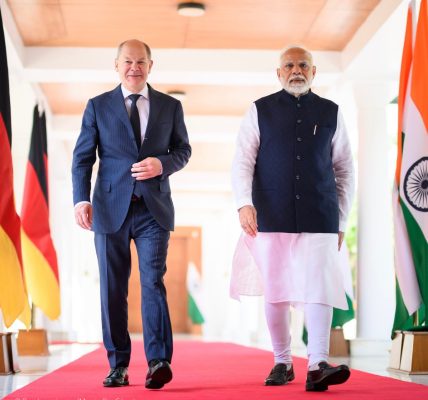







Putin’s Post-Trump Visit to China: Strategic Realignments and Implications for India
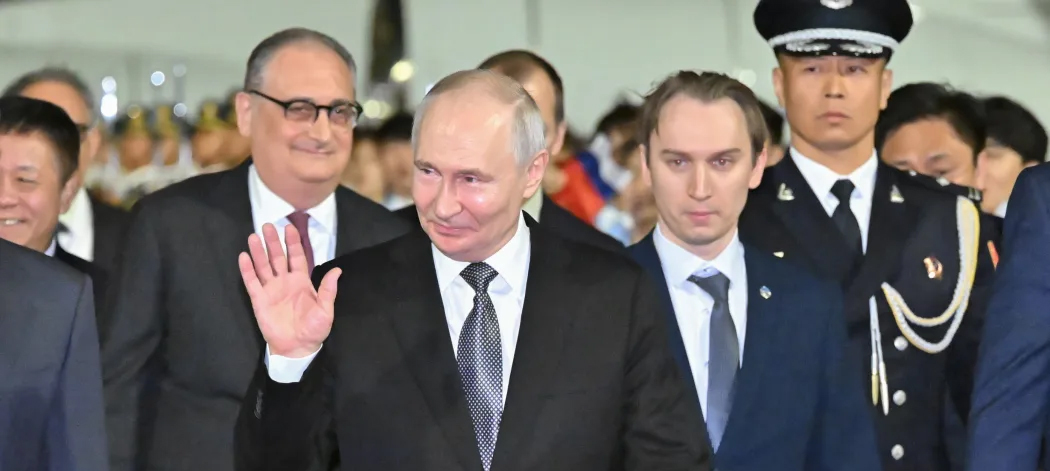
History rarely announces its arrival, yet Beijing’s May 2026 diplomatic calendar unfolded with unmistakable strategic precision. In just six days, the Chinese capital hosted two of the world’s most consequential leaders: United States President Donald Trump from 13–15 May, followed by Russian President Vladimir Putin from 19–20 May. This sequence was no coincidence. It was deliberate geopolitical architecture orchestrated by President Xi Jinping to showcase China’s unrivalled centrality within the emerging multipolar order.
With composed strategic confidence, Beijing demonstrated that it could simultaneously negotiate a trade architecture with Washington while deepening a civilisational partnership with Moscow, without yielding strategic ground to either.
The symbolism surrounding Putin’s arrival extended far beyond diplomatic protocol. It revealed the strategic grammar of a world increasingly shaped by calibrated multipolarity, sovereign manoeuvrability, and competing visions of global governance. As this author observed in the earlier analysis, “Trump–Xi Summit: Beijing’s Cadence and India’s Ascent,”published in The European Times on 17 May 2026, Trump arrived carrying a narrow transactional agenda, while Xi arrived carrying something considerably more sophisticated. That same asymmetry framed the geopolitical atmosphere into which Putin stepped only four days later.
Marking Putin’s twenty-fifth visit to China as president and the twenty-fifth anniversary of the 2001 Sino-Russian Treaty of Good-Neighbourliness and Friendly Cooperation, the visit carried profound geopolitical resonance. From grand red-carpet ceremonies and military honours to the joint declaration on multipolarity and nearly twenty major agreements spanning trade, energy, artificial intelligence, nuclear cooperation, space, and education, the summit reflected exceptional institutional depth and enduring strategic intent. Beijing had hosted both the principal representative of the Western liberal order and its foremost geopolitical challenger within the same week, managing each engagement with calibrated precision and unmistakable diplomatic confidence.
The message to the international system was unmistakable: in the twenty-first century, the diplomatic meridian increasingly runs through Beijing.
Russia-China: Resilient Partnership, Deepening Asymmetry
The trajectory of Russia-China relations over seven decades defies simple labels. What began as ideological brotherhood in the 1950s fractured into the bitter Sino-Soviet split of the 1960s, a rupture so profound that it ironically paved the way for Nixon’s historic opening to China in 1972.
From the post-Soviet thaw under Yeltsin to the deliberate, sustained investment of the Putin era, former adversaries steadily evolved into trusted strategic interlocutors. This journey reached its symbolic peak with the 2001 Treaty of Good-Neighbourliness and, two decades later, the landmark February 2022 joint declaration of a partnership with “no limits” and “no forbidden zones.”
The Ukraine war and its attendant Western sanctions regime, however, produced a structural transformation that the “no limits” rhetoric could not obscure. Russia’s economic isolation from European markets, its technological dependence on Chinese supply chains, and its reliance on Chinese financial institutions as alternatives to SWIFT have fundamentally altered the bilateral equilibrium. China has become Russia’s indispensable economic lifeline and, increasingly, its senior partner in ways that carry no historical precedent. Beijing extracts optimal commercial terms precisely because it does not share Moscow’s urgency. The Power of Siberia-2 gas pipeline — years in negotiation, symbolically important to Russia as a substitute for the European markets it has lost — produced no breakthrough at the May summit. China negotiates from a position of energy market diversification; Russia negotiates from one of pressing market substitution. The impasse is structural, not merely technical.
The joint declaration on multipolarity deserves careful reading for what it reveals about strategic intent. Russia and China present their partnership as a “stabilising force” and a normative counterweight to what they characterise as American hegemonic overreach. Their coordinated resistance to Western-led sanctions architectures, international financial institutions they regard as instruments of coercion, and rule-of-law frameworks they consider selectively applied represents a coherent, if self-serving, revisionist agenda. The twenty or so agreements signed at the Putin-Xi summit — spanning bilateral trade expansion, cross-border infrastructure, AI cooperation frameworks, nuclear energy collaboration, and the formal launch of joint Education Years — constitute the institutional sinew of this agenda, embedding the partnership in binding frameworks that survive the vicissitudes of bilateral atmospherics. The de-dollarisation thrust, the signalling on alternative payments architecture, and the coordinated positions on global governance reform collectively outline a programme whose ambition, if not always its execution, is systematic.
The deeper significance of this convergence, however, extends well beyond hydrocarbons and diplomatic signalling. What the Sino-Russian programme gestures toward is a broader fusion of technology, finance, industrial capacity, and strategic infrastructure into new instruments of geopolitical power. Semiconductors, rare earth ecosystems, digital payment architectures, artificial intelligence platforms, and next-generation telecommunications have become the commanding heights of twenty-first century statecraft. Beijing grasps this transformation with exceptional strategic lucidity — its sustained investment across critical mineral supply chains, advanced manufacturing, quantum research, and clean-energy industrial ecosystems reflects not reactive adjustment but deliberate civilisational positioning for techno-geoeconomic leadership. The expanding integration of Eurasian energy corridors and alternative financial mechanisms signals something larger than bilateral convenience: the gradual construction of a parallel economic architecture whose logic is technological depth as much as ideological solidarity. Future balances of power will be adjudicated not only on military platforms or diplomatic coalitions, but in semiconductor fabrication plants, resilient logistics corridors, data governance systems, and supply-chain networks capable of sustaining stability through disruption. This is the contest that the Beijing summits of May 2026 both illuminate and accelerate.
The relationship is deeply institutionally embedded and politically purposive. Yet it is simultaneously shaped by asymmetric power, divergent long-term interests, and a striking absence of genuine ideological solidarity. As Chatham House aptly observed, “China and Russia’s strategic duo endures — but its limits are clear.” That tension defines the partnership itself: the limits are real, and so is its resilience. Neither can be ignored.
What stands out most clearly, however, is the underlying asymmetry. The relationship serves Chinese strategic objectives far more comprehensively than Russian ones. Moscow gains vital market access and diplomatic cover, while Beijing secures discounted energy, a secure northern buffer against Western pressure, and the powerful narrative of a “multipolar coalition” that grants normative legitimacy to its revisionist vision. The asymmetry is the real story, and it is only set to deepen.
China’s Expansionism: The Ledger of Conduct
No serious assessment of the strategic environment within which this Sino-Russian partnership operates can sustain intellectual credibility without confronting China’s behaviour across multiple theatres of contestation. The gap between Beijing’s declaratory commitment to multilateralism, sovereignty, and non-interference on the one hand, and its operational conduct on the other, constitutes a defining and documented feature of contemporary international relations.
In Tibet, China has pursued a sustained policy of demographic transformation, cultural erasure, and religious coercion that most independent scholars regard as a systematic assault on a distinct civilisation. The forced management of Tibetan Buddhist reincarnation traditions — most acutely in the contested status of the Panchen Lama and the looming succession question surrounding the Dalai Lama — represents an extraordinary intrusion of authoritarian state power into matters of spiritual sovereignty. The international community’s muted response reflects geopolitical calculation, not principled acquiescence, and the issue carries enduring moral weight that no diplomatic normalisation can extinguish.
On Taiwan, China’s approach has grown measurably more coercive. Record-breaking military incursions into the Taiwan Strait, systematic violations of Taiwan’s Air Defence Identification Zone, economic pressure campaigns, and the explicit assertion of a timeline for “reunification” by means that do not exclude force constitute a campaign of strategic intimidation against a functioning democracy of twenty-three million people. Trump’s departure from Beijing without committing to Taiwan arms sales — described by leading American security analysts as a significant concession — underscored the dangerous ambiguity that Beijing has successfully cultivated in Washington’s defence posture. Taiwan’s fate cannot be treated as a transactional variable in great-power commerce.
In the South China Sea, China’s behaviour is a case study in the systematic subversion of established international legal order. The 2016 arbitration ruling under UNCLOS, which comprehensively rejected Beijing’s “nine-dash line” territorial claims, was dismissed by China with open contempt — a posture of extraordinary audacity for a permanent member of the United Nations Security Council that regularly lectures others on respect for international law. Artificial island construction, militarisation of disputed maritime features, and the systematic harassment of Philippine and Vietnamese fishing vessels through coast guard and maritime militia forces constitute a pattern of calibrated coercion designed to achieve territorial objectives that international law explicitly denies.
In the Himalayas, China’s conduct has been demonstrably aggressive. The 2020 Galwan Valley clash — the most serious Sino-Indian military confrontation in decades — was a product of documented Chinese incursions into disputed border territory. The partial disengagement subsequently achieved through sustained diplomatic engagement is welcome, but it does not erase either the precedent of Chinese willingness to employ force in pursuit of territorial claims or the broader pattern of infrastructure development and forward positioning along the Line of Actual Control that precedes and enables such incidents.
China’s debt-trap diplomacy across the Global South completes the ledger. The Hambantota Port model — infrastructure financing on terms that serve Chinese strategic interests, with debt-distress provisions that effectively transfer assets or sovereign access when repayments falter — has been documented in Sri Lanka, Pakistan, Myanmar, and across multiple African and Pacific states. The periodic rebranding of Belt and Road Initiative projects in response to international criticism has not altered the underlying architecture of structured dependency these arrangements create. Nations that receive Chinese infrastructure investment frequently discover that the terms of the relationship shift decisively once the debt is disbursed.
India and the United States, Russia: Partnerships Grounded in Sovereign Calculus
India’s relationship with the United States and Russia rests simultaneously on foundations of strategic logic, material interest, and civilisational self-confidence — and it is precisely this dual architecture that gives New Delhi its distinctive weight in the emerging multipolar order. With Washington, India shares democratic values, institutional complementarities, and an increasingly deep technology partnership: the iCET framework for critical and emerging technologies, Quad engagement across maritime security and pandemic preparedness, defence co-production agreements spanning fighter aircraft and advanced naval platforms, and a bilateral trade relationship now exceeding $190 billion annually. India hosts the 2026 AI Impact Summit as co-chair alongside France — not as a recipient of technological governance frameworks designed elsewhere, but as an architect of the global digital order in its own right. The relationship with the United States serves Indian national interests, and India pursues it on exactly those terms: fully, confidently, and without ideological subordination.
With Russia, India maintains a partnership of comparable strategic depth and equal sovereign integrity. Russia supplies approximately sixty per cent of India’s defence equipment by value — a structural reality that decades of diversification have reduced but not dissolved, and that reflects the accumulated institutional investment of a relationship spanning the Soviet era and its successors. India’s substantial purchase of Russian crude oil since 2022, at commercially favourable terms created by Western sanctions, reflects economic prudence and strategic flexibility — not alignment with Russian foreign policy objectives. Russia’s permanent membership of the UN Security Council, its sustained support for Indian positions on Kashmir, its historical role in India’s nuclear and space programmes, and its continuing relevance as a counterweight in Central Asia make it an interlocutor of enduring strategic value. India maintains this relationship with complete clarity about its own values — including its consistent calls for dialogue and diplomatic resolution in Ukraine — and without endorsing any action that violates the UN Charter principles to which it remains unwaveringly committed.
India and China: Engagement without Illusion
India’s relationship with China is the most complex and consequential bilateral relationship it navigates — and its management over the past three years constitutes one of the most sophisticated exercises in principled strategic engagement in contemporary diplomacy. Following the Galwan Valley crisis of 2020, India calibrated its response with notable precision: imposing targeted economic restrictions on Chinese applications and investments, reinforcing border infrastructure with strategic urgency, deepening Quad engagement as a counterbalancing architecture, while simultaneously maintaining the diplomatic channels through which disengagement agreements were painstakingly negotiated.
Prime Minister Modi’s visit to China for the SCO summit in 2025 — his first in seven years — signalled India’s willingness to stabilise the relationship without surrendering the memory of Chinese aggression or the resolve to prevent its recurrence. India approaches China from a position of growing material power and civilisational confidence, not from anxiety or dependency. It engages China in multilateral formats including BRICS, the SCO, and the G20 with the full recognition that stable bilateral relations serve Indian economic interests, regional stability, and the prospect of an Asia in which two great civilisations share space on terms of genuine equality. India pursues productive engagement with China because it serves India — on terms that India defines, through frameworks that India helps to shape, and with red lines that India enforces.
The Geopolitical Horizon: India’s Expanding Agency
The sequential Beijing summits of May 2026 have produced a geopolitical configuration that, upon careful analysis, expands rather than constrains India’s strategic horizon. The Trump summit, as this author observed in The European Times, delivered “big promises, thin results” — a stabilisation of US-China relations rather than structural resolution, with Taiwan, technology controls, and trade architecture remaining deeply contested. The CSIS assessment of “a relatively modest step toward greater stability” is accurate. The Putin summit deepened an asymmetric partnership whose most symbolically important deliverable, the Power of Siberia-2 pipeline, remains undelivered — evidence that even Russia’s comprehensive dependence on China does not eliminate Beijing’s leverage or Moscow’s frustration.
India is the one major power expanding, simultaneously and without contradiction, its relationships with Washington, Moscow, and Beijing. This is not strategic ambiguity; it is strategic clarity of a sophisticated and deliberately cultivated order, rooted in an honest assessment of national interests and a recognition that the emerging multipolar order rewards nations with genuine relational depth across multiple poles rather than those who subordinate their sovereignty to any single one. India holds the institutional legacy of the G20 presidency, chairs significant multilateral processes, leads the Global South coalition with credibility that neither China nor Russia can replicate given their conduct records, and commands a domestic market and technological base that every major power competes to access. The EU has restarted the EU-India Trade and Technology Council and accelerated free trade agreement negotiations; the United Kingdom has launched its Trade and Security Initiative; the United States has deepened iCET commitments; the Nordic states engaged at the May 2026 India-Nordic Summit on emerging technologies and Arctic governance. The world is not merely watching India’s rise — it is actively soliciting India’s partnership.
India’s neighbourhood diplomacy reinforces this picture of expanding agency. In Nepal, Bangladesh, Bhutan, and Myanmar — theatres in which Chinese infrastructure financing and strategic patronage have created anxieties about sovereignty, debt sustainability, and political dependency — India offers an alternative model of partnership grounded in connectivity without conditionality, capacity-building without asset extraction, and development cooperation that respects the political agency of receiving nations. The contrast with China’s debt-trap model is not merely rhetorical; it is operational and increasingly appreciated across South and Southeast Asia. What further distinguishes India’s regional engagement is its grounding in civilisational familiarity, democratic legitimacy, and genuine capacity enhancement rather than extractive dependency. India’s diplomacy increasingly operates through a framework of developmental statecraft that harmonises infrastructure connectivity, digital public platforms, humanitarian cooperation, energy partnerships, and maritime collaboration across the Indian Ocean littoral and the wider Global South. It projects strategic influence through institutional credibility and cultivated trust — a form of regional leadership whose durability rests on consent rather than coercion. In an international environment increasingly shaped by anxieties about dependency and demands for sovereign dignity, such a model carries normative resonance that no debt-financed port can purchase.
The post-Trump, post-Putin Beijing moment is not a challenge to India’s strategic position. It is a validation of it. Beijing’s dual hosting demonstrated China’s centrality; India’s simultaneous cultivation of Washington, Moscow, and Beijing demonstrates something more enduring: the agency of a civilisation that has learned to navigate a turbulent international system on its own terms, and to shape the system rather than merely respond to it.
Conclusion
The Beijing summits of May 2026 confirm a fundamental truth about the emerging international order: no single power commands unchallenged primacy, every significant relationship is calibrated, and the nations with the most sophisticated relational portfolios hold the most consequential diplomatic leverage. China has demonstrated its capacity to receive America and Russia within the same week on its own terms — an exercise of institutional confidence that reflects genuine material power and exceptional diplomatic management. Russia has demonstrated its continuing relevance as a nuclear power, energy exporter, and military actor even as structural dependence on China deepens in ways that Moscow’s leadership can neither fully acknowledge nor easily reverse. The United States has demonstrated both its enduring centrality in the international system and the limits of transactional summitry when structural competition persists beneath the surface of diplomatic warmth.
India watches these developments from a position of growing strategic maturity and earned confidence. Its civilisational depth, democratic legitimacy, economic momentum, and carefully cultivated relationships across every axis of the emerging multipolar system make it an indispensable actor in every significant international process. India seeks no confrontation with any major power, but it accepts none of their definitions of its interests either. The SCO, BRICS, the Quad, the G20, bilateral partnerships with the EU, the Gulf, and the Nordic states — India participates in all of them, contributes substantively to all of them, and subordinates itself to none of them. This is not the posture of a rising power seeking patronage. It is the posture of a civilisational state exercising sovereign judgment in a world that has finally caught up with its complexity.
India chooses its partnerships by the sovereign calculus of its own national interests and civilisational values — exercising precisely the kind of purposive autonomy that the architects of Nehruvian non-alignment envisioned, but that contemporary India’s material power, institutional reach, and diplomatic sophistication now allows it to practise with far greater effect, far greater consequence, and far greater global recognition.
The larger transformation underway is not simply a redistribution of material capabilities between competing states, but the gradual evolution of the philosophical architecture of international order itself. Legitimacy in this emerging system derives less from unipolar fiat and more from strategic credibility, developmental performance, technological leadership, democratic resilience, and the sovereign agency of nations that choose their own path. India enters this transition endowed with distinctive advantages: democratic continuity, demographic vitality, technological dynamism, maritime centrality, and a civilisational consciousness capable of harmonising antiquity with modernity and tradition with innovation. For much of the twentieth century, India was cast as a balancing presence within international politics; in the twenty-first, it is emerging as a shaping force — not merely participating in global transformations but influencing the normative, strategic, and institutional frameworks through which those transformations acquire meaning and direction. That evolution carries consequences not only for Asia but for the future structure of the international system itself.
The world after Beijing is a world more multipolar, more contested, and more in need of a power that can speak to all of its major actors without being captured by any of them. India is that power. This is not India’s challenge. It is India’s moment.
Views: 1368

Dr. Maheep
Dr. Maheep is Director, Indian Perspective on Global Affairs (IPGA), and a leading analyst of India’s foreign policy and South Asian geopolitics. He earned his PhD in Arab and Islamic Studies. With more than a decade of teaching and research experience in International Relations and Global Politics, he contributes regularly on issues shaping national and global affairs.