


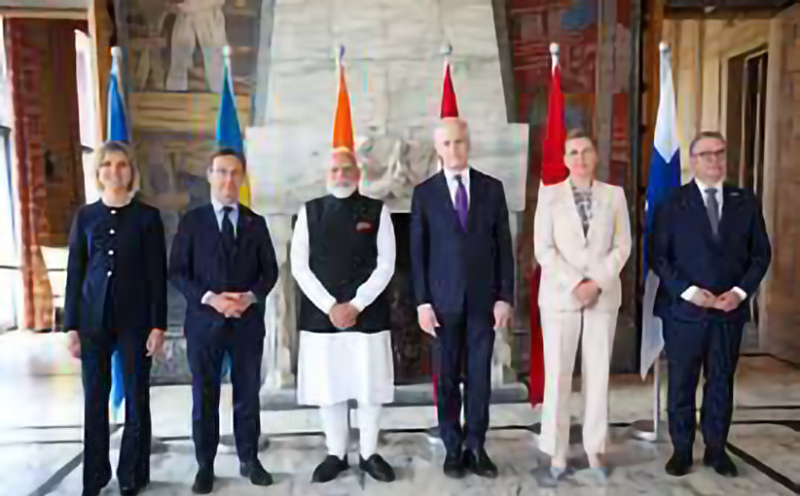







The elevation of India–Nordic relations to a “Trusted Green Technology and Innovation Strategic Partnership” at the 3rd India–Nordic Summit in Oslo on 19 May 2026 constitutes a seminal act of democratic statecraft at a moment of acute global uncertainty. This article argues that the India–Nordic convergence represents far more than a conventional bilateral upgrade; it embodies the emergence of a structurally consequential middle-power coalition animated by techno-geoeconomic complementarity, Arctic strategic depth, ecological urgency, and normative solidarity. Drawing upon frameworks from International Relations theory, Arctic geopolitics, environmental political economy, and developmental statecraft, the analysis examines the architecture of green technology diplomacy, the imperatives of Arctic governance, the political economy of just transition, maritime security, and the governance of artificial intelligence. The analysis confronts with analytical candour the structural impediments that continue to constrain implementation, while advancing a policy vision grounded in the conviction that enduring strategic partnerships are forged not through summit declarations alone, but through the patient construction of institutional density, investment architecture, technological interdependence, and resilient epistemic communities capable of shaping the foundations of a sustainable multipolar order.
Strategic Conjuncture: Why Oslo 2026 is Consequential
The Oslo summit did not occur in a context of diplomatic normalcy. It was convened against a global order under compound stress: Russia’s continuing war on Ukraine fracturing European security architecture; the Trump administration’s tariff offensive dismantling the post-1945 trade consensus; the US–Israel–Iran confrontation generating hydrocarbon market volatility; and the accelerating erosion of multilateral governance institutions designed for a world that no longer exists. In this fractured environment, the deliberate elevation of a partnership between a rising civilisational democracy of continental scale and five of the world’s most institutionally sophisticated small states carries significance that exceeds its immediate bilateral content.
What Oslo 2026 represents analytically is an instance of cooperative geopolitical balancing — the construction, by democratic middle powers, of issue-based coalitions that serve shared interests in sustainable development, technological resilience, and normative order without the ideological rigidity or zero-sum logic of great-power rivalry. It is also the most mature expression thus far of India’s pragmatic multi-alignment — its capacity to deepen strategic relationships with democratic partners across multiple registers while preserving the sovereign agency that distinguishes its foreign policy philosophy from either non-alignment or bandwagoning. That this summit occurred forty-three years after Indira Gandhi’s 1983 visit to Oslo renders the reunion historically charged: the world India returns to is unrecognisable, and the ambition India brings is proportionately transformed.
The summit’s genealogy — Stockholm 2018, Copenhagen 2022, Oslo 2026 — traces a deliberate institutional deepening. Each iteration has expanded the thematic perimeter of the relationship: from trade and climate toward technology, defence, Arctic governance, digital infrastructure, and AI. The formalisation in Oslo of a Trusted Green Technology and Innovation Strategic Partnership — with the operative word trusted carrying explicit connotations of supply chain transparency, governance alignment, and values-consonance — marks the moment at which a relationship of goodwill became a relationship of strategic intentionality. The India–EFTA TEPA of 2024, targeting USD 100 billion in Nordic investment and one million Indian jobs, provides the enabling economic architecture; the Oslo summit provides the strategic framework within which that architecture can be purposefully deployed.
Green Developmental Statecraft and the Political Economy of Decarbonisation
The analytical core of the India–Nordic green technology partnership lies in a structural complementarity that goes deeper than diplomatic goodwill: the convergence between Nordic mastery of decarbonised industrial systems and India’s imperative to execute one of history’s largest clean energy transitions without compromising the developmental aspirations of 1.4 billion people. This is the developmental decarbonisation paradox — the demand that India simultaneously achieve emissions reduction at civilisational scale and sustain the growth trajectory demanded by its demographic reality. Nordic expertise in offshore wind, green hydrogen production chains, carbon capture, circular industrial systems, and sustainable maritime engineering offers precisely the technological toolkit that India’s renewable transition frameworks structurally require.
The political economy of Nordic green leadership is instructive precisely because it is not reducible to ideology. Sweden’s cradle-to-cradle industrial legislation, Denmark’s district heating infrastructure, Finland’s bio-economy strategy, and Norway’s management of the transition from hydrocarbon dependency through sovereign wealth architecture — each represents a distinct policy pathway toward decarbonised growth pursued through deliberate statecraft rather than spontaneous market dynamics. Norway’s Government Pension Fund Global — assets exceeding USD 1.7 trillion — is the paradigmatic case of a small state converting finite resource extraction into permanent intergenerational capital deployed through ethical investment frameworks. It is, in the deepest sense, a model of green developmental statecraft: the use of sovereign capacity to direct economic transformation toward ecologically sustainable pathways while preserving intergenerational equity. For an India managing vast mineral endowments, an expanding renewable energy frontier, and the political economy of coal transition simultaneously, the Norwegian template — adapted with intelligence to India’s democratic federalism and developmental scale — offers a governance model of exceptional practical relevance.
The India–EFTA TEPA’s USD 100 billion investment target is best understood not as a mere diplomatic aspiration but as a structural commitment to mobilising the capital architecture that India’s decarbonised growth paradigm demands. Nordic sovereign wealth, pension capital, and institutional investment, distinguished by long term horizons, ESG discipline, and exacting ethical governance standards, constitute a uniquely suitable match for India’s renewable energy infrastructure requirements, its emerging green hydrogen economy, and its ambitious port and coastal decarbonisation agenda. The blue economy represents one of the most strategically consequential frontiers of this complementarity. Norway’s mastery of deep sea aquaculture, marine biotechnology, and sustainable ocean governance converges seamlessly with India’s 2.3 million square kilometre Exclusive Economic Zone and its strategic ambition to transform oceanic proximity into sovereign developmental capital.
Arctic Axis: Geopolitics of a Transforming Region
The Arctic’s geopolitical transformation constitutes one of the most consequential territorial reconfigurations of the twenty first century. Accelerating ice melt is opening the Northern Sea Route as a commercially viable trans-oceanic corridor, exposing previously inaccessible reserves of hydrocarbons, rare earth minerals, and other critical strategic resources, and elevating a once peripheral geography to the centre of great power competition. Russia continues to militarise its Northern Fleet and associated infrastructure, while China asserts its self-designation as a “near Arctic state” and channels substantial investment into ports, research facilities, and infrastructure across the Eurasian Arctic. The governance architecture centred on the Arctic Council, in which India holds permanent observer status, simultaneously serves as a platform for vital scientific cooperation and as a contested normative arena in which the rules of the future Arctic order are being actively negotiated.
India’s Arctic engagement, formalised through its 2022 Arctic Policy and operationalised via the Himadri research station at Svalbard, demonstrates a sophisticated appreciation of the region’s multidimensional importance to Indian national interests. These encompass climate science that directly influences Himalayan glaciology and monsoon patterns, mineral security essential for the global clean energy transition, shipping route economics that could reshape India’s export competitiveness, and governance norm setting whose outcomes will define international legal frameworks for decades to come. In this domain, the India Nordic partnership acquires exceptional strategic value. Norway, Finland, and Sweden collectively possess a civilisational depth of Arctic expertise spanning scientific research, operational logistics, Indigenous rights, environmental governance, and maritime domain awareness that remains unmatched in the contemporary international system.
The energy security dimension of Arctic geopolitics has acquired heightened strategic urgency in the contemporary international environment. Following the disruption of Russian energy supply chains after 2022, Norway has emerged as Europe’s principal gas supplier and now occupies a position of exceptional significance within the global energy security architecture. For India, which continues to balance a complex energy relationship with Russia while advancing supply diversification and long term resilience, Norway’s emergence as a credible partner in hydrocarbons and advanced energy technologies carries substantial strategic value. This convergence strengthens India’s immediate energy security while reinforcing its broader climate resilience framework in a manner fully consistent with its long term decarbonisation objectives and sustainable energy transition pathway.
Moreover, the Arctic connectivity dividend further strengthens the rationale for India’s northern engagement. The opening of Northern Sea Routes offers substantially reduced shipping times and lower fuel costs between Indian ports and key European and North American markets, transforming Arctic access into a tangible economic and strategic asset within India’s broader maritime and developmental calculus.
Circular Economy, Sovereign Sustainability, and Lessons in Scale
Any serious engagement with the India–Nordic partnership must confront the question of what a nation of India’s scale, complexity, and developmental stage can realistically internalise from the Nordic circular economy experience — and the answer, counterintuitively, is more than is commonly assumed, provided the appropriation is conceptually disciplined rather than structurally wholesale. The Nordic circular economy is not merely an environmental policy programme; it is an organising philosophy of production, consumption, and governance — one that treats material flows as perpetually recoverable rather than linearly disposable, and that embeds ecological accountability into the architecture of corporate law, public procurement, urban planning, and industrial licensing.
India’s urbanisation challenge — 300 million additional urban residents within two decades — renders the question of circular urban metabolism strategically urgent. The carbon trajectories and resource consumption patterns embedded in today’s Indian city-building decisions will constitute path dependencies of extraordinary durability. Nordic innovations in low-carbon mobility, smart energy grids, district heating and cooling, waste-to-energy infrastructure, and green public procurement offer directly applicable models that India’s urban development authorities, state governments, and metropolitan planning bodies could absorb through structured technology partnership rather than requiring wholesale institutional transplantation. The key insight from Nordic governance experience is that circular economy outcomes are not the spontaneous product of technological adoption but require the deliberate alignment of regulatory incentives, pricing mechanisms, public investment, and institutional accountability.
At the macroeconomic level, Norway’s Sovereign Wealth Fund model offers India a conceptual template for what might be termed sovereign sustainability — the conversion of present developmental momentum into permanent national capital managed through ethical, intergenerational governance. India’s mineral endowments, its renewable energy potential, and its digital economy generate substantial sovereign asset flows that could, under appropriate institutional architecture, be managed with the long-term disciplined vision that the Petroleum Fund represents. This is not a counsel of institutional mimicry but an argument for adaptive governance learning — the intelligent appropriation of institutional logic from contexts that differ in scale but share developmental trajectories, democratic values, and the ambition to convert present advantage into enduring prosperity.
People, Knowledge, and the Epistemic Foundation of Durable Partnership
The structural pillars of the India–Nordic relationship — trade, technology, strategic cooperation, climate governance — rest on a foundation that official communiqués routinely underestimate: the rich, self-generating network of intellectual and human exchange that has been quietly deepening across decades. Indian scholars, researchers, engineers, and medical professionals constitute a substantial and growing presence at Nordic universities and research institutions — at the University of Oslo, KTH Royal Institute of Technology, Aalto University, the University of Helsinki, the Technical University of Denmark, and at the research campuses of Nokia, Volvo, and a constellation of Nordic innovation companies. This community does not merely represent human capital deployed across borders; it constitutes a living epistemic bridge — a network of scholars and practitioners who carry with them the conceptual frameworks, cultural sensibilities, and interpersonal relationships that form the real connective tissue of durable international partnerships.
The significance of this human dimension is amplified by its sectoral concentration. Unlike diaspora communities primarily embedded in service industries or manual labour, the Indian presence in the Nordic knowledge ecosystem is disproportionately located in technology research, environmental science, computational engineering, and biomedical innovation — precisely the domains where the India–Nordic strategic partnership aspires to generate its most consequential outputs. Joint doctoral programmes, faculty exchange initiatives, collaborative grants under Horizon Europe and India’s Science and Technology Department, and co-authored publications that are shaping global knowledge frontiers in clean energy, Arctic science, and artificial intelligence all represent science diplomacy functioning at its most productive: the use of scientific collaboration as simultaneously an instrument and an expression of strategic partnership.
Cultural resonances, though less dramatic than civilisational affinities India maintains with some other partners, are nonetheless consequential. The Nordic commitment to institutional transparency, democratic accountability, and individual rights creates a values-consonance that, while insufficient alone to sustain strategic partnership, provides the normative foundation upon which genuine trust — as distinct from mere transactional convenience — can be constructed. Nordic societies’ record of successful intellectual pluralism has generated academic environments in which Indian scholars have been able to contribute with relatively few of the institutional barriers encountered elsewhere, deepening the interpersonal networks that ultimately determine whether formal diplomatic architecture acquires genuine operational vitality.
Climate Finance, Energy Transition, and the Politics of Just Transition
The intersection of climate finance, energy transition, and developmental equity constitutes the most structurally contested terrain within the India Nordic engagement and, correspondingly, the domain in which genuine alignment of interests could generate the most globally significant dividends. The global climate crisis demands an unprecedented mobilisation of capital, with authoritative estimates of the investment required to achieve net zero transitions in developing economies running into tens of trillions of dollars. Yet the architecture of international climate finance remains demonstrably inadequate, structured around instruments designed for a different geopolitical economy, insufficiently responsive to the developmental imperatives of the Global South, and undercapitalised relative to the scale of the crisis it seeks to address.
India’s position in climate multilateralism has consistently articulated the principle of common but differentiated responsibilities with equity, insisting that historical atmospheric indebtedness carries corresponding financing obligations in the present international order. The Nordic states have emerged among the most consistent European advocates of ambitious climate finance architecture. Norway’s international climate initiative, which channels substantial capital into tropical forest conservation and clean energy development across the Global South, represents a model of sovereign climate finance that transforms ethical responsibility into operational policy. Denmark’s offshore wind technology transfer initiatives, Sweden’s leadership in green bond frameworks, and Finland’s advocacy for reforming multilateral development bank structures together constitute deployable institutional assets within a deepened India Nordic climate finance partnership.
The governance challenge of just transition, namely the management of the social and economic consequences of decarbonisation while preserving democratic legitimacy and social cohesion, presents both India and the Nordic states with governance dilemmas of comparable structural character despite their vastly different scales of development. Norway’s management of offshore petroleum transition through the Sovereign Wealth Fund mechanism, its worker retraining programmes, and its industrial diversification strategy offers a governance template with meaningful relevance for India’s coal dependent regions, communities, and state economies. The preservation of democratic consent among communities affected by energy transformation remains central to the success of any decarbonisation strategy, and Nordic governance experience offers valuable and transferable lessons in balancing ecological transition with social stability and long term developmental resilience.
Digital Governance, Artificial Intelligence, and Techno-Geoeconomic Convergence
The technological frontier of the India–Nordic partnership extends well beyond green energy to encompass the governance of artificial intelligence, digital public infrastructure architecture, cybersecurity cooperation, and the construction of democratic alternatives to the extractive platform capitalism models that have come to dominate global digital markets. These domains are rapidly becoming as determinative of national power as conventional strategic assets, and the Oslo summit’s explicit incorporation of AI governance and digital cooperation into its agenda reflects a sophisticated appreciation of their centrality to twenty-first-century statecraft.
India’s Digital Public Infrastructure ecosystem, comprising Aadhaar, UPI, DigiLocker, and ONDC, represents an architecturally distinctive model for harnessing digital technology to achieve inclusive development at scale. Built upon open source architecture, interoperability, public governance, and public accessibility, the framework advances digital inclusion while limiting the concentration of power associated with proprietary platform monopolies. The IndiaStack model resonates strongly with Nordic commitments to technological democratisation, digital rights, institutional transparency, and public interest governance of critical infrastructure. The potential for India Nordic collaboration in developing transferable Digital Public Infrastructure governance frameworks acquires particular significance for Global South economies seeking developmental pathways that preserve digital sovereignty, democratic accountability, and public welfare. Such cooperation can emerge as one of the most consequential contributions of the India Nordic partnership to the evolving architecture of global digital governance. On artificial intelligence, the alignment of democratic values creates a natural basis for joint norm-setting advocacy at the international level. Nordic states have pioneered ethical AI frameworks emphasising transparency, accountability, and the protection of democratic processes against algorithmic manipulation; India has emerged as a significant AI research ecosystem with both the technological capacity and the democratic legitimacy to shape global governance norms. The construction of coordinated India–Nordic positions within emerging international AI governance forums — including the Global Partnership on AI, the UN AI Advisory Body, and bilateral regulatory dialogues with the EU — would amplify both parties’ normative influence beyond what either could achieve independently. In the domain of semiconductor resilience, India’s manufacturing ambitions combined with Nordic precision engineering expertise could contribute to the diversified, trusted technology ecosystems that democratic economies require as US–China technological decoupling accelerates.
Structural Impediments and the Imperative of Implementation
Analytical honesty requires confronting, with precision, the structural impediments that stand between the Oslo Summit’s ambitious framework and its realisation as a genuinely transformative partnership. The most fundamental of these is the implementation gap, namely the persistent tendency of high level summitry to generate declarations whose conversion into concrete projects, technology transfers, investment flows, and institutional mechanisms proves considerably more difficult than the diplomatic encounter itself. The India EFTA TEPA’s USD 100 billion investment target is aspirational in the best sense, yet its achievement demands resolute action on several structural impediments, including regulatory friction within India’s investment environment, intellectual property protection concerns that continue to shadow advanced technology transfer arrangements, and institutional limitations within the bilateral mechanisms tasked with operationalising the summit’s ambitions. As Harsh V. Pant of the Observer Research Foundation has incisively observed, the ultimate test of Oslo lies precisely in this translation from strategic declaration to developmental reality.
India’s maintenance of its strategic relationship with Russia, including continued energy imports and legacy defence dependencies, creates periodic tensions with Nordic and broader European partners whose security interests have been directly affected by Russian aggression. India’s strategic autonomy doctrine, a genuine expression of national interest and historical foreign policy philosophy, requires continuous and sophisticated diplomatic management to prevent it from being misread as indifference to the legitimate security concerns of democratic partners. The Oslo media environment itself offered a salutary reminder of these sensitivities. The Aftenposten cartoon controversy and the accompanying press freedom exchange illustrated how even fundamentally aligned democratic value cultures can generate unexpected friction that demands communicative sophistication, institutional maturity, and cultural empathy to navigate successfully.
The existing institutional architecture of the partnership, comprising periodic summit mechanisms, sectoral working groups, and bilateral chambers of commerce, remains insufficiently dense to sustain the momentum and implementation discipline that a partnership of this ambition requires. Genuine sustainability demands deliberate institutional strengthening, including a dedicated India Nordic Technology and Innovation Council with annual meetings and a binding deliverable agenda, a joint climate finance working group with explicit capital mobilisation targets linked to TEPA timelines, a regular track 1.5 strategic dialogue involving officials, business leaders, and think tank scholars, and a robust Arctic science cooperation framework connecting Himadri with Norwegian and Finnish research infrastructure. Without such institutional densification, the Oslo Summit risks reproducing a familiar pattern in contemporary diplomacy: consequential in declaration, yet incremental in delivery.
Democratic Solidarity, Polycentric Order, and the Normative Stakes
The India–Nordic summit carries normative stakes that exceed its bilateral geography. In an international environment marked by democratic backsliding, authoritarian resurgence, and the weaponisation of economic interdependence, the deepening partnership between the world’s most populous democracy and five of its most institutionally refined small democracies constitutes a meaningful contribution to the resilience of democratic governance as a viable model of political organisation and international behaviour.
The concept of polycentric global governance — the organisation of international order around multiple centres of legitimate authority contributing according to their distinctive capabilities and cultural traditions — finds in the India–Nordic relationship one of its most substantively developed contemporary expressions. India contributes civilisational depth, democratic scale, Global South voice, and the developmental ambition of a rising great power committed to multilateral solutions. The Nordic states contribute institutional excellence, normative credibility, ecological leadership, and a demonstrated capacity to translate democratic values into effective governance outcomes at every level from municipal carbon accounting to international climate treaty architecture. Their convergence in advocacy for United Nations Security Council reform — including explicit Nordic support for India’s permanent membership claim at Oslo — is a concrete expression of the normative alignment that underpins the strategic partnership: both parties believe that a legitimate global governance architecture must reflect the world as it actually is, not as it was configured in 1945.
The India–Nordic partnership is, in this light, best understood as a contribution to multipolar equilibrium of a constructive rather than merely competitive character — one that seeks to preserve the cooperative, rules-based dimensions of the international order while reforming its representational inadequacies, filling its governance gaps with new institutional capacity, and embedding ecological responsibility as a constitutive principle of international legitimacy rather than an optional supplement to strategic calculation.
Conclusion
Oslo 2026, viewed through the lens of strategic history, represents far more than a diplomatic summit. It embodies a conscious wager by responsible democratic powers that the defining challenges of the twenty first century will yield to the patient construction of partnerships that combine sovereign confidence with cooperative discipline, strategic interest with normative integrity, and civilisational ambition with ecological responsibility.
The India Nordic convergence rests upon four mutually reinforcing structural pillars. First, the techno geoeconomic complementarity between Nordic decarbonised industrial leadership and India’s developmental scale generates an interdependence of genuine strategic depth. Second, the Arctic strategic axis, connecting India’s expanding interests in governance, shipping routes, critical minerals, and climate science with Nordic expertise of exceptional sophistication, anchors this partnership within one of the most geopolitically dynamic regions of the emerging international order. Third, the dense network of scholars, researchers, innovators, and knowledge professionals moving between Indian and Nordic institutions constitutes the epistemic capital that ultimately sustains durable diplomacy, preserving the intellectual connective tissue of the partnership even during periods of fluctuating political momentum. Fourth, the shared commitment to democratic governance, institutional transparency, and an equitable rules based international order provides the normative foundation through which strategic cooperation acquires long term resilience and legitimacy.
The policy prescription emerging from this analysis is both structural and patient in orientation. The Oslo declarations must be translated into specific project agreements, dedicated investment vehicles, joint research programmes, and institutional mechanisms supported by clear accountability frameworks and measurable implementation timelines. Nordic sovereign and institutional capital can be systematically channelled through the TEPA architecture into India’s renewable energy transition, green hydrogen expansion, and circular urban infrastructure initiatives. The Arctic cooperation agenda can advance through expanded scientific exchange, coordinated Arctic Council engagement, and the development of maritime connectivity frameworks serving the geoeconomic interests of both partners. The dialogue on artificial intelligence and digital governance likewise possesses the potential to evolve into a structured joint norm setting initiative capable of exercising meaningful multilateral influence.
Ultimately, this partnership represents a powerful demonstration that sustainable strategic cooperation is grounded not in utopian aspiration but in structural rationality. Nations sharing democratic values, complementary economic architectures, technological ambition, and a common stake in an equitable international order possess the capacity to construct partnerships of genuine geopolitical consequence while preserving sovereign autonomy, ideological independence, and strategic flexibility. Between the fjords of Norway and the Himalayas of India, separated by geography yet connected by democratic values, ecological urgency, and civilisational confidence, a partnership is emerging whose significance extends well beyond bilateral diplomacy. Its success will ultimately be measured by the scale of capital mobilised, the depth of technological collaboration achieved, the resilience of institutions constructed, and the contribution that democratic powers committed to sustainable futures can collectively make toward the renewal of international order in an age of profound global uncertainty.
Views: 783

Dr. Maheep
Dr. Maheep is Director, Indian Perspective on Global Affairs (IPGA), and a leading analyst of India’s foreign policy and South Asian geopolitics. He earned his PhD in Arab and Islamic Studies. With more than a decade of teaching and research experience in International Relations and Global Politics, he contributes regularly on issues shaping national and global affairs.


