






In the second quarter of the twenty-first century, the architecture of international order undergoes a transformation of historic consequence. India, as the world’s most populous democracy and an ascending civilisational power, positions itself with purposeful confidence at the fulcrum of a genuinely multipolar world—one defined by plural centres of gravity, distributed agency, and the irreversible diffusion of power away from dyadic superpower competition.
Alongside this rise, Chile emerges as an indispensable Pacific gateway, a democratic anchor in South America, and a sovereign custodian of mineral endowments whose strategic importance may well determine the trajectory of the global green transition. Between these two geographically distant yet normatively proximate nations, a partnership of exceptional depth and transformative potential takes shape—one that rewards analytical scrutiny through the lens of constructivist international relations theory. Where classical realist frameworks would emphasise distance, asymmetry, and strategic inertia, constructivism illuminates the generative power of shared norms, post-colonial identity, democratic solidarity, and convergent visions of multipolarity and sustainable development as the very architectonic forces actively constructing and deepening India–Chile bilateral relations.
This article engages the India–Chile relationship as a paradigmatic case of what Alexander Wendt termed the social construction of interstate identity—wherein states come to perceive one another as partners through cumulative normative alignment rather than mere interest calculation. The partnership transcends the gravitational pull of geography, anchored instead in the shared normative grammar of sovereign equality, South–South solidarity, multilateral governance, and strategic autonomy. As the global economy undergoes a structural reorientation toward critical minerals essential for the energy transition, India’s designation of lithium, copper, cobalt, and rare earths as nationally strategic resources, and Chile’s status as the world’s foremost lithium reserve-holder and second-largest copper producer, generate a complementarity of rare material precision. The present moment—marked by accelerating Comprehensive Economic Partnership Agreement (CEPA) negotiations and the landmark visit of Chilean Foreign Minister Francisco Perez Mackenna to New Delhi in May 2026—offers a moment of analytical clarity to assess how India and Chile are constructing a bilateral relationship of enduring geostrategic and geoeconomic significance.
Latest Developments: The May 2026 diplomatic movement
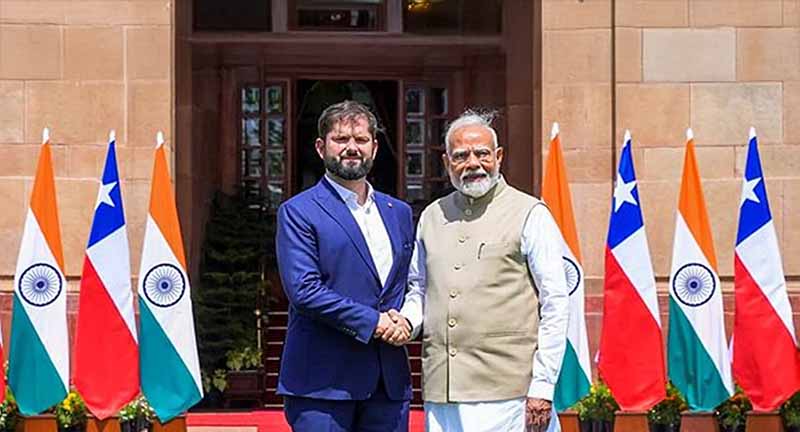
The visit of Chilean Foreign Minister Francisco Perez Mackenna to India between 9 and 15 May 2026 represents the most consequential bilateral engagement in recent years, crystallising the momentum generated by President Gabriel Boric Font’s state visit to New Delhi in April 2025. The MEA Official Visit Advisory (May 2026) confirms that Mackenna’s engagements with External Affairs Minister Dr. S. Jaishankar and Commerce Minister Piyush Goyal placed CEPA negotiations, critical minerals cooperation, technology transfer, and investment facilitation at the heart of bilateral dialogue. The Tribune India (May 2026) reports that the Foreign Minister arrived for a seven-day official visit to strengthen bilateral ties, while the Times of Oman (May 2026) characterises the visit as oriented squarely toward boosting trade and technology deals at a moment of exceptional strategic opportunity. Chile’s explicit invitation to Indian firms to regard it as a reliable partner for the coming decades—articulated personally by Foreign Minister Mackenna at meetings with Indian business leaders, as documented by ADP Prensa (May 2026)—resonates powerfully with India’s National Critical Minerals Mission, launched with a ₹16,300 crore budget, and its imperative to secure diversified, resilient supply chains for the energy transition.
The acceleration of CEPA negotiations—formally launched during the India–Chile Joint Statement of April 1, 2025and now in their advanced rounds—exemplifies India’s geoeconomic pivot toward Latin America as a masterful exercise in statecraft. The Joint Statement itself is strikingly ambitious, affirming both governments’ determination to boost cooperation in trade, investment, mineral exploration, and space, as reported by the Hindu BusinessLine (2025). With bilateral trade standing at approximately US$2.5 to 3 billion and growing, the CEPA carries the potential to double or treble this figure within a decade, generating substantial export opportunities for Indian manufactured goods—pharmaceuticals, engineering products, textiles, and information technology services—while securing long-term access to Chilean lithium and copper for India’s electric vehicle and renewable energy sectors. The Times of India (March 2026)confirms that both sides reviewed CEPA progress ahead of the WTO ministerial, signalling the deep institutional commitment now underpinning negotiations.
| Chile’s Mineral Endowments and India’s Imperative Chile holds approximately 9.3 million tonnes of lithium reserves — some 35 per cent of the world’s total — and accounts for roughly 27 per cent of global copper output, making it the world’s second-largest copper producer. India’s copper imports, already at 1.2 million metric tonnes in FY 2024–25, are projected to rise to 3.3 million metric tonnes by 2030 and upwards of 9 million metric tonnes by 2047.Source: MEA India–Chile Bilateral Brief (2026); CSEP, “Latin America: A New Geography for India’s Emerging Critical Minerals Partnerships” (January 2026). |
Historical relations: Ideational foundations of a durable partnership
The foundations of India–Chile bilateral relations extend to 1949, when both nations, newly sovereign and navigating the complex cartography of a post-colonial world, established formal diplomatic ties. The MEA’s historical overview of India–Chile relations and the MEA India–Chile Bilateral Brief (2026) record that Chile’s attendance at India’s independence celebrations in 1947 and its early expressions of solidarity at the United Nations speak to a normative affinity that preceded institutional formalisation. The visit of Prime Minister Indira Gandhi to Chile in 1968 marked a high watermark of this early solidarity, situating the bilateral relationship within the broader architecture of the Non-Aligned Movement and affirming a shared commitment to sovereign equality, non-interference, and an equitable international economic order. The intellectual and political affinities of the NAM era—anti-colonialism, developmental sovereignty, the demand for a New International Economic Order—constituted the ideational substrate upon which later material cooperation would be erected.
The signing of the Preferential Trade Agreement in 2006, and its subsequent upgrade in 2017, transformed the ideational foundations of the relationship into institutional architecture. Analyses published in the Latin American Journal of Trade Policy (Universidad de Chile, 2025) in the study “Trade and Diplomatic Relations between Chile and India: Evolution, Impacts, and Perspectives” affirm that the PTA produced measurable welfare gains for both economies, diversifying Indian exports while expanding Chilean market access for copper, iodine, and agricultural products. High-level visits—including President Ricardo Lagos’s visit to India and reciprocal engagements at ministerial level—sustained the political attention necessary to translate institutional frameworks into commercial reality. The paper further underscores how evolving diplomatic exchanges and shared multilateral positions generated a progressive deepening of bilateral engagement that the PTA formalised and accelerated.
The Gateway House analysis “India–Chile: Transcending Geography” (2014) captures this historical trajectory with particular persuasiveness, arguing that the two nations demonstrate how shared norms and visionary leadership enable states to overcome the structural impediment of distance. This observation acquires even greater force in 2026, as the CEPA negotiations represent the culmination of a cumulative process of socially constructed partnership: NAM-era solidarity generated the political trust that made the 2006 PTA possible; the PTA’s economic dividends provided the material referent for upgrading in 2017; and the CEPA of 2025–2026 represents the apex of this upward spiral. The MEA Bilateral Brief (2026) notes with admirable precision the continuity of shared democratic values, multilateral commitments, and the progressive institutionalisation of economic ties as defining features of a relationship that has consistently outpaced its geographical constraints.
Cultural Relations and People-to-People ties
The material and institutional dimensions of India–Chile relations acquire their fullest meaning only when placed alongside the flourishing of cultural and people-to-people ties that sustain the partnership’s social depth. India’s soft power projection in Chile—manifested through the practice of yoga, the celebration of cultural festivals, the dissemination of Indian philosophical and aesthetic traditions through ICCR programmes, and the network of Indian diaspora professionals—constitutes a mechanism of identity construction through which Chileans and Indians come to perceive one another as culturally proximate despite geographic distance. Research published in the Multi-Research Journal (2025) on India’s Soft Power in Latin America demonstrates that yoga, democracy promotion, and cultural diplomacy function as sustained vehicles of people-to-people connectivity that humanise and personalise bilateral relations beyond the realm of state interaction. Academic exchanges facilitated through ICCR scholarships, the Indian Technical and Economic Cooperation (ITEC) programme, and university partnerships build epistemic communities that carry the relationship forward across generations of scholars, diplomats, and policy practitioners.
The scholarship of cultural perception offers further insight into this soft-power dynamic. A study published in the Rupkatha Journal on Interdisciplinary Studies in Humanities under the title Imagining India/Hinduism from Chiledocuments the Chilean cultural encounter with Indian philosophical traditions—Vedanta, yoga, Ayurveda—as a creative and generative engagement that reshapes Chilean understanding of India in ways that transcend stereotypes and generate genuine affective solidarity. The study finds that Chilean engagement with Indian thought produces a reimagining of India not as a distant civilisation but as a living philosophical presence whose values resonate with Chilean spiritual and intellectual aspirations. This cultural intimacy matters for foreign policy: constructivist scholars have long demonstrated that states whose publics hold positive mutual images prove more capable of sustaining the domestic political support necessary for deep institutional partnership.
| Soft Power as Strategic Architecture “Yoga, democracy promotion, and cultural diplomacy function as sustained vehicles of people-to-people connectivity that humanise and personalise bilateral relations beyond the realm of state interaction.”Research on India’s soft power in Latin America confirms that cultural engagement is not supplementary but structural — it generates the affective solidarity that makes deep institutional partnerships politically sustainable across electoral cycles and leadership changes. |
Global Politics, Diplomacy, and National Security Strategy
At the multilateral level, India and Chile demonstrate a remarkable convergence of positions across the United Nations, the G20, and the Voice of the Global South platform that India has championed with considerable conviction since 2023. The ICWA Sapru House Paper on India and Latin America (2023) identifies this multilateral alignment as one of the most structurally significant dimensions of the India–LAC relationship, observing that both India and Chile affirm the centrality of the UN Charter, advocate reform of the Security Council to reflect twenty-first century realities, and champion multilateral trade governance through the WTO. Both nations position themselves as advocates for a rules-based international order that accommodates the legitimate aspirations of the Global South rather than perpetuating the structural inequities inherited from the post-war settlement. India’s active hosting of the Voice of the Global South Summit finds in Chile a natural interlocutor: a state whose sophisticated foreign policy establishment, democratic credentials, and Pacific connectivity make it an ideal bridge between India and the Latin American community of nations.
Chile’s Indo-Pacific aspirations, steadily articulated since the early 2020s, reinforce the strategic logic of deepening ties with India. The CEEEP analysis “Chile in the Current Geopolitical Scenario: Indo-Pacific Destination?” (November 2024) provides a detailed mapping of Chile’s tricontinental ambitions, arguing that Chile’s Pacific orientation and active APEC and Pacific Alliance engagement create structural incentives for deeper partnerships with Indo-Pacific anchor states, including India. The ICWA Sapru House Paper (2023) identifies this Indo-Pacific convergence as one of the most promising structural developments in India–LAC relations, arguing that Chile’s Pacific orientation creates a natural axis of cooperation extending from critical minerals to maritime domain awareness, digital connectivity, and green technology. India’s Indo-Pacific vision—inclusive, rules-based, and grounded in respect for sovereign equality and freedom of navigation—resonates strongly with Chilean foreign policy priorities.
The defence and security dimensions of the bilateral relationship, while nascent, carry significant potential for development. India and Chile share an interest in Antarctic research and governance, cooperating through multilateral scientific frameworks that bring their respective Antarctic programmes into productive alignment. The Chintan Research Foundation’s analysis “India’s Multifaceted Ties with Brazil, Argentina and Chile” (2025) notes that defence-to-defence contacts are expanding in frequency and institutional depth, and identifies Antarctic research, maritime domain awareness, and naval capacity-building exchanges as the most immediately actionable pillars of emerging security cooperation. From an Indian strategic autonomy perspective, the Chile relationship exemplifies omnidirectional hedging—the deliberate cultivation of partnerships across multiple geographies and geopolitical blocs to reduce dependence on any single axis and to maximise India’s freedom of manoeuvre. The Real Instituto Elcano analysis “India and Latin America: A New Perception and a New Partnership” (2014) anticipated precisely this dynamic, observing that India’s engagement with the region reflects a long-term strategic calculus that positions South America as a complement to India’s partnerships in Asia, Africa, and the Middle East rather than a peripheral afterthought.
South American Significance for India: Geostrategic, Geoeconomic, and Energy Security Dimensions
Chile’s material significance for India’s economic transformation requires no rhetorical embellishment: the facts speak with unusual eloquence. As the MEA India–Chile Bilateral Brief (2026) and the CSEP analysis “Latin America: A New Geography for India’s Emerging Critical Minerals Partnerships” (January 2026) jointly affirm, Chile possesses the world’s largest lithium reserves—approximately 9.3 million tonnes, representing roughly 35 per cent of global reserves—and is the world’s second-largest copper producer, contributing some 27 per cent of global copper output. India’s demand for both minerals is poised for exponential growth: copper imports already stood at 1.2 million metric tonnes in FY 2024–25, with projections suggesting a near-tripling to 3.3 million metric tonnes by 2030 and potentially nine million metric tonnes by 2047 as India’s industrial and energy transition accelerates. Lithium, essential for battery storage, electric vehicles, and grid-scale renewable energy infrastructure, positions Chile as a strategic imperative for India’s green transition—a recognition embedded explicitly in India’s National Critical Minerals Mission.
The complementarity between India’s technology and manufacturing capacity and Chile’s mineral endowments and investment needs creates a powerful basis for joint ventures that generate mutual value well beyond the conventional extractive paradigm. The Observer Research Foundation analysis “From Trade to Strategy: Why Latin America Matters to India’s Economic Future” (ORF, 2025) argues that India brings to the partnership an expanding capacity in battery technology, electric vehicle manufacturing, sustainable mining technology, and renewable energy systems—sectors in which Indian firms are rapidly scaling and seeking international partnerships. Chilean lithium, processed through direct lithium extraction (DLE) technologies in which Indian firms and research institutions are developing competencies, could serve not merely as a raw commodity export but as the foundation for a vertically integrated supply chain encompassing extraction, processing, battery-grade lithium carbonate and hydroxide production, and integration with Indian EV manufacturing.
Chile’s distinctive positioning relative to other South American partners—Peru and Argentina—merits explicit comparative analysis. Peru, though a significant copper producer (ranked third globally) and an emerging lithium province, presents India with a somewhat different strategic profile: bilateral trade skewed heavily toward gold imports, a slower-moving FTA negotiation, and infrastructure challenges that condition the pace of deepening cooperation. The ORF analysis on redrawing India–Latin America relations (2025) notes that Argentina, through KABIL’s landmark acquisition of lithium blocks valued at approximately US$2 billion, represents India’s most advanced direct investment in South American lithium—but Chile’s superior mining infrastructure, institutional stability, deep capital markets, and established export logistics render it the most investment-ready environment for Indian companies seeking to operationalise large-scale critical minerals partnerships. Chile’s Pacific port infrastructure—notably the ports of Antofagasta, Iquique, and Mejillones—and established shipping routes to Asia materially reduce the effective distance penalty that has historically constrained India–LAC economic integration.
The CEPA negotiations, now in their advanced stages, represent the institutional centrepiece of India’s energy security strategy in South America. The CSEP analysis (January 2026) articulates the transformative vision with particular clarity, arguing that India’s engagement with Chile represents a genuine paradigm shift in its geoeconomic statecraft—one that reflects the maturation of India’s economic diplomacy from a primarily import-focused posture to one that actively shapes global supply chains in sectors of strategic importance. The ORF identifies securing long-term offtake agreements, facilitating Indian investment in mining and processing, and co-developing sustainable mining standards as the three key deliverables that would render the CEPA transformative rather than merely transactional.
Uniqueness, Complementary, and Mutual Dividends
The uniqueness of the India–Chile partnership rests, ultimately, on the rare convergence of ideational and material synergies that seldom manifest simultaneously in bilateral relationships. Ideationally, both states share a commitment to democratic governance, multilateral institutions, climate action, sovereign development, and a multipolar international order in which the Global South exercises genuine agency. Materially, their economies present a complementarity of extraordinary precision: India supplies technology, investment, pharmaceutical products, IT services, and manufactured goods; Chile supplies critical minerals, agricultural commodities, and a Pacific gateway to South America’s rapidly integrating markets. The Chintan Research Foundation (2025) describes this convergence as a strategic sweet spot in which geopolitical alignment reinforces commercial logic and commercial logic deepens geopolitical alignment in a self-reinforcing dynamic of bilateral strengthening—a characterisation that captures the constructivist essence of this relationship with unusual precision.
Both nations’ championing of Global South solidarity amplifies the partnership’s significance beyond its bilateral parameters. As co-inhabitants of what scholars term the “Global Middle”—states with sufficient weight to shape international norms yet insufficient dominance to dictate them—India and Chile possess a natural interest in constructing a multipolar order that respects sovereign equality, enables development-centred trade governance, and resists the temptation of great-power hegemony. Their convergent positions on climate finance, technology transfer, intellectual property reform, and WTO governance—well documented in the ICWA Sapru House Paper (2023)—reflect this shared structural interest, generating a basis for coordinated diplomatic action in multilateral forums that multiplies the influence of each state beyond what either could achieve acting alone.
| FORWARD VISION | The CEPA as a Model for India’s Broader LAC Engagement “India’s engagement with Chile represents a genuine paradigm shift in its geoeconomic statecraft – one that reflects the maturation of India’s economic diplomacy from a primarily import-focused posture to one that actively shapes global supply chains in sectors of strategic importance. “The India–Chile CEPA, upon its conclusion, will be India’s most ambitious critical minerals agreement in Latin America and a potential template for similar frameworks with Peru, Argentina, and beyond — anchoring a rules-based, multipolar Indo-Pacific–Pacific order built on South–South partnership. |
Conclusions
The India–Chile relationship, as this analysis has sought to demonstrate, is best understood not as a bilateral coincidence of material interests—though those interests are real and growing—but as a constructivist achievement: a partnership that shared norms, historical memory, cultural affinity, and visionary leadership have actively built and continue to build. The CEPA, upon its conclusion, will constitute the most consequential institutional development in the relationship’s seven-decade history, providing the legal framework for India’s most ambitious critical minerals partnership in Latin America and establishing Chile as a cornerstone of India’s geoeconomic architecture in the Pacific. Untapped scopes abound: green technology co-development, in which Indian engineering capacity and Chilean mineral endowments could together produce battery storage solutions and DLE technologies for global markets; critical minerals processing joint ventures that capture value in-country rather than exporting it as raw commodities; space and defence cooperation rooted in the complementary capabilities of ISRO and Chilean research institutions; and educational partnerships that build the human capital necessary to sustain deep bilateral engagement across generations. The India Briefing analysis “India–Chile Bilateral and Trade Relations in 2025” projects that a concluded CEPA could generate trade growth of 30 to 50 per cent within the first five years, making it one of the highest-return bilateral trade frameworks in India’s LAC portfolio.
The long-term mutual benefits of deepening India–Chile relations are both material and ideational. For India, Chile offers a politically stable, institutionally reliable, and strategically accessible source of minerals essential to the Viksit Bharat vision—a vision in which India achieves developed-country status by 2047 on the back of a green industrial revolution powered by domestically manufactured electric vehicles, renewable energy infrastructure, and advanced electronics. For Chile, India offers a market of 1.4 billion consumers, a source of foreign direct investment in sustainable mining and manufacturing, a technology partner for the green transition, and a diplomatic ally whose growing international weight amplifies Chilean voices in global governance fora. The Chintan Research Foundation (2025) articulates this mutual logic with commendable directness, arguing that the partnership is poised to generate abundant dividends for both nations through market access, technology transfer, investment flows, and shared diplomatic weight in multilateral institutions. The vision of an India–Chile Strategic Minerals Partnership—formalised through CEPA, institutionalised through joint venture frameworks, and animated by the shared values of democratic governance and sustainable development—holds the potential to become a model for India’s broader engagement with Latin America and the Caribbean.
Viewed through the broadest constructivist aperture, the India–Chile relationship embodies the most hopeful possibility of the emerging multipolar order: that states separated by oceans and histories can, through shared values, institutional creativity, and visionary leadership, construct partnerships of genuine depth and enduring mutual benefit. Francisco Perez Mackenna’s May 2026 visit to New Delhi, EAM Dr. S. Jaishankar’s diplomatic architecture across the Indo-Pacific and beyond, and the CEPA negotiations underway in their advanced stages are not merely the bureaucratic mechanics of bilateral diplomacy—they are the generative acts through which a new and transformative chapter of India–Chile relations is being written. The partnership’s logic, grounded in the complementarity of civilisational values and material endowments, carries within it the promise of a relationship that enriches both nations, strengthens the rules-based multipolar order, and demonstrates, with vivid eloquence, what South–South solidarity can achieve when it is anchored in institutional wisdom, mineral wealth, and visionary statesmanship.
Views: 1624

Dr. Maheep
Dr. Maheep is Director, Indian Perspective on Global Affairs (IPGA), and a leading analyst of India’s foreign policy and South Asian geopolitics. He earned his PhD in Arab and Islamic Studies. With more than a decade of teaching and research experience in International Relations and Global Politics, he contributes regularly on issues shaping national and global affairs.