






Myanmar at the Crossroads: Post-Election Instability and India’s Regional Responsibility
MYANMAR: Imagine a nation where the ballot box serves not as a beacon of hope but as an instrument of authoritarian consolidation. The echoes of gunfire drown out the promise of democratic transition. Ancient ethnic fractures intersect with contemporary geopolitical rivalries. This is Myanmar in the aftermath of its 2026 elections, a landscape of engineered legitimacy amid systemic collapse.
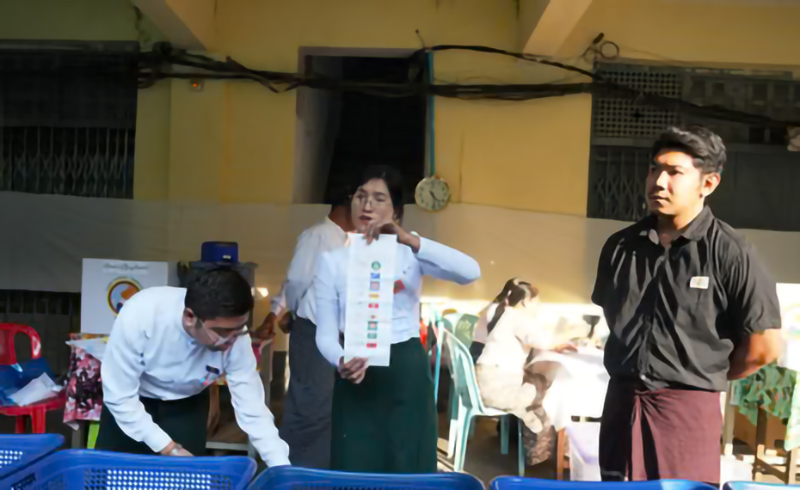
The polls, heralded by the ruling junta as a return to constitutional normalcy, unfolded as a carefully scripted exercise. Opposition forces were silenced. Conflict zones were excluded from participation. The military’s proxy party delivered a preordained landslide that reflected not popular consent but institutional coercion, entrenching a hybrid regime where civilian forms obscure uncompromising Tatmadaw supremacy.
Yet this episode is not an isolated aberration. It crowns a decade of political rupture — from the fragile democratic resurgence under Aung San Suu Kyi’s National League for Democracy to the violent rupture of the 2021 coup. From mass civil resistance met with lethal repression to a nationwide insurgency that steadily eroded state authority. And finally to elections conducted under emergency rule, forced conscription, and humanitarian devastation following the 2025 earthquake. Myanmar today confronts not merely democratic backsliding, but the progressive disintegration of state legitimacy itself.
For India, Myanmar’s unravelling constitutes a direct strategic concern. Sharing over 1,600 kilometres of border, it remains India’s gateway to Southeast Asia under the Act East Policy, a frontline buffer against insurgency, and a critical arena of strategic competition where China’s influence increasingly consolidates. Domestic collapse within Myanmar thus generates regional destabilisation with immediate security consequences for New Delhi.
Electoral Engineering and the Continuity of Militarised Power
The 2026 elections were a masterclass in political manipulation, conducted under a veil of emergency laws that stifled media freedom, dissolved key opposition parties like the National League for Democracy, and systematically excluded millions in rebel-controlled areas, resulting in a parliamentary composition that not only amplified the military’s reserved seats but also ensured its proxies dominated the civilian facade, thereby perpetuating a system where true power remains insulated from electoral accountability. This engineered outcome, far from bridging Myanmar’s divides, has deepened the legitimacy deficit that has plagued the nation since independence, where cycles of military coups—from Ne Win’s 1962 takeover to the 2021 seizure—have repeatedly derailed democratic experiments, fostering a governance model that prioritises coercion over consensus and entrenches elite Burman dominance at the expense of ethnic pluralism. Critically analysed, this electoral theatre reveals a constructivist irony: while the junta seeks international recognition through procedural mimicry, the absence of genuine inclusivity undermines any normative foundation, leading to intensified resistance from coalitions like the National Unity Government and ethnic armed organizations, which now control swathes of territory and command popular allegiance, highlighting how such illegitimacy not only sustains internal fragmentation but also invites external interventions that further erode sovereignty. For India, this continuity of militarised power poses acute dilemmas, as engaging the junta risks complicity in repression while isolation could cede influence to rivals, necessitating a nuanced strategy that balances border security imperatives with support for inclusive transitions, drawing on lessons from India’s own federal model to advocate federalism as a pathway out of Myanmar’s impasse.
Humanitarian Catastrophe and the Violence Continuum
Myanmar’s humanitarian catastrophe unfolds as a relentless saga of suffering, where millions endure internal displacement, acute food insecurity grips conflict zones, collapsed healthcare systems leave populations vulnerable to disease, and deliberate targeting of civilian infrastructure compounds daily hardships, creating a landscape where survival itself becomes a form of resistance against systemic erasure. Galtung’s triadic model provides a sharp lens for dissection: direct violence erupts in indiscriminate bombardments, mass executions that terrorize communities, and forced recruitments that tear families apart; structural violence embeds itself in policies like the 1982 Citizenship Law that strip minorities of rights, confining them to apartheid-like camps devoid of education or economic opportunity; and cultural violence normalizes this through ethno-nationalist narratives that cast groups like the Rohingya as perpetual outsiders threatening Buddhist-majority identity.
The Rohingya crisis, in particular, traces a harrowing arc from colonial-era migrations and 1942 communal clashes that sowed seeds of division, through post-independence exclusions culminating in the 1978 and 1991 expulsions that pushed hundreds of thousands into Bangladesh, to the 2017 clearance operations that unleashed genocide-scale horrors—killing at least 6,700, displacing over 740,000, and earning UN labels of ethnic cleansing—all while the International Court of Justice’s scrutiny, from The Gambia’s 2019 filing through 2020 provisional measures mandating prevention, 2022 jurisdiction rulings affirming third-state standing, and January 2026 merits hearings probing genocidal intent, underscores global accountability failures and sets precedents for inferring dolus specialis from patterned atrocities, with a forthcoming judgment poised to demand reparations and reforms. Bangladesh now hosts over 1.1–1.2 million Rohingya refugees, primarily in Cox’s Bazar, with renewed influxes of 130,000–200,000 since 2023 driven by fighting between the junta and the Arakan Army.
Camp conditions reflect managed precarity: overcrowding, shrinking rations, rising malnutrition, insecurity, and deepening donor fatigue. Repatriation remains politically unattainable without citizenship guarantees and safe conditions—neither of which exist in Rakhine under current control dynamics. For India, this violence continuum spills vividly across borders, as more than 65,000 refugees—including Rohingya—strain Northeast resources, ignite ethnic tensions in states like Manipur—where the arrival of Chin and Kuki refugees has intersected with pre-existing Meitei–Kuki tensions—turning humanitarian flows into a catalyst for localised violence. While border management is essential, purely securitised responses cannot address the structural drivers of displacement. Regional humanitarian coordination, political dialogue on citizenship and inclusion, and burden-sharing mechanisms are indispensable for long-term stability.
Internal Conflicts and the Fragmentation of the Myanmar State
Myanmar today resembles a mosaic of contested sovereignties, where ethnic armed organisations and pro-democracy militias hold sway over peripheral regions, establishing parallel administrations that provide rudimentary services amid junta retreats, while the military clings to urban strongholds through airstrikes and alliances with foreign suppliers, resulting in a fragmented state where governance gaps breed illicit economies and perpetual low-intensity warfare. This territorial splintering, accelerated since the 2021 coup’s aftermath of protests turning to armed struggle, has seen resistance forces like the Arakan Army and Three Brotherhood Alliance seize key border areas, disrupting trade routes and exposing the junta’s vulnerabilities despite Russian arms infusions and conscription laws, creating a stalemate where neither side can claim decisive victory but both perpetuate civilian suffering. Critically, this fragmentation internationalises the conflict, as armed groups forge trans-border networks for logistics and finance, turning Myanmar into a conduit for regional instability that no electoral facade can conceal, and highlighting how the absence of federal structures—long demanded by ethnic minorities—fuels endless cycles of revolt and repression.
China’s Role in Aggravating Strategic Entrenchment
China’s involvement in Myanmar reflects a calculated pursuit of geostrategic advantage, channelling over $22 billion into the China-Myanmar Economic Corridor (CMEC) under the Belt and Road Initiative (BRI) to secure energy pipelines, rare earth access, and Indian Ocean ports like Kyaukphyu, while employing a “three-pronged” strategy of de-escalation calls, election support, and selective mediations with ethnic armed groups to safeguard investments amid civil war disruptions that have stalled major rail links but sustained operational pipelines. This approach, prioritizing stability for Chinese assets over genuine peace, fragments Myanmar’s sovereignty by cultivating dependencies across factions, enabling Beijing to exert influence irrespective of political shifts and aggravating the crisis through arms flows and economic leverage that discourage inclusive settlements. For India, this entrenchment heightens encirclement anxieties, as BRI corridors abut sensitive Northeast borders, potentially enabling dual-use facilities that alter Bay of Bengal power balances and intersect with ongoing India-China border tensions, where recent 2024 disengagements in Ladakh’s Depsang and Demchok offer tentative calm but leave underlying territorial disputes unresolved amid infrastructure races and forward deployments.
The Role of Major Powers and Regional Institutions
Western powers have responded with targeted sanctions and diplomatic isolation of Myanmar’s junta, channeling humanitarian aid through international channels while condemning atrocities, yet these measures, though ethically sound, yield limited impact by pushing the regime toward alternative patrons without compelling systemic change. Russia has deepened its transactional military relationship with the junta, supplying arms and political cover that help sustain the regime amid Western isolation. Meanwhile, ASEAN grapples with normative erosion, as its Five-Point Consensus—reaffirmed in 2026 under Philippine leadership with envoy permanence proposals—falters due to internal schisms and non-interference principles, allowing bilateral hedgings that undermine collective efficacy and expose the bloc’s crisis-management limitations. This vacuum amplifies power politics, marginalising multilateral paths and inviting hegemonic manoeuvres that India must navigate through enhanced ASEAN coordination and Global South platforms to restore regional equilibrium.
Spillover Effects on India’s Northeast
Myanmar’s internal implosion directly permeates India’s Northeast, transforming shared borders into conduits for insurgent safe havens like those used by NSCN-K factions, narcotics trafficking from Shan State syndicates that flood markets with methamphetamine, and refugee surges exceeding 57,000 since 2021 that strain local resources and ignite communal frictions in states like Mizoram and Manipur. These spillovers exacerbate economic sabotage, social fragmentation, and security burdens, where poverty-driven migrations intersect with ethnic sensitivities to fuel unrest, compelling India to balance humanitarian reception with border fortification measures that, while necessary, risk alienating cross-border kin communities essential for long-term stability.
India’s Constructive and Humanitarian Statecraft
Unlike coercive external strategies, India has adopted a measured approach that intertwines engagement with humanitarianism, delivering essential aid like food supplies, medical kits, and disaster relief to conflict zones while advancing infrastructure projects that bolster connectivity and livelihoods, thereby fostering goodwill without endorsing repression. This normative realism—engaging multiple stakeholders for border calm while advocating inclusive governance—reflects India’s civilizational ethos, positioning New Delhi as a bridge-builder in platforms like BRICS and G20, where it champions development-focused conflict mitigation, sustainable debt practices, humanitarian corridors, and broad participation to reframe Myanmar’s crisis as a shared regional imperative rather than a zero-sum contest.
Toward a Coherent Stabilisation Strategy
Sustainable resolution in Myanmar hinges on interconnected reforms: inclusive dialogues uniting civilian resistance, ethnic groups, and state actors to dismantle exclusionary power structures; citizenship overhauls and minority safeguards to eradicate structural violence; humanitarian pathways and economic rebuilding to sever poverty-conflict links; regional integration tying Myanmar’s revival to South and Southeast Asian networks for mutual growth; and strengthened multilateral mediation that bolsters ASEAN centrality while curbing great-power dominance, with India leveraging its Act East momentum—through initiatives like the 2026 ASEAN-India Maritime Cooperation Year and BIMSTEC connectivity—to anchor these efforts and promote equitable outcomes.
Conclusion
Myanmar’s post-election landscape signifies a defining juncture for Indo-Pacific equilibrium, where electoral manipulation has solidified militarised rule, structural violence fuels humanitarian disasters and economic decay, and great-power opportunism like China’s BRI entrenchment intensifies fragmentation, collectively forging a regional security dilemma with India at its nexus. For New Delhi, this turmoil reshapes internal defences, diplomatic arenas, and Asian power balances, yet it also unveils prospects for principled guidance. Through humanitarian involvement, inclusive negotiation, and alliance forging, India can transmute volatility into collaborative safety and progress. Myanmar’s destiny—and the eastern Indo-Pacific’s steadiness—will depend on whether area forces favour control or joint steadiness, with India’s growing part as an ethical regional pivot providing one of the scarce reliable bases for enduring harmony. Should the junta collapse without a negotiated political settlement, the resulting power vacuum could trigger even larger displacement waves and intensified proxy competition along India’s eastern frontier.
Views: 1386

Dr. Maheep
Dr. Maheep is Director, Indian Perspective on Global Affairs (IPGA), and a leading analyst of India’s foreign policy and South Asian geopolitics. He earned his PhD in Arab and Islamic Studies. With more than a decade of teaching and research experience in International Relations and Global Politics, he contributes regularly on issues shaping national and global affairs.